
Crossing the Border near Malone
Every border crossing near the cabins south of Malone in 2026: hours both ways, road miles, documents, NEXUS, food, firewood, dog and duty-free rules.
Eleven border crossings join northern New York to Quebec and Ontario within about 81 road miles of the cabins. The closest, Trout River on NY 30, is 21 road miles away, and it has been closed to traffic entering the United States since June 1, 2026, with the rebuild due to finish around May 2028. This guide gives the hours at every other crossing in both directions, the road miles from each one to the cabins, the papers to carry and the rules on food, firewood, dogs, alcohol and cash.
The Trout River closure
The Trout River port joins Constable, New York, to Elgin, Quebec, where NY 30 becomes Quebec Route 138. Its U.S. inspection building went up in 1931. The General Services Administration is keeping that 7,748-square-foot building, adding a 9,917-square-foot wing for U.S. Customs and Border Protection, about 17,000 square feet in all, and improving the vehicle inspection areas. The construction contract, worth $32,866,400, was awarded on April 21, 2026, and the notice to proceed followed on May 1.
To keep the crews working without interruption, the port closed to southbound traffic on June 1, 2026. The GSA's target for substantial completion is May 20, 2028. Before the closure the port handled about 146,000 personal vehicles and 2,000 commercial vehicles a year, and that traffic now goes through the other ports on this page. Construction schedules slip, so check the port's status before you plan around a reopening date. In October 2026, CBP's own page for the port still listed its old hours of 6 a.m. to 6 p.m.; that listing does not mean you can drive south through it.
Traffic heading north into Canada still crosses at Trout River, but only while the Canadian office is open. The Canada Border Services Agency staffs it from 6 a.m. to 6 p.m., seven days a week. Both governments cut Trout River, and the Chateaugay crossing to the east, from 24 hours a day to those twelve hours on January 6, 2025. What the closure changed for the drive from Montreal is in the journal post on the Trout River closure.
The crossings at a glance
The hours below are for travelers in private vehicles, as the U.S. and Canadian border agencies listed them in October 2026. Road miles run from each U.S. port to the cabins on OpenStreetMap's road network. Hours at the small ports changed in January 2025, and Trout River closed to southbound traffic in June 2026, so check both agencies' pages in the week before a trip.
| Crossing | Roads at the line | Into the United States | Into Canada | Road miles to the cabins |
|---|---|---|---|---|
| Trout River and Elgin | NY 30 and Route 138 | Closed until about May 2028 | 6 a.m. to 6 p.m. | 21 |
| Fort Covington and Dundee | Dundee Road off NY 37, and Route 132 | 24 hours | 24 hours | 26 |
| Chateaugay and Herdman | County Route 52 and Montée Herdman | 6 a.m. to 6 p.m. | 6 a.m. to 6 p.m. | 27 |
| Churubusco and Franklin Centre | NY 189 and Route 209 | 8 a.m. to 4 p.m. | No Canadian port | 36 |
| Massena and Cornwall (Three Nations Crossing) | NY 37 and the Seaway International Bridge | 24 hours | 24 hours | 38 |
| Cannon Corners and Covey Hill | Cannon Corners Road and Route 203 | 8 a.m. to 4 p.m. | 8 a.m. to 4 p.m. | 46 |
| Mooers and Hemmingford | Hemmingford Road and Route 219 | 24 hours | 24 hours | 52 |
| Champlain and Lacolle | I-87 and Autoroute 15 | 24 hours | 24 hours | 57 |
| Overton Corners and Lacolle | NY 276 and Route 221 | 6 a.m. to 10 p.m. | 6 a.m. to 10 p.m. | 60 |
| Rouses Point and Lacolle | US 11 and Route 223 | 8 a.m. to 8 p.m. | 8 a.m. to 8 p.m. | 63 |
| Ogdensburg and Prescott | NY 812 and the international bridge | 24 hours | 24 hours | 81 |
From each city
Road miles here are for the whole trip to the cabins. The drive-from pages have each route in more detail.
- Montreal. About 93 miles through Fort Covington or 101 through Champlain, at any hour; about 75 through Chateaugay or 84 through Churubusco in their daytime hours. See the Montreal drive and the Montreal day trip.
- Ottawa. About 104 miles through Cornwall and Massena, or 138 through Prescott and Ogdensburg. See the Ottawa drive.
- Kingston. About 146 miles, by Highway 401 to Prescott and the Ogdensburg bridge. See the Kingston drive.
- Quebec City. About 247 miles, by Autoroutes 20, 30 and 15 to Lacolle and Champlain. See the Quebec City drive.
Fort Covington and Dundee
This is the crossing to remember. While Trout River is closed, Fort Covington is the only U.S. port in Franklin County open 24 hours a day, and the Canadian office at Dundee, on Route 132 in Sainte-Agnès-de-Dundee, is open around the clock too. The port is on Dundee Road in Fort Covington, about 14 miles west of Trout River. From the booth it is about 26 road miles to the cabins: NY 37 east to Malone, then south on Duane Street, which runs into County Route 25. CBP gives (518) 358-2444 as the number for traveler questions at Fort Covington.
From Montreal, the Fort Covington route is about 93 road miles: Autoroute 30 to Salaberry-de-Valleyfield, then Route 132 west along the St. Lawrence to Dundee. It is longer than the routes through Chateaugay or Churubusco, and unlike those two it works at any hour, which makes it the one to use for a late Friday arrival or a late return from the city.
Chateaugay and Herdman
The Chateaugay port, about 14 miles east of Trout River, is open from 6 a.m. to 6 p.m. in both directions; the Canadian office across the line, Herdman, keeps the same twelve hours. Both changed from 24 hours on January 6, 2025. The port sits about five road miles north of Chateaugay village, so while the village is about 22 road miles from the cabins, the port is about 27: County Route 52 south into the village, US 11 west to Malone, and County Route 25 south. Of the ports CBP named as alternatives to Trout River, only Chateaugay and Champlain take commercial traffic.
From Montreal, Chateaugay is the shortest way to the cabins, about 75 road miles. The catch is the clock. A driver who reaches the booth at 6:05 p.m. has to turn around and head for Fort Covington or Champlain. Aim to be at the port by 5:30 p.m. at the latest, and look at CBP's page for the port in the week you travel, because these hours have changed before.
Churubusco and Franklin Centre
Churubusco, about 23 miles east of Trout River on NY 189, takes traffic into the United States from 8 a.m. to 4 p.m., seven days a week. It works in one direction only. Canada closed and demolished its Franklin Centre port in 2011, and the new U.S. station opened in 2013, so you can come south from Quebec Route 209 but you cannot drive north into Canada here. From Montreal, the Churubusco route is about 84 road miles; from the port it is about 36 road miles to the cabins, by NY 189 to US 11 and west through Chateaugay and Malone. Use it only as a daytime way into the United States, and remember that it closes at 4 p.m.
The Clinton County crossings
Champlain and Lacolle
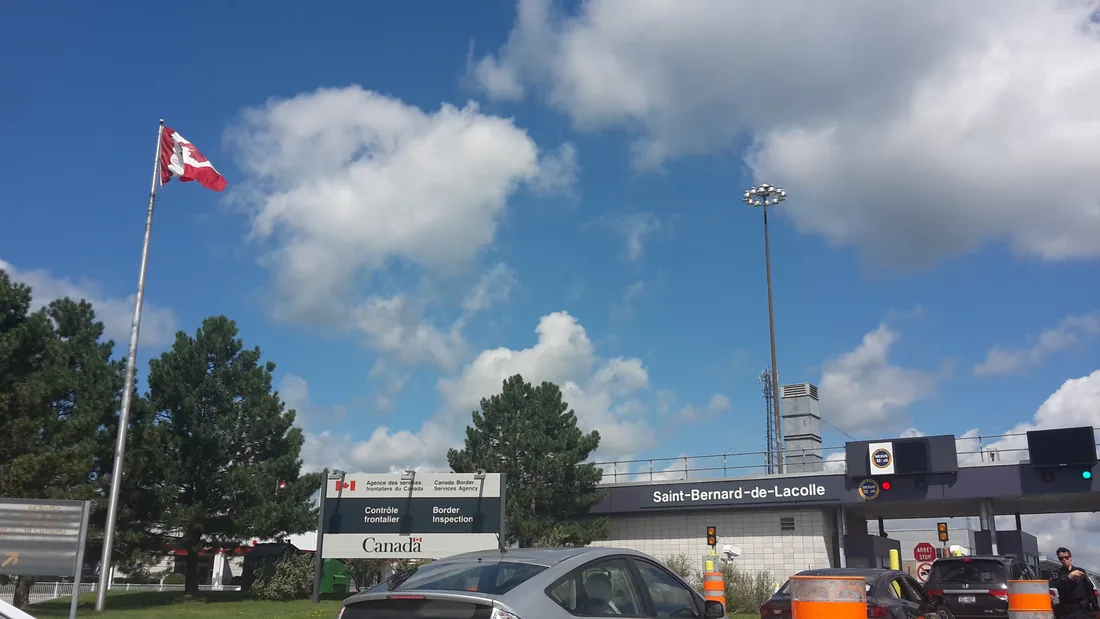
The biggest crossing near the cabins carries Interstate 87 across the line, where it becomes Quebec's Autoroute 15, the expressway into Montreal. CBP handles passenger and commercial traffic at Champlain 24 hours a day, with up to ten lanes for cars heading into the United States, and the Canadian office at Saint-Bernard-de-Lacolle is also open around the clock. The port is about 50 miles east of Trout River. From the booth it is about 57 road miles to the cabins: a short run south on I-87, then US 11 west through Mooers, Chateaugay and Malone. From downtown Montreal the whole trip is about 101 road miles.
One thing to know at Lacolle in 2026: the Canada Border Services Agency is rebuilding the primary inspection line there, with the work expected to end in winter 2027, and it warns that waits may be longer than normal until then. The NEXUS lanes on both sides are covered below.
Mooers and Hemmingford
Mooers, about 39 miles east of Trout River, is the other 24-hour crossing in Clinton County. CBP processes passengers there around the clock, and the Canadian office at Hemmingford, on Quebec Route 219, is open 24 hours as well. From the port it is about 52 road miles to the cabins: Hemmingford Road south into Mooers, then US 11 west. CBP does not post a wait time for Mooers, while the Canadian agency does post one for its Hemmingford side.
Cannon Corners, Overton Corners and Rouses Point
Three smaller crossings keep shorter hours, the same on both sides of the line. Cannon Corners, west of Mooers, is open from 8 a.m. to 4 p.m., with the Canadian office at Covey Hill on Route 203. At about 46 road miles it is closer to the cabins than Mooers or Champlain, but it is a daytime crossing only. East of Champlain, Overton Corners on NY 276 is open from 6 a.m. to 10 p.m., opposite the Lacolle office on Route 221, and Rouses Point on US 11 from 8 a.m. to 8 p.m., opposite the Lacolle office on Route 223. Those two are about 60 and 63 road miles from the cabins, so they only make sense if you are coming from somewhere east of Lacolle.
Massena, Cornwall and Ogdensburg
The Three Nations Crossing
From Ottawa, Cornwall and the rest of eastern Ontario, the usual way in is the Seaway International Bridge between Cornwall and Massena, renamed the Three Nations Crossing for the three nations it joins: Canada, Akwesasne and the United States. The U.S. port at Rooseveltown, east of Massena village, is open 24 hours a day, and so is the Canadian office on Brookdale Avenue in Cornwall. The car toll has been C$5.25 or US$3.75 since April 1, 2025, and it can be paid in either currency; a Seaway Transit Card takes 10 percent off.
From the bridge plaza it is about 38 road miles to the cabins, east on NY 37 through Akwesasne and Fort Covington to Malone. Ottawa to the cabins is about 104 road miles by this route. CBP posts live wait times for Massena, and the Canadian agency posts them for its Cornwall office.
Ogdensburg and Prescott
Farther west, the Ogdensburg–Prescott International Bridge is a 1.5-mile crossing for vehicles only, with no foot traffic. Both border offices are open 24 hours, and the car toll is US$3.25 or C$4.25. It is the natural crossing from Kingston, about 146 road miles from the cabins by Highway 401 and the bridge, and the longer of the two routes from Ottawa, at about 138. From the U.S. plaza it is about 81 road miles to the cabins, by NY 37 and NY 420 to US 11 and east to Malone.
Documents for the booth
Adults
Under the Western Hemisphere Travel Initiative, a U.S. citizen driving in from Canada can show a valid U.S. passport, a passport card, an enhanced driver's license or a trusted traveler card: NEXUS, SENTRI or FAST. A Canadian citizen can show a valid passport, an enhanced driver's license or one of the same trusted traveler cards. An ordinary driver's license is not on either list. Lawful permanent residents of the United States show their permanent resident card. Visitors of other nationalities need their passport and whatever visa or travel authorization their nationality requires.
Enhanced licenses come from only a few places. In the United States, Michigan, Minnesota, New York, Vermont and Washington issue them. In Canada the programs have wound down: Quebec retired its program in 2014, Ontario stopped offering the card in 2019, British Columbia phased its program out by September 2025, and Manitoba announced in 2021 that it would end its program in 2022. CBP still lists an enhanced license as a document for Canadian citizens, but most Canadian guests will cross with a passport or a NEXUS card.
Children and teenagers
By land, U.S. and Canadian citizens under 16 need only proof of citizenship, such as a birth certificate; CBP accepts an original, a photocopy or a certified copy. The same rule covers children under 19 traveling with a school, religious or other youth group. If a child travels with one parent, both countries advise a consent letter from the other parent. The U.S. government prefers the letter in English and notarized. Canada's advice is that any parent who is not traveling signs it, preferably in front of a notary, and that an original is better than a copy. Before the 2026 Thanksgiving weekend the Canada Border Services Agency repeated the point: an adult traveling with children who are not their own, or not in their legal custody, should carry a consent letter from the parent or guardian.
Canadians staying 30 days or more
A Canadian visitor who entered the United States by land and was not given an I-94 record, and who stays 30 days or longer, must register with U.S. Citizenship and Immigration Services, on Form G-325R through an online account. The rule applies to each trip of 30 days or more, and parents register children under 14. It matters for a long winter stay, not for a weekend; see long stays at the cabins.
Apps and wait times
The border apps
The app many travelers knew as CBP One became CBP Home in March 2025, and CBP Home is now used only for self-deportation. Its traveler functions moved to CBP Link, which CBP launched on June 16, 2025. CBP Link is free; it shows border wait times and open lanes at land ports, and it lets travelers who need an I-94 apply before they reach a land crossing. Mobile Passport Control, CBP's app for faster arrival processing, works at airports, a few seaports and four land crossings, all in Washington State, so it does not help at these crossings. On the Canadian side, ArriveCAN now carries the optional Advance Declaration, a customs and immigration declaration made up to 72 hours before you fly into one of Canada's participating airports. It is not used at land crossings.
Where to check the wait
Near the cabins, CBP posts live wait times only for its larger ports: Champlain, Massena and Ogdensburg. Fort Covington, Chateaugay, Churubusco and Mooers are not on its list. The Canada Border Services Agency's page covers the busiest crossings into Canada, including Lacolle, Hemmingford, Cornwall and Prescott, and it warns that its times leave out any delay on the roads leading to a port. Check CBP Link or CBP's border wait times page before you choose a crossing, and again before you start back.
The Canadian agency's advice for long weekends is to cross early in the morning, and it says the Monday of a holiday long weekend tends to be the busiest day. Canada's Monday holidays include Victoria Day in May, Labour Day in September and Thanksgiving in October. Have everyone's documents out before you pull up to the booth.
NEXUS
NEXUS is the trusted traveler program run jointly by CBP and the Canada Border Services Agency, and its card counts as a travel document at the land border. The application fee is US$120, membership lasts five years, and children under 18 are free. Applicants book separate interviews with the two agencies, with fingerprints, identity checks and questions from each. From April 1, 2027, a conditionally approved applicant will have two years to book those interviews.
The card only helps when everyone in the vehicle has one, children included. Entering Canada, you cannot use a NEXUS lane if you carry commercial goods, restricted or prohibited items, goods that need a permit, or CAN$10,000 or more in currency or monetary instruments. Near the cabins, Champlain has NEXUS lanes into the United States, and CBP's wait-time page shows whether they are open. Into Canada, the dedicated NEXUS lane on Autoroute 15 at Lacolle is listed as not available until further notice, while the smaller Lacolle crossing on Route 221 has NEXUS lanes from 8 a.m. to 8 p.m.
Food and firewood
Food into the United States
Declare every food item at the U.S. booth. If you declare it, there is no penalty, even when the inspector decides it cannot come in. The rules for food from Canada, as of March 2026:
- Fresh fruit and vegetables grown on a commercial farm in Canada may come in for personal use if they are free of soil, pests and disease, are not on the prohibited list, and you can show they were grown in Canada, with a receipt and the produce stickers or a commercial "Produce of Canada" label. Field-grown produce must arrive during the Canadian growing season, May 1 to October 31.
- The prohibited list includes citrus, tomatoes, peppers, avocados, bananas and fresh cherries grown in Ontario. Onions, garlic, leeks, scallions and the rest of the onion family are on it too, though thoroughly dried bulbs with papery skins may come in.
- Homegrown or backyard produce, and any produce without a commercial label, is generally refused.
- Up to 50 pounds of commercially packaged potatoes labeled as grown in Canada or the United States are allowed.
- Fresh, frozen, cooked, cured or dried beef, bison, veal, lamb, goat and pork from Canada may come in, up to 50 pounds of meat per traveler.
- Poultry meat, eggs and egg products are allowed in personal amounts when no temporary restrictions are in force. The U.S. Department of Agriculture sets those restrictions when certain bird diseases are present in North America.
- Milk and other dairy products need proof of Canadian origin, such as the package label or a receipt.
- Pet food must be in unopened retail packaging, up to 50 pounds per vehicle by land.
The easy answer is to leave the cooler at home and shop in Malone, which every route from the open crossings passes through; see groceries and supplies. Going the other way, Canada does not let homemade food or leftovers containing poultry in from the United States, so finish the chicken sandwiches before you reach the line.
Firewood
Firewood is the one thing to leave behind every time. Under a federal order in force since 2011, the United States accepts hardwood firewood from Canada only if it has been heat treated to a core temperature of 60°C for 60 minutes, and softwood at 56°C for 30 minutes, with a treatment certificate or a commercial treatment label to prove it; without proof, it is refused. Going north, Canada requires an import permit and a certificate for firewood from the United States. New York adds its own rule: untreated firewood may not be brought into the state from any other state or country, and untreated firewood cut in New York may not travel more than 50 miles from its source unless it has been heat treated to 71°C (160°F) for 75 minutes. Treated wood sold in the state carries the label "New York Approved Heat-Treated Firewood/Pest Free". Every cabin has a fire pit, so buy wood locally.
Cannabis, alcohol, tobacco and cash
Do not carry cannabis across the border in either direction, whatever its legal status where you bought it. Marijuana is a controlled substance under U.S. federal law, and arriving at a U.S. port with it can mean seizure, fines or arrest, and can affect whether a visitor is admitted. Canada treats taking cannabis across the border in any form, including oils containing THC or CBD, as a serious criminal offense without a permit or exemption. Check the car before you leave.
Duty-free allowances
Coming back into the United States, a U.S. resident who has been out of the country at least 48 hours can bring $800 worth of goods duty-free, including one liter of alcohol for anyone 21 or older, 200 cigarettes and 100 cigars. After a shorter trip, such as a day in Montreal, the allowance is $200, which may include 50 cigarettes, 10 cigars and 150 milliliters (5 fluid ounces) of alcohol, and family members cannot pool their $200 allowances. Alcohol and tobacco over those amounts are taxed even if you are under the dollar limit.
An adult Canadian visitor can bring 1 liter of alcohol duty-free for personal use, and one of these: 200 cigarettes, 50 cigars or 2 kilograms of smoking tobacco. A visitor staying at least 72 hours can also bring up to $100 in gifts, if the gift exemption has not been claimed in the previous six months.
Before you bring Canadian-made alcohol across under either allowance, check CBP's current guidance: a U.S. proclamation barring imports of a long list of Canadian-made beer, wine, cider and spirits took effect September 29, 2026, and its text makes no exception for travelers. The breweries, wineries and distilleries guide lists what you can buy near the cabins instead.
Back in Canada, residents get no exemption after less than 24 hours away. After 24 hours they can bring back CAN$200 of goods, with no alcohol or tobacco included. After 48 hours the limit is CAN$800, and it can include one of these: 1.5 liters of wine, 1.14 liters of spirits or 8.5 liters of beer, plus 200 cigarettes, 50 cigars, 200 grams of manufactured tobacco and 200 tobacco sticks. The minimum age for the alcohol allowance is 18 in Quebec and 19 in Ontario.
Cash
There is no limit on how much money you can carry into or out of the United States, but amounts over $10,000 in currency or monetary instruments must be reported to CBP on FinCEN Form 105, which can be filed online. For a family or a group, the $10,000 counts what everyone is carrying together. Failing to report can mean losing the money and facing civil or criminal penalties. Canada requires every traveler to declare currency or monetary instruments worth CAN$10,000 or more.
Dogs
Into the United States
Every dog entering the United States at a land border must meet the CDC's rules, and that includes an American dog coming home from a day in Quebec. A dog that has been only in Canada, the United States or Mexico for the previous six months must be at least six months old, carry a microchip that a universal scanner can read, look healthy on arrival, and travel with a receipt for the CDC Dog Import Form. The form is free and filled in online. Once you verify your email address, the receipt arrives by email within about 15 minutes, and you can print it or show it on your phone. One receipt covers repeat entries from the same country for six months from the date it was issued.
Into Canada
For a dog going north, the Canadian Food Inspection Agency asks for a rabies vaccination certificate for any dog three months or older, issued in English or French by a licensed veterinarian, identifying the dog and showing that it is currently vaccinated. A puppy under three months needs none, and a guide, hearing or other service dog crossing with its user is exempt. One or two pet dogs traveling with their owner need no health certificate. The cabins allow pets for a fee; the bringing your dog guide covers the yards, the walks and the vet in Malone, and the pet-friendly stays page covers planning a trip around a dog.
Rental cars
Rental companies set their own cross-border rules, so ask when you book. Enterprise, for example, allows most vehicles rented in the United States to be driven into Canada, with exotic cars, large passenger vans and cargo vans among the exceptions, and allows most vehicles rented in Canada to be driven into the United States; it asks renters to confirm with the renting location. Keep the rental agreement with the car's papers for the booth.
Two Canadian rules matter here. A Canadian resident may bring a car rented in the United States into Canada for non-commercial use for up to 30 days. And Quebec requires winter tires from December 1 to March 15 on every motor vehicle registered in Quebec, rental cars included; the rule does not apply to vehicles registered elsewhere, so a car rented in Montreal will have them and a car from New York may not. For snow on the way in, see winter driving, and for flights, airports near the cabins.
Duty-free shopping, fuel and money
If you buy anything at a border duty-free shop, remember that goods bought duty-free are not automatically free of duty when you come back into the United States; they count against your allowance like anything else.
Canada sells gasoline by the liter, and a U.S. gallon, 231 cubic inches, is almost four liters, so compare prices with that in mind. Every route to the cabins passes through Malone, where Stewart's has shops on both East Main Street and West Main Street, so fill up there on the way north and again on the way back. Canada uses the Canadian dollar. The Seaway International Bridge at Massena takes either currency, and the Ogdensburg bridge posts its toll in both.
Malone on the way in
Every open route from the border reaches the cabins through Malone. From Fort Covington and Massena you come in on NY 37; from Ogdensburg, and from Chateaugay, Churubusco, Mooers and Champlain to the east, you come in on US 11. Either way, the last ten road miles are County Route 25 south from the village. Malone has the supermarkets, the drugstore, the gas and the hospital, so it is the place to stock up after the border. The Malone town guide has the shops and restaurants, and getting to the cabins covers the last miles and the host's directions, which beat a phone's map out here.
Questions
Is the Trout River crossing open?
Only northbound, into Canada, and only from 6 a.m. to 6 p.m., when the Canadian office at Elgin is staffed. The U.S. port on NY 30 has been closed to traffic entering the United States since June 1, 2026, while its 1931 building is renovated and expanded; the target for substantial completion is May 20, 2028. The Trout River post has the background.
Which crossing near the cabins is open all night?
Fort Covington, about 26 road miles from the cabins, is the only U.S. port in Franklin County open 24 hours while Trout River is closed, and the Canadian office at Dundee is open around the clock too. Farther away, Mooers and Champlain in Clinton County and the bridges at Massena and Ogdensburg are also open 24 hours in both directions.
Can children cross the border with a birth certificate?
Yes, by land. U.S. and Canadian citizens under 16 can show a birth certificate or other proof of citizenship, and CBP accepts an original, a photocopy or a certified copy. Children under 19 traveling with a school, religious or other youth group follow the same rule. A child traveling with only one parent should carry a consent letter from the other parent, preferably notarized.
Can we bring firewood or groceries from Canada?
Leave the firewood at home. The United States takes Canadian firewood only with proof of heat treatment, and New York bars untreated firewood from any other state or country. Food is allowed within limits, and every item must be declared; citrus, tomatoes and peppers are banned, and produce must be shown to be grown in Canada. Shopping in Malone is easier; see groceries and supplies.
What does a dog need to enter the United States from Canada?
The dog must be at least six months old, carry a microchip that a universal scanner can read, look healthy, and travel with a receipt for the free online CDC Dog Import Form. For a dog that has been only in Canada, the United States or Mexico for six months, that receipt is the only paperwork, and it covers repeat entries from the same country for six months. See bringing your dog.
Do we need ArriveCAN or a CBP app to drive across?
No. ArriveCAN now carries an optional declaration for flights into participating Canadian airports and is not used at land crossings. CBP's free app, CBP Link, which took over the traveler features of the old CBP One and CBP Home apps, shows wait times and lets travelers who need an I-94 apply before reaching a land crossing. Mobile Passport Control does not work at these crossings. At the booth, have each person's passport, passport card, NEXUS card or enhanced license ready.
What can we bring back duty-free after a day in Montreal?
A U.S. resident who has been out of the country less than 48 hours has a $200 allowance, which may include 50 cigarettes, 10 cigars and 150 milliliters of alcohol, and family members cannot combine their allowances. After 48 hours or more the allowance is $800, including one liter of alcohol for adults 21 and older. Before you bring Canadian-made bottles back, check CBP's current guidance: a U.S. proclamation barring imports of a long list of Canadian-made beer, wine, cider and spirits took effect September 29, 2026, and its text makes no exception for travelers. The Montreal day trip guide covers the timing.
Sources
Facts on this page were checked against these sources in October 2026. Hours, fees and schedules change; confirm before you go.
- U.S. General Services Administration gsa.gov/real-estate/ongoing-construction-projects/trout-river-land-por
- content.govdelivery.com content.govdelivery.com/accounts/USDHSCBP/bulletins/415e6c6
- U.S. Customs and Border Protection cbp.gov/about/contact/ports/trout-river-new-york-0715
- U.S. Customs and Border Protection cbp.gov/about/contact/ports/champlain-new-york-0712
- U.S. Customs and Border Protection cbp.gov/about/contact/ports/massena-new-york-0704
- U.S. Customs and Border Protection cbp.gov/about/contact/ports/ogdensburg-new-york-0701
- U.S. Customs and Border Protection cbp.gov/newsroom/national-media-release/cbp-aligns-hours-operations-no
- canada.ca canada.ca/en/border-services-agency/news/2024/11/the-cbsa-is-adjusting
- open.canada.ca open.canada.ca/data/en/dataset/1018c301-d359-4077-8d9b-4e9fbe6a223f
- cbsa-asfc.gc.ca cbsa-asfc.gc.ca/data/cbsa-offices-services-bureaux-asfc-en.json
- cbsa-asfc.gc.ca cbsa-asfc.gc.ca/bwt-taf/menu-eng.html
- U.S. Customs and Border Protection bwt.cbp.gov/
- clui.org clui.org/ludb/site/churubuscofranklin-border-crossing
- visitstlc.com visitstlc.com/getting-here/
- sibc.ca sibc.ca/the-seaway-international-bridge-corporation-ltd-announces-toll
- sibc.ca sibc.ca/toll-rates-2/
- ogdensport.com ogdensport.com/?page_id=199
- U.S. Customs and Border Protection cbp.gov/travel/us-citizens/western-hemisphere-travel-initiative
- dhs.gov dhs.gov/enhanced-drivers-licenses-what-are-they
- ontario.ca ontario.ca/page/enhanced-drivers-licence
- globalnews.ca globalnews.ca/news/7585720/phased-out-bc-enhanced-licence/amp
- usa.gov usa.gov/travel-documents-children
- travel.gc.ca travel.gc.ca/travelling/children/consent-letter
- canada.ca canada.ca/en/border-services-agency/news/2026/10/travelling-for-thanks
- canada.ca canada.ca/en/revenue-agency/services/tax/public-holidays.html
- uscis.gov uscis.gov/alienregistration
- U.S. Customs and Border Protection cbp.gov/newsroom/national-media-release/cbp-announces-new-cbp-link-mob
- U.S. Customs and Border Protection cbp.gov/about/mobile-apps-directory/cbplink
- dhs.gov dhs.gov/news/2025/03/10/dhs-launches-cbp-home-app-self-deport-reportin
- U.S. Customs and Border Protection cbp.gov/travel/us-citizens/mobile-passport-control
- canada.ca canada.ca/en/border-services-agency/services/arrivecan.html
- cbsa-asfc.gc.ca cbsa-asfc.gc.ca/multimedia/declaration/menu-eng.html
- cbsa-asfc.gc.ca cbsa-asfc.gc.ca/prog/nexus/menu-eng.html
- cbsa-asfc.gc.ca cbsa-asfc.gc.ca/services/travel-voyage/prog/nexus/how-utiliser-eng.htm
- cp24.com cp24.com/news/canada/2026/10/01/changes-are-coming-to-the-nexus-applic
- aphis.usda.gov aphis.usda.gov/traveling-with-ag-products/traveling-united-states-cana
- aphis.usda.gov aphis.usda.gov/media/document/5398/file
- U.S. Customs and Border Protection cbp.gov/newsroom/local-media-release/cbp-cbsa-remind-travelers-leave-f
- inspection.canada.ca inspection.canada.ca/en/plant-health/invasive-pests-and-plants/directi
- New York State Department of Environmental Conservation dec.ny.gov/nature/animals-fish-plants/invasive-species/terrestrial/fir
- U.S. Customs and Border Protection cbp.gov/travel/clearing-cbp/cbp-reminds-travelers-canada-marijuana-rem
- cbsa-asfc.gc.ca cbsa-asfc.gc.ca/travel-voyage/cannabis-eng.html
- U.S. Customs and Border Protection cbp.gov/travel/international-visitors/know-before-you-visit/customs-du
- U.S. Customs and Border Protection cbp.gov/travel/international-visitors/kbyg/types-exemptions
- law.cornell.edu law.cornell.edu/cfr/text/19/148.43
- law.cornell.edu law.cornell.edu/cfr/text/19/148.44
- U.S. Customs and Border Protection cbp.gov/travel/international-visitors/money-monetary-instruments
- travel.gc.ca travel.gc.ca/returning/customs/bringing-to-canada/personal-exemptions-
- cbsa-asfc.gc.ca cbsa-asfc.gc.ca/travel-voyage/declare-eng.html
- cdc.gov cdc.gov/importation/dogs/faqs.html
- cdc.gov cdc.gov/importation/dogs/rabies-free-low-risk-countries.html
- cdc.gov cdc.gov/importation/dogs/dog-import-form-instructions.html
- inspection.canada.ca inspection.canada.ca/en/animal-health/terrestrial-animals/imports/impo
- aphis.usda.gov aphis.usda.gov/pet-travel/us-to-another-country-export/pet-travel-us-c
- enterprise.com enterprise.com/en/car-rental-faqs/us-general/driving-rental-car-to-can
- enterprise.com enterprise.com/en/car-rental-faqs/canada-general/driving-rental-car-to
- cbsa-asfc.gc.ca cbsa-asfc.gc.ca/publications/dm-md/d2/d2-4-1-eng.html
- quebec.ca quebec.ca/en/transports/traffic-road-safety/winter-road-safety/require
- U.S. Customs and Border Protection cbp.gov/travel/us-citizens/know-before-you-go/shopping-abroad-duty-fre
- nist.gov nist.gov/how-do-you-measure-it/how-do-you-measure-fuel-gas-pump
- router.project-osrm.org router.project-osrm.org/route/v1/driving/-74.507795,44.997968;-74.192,
- router.project-osrm.org router.project-osrm.org/route/v1/driving/-74.085781,44.993667;-74.192,
- router.project-osrm.org router.project-osrm.org/route/v1/driving/-74.0796,44.9262;-74.192,44.7
- router.project-osrm.org router.project-osrm.org/route/v1/driving/-73.7563,45.0028;-74.192,44.7
- router.project-osrm.org router.project-osrm.org/route/v1/driving/-73.4535,45.0064;-74.192,44.7
- router.project-osrm.org router.project-osrm.org/route/v1/driving/-73.4000,45.0096;-74.192,44.7
- router.project-osrm.org router.project-osrm.org/route/v1/driving/-73.3708,45.0103;-74.192,44.7
- router.project-osrm.org router.project-osrm.org/route/v1/driving/-74.7395,44.9812;-74.192,44.7
- router.project-osrm.org router.project-osrm.org/route/v1/driving/-75.4557,44.7299;-74.192,44.7
- OpenStreetMap (road distances) openstreetmap.org/
- govinfo.gov govinfo.gov/content/pkg/FR-2026-09-14/pdf/2026-18835.pdf
- content.govdelivery.com content.govdelivery.com/bulletins/gd/USDHSCBP-42ce49a
In this guide
Stay nearby
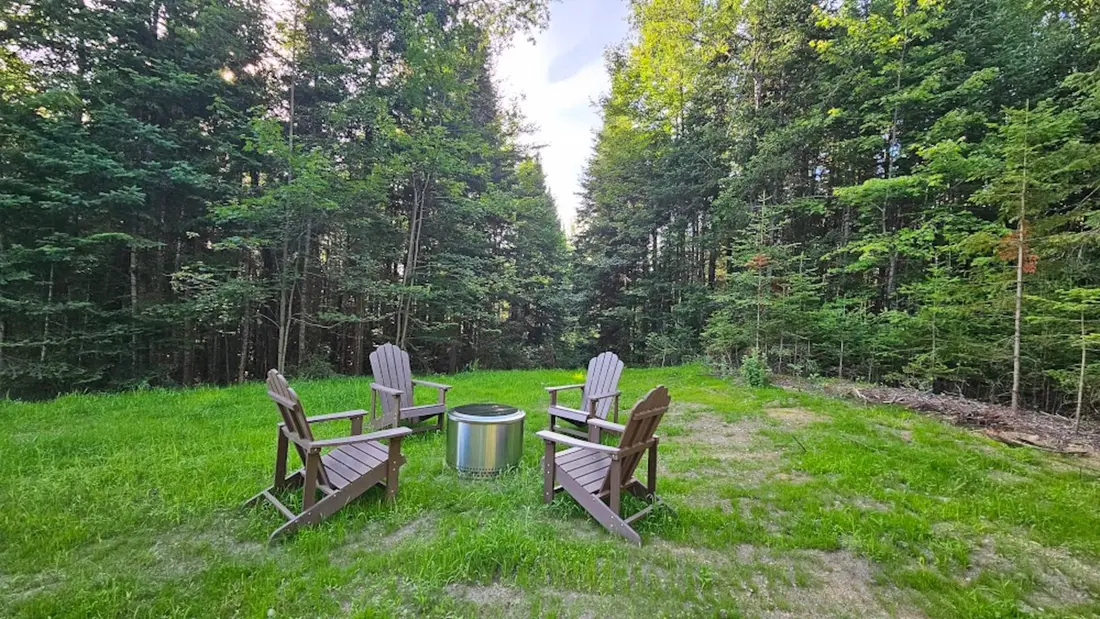
The aviation cabin: flight-themed décor, a Jøtul gas stove, a large open deck with its own hot tub, and a smokeless fire pit on the lawn.
 The AviatorCabin 3 · 2 bd · 1 ba · sleeps 4
More in Plan Your Trip
Sources
72 references, listed in full at the end of this guide: official park, state, tourism-office and business sources, checked October 2026.
Related guides


Photos on this page: 20170809-Saint-Bernard-de-Lacolle US-Canada (NY-Quebec) border crossing by Aude, CC BY-SA 4.0; Malone NY by P199, CC BY-SA 3.0; Montreal - QC - Skyline by Taxiarchos228, CC BY 3.0. Resized and cropped for this site. All photo credits