
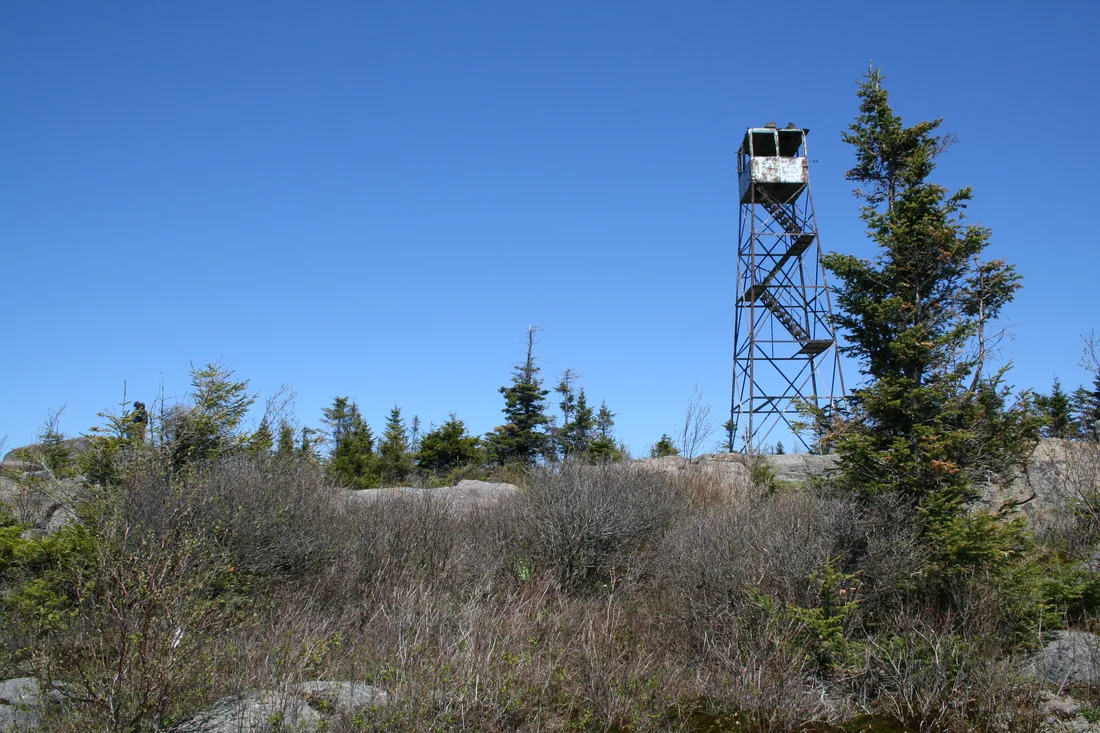
The Fire Tower Challenge from the Cabins
How the ADK Fire Tower Challenge works, the towers nearest the cabins with miles and climbs, two-tower days, tower history, safety and a four-day plan.
The Adirondack Mountain Club's Fire Tower Challenge asks you to climb 23 mountains that still carry fire towers: 18 of the 27 on its Adirondack Park list and all 5 in the Catskill Park. Four of the Adirondack towers have trailheads within about 45 road miles of the cabins, and eight more are within about 95. Finish the list and the club sends you its patch.
How the challenge works
The Glens Falls-Saratoga Chapter of the Adirondack Mountain Club started the challenge in 2001, when John P. (Jack) Freeman's guide to these trails, Views from on High, came out, and the chapter still runs it. Since then thousands of people have used it as their way into the Forest Preserve of the Adirondack and Catskill parks, and you do not have to be a club member to take part.
The core rule is short: climb and document, by date, at least 23 fire-tower summits, meaning 18 of the 27 Adirondack Park summits on the list and all 5 in the Catskills. Three details shape the planning:
- You need the summit; the stairs are optional. Climbing each tower is not required, and the club does not recommend climbing towers that still need restoration work for safe public use. That is why Loon Lake Mountain, whose cab is permanently closed, still counts.
- The tower has to be standing. Each mountain must have a standing fire tower on the date of your ascent, so a summit whose tower came down does not count.
- Walk up. Gore and Hunter have ski lifts, and ascents by lift do not count; the club asks finishers to use the trails.
Along with the dates, the organizers ask you to write about each hike, with your impressions, companions, weather and wildlife, so keep notes as you go.
The patch, the winter rocker and the stewardship step
To finish, sign the club's Fire Tower Challenge Pledge and add proof that you have done something for public land. The club's examples are a completed Leave No Trace 101 course, photos from a volunteer project you attended and other public-land stewardship, including projects of its partner, the New York State chapter of the Forest Fire Lookout Association; its 2026 log also mentions picking up trash. A work day with one of the tower friends groups described below fits well.
Submit the completion form online, or mail your log with a $15 check payable to the ADK Glens Falls-Saratoga Chapter, P.O. Box 2314, Glens Falls, NY 12801. Confirm the fee before you send it, and allow four to six weeks for the patch to arrive.
The winter challenge uses the same list but counts only hikes made between December 21 and March 21, inclusive. Finishers earn a rocker, a patch shaped like the rung of a rocking chair. Its rules add one firm instruction: do not climb the towers themselves in those months. Gore comes off the list during ski season, because the ski area does not allow uphill travel while it is open, and it goes back on when the season ends; check the challenge page for the dates.
The Adirondack towers on the list
The 2026 log lists these Adirondack Park summits: Mount Adams, Mount Arab, Azure Mountain, Bald (Rondaxe) Mountain, Belfry Mountain, Black Mountain, Blue Mountain, Buck Mountain, Cathedral Rock, Goodnow Mountain, Gore Mountain, Hadley Mountain, Hurricane Mountain, Kane Mountain, Loon Lake Mountain, Lyon Mountain, Owls Head Mountain, Pillsbury Mountain, Poke-O-Moonshine Mountain, Snowy Mountain, Spruce Mountain, Stillwater Mountain, St. Regis Mountain, Swede Mountain, Vanderwhacker Mountain, Wakely Mountain and Woodhull Mountain. The Catskill five are Balsam Lake Mountain, Hunter Mountain, Overlook Mountain, Red Hill and Mount Tremper.
Several carry conditions in fall 2026:
- Cab permanently closed on Black, Gore, Loon Lake and Woodhull. The summits still count.
- Cab marked temporarily closed on Spruce and Goodnow. Spruce's tower is closed over structural concerns; do not use it. At Goodnow, SUNY ESF reopened the repaired tower in October 2025, so check its status before you go.
- Closed in hunting season: Swede from September 11 to December 15, 2026, Stillwater from October 13 to December 20, and Spruce from October 24 to December 6.
Closures change from year to year, so check the challenge page before you build a trip around one of these.
Summits that no longer count
Because a mountain counts only while its tower stands, several summits with tower histories are off the list. Three are close to the cabins or on familiar hikes:
- Debar Mountain, the namesake of the wild forest south of the cabins. A wooden tower went up in 1912 and a steel one in 1918; it closed after the 1970 season and was removed in 1979. The climb is still a good one; see the Debar Mountain Wild Forest guide.
- Whiteface Mountain. Its tower was the first taken off an Adirondack summit, on May 23, 1972, and it was put back up the next year at the Adirondack Museum at Blue Mountain Lake, now the Adirondack Experience.
- Ampersand Mountain, one of the six peaks of the Saranac Lake 6er, lost its tower in August 1977.
The nearer towers at a glance
| Tower | Road miles from the cabins | Round trip | Climb | Notes |
|---|---|---|---|---|
| Loon Lake Mountain | About 20 | 5.6 miles | About 1,650 feet | Cab permanently closed; the summit counts |
| St. Regis Mountain | About 33 | 6.8 miles | About 1,250 feet | Reopened in 2016; also a Saranac Lake 6er peak |
| Azure Mountain | About 42 | About 2 miles | 944 feet | Cab open; volunteer stewards on many summer weekends |
| Lyon Mountain | About 45 | 6.8 miles | About 1,900 feet | 1917 tower; the biggest climb of the four |
| Mount Arab | About 67 | 2 miles | 750 feet | Restored in 1999; observer's cabin museum on top |
| Hurricane Mountain | About 71 | 6.8 miles from NY 9N | About 2,000 feet | Reopened in 2015; also a Lake Placid 9er peak |
| Owls Head Mountain, Long Lake | About 80 | 6.2 miles | About 1,100 feet | 35-foot tower from 1919, restored |
| Poke-O-Moonshine Mountain | About 81 | 3.6 miles by the Ranger Trail | About 1,280 feet | Restored tower; a steward in summer |
| Belfry Mountain | About 88 | Under a mile | About 150 feet | The shortest walk to a tower on the list |
| Blue Mountain | About 89 | 4.2 miles | 1,550 feet | 1917 tower, the first restored on the Forest Preserve |
| Goodnow Mountain | About 91 | 4 miles | 1,075 feet | 60-foot tower from 1922, repaired again in 2025 |
| Cathedral Rock, Wanakena | About 94 | 2 miles | 225 feet | On SUNY ESF land |
Road miles run from the cabins to each trailhead by the quickest route, and climbs are the rise from trailhead to summit. Past these twelve, the next towers are Vanderwhacker Mountain, about 106 road miles away, Snowy Mountain and Mount Adams, both about 109, and Wakely Mountain, about 111; the rest of the list is about 120 road miles or more from the cabins.
The towers closest to the cabins
Loon Lake Mountain
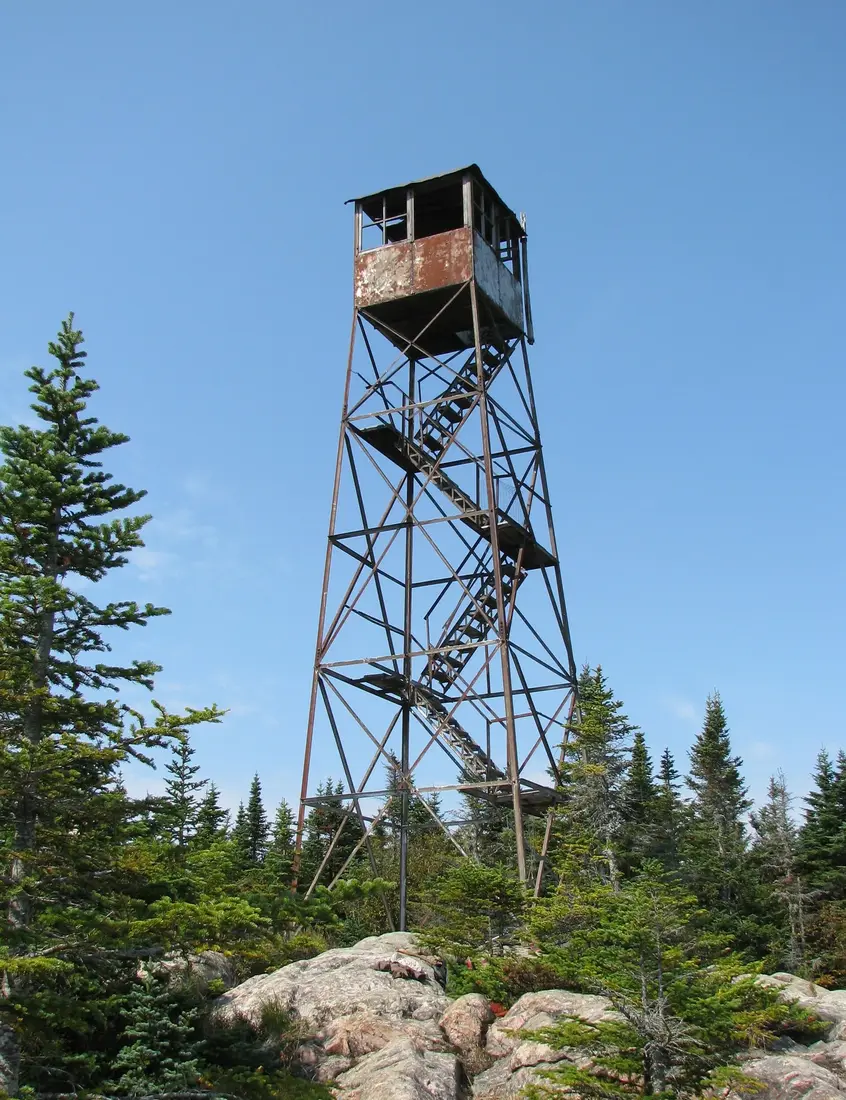
About 20 road miles, roughly 40 minutes, by County Route 27 and County Route 26 to a lot on the west side of the road, about 4.7 miles north of the hamlet of Loon Lake. The DEC opened the trail in 2013. It follows old woods roads for the first mile or so, then climbs more steeply over several bridges, and the last stretch, by a mossy, rocky stream, is steep and slippery. In all it runs 2.8 miles each way and climbs about 1,650 feet to an open bedrock summit of about 3,350 feet. The 35-foot Aermotor tower went up in 1917 and was rebuilt in 1928 after hurricane-force winds blew it over in the winter of 1927-28. Its lowest stairs are gone and the cab is closed for good, but the summit view takes in Lyon Mountain, Whiteface, the High Peaks and Debar Mountain. Allow about half a day; see the Loon Lake Mountain guide.
St. Regis Mountain
About 33 road miles, roughly an hour, by NY 30 to Paul Smiths and west on Keese Mills Road. The trail runs 3.4 miles each way and climbs about 1,250 feet to a 2,874-foot summit over the Saint Regis Canoe Area. The state stationed an observer here in April 1910 with no tower at all, because fires had already burned the summit open; the Conservation Commission put up the 35-foot Aermotor tower in 1918. Staffed continuously from 1910 through 1990, St. Regis was the longest-operating fire tower in New York. After years closed, it reopened to the public on September 1, 2016, for the first time in 26 years. See the St. Regis Mountain guide.
Azure Mountain
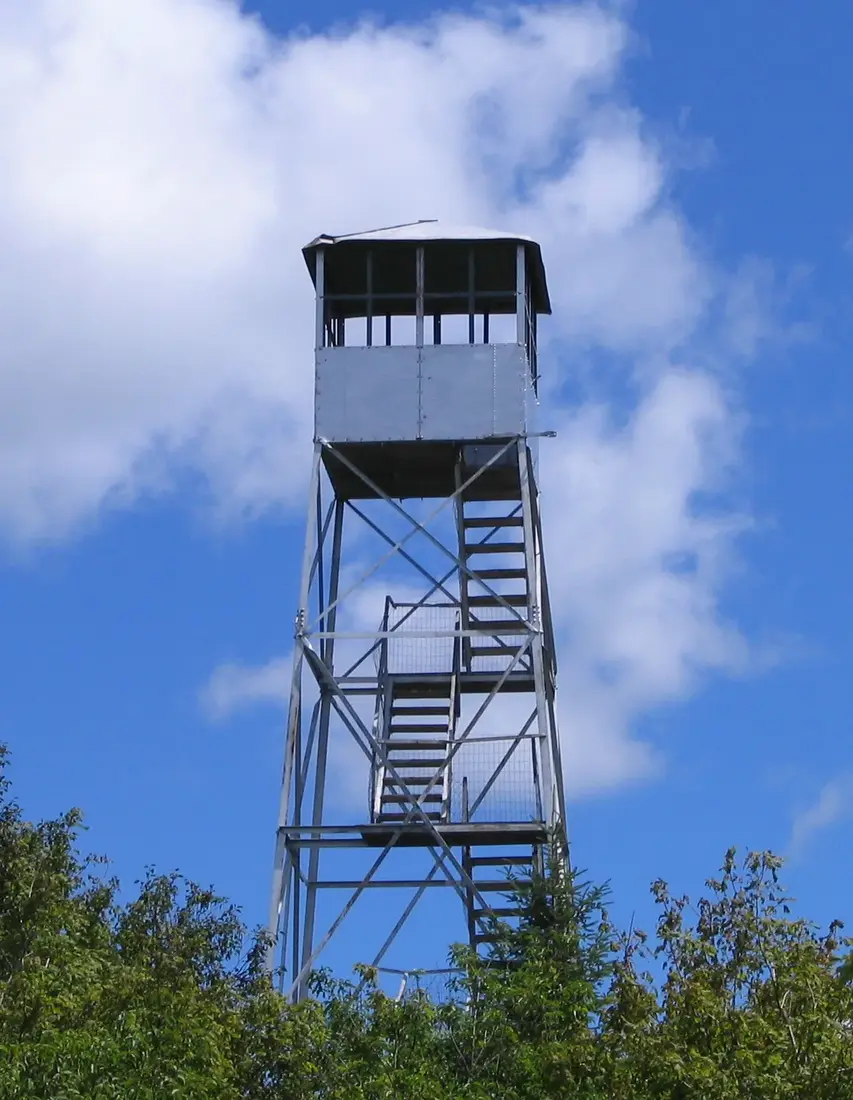
About 42 road miles by NY 30, NY 458 and Blue Mountain Road, the last four miles or so on dirt. It is the short one, a mile each way with the 944 feet of climbing packed into the second half, to a 1918 tower with an open cab. The Azure Mountain guide has the trail, the history, winter access and St. Regis Falls.
Lyon Mountain
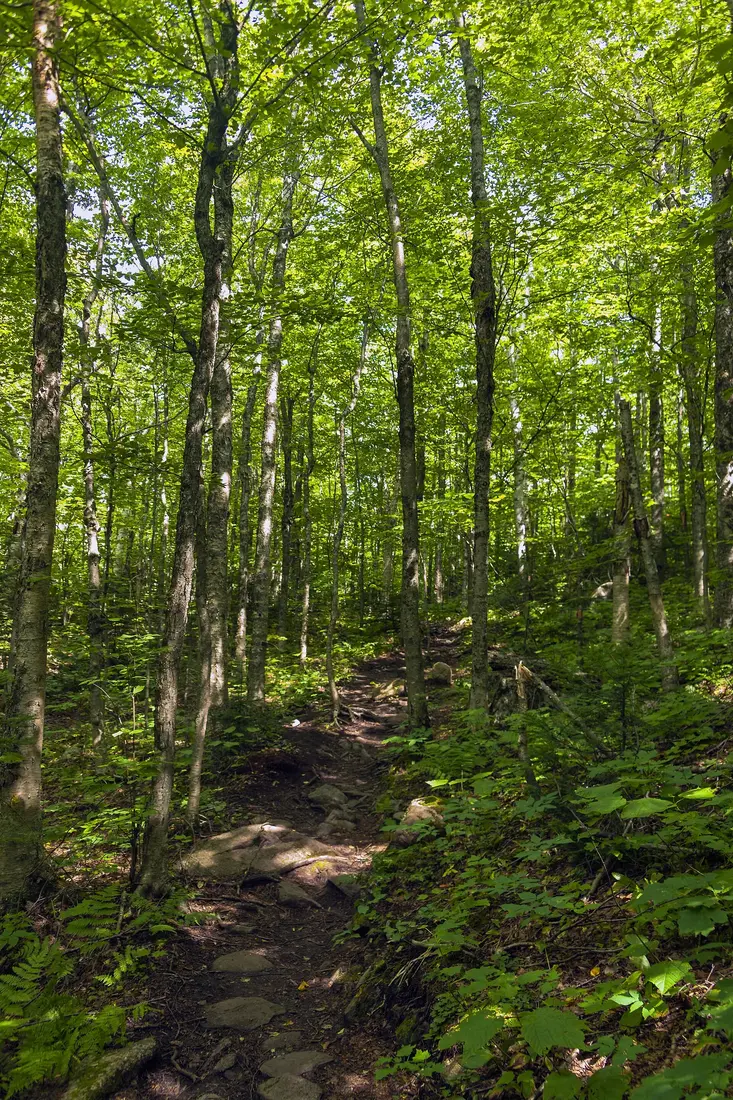
About 45 road miles, roughly an hour and a quarter, through Malone and Chateaugay, then south on NY 374 past the Chateaugay Lakes to Chazy Lake Road and the gravel road to the trailhead, once called Lowenburg Road. At 3,830 feet Lyon is the highest point in Clinton County and the highest summit north of the Saranac River, and it is the biggest climb of the four: 3.4 miles each way and about 1,900 feet, with switchbacks through the steepest sections. The 35-foot tower went up in 1917 and served until the end of the 1988 season. Its view runs north to the Montreal skyline, east to Lake Champlain and Vermont's Green Mountains, and south to the High Peaks, and birders start early for a chance at Bicknell's thrush. See the Lyon Mountain guide and, for the drive, the Chateaugay Lakes guide.
Towers for a longer day
- Mount Arab, about 67 road miles by NY 30 to Tupper Lake and NY 3 toward Piercefield. The 2-mile round trip climbs 750 feet to a 35-foot steel tower from 1918, fully restored in 1999. The old observer's cabin on top is a small museum run by the Friends of Mount Arab, and the parking area is plowed in winter. It pairs well with the Wild Center in Tupper Lake.
- Hurricane Mountain, about 71 road miles by Saranac Lake, Lake Placid and NY 73 to NY 9N. The trail from NY 9N runs 3.4 miles each way and climbs about 2,000 feet to an exposed summit with a 360-degree view. The 35-foot tower went up in 1919, stands in a designated historic area inside the Hurricane Mountain Wilderness, and reopened to the public in 2015.
- Owls Head Mountain, about 80 road miles, on Endion Road off NY 30 near Long Lake. The 3.1-mile trail climbs about 1,100 feet to a 35-foot tower from 1919, inactive since the 1970s and restored with help from volunteers. Long Lake lies below, with Blue Mountain behind it. This is a different mountain from Owls Head near the cabins, which has no tower.
- Poke-O-Moonshine Mountain, about 81 road miles by US 11, NY 190 and the Northway, on US 9 about 7.5 miles south of Keeseville. The Ranger Trail is the shortest and steepest way up, 1.8 miles each way with about 1,280 feet of climbing; the Observer's Trail starts farther south and follows the old access road the fire observers used. The 35-foot tower dates from 1917; the Friends of Poke-O-Moonshine began restoring it in 1997, have hired a summer steward since 2002, usually on the summit Thursday through Monday, and saw the fully restored tower rededicated in June 2005. The view takes in the High Peaks, Lake Champlain and Vermont's Green Mountains. Its 400-foot Main Face draws rock climbers, and the DEC closes climbing routes from April 1 into midsummer while peregrine falcons nest.
- Belfry Mountain, about 88 road miles, on Dalton Hill Road about a mile north of Witherbee. A gravel road climbs about 150 feet to the summit, under a mile round trip, which makes it the shortest walk to any tower on the list. The 47-foot tower dates from 1917, and the view runs from Lake Champlain in the east to the High Peaks in the west.
- Blue Mountain, about 89 road miles, off NY 30 about 1.5 miles north of the hamlet of Blue Mountain Lake. The 4.2-mile round trip climbs 1,550 feet over steep rock slab that is slippery on the way down. Its 1917 tower was the first restored on the Forest Preserve, and the best views are from the cab.
- Goodnow Mountain, about 91 road miles, on NY 28N west of Newcomb on SUNY ESF's Huntington Wildlife Forest. The 4-mile round trip climbs 1,075 feet to a 60-foot tower built in 1922, one of the tallest in the Adirondacks, which ESF and the Town of Newcomb restored in 1995 and ESF repaired again in 2025. The club's 2026 log still marks the cab temporarily closed, so check before you go.
- Cathedral Rock, about 94 road miles, at the SUNY ESF Ranger School in Wanakena, reached by Ranger School Road and Arboretum Road with parking behind the school. The 2-mile round trip gains only 225 feet, and the trail can be done on a bike or on snowshoes. Ranger School students moved the tower here from Tooly Pond Mountain in the mid-1900s.
- Mount Adams, about 109 road miles, from a lot 0.15 mile past the old MacIntyre Blast Furnace on Upper Works Road in Newcomb. The 4.76-mile round trip climbs 1,800 feet, passing the observer's cabin at 0.9 mile and turning steep near the top, to a 47-foot tower from 1917 with views of the High Peaks that you cannot see from the ground.
Planning two towers in one day
Many towers on the list are short enough that two fit into a day when the trailheads are close together. A few habits help:
- Do the longer climb first, while legs are fresh and before summer afternoon storms build.
- Keep the second hike short; a 2-mile tower after a 6-mile one is a full day.
- Count the daylight. At the cabins the sun sets at about 8:50 p.m. on June 21, 6:55 p.m. on September 22, 6:15 p.m. on October 15 and 4:30 p.m. on November 15.
- Pack lunch and water for both hikes, and write both dates in the log that evening.
Four pairs work well from the cabins:
| Pair | Between the trailheads | Hiking for the day | Driving for the day |
|---|---|---|---|
| Azure Mountain and St. Regis Mountain | About 15 miles, about 10 of them dirt, by Blue Mountain Road and Keese Mills Road; not in winter | About 8.8 miles, about 2,200 feet | About 91 miles |
| Hurricane Mountain and Poke-O-Moonshine | About 21 miles by NY 9N and US 9 through Elizabethtown | About 10.4 miles, about 3,300 feet by the Ranger Trail | About 173 miles |
| Mount Arab and Owls Head | About 32 miles by NY 3 and NY 30 through Tupper Lake | About 8.2 miles, about 1,850 feet | About 179 miles |
| St. Regis Mountain and Mount Arab | About 39 miles by NY 30 and NY 3 through Tupper Lake | 8.8 miles, about 2,000 feet | About 140 miles |
The first pair keeps the driving shortest and stays in the northern Adirondacks; the Azure Mountain guide describes the dirt road between the two lots. The other three are long days, with three hours or more behind the wheel, so save them for June and July, when the light lasts.
A four-day tower plan from the cabins
This plan collects six fire-tower summits in four days, with one two-tower day, and leaves every evening for the hot tub. It fits late spring through fall; in winter, keep to the summits and leave the towers alone.
Day one, Loon Lake Mountain
The closest tower, about 20 road miles away. The 5.6-mile round trip takes about half a day, so you are back at the cabin by mid-afternoon. The cab is closed; the open summit is the prize, and it counts.
Day two, Azure Mountain and St. Regis Mountain
The long day, the first pair in the table above. Leave by 8 a.m. and climb Azure Mountain while the morning is cool, then follow Blue Mountain Road south and Keese Mills Road east to St. Regis, and come home by Paul Smiths and NY 30. In September and October, start St. Regis by early afternoon so the descent finishes in daylight.
Day three, Lyon Mountain
About 45 road miles through Chateaugay and past the Chateaugay Lakes. The 6.8-mile round trip with about 1,900 feet of climbing is the biggest of the four nearby towers, so start early and stop at the lakes on the way home.
Day four, east or west
West: drive about 67 road miles to Mount Arab for its 2-mile round trip, then either spend the afternoon at the Wild Center in Tupper Lake or drive about 32 miles on to Owls Head near Long Lake for a 6.2-mile climb; from Owls Head the cabins are about 80 road miles. East: drive about 71 road miles to Hurricane Mountain, then about 21 miles through Elizabethtown to Poke-O-Moonshine, and come home by the Northway and US 11, about 81 miles.
With Owls Head or the eastern pair on the last day, the stay adds up to six of the 18 Adirondack summits you need, a third of the Adirondack part of the challenge.
How New York's fire towers began
The towers grew out of two disastrous fire years. Between April 20 and June 8, 1903, 643 forest fires burned about 428,180 acres in the Adirondacks and more than 36,000 in the Catskills. Fires in 1908 scorched more than 360,000 acres, and the state concluded that its fire warden system was not enough. A committee headed by John C. Agar drafted fire-protection amendments to the Forest, Fish and Game Law, and the Legislature passed them in 1909. The plan called for trained fire observers, on duty from April to November, watching from the highest mountains.
The first stations were often open wooden platforms, or even tents on bare summits. In 1916 the state began replacing the wooden towers with steel ones from the Aermotor Company, a Chicago windmill maker: the ten bought that year were a light model with outside ladders, and in 1917 it moved to a heavier model with an interior stairway. By 1916 every station also had a cabin for its observer; a standard 12-by-16-foot design followed in 1922, and a roomier 16-by-20-foot cabin with a 7-foot porch in 1936. Of the 110 steel towers the state built through 1950, 57 stood in the Adirondack Park.
An observer worked with field glasses, a topographic map of the country in view, often 100,000 acres or more, and a telephone line to the local forest ranger. In 1919 St. Regis got an Osborne Fire Finder, a circular map with an alidade turning on a pin at its center, which let the observer read the bearing to a smoke and call it in. The first observer on St. Regis Mountain, George F. Brown, reported 55 fires in his first year. In the 1930s the state began trying two-way radios.
In the end, airplanes and other reports did the job for less. By 1971 only seven towers in Essex, Clinton and Franklin counties were still in use, and aerial patrols cost less than the $6,000 it took to keep a single tower running for one season. In the towers' last years, observers reported only about 4 percent of fires. In 1988 the DEC decided to phase the towers out, and in 1990 the last five still operating closed, St. Regis among them, ending 82 years of organized fire watching from the mountaintops.
The friends groups that saved the towers
Closing a tower did not end the argument over it. The Adirondack Park State Land Master Plan treated towers in wilderness, primitive and canoe areas as nonconforming structures that had to come down, and the removals that began on Whiteface went on through the 1970s. Towers left standing lost their lowest flights of stairs so no one could climb them, as Azure Mountain's did in 1978 and St. Regis's did after 1990.
Across the state, local volunteers formed groups to save the ones that were left, and the restorations came one after another:
- 1995. SUNY ESF and the Town of Newcomb restored the Goodnow tower.
- 1999. Mount Arab's tower was fully restored; its old observer's cabin is now a museum run by the Friends of Mount Arab.
- 2003. Azure Mountain reopened after a 2002 restoration by the DEC, AmeriCorps workers and the Azure Mountain Friends.
- 2005. The Poke-O-Moonshine tower was rededicated in June after a restoration the Friends of Poke-O-Moonshine began in 1997; they have hired summer stewards since 2002.
- 2010. In October the Adirondack Park Agency voted to classify the land under the St. Regis and Hurricane towers as historic, which let both stand and be restored; Governor David Paterson approved the classification in December.
- 2015. Hurricane reopened to the public after its stairs were replaced and fenced.
- 2016. St. Regis reopened on September 1, after volunteers and a Student Conservation Association crew installed new railings, stairs, landings and a cab floor, and a new roof was flown to the summit.
- 2025. SUNY ESF closed Goodnow in July, flew new steps, landings and a roof to the summit by helicopter, repaired the cab and the observer's cabin, and reopened the tower in October.
The groups still hold work days and put stewards on the summits in summer, and a work day with one of them is the kind of stewardship proof the club asks for.
Other challenges the same climbs count toward
- Saranac Lake 6er. St. Regis Mountain is one of its six peaks, with Baker, Scarface, Ampersand, Haystack and McKenzie. Finish all six, register for $15, and ring the bell on Berkeley Green in Saranac Lake; see the 6er guide.
- Tupper Lake Triad. Mount Arab is one of three peaks, with Coney and Goodman mountains. Registration is $10; the summer patch counts hikes from March 21 to December 19 and the winter patch from December 20 to March 20.
- Lake Placid 9er. Hurricane Mountain is one of its nine peaks.
- ESF's two towers. SUNY ESF gives a sticker to hikers who climb both of its towers, Goodnow and Cathedral Rock, in the same year and send photos.
One climb of St. Regis or Mount Arab can count toward two patches at once, which makes those two worth placing early in a trip.
Safety on the stairs and in the wind
- Lightning. At the first thunder, come down from the tower and get off the summit, and stay sheltered for at least 30 minutes after the last thunder.
- Wind and cold. An exposed summit is much colder than the trailhead, and wind makes it colder still. Carry a warm layer and a windbreaker even in July.
- Stairs. Keep a hand on the rail, let people coming down pass at the landings, and respect any occupancy sign in the cab; St. Regis put one up when it reopened.
- Winter. Towers are extremely unsafe in winter: high winds add risk, the stairs are often covered in ice and snow, and crampon points damage the wooden steps. Climbing Blue Mountain's tower in winter is dangerous for the wind, the wind chill and the ice.
- Closed towers. Never climb a tower whose stairs have been removed or that is posted closed, as at Loon Lake Mountain and Spruce Mountain.
- Hunting season. The Forest Preserve trails to these towers are open to hunting in season. Wear blaze orange or blaze pink, and expect to meet hunters carrying firearms or bows.
Tell someone your route and return time before each hike. In an emergency, call 911 and ask for a DEC Forest Ranger, or call DEC dispatch at 1-833-NYS-RANGERS (1-833-697-7264).
Children and dogs
For children new to hiking, start with the short towers: Belfry's gravel road, the 2-mile round trip to Cathedral Rock, Mount Arab's mile each way, and Azure Mountain's steep mile for children who already hike. Save Lyon, Hurricane and St. Regis for older children with half-day stamina. On tower stairs, an adult should climb just below a child going up and just ahead coming down. In winter the club generally does not recommend these trails for children, and asks parents who try to judge their children's abilities carefully.
Dogs are allowed on the Forest Preserve trails. The DEC requires a leash at trailheads, at campsites and above 4,000 feet, and asks that dogs be leashed whenever they meet another group and kept under complete control at all times. Keep dogs off tower stairs, where one adult can wait with them at the base, and give them a bright vest in hunting season. Goodnow and Cathedral Rock are on SUNY ESF land with rules of their own, so check before you bring a dog there. The cabins allow pets for a fee; see bringing your dog.
Gear, maps and the guidebook
- The guidebook. The club's own guide to these trails is Views from on High: Fire Tower Trails in the Adirondacks and Catskills, second edition, 2021.
- The log. Print the club's 2026 challenge log, keep it in the car, and write each date on the day you climb.
- Maps. National Geographic's Trails Illustrated map 746 covers the Debar Mountain Wild Forest, which takes in Azure Mountain and the upper Loon Lake Mountain trail, and the Saint Regis Canoe Area around St. Regis Mountain, at about 1:75,000 on waterproof paper; it was $14.95 at the club's shop in 2026.
- The basics. Water, food, warm layers and a rain shell, a headlamp, a first-aid kit and an offline map.
- Seasonal extras. A head net and repellent in black-fly season, blaze orange in the fall, and microspikes and snowshoes in winter; the cabins do not supply snowshoes. The bug guide covers the black flies and ticks.
For what to pack for the whole trip, see when to come and what to pack, and for every other trail near the door, hiking near the cabins. When you are ready to pick a base, start with the cabins.
Questions
How many fire towers do you need for the Fire Tower Challenge?
Twenty-three: at least 18 of the 27 Adirondack Park summits on the Adirondack Mountain Club's list and all 5 in the Catskill Park. Record the date of each ascent, sign the pledge, add proof of public-land stewardship and submit online or by mail. Four of the Adirondack towers are within about 45 road miles of the cabins.
Do you have to climb the tower itself?
No. The summit counts as long as a tower is standing on the day you climb, and the club does not recommend climbing towers that still need restoration. Loon Lake Mountain's cab is permanently closed, yet the summit still counts. In winter the rules ask you to stay off the towers altogether.
Which fire towers are closest to the cabins?
Loon Lake Mountain, about 20 road miles to the trailhead; St. Regis Mountain, about 33; Azure Mountain, about 42; and Lyon Mountain, about 45. See the guides to Loon Lake Mountain, St. Regis Mountain, Azure Mountain and Lyon Mountain.
What is the winter Fire Tower Challenge?
The same list, climbed between December 21 and March 21, inclusive. Finishers earn a rocker, a patch shaped like the rung of a rocking chair. Do not climb the towers in that season, when wind and icy stairs make them unsafe, and attempt these winter hikes only with winter experience, proper gear and a group of at least four.
Does Debar Mountain count toward the challenge?
No. Debar's steel tower, built in 1918, closed after the 1970 season and was removed in 1979, and a mountain counts only if its tower is standing on the day you climb. The hike is still a good one; see the Debar Mountain Wild Forest guide.
What counts as proof of stewardship?
The club accepts a completed Leave No Trace 101 course, photos from a volunteer project you attended, picking up trash and other examples of public-land stewardship. A work day with a tower friends group, such as the Azure Mountain Friends, is a good fit.
How many towers can you climb in a four-day stay?
About six summits: Loon Lake Mountain on the first day, Azure Mountain and St. Regis Mountain together on a long second day, Lyon Mountain on the third, and two more on a final day east (Hurricane and Poke-O-Moonshine) or west (Mount Arab and Owls Head near Long Lake). The four-day plan on this page lays out the driving.
Sources
Facts on this page were checked against these sources in October 2026. Hours, fees and schedules change; confirm before you go.
- Adirondack Mountain Club adk.org/adk-fire-tower-challenge/
- Adirondack Mountain Club adk.org/wp-content/uploads/2026/09/ADK-Fire-Tower-Challenge-Log-2026.p
- adk-gfs.org adk-gfs.org/FTC/FTC.Brochure.2018-02-01.pdf
- adk-gfs.org adk-gfs.org/firetower.challenge.php
- New York State Department of Environmental Conservation dec.ny.gov/things-to-do/hiking/fire-towers
- New York State Department of Environmental Conservation dec.ny.gov/places/saint-regis-canoe-area
- New York State Department of Environmental Conservation dec.ny.gov/places/chazy-highlands-wild-forest
- New York State Department of Environmental Conservation dec.ny.gov/places/sargent-ponds-wild-forest
- New York State Department of Environmental Conservation dec.ny.gov/places/taylor-pond-wild-forest
- New York State Department of Environmental Conservation dec.ny.gov/things-to-do/hiking/adirondack-day-hikes
- nysffla.org nysffla.org/towers5.htm
- friendsofstregis.org friendsofstregis.org/history-of-the-tower-observers-and-friends-group/
- carogamuseum.org carogamuseum.org/kane-mountain-fire-tower/
- Lake Placid tourism (ROOST) lakeplacid.com/story/2012/03/adirondack-history-fire-towers
- hurricanefiretower.org hurricanefiretower.org/restoration/
- newyorkalmanack.com newyorkalmanack.com/2020/10/featured-adirondack-hike-hurricane-mountai
- content.govdelivery.com content.govdelivery.com/accounts/NYSDEC/bulletins/8f1d39
- Saranac Lake tourism saranaclake.com/hiking/loon-lake-mountain
- Saranac Lake tourism saranaclake.com/hiking/st-regis-mountain
- Saranac Lake tourism saranaclake.com/hiking/lyon-mountain
- azuremountain.org azuremountain.org/history
- tupperlake.com tupperlake.com/hiking/mount-arab
- tupperlake.com tupperlake.com/story/2018/07/mount-arab-celebrates-100-years-celebrate
- tupperlake.com tupperlake.com/tupper-lake-hiking-triad
- Lake Placid tourism (ROOST) lakeplacid.com/do/hiking/hurricane-mountain
- tupperlake.com tupperlake.com/hiking/owls-head-mountain
- experienceouradirondacks.com experienceouradirondacks.com/story/2019/one-down-four-to-go
- lakechamplainregion.com lakechamplainregion.com/hiking/poke-o-moonshine
- Adirondack Explorer adirondackexplorer.org/almanack/2014/04/david-thomas-train-friends-of-
- pureadirondacks.com pureadirondacks.com/blogs/adirondack-hiking/belfry-mountain
- passageport.org passageport.org/things-to-do/belfry-mountain-trail/
- experienceouradirondacks.com experienceouradirondacks.com/hiking/blue-mountain
- esf.edu esf.edu/firetower-challenge/index.php
- esf.edu esf.edu/newcomb/firetower/index.php
- adirondackalmanack.com adirondackalmanack.com/2025/07/goodnow-mountain-fire-tower-temporarily
- Lake Placid tourism (ROOST) lakeplacid.com/hiking/goodnow-mountain
- newcombny.gov newcombny.gov/mt-adams
- hmdb.org hmdb.org/m.asp?m=44649
- New York State Department of Environmental Conservation dec.ny.gov/things-to-do/hiking/trail-etiquette
- New York State Department of Environmental Conservation dec.ny.gov/things-to-do/hiking/lost
- New York State Department of Environmental Conservation dec.ny.gov/news/press-releases/2025/10/dec-reminds-new-yorkers-to-hunt
- National Weather Service weather.gov/safety/lightning-tips
- Adirondack Mountain Club adk.org/product/map-746-saranacpaul-smiths/
- OpenStreetMap (road distances) openstreetmap.org/
- router.project-osrm.org router.project-osrm.org/
- epqs.nationalmap.gov epqs.nationalmap.gov/v1/json
- api.sunrise-sunset.org api.sunrise-sunset.org/json
In this guide
Stay nearby
The first of the cabins: a big stone fire pit you see as you walk up, a screened corner of the deck, direct trail access, and a short walk to an observation deck over the pond.
 The Modern Tiny HomeCabin 1 · 2 bd · 1 ba · sleeps 4
More in Trails & Hiking
Sources
47 references, listed in full at the end of this guide: official park, state, tourism-office and business sources, checked October 2026.
Related guides


Photos on this page: Saint Regis Fire Tower 2010 t6 by John Sweeney, CC BY-SA 3.0; Fire Observation Tower on the summit of Loon Lake Mountain, Loon Lake, New York, Franklin County by Marc Wanner, CC BY-SA 3.0; Azure Mountain Fire Tower by Mwanner, CC BY-SA 3.0; Hiking trail in sunlit forest, Lyon Mountain, NY by Daniel Case, CC BY-SA 3.0. Resized and cropped for this site. All photo credits