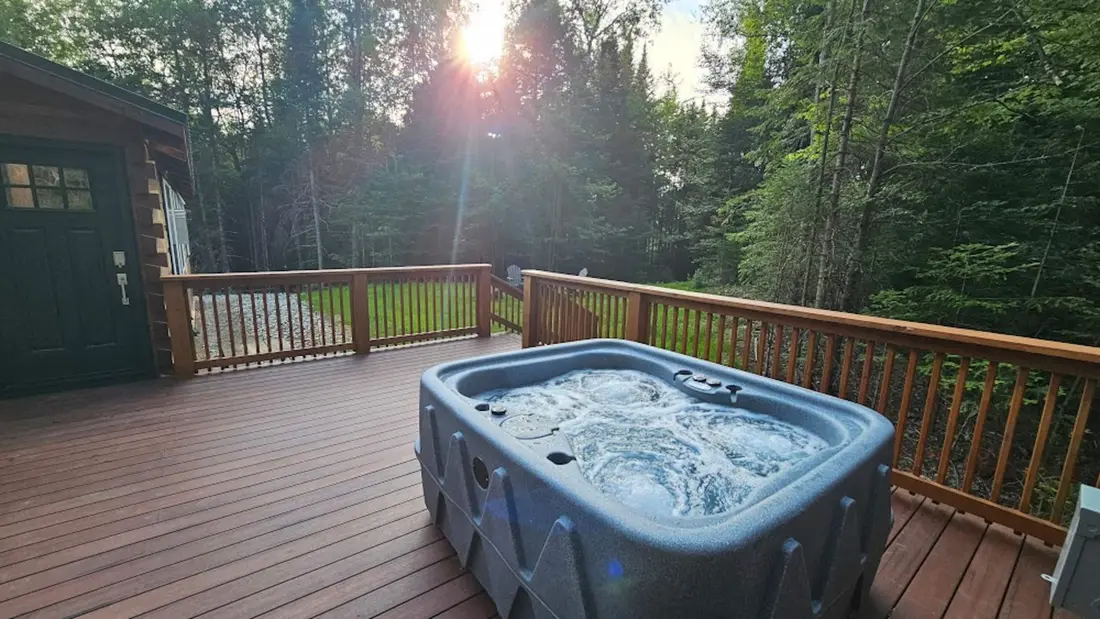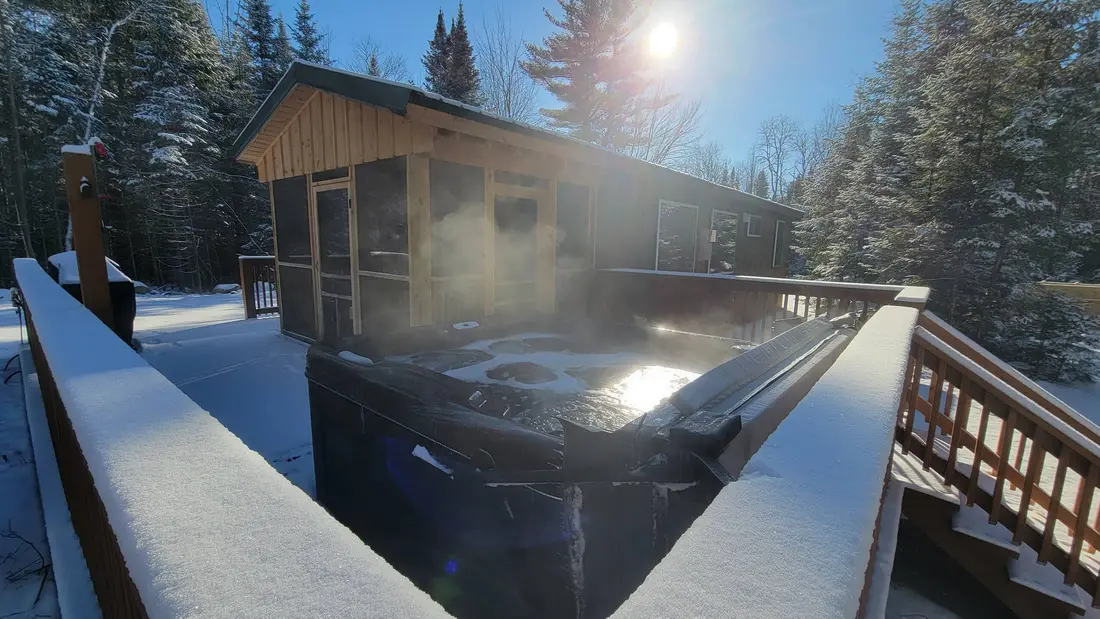
Winter Driving to the Cabins
Who plows the roads to the cabins, 511NY, New York's winter driving laws, snow tires, rental cars, lake-effect squalls and what to keep in the car.
From December through March the drive to the cabins is a winter drive. Malone, about ten road miles north of the cabins, averages about 95 inches of snow a year, and every route ends on county and town roads and a private gravel drive, each cleared by a different crew. This guide covers who plows which road, where to check conditions, New York's winter rules, tires and rental cars, the snow belts on the routes in, the crossing from Canada, and what to do if you slide off.
The winter you are driving into
Malone's 1991-2020 averages make December and January the snowiest months, at about 21 and 22 inches, with 18 inches in February and 15 in March. November averages about 9 inches and April about 7, so a stay in either month can still include a snowy drive. January is the coldest month, with an average high of 23°F and an average low of 4°F, and cold snaps go far lower: a family at The Modern Pine in February 2026 wrote of "-30 temperatures" and a cabin that stayed "so cozy and warm".
Some of the routes in get more snow than Malone does. Watertown, on the way in from the west, averages 114 inches a year. Lake Placid, on the High Peaks route from the south, averages 104 inches at about 1,740 feet above sea level; the Malone weather station sits at about 770.
The days are short. On December 21, 2026, the sun rises at the cabins at 7:31 a.m. and sets at 4:19 p.m., and dusk is over by 4:52. Plan to reach the area by mid-afternoon if you want the last miles in daylight. Speed is the other thing to plan around: across New York, an average of 32 percent of speed-related crashes from 2021 through 2023 happened in December, January and February.
Who plows which road
Between the interstate and your cabin door, up to four public road crews clear the way, each with its own trucks, and the last stretch is a private drive.
- The state. The New York State Department of Transportation, NYSDOT, is responsible for 43,716 lane miles of state highway. Its own crews cover 36,736 of them, and towns, villages and counties cover the other 6,980 under about 160 contracts with the department. Ahead of a late-December 2025 snowfall it had 3,605 operators and supervisors, 1,630 large plow trucks and 53 tow plows, trailers that let one truck clear two lanes at once. The Northway, which runs from the Thruway at Albany to the Canadian border, and the state routes on the way in, such as NY 30, are the department's roads.
- The Thruway. From the New York City line to exit 24 at Albany, I-87 is the New York State Thruway, which has its own crews. For that same December snowfall it had 688 operators and supervisors and 332 plow trucks ready. At exit 24, I-87 North leaves the Thruway and continues as the Northway.
- The county. County Route 25, the Duane Road, is a Franklin County road. New York's Highway Law lets a county hire a city, town or village to plow and sand its county roads, under a written contract of up to ten years, so who plows a given stretch of county road depends on the contract in force. Those contracts change: the Town of Bellmont, for one, says it no longer contracts with the county to maintain County Route 24 and that its crew is not responsible for conditions there.
- The town. The last couple of miles before each drive are town roads, plowed by the town highway crew. New York's Highway Law lets a town highway superintendent name a town road a seasonal limited use highway each year by November 1. The town can then stop plowing and maintaining it from December 1 to April 1, as long as the road is posted. Phone maps do not always know which roads those are; the host's directions do.
- The drive. The gravel drives at the cabins are private property. Tell the host when you expect to arrive, and say so again if a storm moves into the forecast.
How the state ranks its roads
NYSDOT ranks its roads by traffic for snow and ice work, because traffic reflects how hard a road is to keep clear, how fast people drive it and how many people a delay would hold up. Its snow and ice manual sets four classes: expressways that run near capacity, which get priority attention; interstate-type expressways carrying 500 or more vehicles an hour in each direction at design volume; major state highways carrying 200 to 500; and minor state highways carrying fewer than 200. Steep grades, sharp curves, intersections, bridges and railroad crossings get special attention whatever their class, as do stretches prone to Great Lakes squalls, sudden icing or drifting snow.
A few numbers from the same manual show why a big storm takes hours to clean up. Staffing is planned for snow falling at 1.1 inches an hour, a rate exceeded only a few times a year in any part of the state. Each large truck is assigned about 30 lane miles, and a plow averages about 16.5 miles an hour once the runs back to reload are counted. The stated goal is roads that are passable and reasonably safe as much of the time as possible. Pavement will be snow covered or slippery some of the time, and drivers are expected to drive for it.
These classes cover state highways only. No plowing order or schedule is published for the county and town roads near the cabins, so nobody can tell you in advance when a given stretch will be cleared after a storm. Ask the host how the roads look before you set out, and plan to drive the last miles in daylight.
Salt, sand and low temperatures
Salt is the main tool, and it weakens as the temperature drops. At 30°F one pound of rock salt melts about 46 pounds of ice; at 15°F it melts about 6. When the pavement is colder than about 15°F, or traffic is light, state crews may spread sand and other abrasives for grip instead, and when dry snow is blowing at those low temperatures they plow it off without salting it. Salt also works better under heavy traffic, which warms the pavement and breaks up the ice, while on a lightly traveled road slush can sit in ruts and freeze again at night. Put together, a quiet county or town road on a January night near the 4°F average low is more likely to be packed snow and sand than bare pavement.
Two more points from the manual help with timing. From mid-morning on, sun can warm the pavement as much as 40 degrees above the air temperature, while in the early morning the pavement is colder than the air, so a road that was wet at 2 p.m. can be glazed by 7 the next morning. And black ice is a thin, clear, bubble-free coat that forms on pavement at or just above freezing when the air against it is below freezing. Bridges, ramps and overpasses freeze first.
Checking the roads before you go
511NY is the state's traffic and travel information service: dial 511, use the website, or use the 511NY app. In winter its map adds Winter Road Conditions, color-coded stretches of road reported by the plow operators working them, in steps from generally clear and dry through wet, snow and ice, and severe snow and ice, to closed. The reports cover many of the state's most traveled highways and are updated at least every four hours in winter, more often during a storm, and the service also carries more than 1,000 live traffic cameras statewide.
Two limits matter on this trip. The conditions map covers major state highways, not the county and town roads at the end of the drive. And a gray stretch means no weather there currently calls for reports, so the map says nothing about that pavement. For the last miles, the host is the best report, so send a message before you leave Malone or Saranac Lake. For the weather, the National Weather Service office in Burlington, Vermont, forecasts for northern New York, Franklin County included, and posts a hazardous weather outlook along with any watches and warnings. A day or two out, read the forecast for your whole route, not only for the cabins; the next section explains why.
Lake-effect snow and squalls on the way in
Lake-effect snow off Lake Ontario falls in narrow, heavy bands, hardest on the Tug Hill Plateau and around Watertown, and Interstate 81 runs through that belt on the way north from Syracuse. Over Thanksgiving weekend 2024 the state warned of three to four more feet of snow in the Tug Hill and Watertown areas and posted tow trucks along I-81 in Oswego and Jefferson counties. Twelve days later a lake-effect state of emergency covered Franklin County as well as St. Lawrence, Jefferson and Lewis, with snow falling at two to three inches an hour east of Lake Ontario and strong winds bringing whiteouts. If a lake-effect warning covers your route, wait it out.
Snow squalls are the other hazard. A squall is a short, intense burst of snow and wind, often tied to a strong cold front; it usually passes within 30 to 60 minutes but brings very low visibility while it lasts. Since November 2018 every National Weather Service office can issue a Snow Squall Warning, and snow squalls are on the short list of warnings that can reach your phone as a wireless emergency alert. When one is issued for your road, delay the drive until it passes. If you are already moving, slow down, turn on your headlights and hazard lights, leave plenty of room, and avoid hard braking on a slick surface.
Choosing a route in winter
The routes in, with road miles from every direction, are on the getting to the cabins page. In winter a few things change the choice.
- From New York City and Albany. Both routes follow the Northway north from Albany. The High Peaks route leaves it at exit 30 and climbs through Keene, Lake Placid and Saranac Lake, the higher and snowier country described above. The Plattsburgh route stays on the interstate to exit 37, then takes NY 190 and US 11 west to Malone, north of the High Peaks. In a storm, the second keeps you on the interstate longer, and interstates sit near the top of the state's plowing classes.
- Fuel on the High Peaks route. Fill the tank in Lake Placid or Saranac Lake. From Saranac Lake the cabins are about 43 road miles away, and this route reaches them before it reaches Malone, where the Stewart's at 289 West Main Street and the Mobil at 593 East Main Street sell gas.
- From the west. I-81 between Syracuse and Watertown crosses the lake-effect belt, so check the forecast and 511NY before you commit to it. From Watertown, US 11 runs northeast through Canton and Potsdam to Malone.
- From Montreal and Ottawa. The border crossing is part of the timing; see the section on driving in from Canada below.
Snow tires, all-season tires and all-wheel drive
All-wheel drive gets a car moving on snow and up a slippery grade, but it does not help the car stop, and all-wheel-drive cars still slide when turning and braking on slick roads. Winter tires help with starting, turning and stopping, because their tread patterns and rubber compounds are made to grip snow and ice in the cold. Put them on before the first storm. Front-wheel and four-wheel drive handle better on snow, but neither gives flawless traction, and a skid can start without warning. If you can choose, choose winter tires first and all-wheel drive second. A February 2026 guest at The Modern Tiny Home was glad to have all-wheel drive on the rural road in.
To check a tire, look on the sidewall for a three-peak mountain with a snowflake inside it. That symbol means the tire passed a packed-snow traction test that the U.S. and Canadian tire industries agreed on in 1999. The letters M+S, for mud and snow, describe the tread design and involve no performance test. The snowflake test measures grip on packed snow, not braking or cornering on ice, and some all-weather tires carry the symbol too. Quebec requires the symbol, or studs, on Quebec-registered cars from December 1 to March 15.
New York sets dates for studded tires but does not require winter tires. Studs are legal from October 16 through April 30 and barred from May 1 to October 15, except on school buses and state or municipal vehicles. Quebec allows studs on passenger cars from October 15 to May 1, so a car from Quebec on studs is legal in New York all winter apart from those two edge days.
Cold also lowers tire pressure, because the air inside the tire contracts. Check the pressure with the tires cold and fill to the number on the label in the driver's door frame, not the maximum printed on the tire.
Renting a car for a winter trip
- Ask for winter tires, then check. Every car registered in Quebec, rentals included, must be on winter tires from December 1 to March 15, so a Quebec-registered car picked up in Montreal in that window will have them. The rule does not apply to cars registered anywhere else, and a car from a U.S. counter may come on all-season tires. Ask when you book, and look for the snowflake symbol before you drive away. Airports near the cabins lists the rental desks.
- Ask for all-wheel drive as well, and count it as help getting moving.
- Do not plan on chains. Enterprise, for one, neither supplies chains nor allows them on its rental cars unless a state law requires them.
- Read the rules on unpaved roads. Some rental agreements bar them; Budget's U.S. terms, for example, list driving on unpaved roads as a prohibited use that voids its loss damage waiver. The last stretch to each cabin is a private gravel drive, so if your coverage matters to you, ask the rental company how it treats one.
- Check for a snow brush. If the car has none, buy a brush and an ice scraper in Plattsburgh or Malone before the first snowfall of the trip.
New York's winter driving rules
- Headlights with wipers. State law requires headlights whenever your wipers are running because of rain, sleet, snow or hail, as well as from half an hour after sunset to half an hour before sunrise. In falling snow, use low beams.
- Move over. On any road, slow down when you come up on a police car, ambulance or fire truck stopped with its emergency lights on, or a plow, tow truck or highway crew vehicle stopped with amber lights flashing. On the Northway, the Thruway, I-81 and other controlled-access highways, also move out of the lane next to it unless traffic or another hazard makes that unsafe, and slow down if you cannot change lanes. Since March 27, 2024, that duty on those highways covers any vehicle stopped on the shoulder or in a lane.
- Plows. Never pass a plow, and stay well back, up to eight car lengths, where the road is freshly cleared. A loaded plow weighs more than 10 tons, has blind spots and cannot stop quickly, and plows throw up clouds of snow and leave ridges between lanes. On the Thruway they work at about 35 miles an hour, often below the speed limit.
- Clear the whole car. Brush the snow and ice off the lights, the wipers, the hood, the roof and every window before you drive. New York has no law aimed at snow left on a roof. Bills to require clearing it, with fines starting at $75, were filed in Albany in every two-year session from 2013 through 2020, and none passed. A snowy windshield or rear window is different: the State Police have said you can be ticketed for not clearing either one.
- Skids and brakes. If the car skids, turn the steering wheel in the direction the car is trying to go. With anti-lock brakes, keep steady pressure on the pedal; without them, pump it gently.
What to keep in the car
- A snow brush, an ice scraper and a small shovel.
- A bag of sand or cat litter for traction, and jumper cables.
- A flashlight or headlamp, flares or a warning triangle, and a reflective vest.
- Blankets, gloves and a warm layer for everyone in the car.
- Water, snacks and any medicine you need.
- A car charger for your phone, and a basic first aid kit.
- Winter washer fluid with de-icer in the reservoir, and a spare jug.
Before the trip, have the battery checked: cold weather cuts a battery's power just as the engine needs more of it to start. Fill the tank before the last stretch and keep it well up, since the engine is your heater if you get stuck. Electric and hybrid cars lose range in the cold. Malone has a Red E fast-charging site at the Aldi at 3324 State Route 11, with four DC fast chargers listed as open 24 hours; check the network's app for their status before you count on them.
Deer and moose
The risk of hitting a deer peaks from October through December, at dawn and dusk, and in late December dusk is over before 5 p.m., which is one more reason to arrive by mid-afternoon. Deer travel in groups, so when one crosses, slow down and expect another. Moose are far fewer, but their height and dark coats make them hard to see until you are close, and in spring they come to the roadsides for the salt left by winter road crews. Getting to the cabins has the crash figures and what to do if an animal stands in the road, and wildlife watching covers the animals themselves.
Driving in from Canada in winter
- Tires. Cars registered in Quebec must be on winter tires from December 1 to March 15, and studs that are legal in Quebec are legal in New York from October 16 to April 30.
- Road reports. Québec 511, by phone at 511 in Quebec or online, covers roadwork, winter road conditions and border wait times; from October 15 to April 15 its winter road conditions are updated every day between 3 and 6 a.m. and whenever conditions change. From Ottawa, Ontario 511, by phone, website or app, reports highway conditions as bare, partly covered or covered, and its app can track snowplows on provincial highways.
- The crossing. The Trout River crossing on NY 30 has been closed to traffic entering the United States since June 1, 2026, with reconstruction expected to finish around May 2028. Chateaugay closes at 6 p.m. and Churubusco at 4 p.m., while Fort Covington, Champlain and Massena are open around the clock. After dark on a winter evening, plan on one of the 24-hour ports. Crossing the border has the hours, the documents and the rules for food and dogs.
- The route. From Montreal, the Fort Covington route uses Autoroute 30 and Route 132, and the Champlain route Autoroute 15, and Québec 511 reports on both. The city ends of the trip are on the drive from Montreal and the drive from Ottawa.
- Going home. Trout River stays open to traffic heading north into Canada, so the direct route north from Malone is still there after a winter weekend.
The last miles and the cabin drives
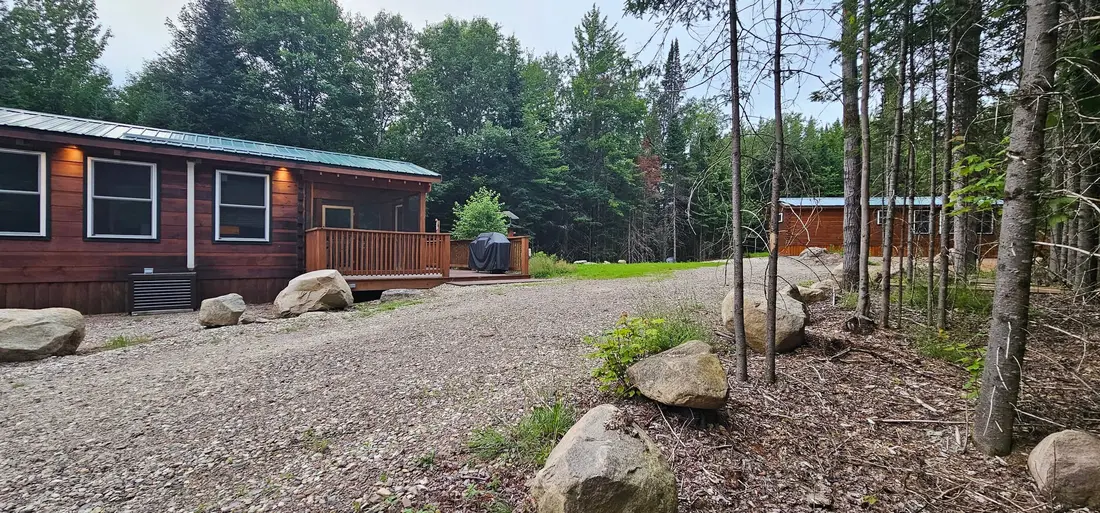
Every route ends the same way: County Route 25, a couple of miles of town road, and a private gravel drive. Use the host's directions; a March 2026 guest at The Aviator found that GPS never brought them the same way twice and warned others about the seasonal road closure. Save the directions and an offline map while you still have a signal.
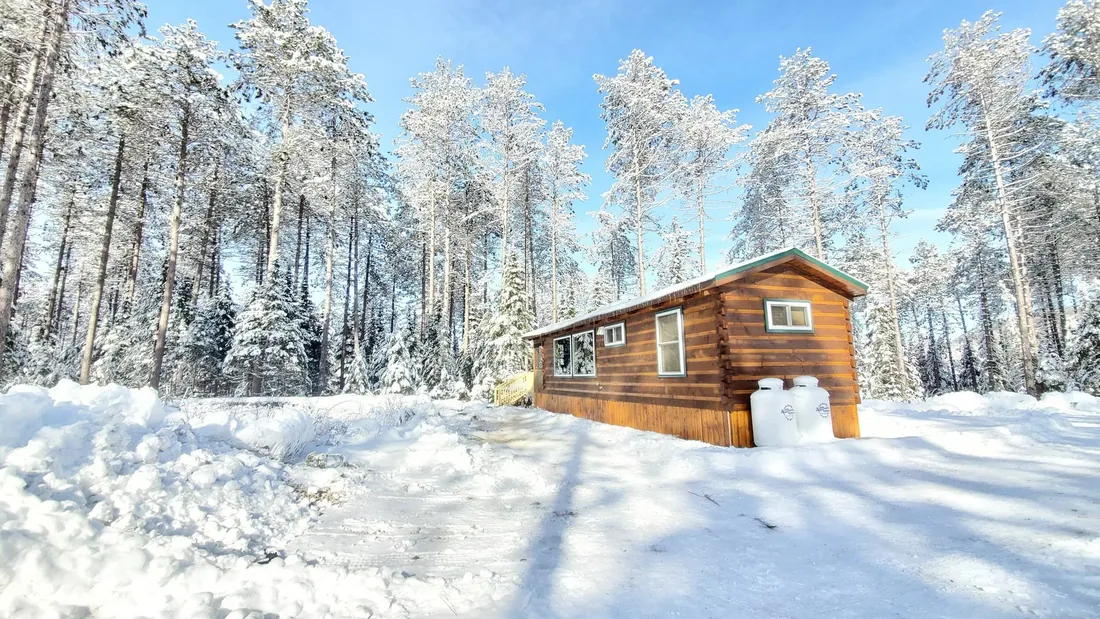
In winter the drives, steps and decks can carry snow and ice. Wear boots with good tread from the car to the door, keep a hand free on the steps, and carry the bags in a few trips. When you park, turn the car around or back in, so you can drive out forward if it snows overnight. A January 2021 guest at The Modern Tiny Home wrote:
Although it snowed so much, way to the cabin was clean enough to easily access.
The listings for The Modern Pine and The Modern Tiny Home note room in the parking area for a snowmobile or an ATV, and the C7 trail runs close by; see snowmobiling from the cabin door. Titus Mountain's base lodge is about 3.5 road miles away on local roads, so after a storm add a few minutes for the drive to the lifts; see skiing Titus Mountain. To match a cabin to a ski or sled trip, start with the stays by trip type, and for the clothes and gear that go in the bags, see when to come and what to pack.
If you slide off or get stuck
If the car slides into a snowbank or spins on a grade near the cabins:
- Ease off the gas, and clear the snow from around the drive wheels and from the exhaust pipe.
- Spread sand or cat litter in front of the drive wheels and in your tracks; branches or a plank will do in a pinch.
- Call the host, who knows the local roads. An April 2023 guest whose car got stuck in the snow near the cabin wrote that someone from the host's team came right over and helped get them out.
- If anyone is hurt, the car is blocking the road, or you are stranded in a storm, call 911.
If a storm strands you on the road, stay in the car; leave it in wind-driven snow and you can become disoriented quickly. Run the engine about ten minutes each hour for heat, with a window open a little, and keep the exhaust pipe clear of snow so fumes cannot build up inside. At night, turn on the dome light while the engine runs. Tie a bright cloth, red if you have one, to the antenna or a door, and once the snow stops, raise the hood to show you need help.
Cell coverage depends on your carrier. One family found that Verizon worked across The Modern Tiny Home's property in 2020, while a guest the next summer found the signal in the area weak. Send the host your arrival time from Malone or Saranac Lake while your phone still has service. Every cabin has wifi, and health and safety lists the emergency numbers and the hospital in Malone.
Questions
Do we need snow tires to reach the cabins in winter?
New York does not require them, but bring them if you can. The last miles are county and town roads and a private gravel drive, each plowed by a different crew, with no published schedule. Winter tires with the mountain-and-snowflake symbol help you start, turn and stop; all-wheel drive mainly helps you get moving. The routes in are on getting to the cabins.
Are studded tires legal in New York?
Yes, from October 16 through April 30. From May 1 to October 15 they are barred on public roads, except on school buses and state or municipal vehicles. Quebec allows studs on passenger cars from October 15 to May 1, so a Quebec car on studs is legal in New York all winter apart from those two edge days.
Does 511NY show the roads to the cabins?
It shows winter conditions on many of the state's main highways, reported by the plow operators and updated at least every four hours in winter, more often in storms. It does not cover the county and town roads at the end of the trip, and a gray stretch carries no report on the pavement. For the last miles, message the host before you leave Malone or Saranac Lake.
Can we put chains on a rental car?
Usually not. Enterprise, for example, does not supply chains and does not allow them on its rental cars unless a state law requires them. Ask for winter tires and all-wheel drive when you book, and check the tire sidewall for the mountain-and-snowflake symbol before you drive away. Cars registered in Quebec carry winter tires from December 1 to March 15.
What should we do if we get stuck in the snow near the cabins?
Ease off the gas, clear the snow from the drive wheels and the exhaust pipe, and spread sand or cat litter in your tracks. Then call the host, who knows the local roads. If anyone is hurt or you are stranded in a storm, call 911, stay in the car, run the engine about ten minutes an hour with a window open a little, and keep the exhaust clear.
What time should we plan to arrive in winter?
By mid-afternoon if you can. On December 21, 2026 the sun sets at the cabins at 4:19 p.m. and dusk is over by 4:52, when deer are moving. Shop and fill the tank in daylight, then drive the last ten miles before dark. If a storm is forecast for Friday night, consider driving up on Saturday, after the snow stops and the host says the roads near the cabins are clear.
Sources
Facts on this page were checked against these sources in October 2026. Hours, fees and schedules change; confirm before you go.
- usclimatedata.com usclimatedata.com/climate/malone/new-york/united-states/usny0854
- usclimatedata.com usclimatedata.com/climate/watertown/new-york/united-states/usny1525
- usclimatedata.com usclimatedata.com/climate/lake-placid/new-york/united-states/usny0778
- aa.usno.navy.mil aa.usno.navy.mil/api/rstt/oneday?date=2026-12-21&coords=44.769,-74.192
- New York State Department of Transportation dot.ny.gov/divisions/operating/oom/transportation-maintenance/snow-ice
- New York State Department of Transportation dot.ny.gov/divisions/operating/oom/transportation-maintenance/reposito
- New York State Department of Transportation dot.ny.gov/programs/safe-winter-driving
- New York State Department of Transportation dot.ny.gov/wta
- 511NY 511ny.org/faq
- governor.ny.gov governor.ny.gov/news/governor-hochul-urges-caution-ahead-post-holiday-
- thruway.ny.gov thruway.ny.gov/travelers/interchange-exit-listing
- townofbellmontny.org townofbellmontny.org/departments
- nysenate.gov nysenate.gov/legislation/laws/HAY/205-A
- nysenate.gov nysenate.gov/legislation/laws/VAT/375
- New York State DMV dmv.ny.gov/new-york-state-drivers-manual-and-practice-tests/chapter-10
- New York State DMV dmv.ny.gov/news/gtsc-advises-safer-winter-driving-speeds
- New York State DMV dmv.ny.gov/news/dmv-gtsc-and-other-state-agencies-offer-drivers-tips-t
- governor.ny.gov governor.ny.gov/news/governor-hochul-reminds-new-yorkers-about-expande
- cnycentral.com cnycentral.com/news/local/clarifying-what-can-get-you-a-ticket-if-you-
- nysenate.gov nysenate.gov/legislation/bills/2015/2015-a5985
- National Weather Service weather.gov/btv/
- National Weather Service weather.gov/safety/winter-snow-squall
- National Weather Service weather.gov/safety/winter-during
- National Weather Service weather.gov/buf/lake1314_stormg.html
- governor.ny.gov governor.ny.gov/news/governor-hochul-updates-new-yorkers-lake-effect-s
- governor.ny.gov governor.ny.gov/news/governor-hochul-reminds-new-yorkers-take-precauti
- consumerreports.org consumerreports.org/cars/winter-driving/winter-driving-tips-from-consu
- nhtsa.gov nhtsa.gov/winter-driving-tips
- lesschwab.com lesschwab.com/article/tires/what-is-a-3-peak-mt-snowflake-designation.
- quebec.ca quebec.ca/en/transports/traffic-road-safety/winter-road-safety/require
- enterprise.com enterprise.com/en/car-rental-faqs/us-products/rental-car-snow-chains.h
- budget.com budget.com/en/legal-documents/rental-terms
- locations.redecharge.com locations.redecharge.com/ev-charging/new-york/malone/
- quebec511.info quebec511.info/en/quebec511/faq.asp
- 511on.ca 511on.ca/roadconditions
- U.S. General Services Administration gsa.gov/real-estate/ongoing-construction-projects/trout-river-land-por
- U.S. Customs and Border Protection cbp.gov/about/contact/ports/trout-river-new-york-0715
- U.S. Customs and Border Protection cbp.gov/about/contact/ports/champlain-new-york-0712
- Adirondack Explorer adirondackexplorer.org/adirondacks-almanack/be-careful-of-roadside-moo
- The cabin's Airbnb listing airbnb.com/rooms/53628054
- The cabin's Airbnb listing airbnb.com/rooms/41023086
- The cabin's Airbnb listing airbnb.com/rooms/1168252128174283244
- nysenate.gov nysenate.gov/legislation/laws/HAY/135-A
- nysenate.gov nysenate.gov/legislation/laws/VAT/1144-A
- nysenate.gov nysenate.gov/legislation/laws/VAT/117-A
- New York State DMV dmv.ny.gov/new-york-state-drivers-manual-and-practice-tests/chapter-5-
- nysenate.gov nysenate.gov/legislation/bills/2013/2013-s395a
- nysenate.gov nysenate.gov/legislation/bills/2019/A4197
- National Weather Service weather.gov/media/nwr/Snow%20Squall_WRN_110519.pdf
- National Weather Service weather.gov/wrn/wea
In this guide
Stay nearby
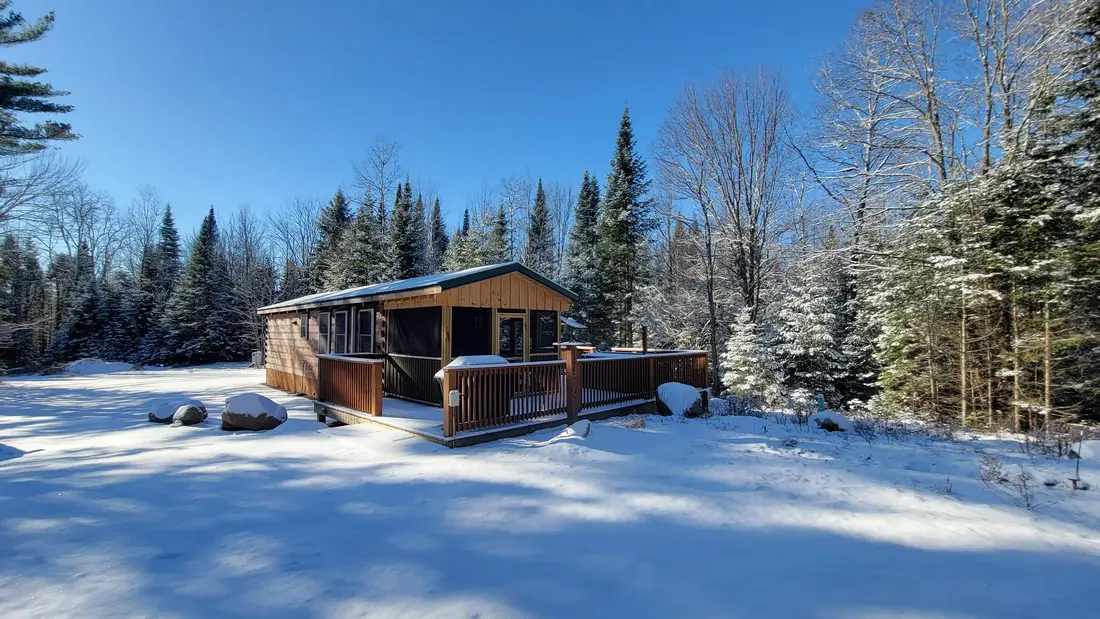
The après-ski cabin: a Jøtul gas stove between two picture windows, a large screened room on the deck, a hot tub open all year, and Titus Mountain minutes away.
 The Modern PineCabin 2 · 2 bd · 1 ba · sleeps 4
More in Plan Your Trip
Sources
50 references, listed in full at the end of this guide: official park, state, tourism-office and business sources, checked October 2026.