
The Lake Champlain Ferries
Lake Champlain's car ferries for the drive to the cabins: Plattsburgh to Grand Isle all year, Essex to Charlotte, fares, RV limits, ice and the bridges.
Lake Champlain Transportation runs two car ferries between Vermont and New York in 2026: Grand Isle to Plattsburgh around the clock all year, and Charlotte to Essex from early morning into the evening. The Plattsburgh landing at Cumberland Head is about 66 road miles from the cabins, so for guests driving in from Vermont, New Hampshire, Maine or Boston, a quarter of an hour on the water can take the place of the drive around the top of the lake. Here are both crossings, the boats, the fares, what happens in wind and ice, and the two bridges that are the other ways across.
The crossings in 2026
The company's route page lists two crossings this year. A third, between Port Kent and Burlington, ran for years as a summer boat and has not sailed since 2019; it has its own section below so nobody plans around it.
| Crossing | New York landing | Vermont landing | On the water | When it runs |
|---|---|---|---|---|
| Plattsburgh and Grand Isle | Cumberland Head, 820 Commodore Thomas Macdonough Highway | 1268 Gordons Landing, Grand Isle | about 14 to 15 minutes | 24 hours a day, every day of the year |
| Essex and Charlotte | 1 Main Street, Essex | 2901 Ferry Road, Charlotte | about 25 minutes, 3 miles | about 6 a.m. to 8:30 p.m., all year as weather permits |
| Port Kent and Burlington | Port Kent | King Street, Burlington | no service | last sailed in 2019 |
Neither running crossing takes reservations. Cars board first come, first served, and the company asks drivers to be on the dock about 15 minutes before the boat they want. Times can shift with wind, maintenance or traffic, so treat any departure below as the posted plan for the fall of 2026 and check the current timetable on the day you travel.
Plattsburgh to Grand Isle
This is the northern crossing and the one that matters most for the cabins. It runs from Cumberland Head, a point of land north of the city of Plattsburgh, to Gordon's Landing on Grand Isle, Vermont. The company built the M/V Plattsburgh for this run in 1984, and the boats posted for the two working crossings in 2026 are the Valcour, the Vermont, the Grand Isle, the Plattsburgh, the Governor Aiken, the Evans Wadhams Wolcott and the Cumberland.
How often the boats leave
On a weekday the New York side sends a boat roughly every 12 to 15 minutes from a little before 6 a.m. until just before 7 p.m. After that the gaps open to about 20 minutes, with the last evening boats at 10:45 and 11:25 p.m., and from midnight to about 5 a.m. a boat leaves every 40 minutes. Weekends start slower: from 5 a.m. the boats run about every 20 minutes until around 9 a.m., then every 12 to 15 minutes until about 7 p.m. Two early weekend departures from Plattsburgh, at 5:45 and 6:25 a.m., are marked as not running on Sundays. The Vermont side runs the mirror of the same pattern, offset by a few minutes.
Getting to each landing
On the New York side, leave the Northway at exit 39 and go straight through the light; the dock is about five miles out the point. On the Vermont side, leave I-89 at exit 17, follow US 2 west for about nine miles and turn left at the light onto VT 314 for the last three. Both docks have an ATM and a lot for people who leave the car and walk on, and a car can stay in either lot for up to 72 hours.
From the landing to the cabins
From the Cumberland Head dock it is about 66 road miles to the cabins, about an hour and a half of driving, west through the Plattsburgh area to US 11 and on through Chateaugay to Malone. The turn-by-turn version, with the last miles south of Malone, is in the getting to the cabins guide.
Essex to Charlotte
The southern crossing links the hamlet of Essex, New York, with Charlotte, Vermont, south of Burlington. The ride is about 25 minutes and covers about three miles, over the deepest part of the lake: the Lake Champlain Basin Program puts the greatest depth, about 400 feet, between Charlotte and Essex. The company lists the Grand Isle, built in 1953 and lengthened in 1995, and the Governor Aiken, built in 1975, on this run.
The posted timetable
On the timetable posted in October 2026, the first boat left Charlotte at 6 a.m. and the last at 8 p.m., 22 sailings a day: hourly until 10 a.m., every half hour from 10 a.m. to 5 p.m., then at 6, 7 and 8 p.m. From Essex the first boat left at 6:30 a.m. and the last at 8:30 p.m., 22 a day, half-hourly from 10:30 a.m. to 5:30 p.m. and hourly before and after. There is no night boat on this crossing, so a late arrival from Vermont uses Grand Isle.
Practical points at Essex
The Essex dock is at 1 Main Street, about 12 miles from the Northway by exit 31 or exit 33; follow the ferry signs. There is no commuter lot on the Essex side, so walk-on passengers park in Charlotte, where a small lot sits just before the ticket booth with the same 72-hour limit. The only ATM on this crossing is on the Essex dock. From Essex to the cabins it is about 91 road miles, north along the lake on NY 22 and up the Northway to the Plattsburgh route.
Winter on the southern crossing
Before 1998 this was a seasonal boat; since then the company has kept it running through most winters. Its own wording is that the crossing stays open all year as weather permits and can close for bad ice or high north winds in the winter months. In 2014 a captain on this run said there are no true icebreakers on the lake, and explained that the crew keeps the channel open by running back and forth through the same strip of open water, and that on some mornings the boat has to work itself free of ice in its slip. In February 2015, heavy ice stopped it until the lake cleared.
The pandemic years
The Charlotte boat stopped twice during the pandemic: at the end of the day on March 19, 2020, when traffic fell, and again from January 4, 2021, when the company closed it indefinitely. A petition started by the Essex town supervisor drew more than 2,300 signatures. The route is back on the company's schedule pages in 2026.
Port Kent and Burlington
For years the third crossing ran in summer from the company's dock at the foot of King Street in Burlington to Port Kent, New York, south of Plattsburgh. In 2015 its season opened on June 11, after the previous season had ended on September 7. The Adirondack, a boat built in 1913, worked it every summer from 1954 until the route stopped. Port Kent even had its own seasonal Amtrak stop, open in the warmer months, to meet the boat.
The last crossing ran in 2019. In 2022 the company said it had discontinued the route for "the near future," citing staffing and the money lost in the pandemic, and it moved its maintenance work from Burlington to Grand Isle. In October 2026 the route is missing from the company's list of crossings, and Amtrak's station listing shows the Adirondack made no stops at Port Kent in fiscal 2025 because the ferry was not running. Port Kent itself is about 78 road miles from the cabins. If you are coming from Burlington, the Grand Isle and Charlotte boats are your choices.
Fares and how to pay
The two crossings charge the same fares, each way. On the rates pages read in October 2026, a car under 19 feet with its driver paid $12.25, each adult passenger $5.50, a senior 65 or older $5.00, a child 6 to 12 $3.25, and children under 6 rode free. The Plattsburgh guide lists the rest of the passenger fares. A fuel surcharge may be added, the company says rates can change without notice, and neither rates page gives an effective date, so check them before you go.
Longer vehicles pay by length, driver included:
| Vehicle length | Posted fare each way, October 2026 |
|---|---|
| Under 19 feet | $12.25 |
| 19 to 23 feet | $17.50 |
| 23 to 27 feet | $19.50 |
| 27 to 36 feet | $27.00 |
| 36 to 45 feet | $35.50 |
| 45 to 54 feet | $43.00 |
| 54 to 63 feet | $52.00 |
| 63 to 72 feet | $63.00 |
| Over 72 feet | $2.00 for each added foot |
The company sets these by the total length and width of the vehicle and the deck space it takes, so a car towing a trailer or a boat pays for the whole rig. A vehicle more than eight and a half feet wide pays the regular rate times one and a half. A bus with its driver paid $35.50, plus each passenger.
Paying at the booth
Credit cards are taken at every ticket booth, and there are ATMs on both Grand Isle crossing docks and on the Essex dock. Personal checks stopped being accepted at the booths on July 15, 2018. Canadian cash is not taken, though Canadian credit cards are. A Commuter Card takes 30 percent off regular fares on either crossing (surcharges excluded); it only pays off if you cross often, and the company also sells gift cards.
RVs, trailers, motorcycles and bikes
Every boat in the posted fleet has a 40-ton weight limit and a height limit of 13 feet 6 inches. On the Charlotte crossing the ramp is 11 feet 4 inches wide at the deck and rated for 40 tons. If you drive a tall motorhome, a fifth-wheel or a van with a roof box, measure it before you count on the boat. A vehicle carrying hazardous materials under placard must fill in the company's Hazardous Material Certification form before boarding. The posted rules say nothing specific about propane cylinders, so a camper with tanks aboard is a good reason to call the company at 802-864-9804 ahead of the trip.
A motorcycle and rider paid $8.00 on the October 2026 rates, a three-wheeler $12.25 and a motorcycle trailer $4.25. There are no tie-downs: riders stay with the bike and steady it as the boat docks. A cyclist paid $6.75. A child cyclist 6 to 12 paid $4.50. Canoes, kayaks and similar gear longer than four feet go aboard as carry-ons; ask at the booth what they cost.
Dogs and passengers on board
Dogs ride the ferries. The rule is a leash on the boat and on the dock, anywhere on company property. Each boat has a covered lounge with seats, on the second deck on most of them. The cabins take dogs too, with a pet fee; the dog guide covers the trails and the rules on this side of the lake.
A few other house rules from the company: children 12 and under must travel with someone 16 or older, passengers and vehicles may be screened before boarding, and nobody should stand on the stairs while the boat is landing. Watch the raised door thresholds as you move around the decks. There are no buses or shuttles at the docks, so a walk-on passenger needs a ride waiting on the far side.
Wind, ice and winter crossings
Lake Champlain does not freeze over every year. The Basin Program gives February 12 as the average date for ice across the widest part of the lake, and notes it froze across only three winters in the 1990s. On February 13, 2026, the National Weather Service office in Burlington declared the lake closed for the first time since 2019 and the ninth time since 2000. Even then, the ice in the middle was new, thin and shifting; it is not a road.
The ice boat on the northern crossing
The Grand Isle crossing is the one that keeps going. The Cumberland, built in 2000, is a steel boat with a heavy-duty hull and propellers and extra engine power for ice; in 2015 its captain described breaking through at about 10 miles an hour, shattering the ice and letting the weight of the hull do the rest, and put shutdowns at about once or twice every three years. A boat on that run also carries a bubbler to keep ice from building up. Shutdowns are rare and short. The company counted a stop overnight on February 1 into February 2, 2022, for ice and strong wind, a brief one on January 27, 2022, two in 2019 and one in February 2016.
What to do when a boat is not running
Before you leave home in winter, sign up for the company's alerts: text LCTFerries to 855-450-0444, or use the email notices on its site. If the Grand Isle boat is stopped, keep north on I-89 or US 2 to the Rouses Point bridge. If the Charlotte boat is stopped, the Lake Champlain Bridge at Crown Point is about 25 miles south of Essex, or drive north to the Grand Isle boat, which kept sailing in February 2015 while ice held the southern boat at the dock. Snow on the New York side is covered in the winter driving guide, and the winter season page has what January at the cabins is like.
Where the ferries fit the drive to the cabins
The road route from New England goes around the north end of the lake: I-89 to Swanton, VT 78 and US 2 across to Rouses Point, and US 11 west, with no border crossing and no boat. The ferries are the shortcut. The road miles below were measured on the same router the rest of this site uses, from each city to the Vermont landing and then from the New York landing to the cabins; the boat ride itself adds about 15 minutes at Grand Isle or 25 at Charlotte, plus any wait for the next sailing.
| Starting from | No boat | Grand Isle boat | Charlotte boat | Crown Point bridge |
|---|---|---|---|---|
| Burlington, Vermont | 115 | 89 | 106 | 142 |
| Montpelier, Vermont | 152 | 126 | 141 | 166 |
| Concord, New Hampshire | 265 | 239 | 254 | 250 |
| Boston | 329 | 303 | 318 | 314 |
| Portland, Maine | 300 | 296 | 311 | 355 |
From almost anywhere east of the lake the Grand Isle boat is the shortest way, by about 26 miles from Burlington, Montpelier, Concord and Boston. The Charlotte boat saves fewer miles because the Essex landing is about 91 road miles from the cabins against 66 from Cumberland Head, and the Crown Point bridge beats the road around the top only from Concord and Boston, never the Grand Isle boat. Miles are not the whole story: the router puts the drive around the top from Burlington at about the same time as the Grand Isle route once you count the boat and the wait.
From Burlington and northern Vermont
From downtown Burlington it is about 23 road miles to Gordon's Landing and about 15 to the Charlotte dock. In daylight the Grand Isle boat saves 26 miles of driving; the drive around saves the wait. Late at night, with boats 40 minutes apart, the road route is the steadier choice, since a missed boat means a long wait on the dock. The drive from Burlington compares the routes in detail.
From central Vermont and New Hampshire
From Montpelier it is about 60 road miles to Gordon's Landing and about 50 to Charlotte, so I-89 brings you to the same choice at exit 17: the boat, or the interstate on to Swanton. From Concord, New Hampshire, the Grand Isle boat route is about 239 miles against about 265 with no boat. The Crown Point bridge route from Concord measures about 250 miles, shorter than the drive around the top, though the router has it as the slowest of the four in driving time.
From Boston and Maine
From Boston, I-93 and I-89 carry you north through New Hampshire and Vermont to Burlington's exits, and the Grand Isle boat cuts the trip from about 329 road miles to about 303; the drive from Boston has the stops along I-89. From Portland, Maine, the boat saves only about four miles over the road route, so take whichever way the clock and the weather favor that day.
The Rouses Point bridge
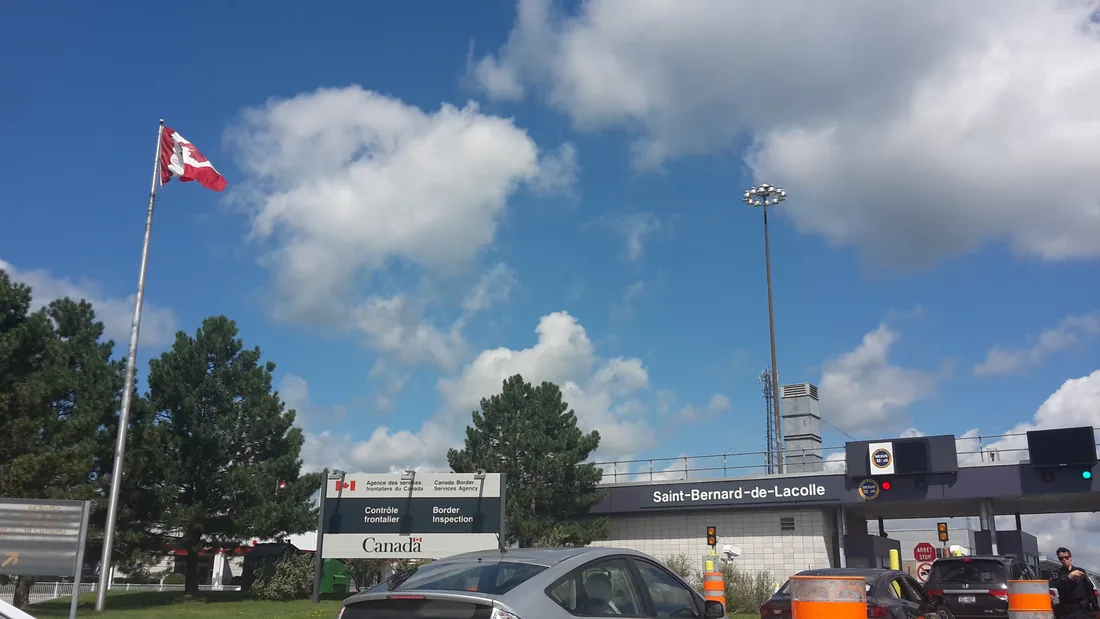
At the top of the lake, US 2 crosses from Alburgh, Vermont, to Rouses Point, New York, on the Korean War Veterans Memorial Bridge. People from both states gathered at the middle of the new span on September 22, 1987; it replaced a bridge built on the same spot in 1937. It is the only road crossing over the lake between New York and northern Vermont, and US 2 and VT 78 are the only roads that tie the Vermont islands to the rest of the state. On February 2, 2022, the same day ice and wind stopped the Grand Isle boat, a jackknifed tractor-trailer closed the Rouses Point Bridge for a time, so on a stormy winter day check both before you choose. Rouses Point is about 61 road miles from the cabins, the same distance as Plattsburgh, and from there US 11 runs west through Champlain and Chateaugay to Malone. The Champlain border crossing is close by; the border guide covers that side.
The Lake Champlain Bridge at Crown Point
Far down the lake, the Lake Champlain Bridge joins Crown Point, New York, and Chimney Point, Vermont. The first bridge here opened in 1929. Inspectors found its concrete footings failing in the summer of 2009; it was cut to one lane, closed in October 2009 and demolished on December 28, 2009. While it was out, a free ferry ran between Chimney Point and Crown Point. New York awarded the construction contract on May 27, 2010, for $69.6 million, with the two states sharing the cost; the center arch was lifted into place on August 26, 2011, and the new bridge opened to traffic at about 3:30 p.m. on November 7, 2011, with vintage cars in front to honor the people who had been at the 1929 ribbon cutting.
From the New York end it is about 105 road miles to the cabins, so for the drive north the bridge is a fallback more than a shortcut. When ice or north wind stops the Charlotte boat, this is the way across in the south.
The historic sites at each end
Both ends of the bridge are state historic sites. In New York, Crown Point State Historic Site keeps the ruins of two forts: Fort St. Frederic, built by the French from 1734 to 1737, and His Majesty's Fort of Crown Point, which the British began in 1759 and which enclosed more than seven acres. Its walking paths run on either side of the bridge. The grounds are open sunrise to sunset all year at no charge, and the museum opens Wednesday to Sunday from early May to mid-October (May 9 to October 18 in 2026), 9:30 a.m. to a last entry at 4:30 p.m., with adult admission at $5. In Vermont, Chimney Point State Historic Site opens Wednesday to Sunday, 10 a.m. to 5 p.m., from late May to Indigenous Peoples' Day (May 22 to October 12 in 2026), with adult admission at $6. Both post next season's dates on their pages in spring. Either one is a good stretch on a long drive north.
A company on the lake since 1826
Lake Champlain Transportation dates itself to 1826, the year it gives as its founding, and says its boats have worked the lake ever since. In its telling, Burlington was the country's third-largest lumber port in the late 1800s, and the ferries carried lumber and goods as well as travelers; then railroads and automobiles nearly finished off the steamboats in the early 1900s. Ray Pecor Jr. bought the company in 1976, and his son, Ray Pecor III, owns it now.
In the first half of the 1800s, some short crossings on the lake were made by horse power. The Lake Champlain Maritime Museum studied a turntable "team-boat" wreck found by sonar in Burlington Bay in the fall of 1983: 63 feet long and 23 feet wide, in about 50 feet of water, with horses walking a turntable that drove two paddle wheels. Animal-powered boats reached North America in 1814 and were most used on Lake Champlain in the 1830s and 1840s. The museum shows a working half-size model of the horse machinery.
The boats
- Adirondack, built in 1913 as the South Jacksonville for a Florida ferry company, bought in 1954. The company calls her the oldest double-ended American ferryboat still in service.
- Champlain, built in 1930 as the City of Hampton and bought from the Virginia Department of Highways' fleet in November 1957.
- Valcour, built in 1947 by the old Champlain Transportation Company and repowered in 1990.
- Grand Isle, built for the company in 1953 and lengthened in 1995 in Panama City, Florida.
- Governor Aiken, 1975, Plattsburgh, 1984, Evans Wadhams Wolcott, 1988, the company's first boat built to be taken apart, Vermont, 1992, Cumberland, 2000, and Raymond C. Pecor, Jr., 2010, all built to the company's specifications.
The Evans Wadhams Wolcott is named for three of the company's earlier owners, Lewis P. Evans, Richard Wadhams and James G. Wolcott.
The lake you cross
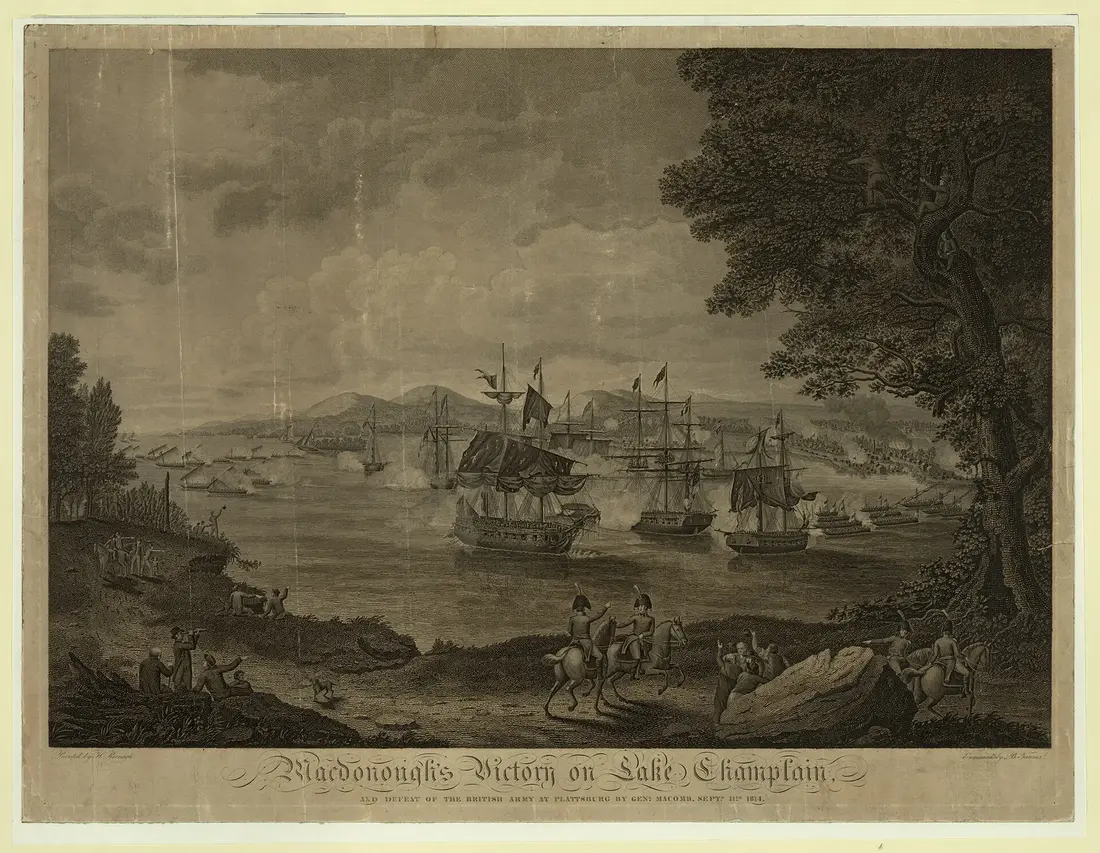
The Basin Program measures Lake Champlain at 120 miles from Whitehall, New York, almost to the Canadian border, 12 miles across at its widest, with an average depth of 64 feet, more than 70 islands and 587 miles of shoreline. It drains north, out through the Richelieu River in Quebec to the St. Lawrence. On the Grand Isle boat you are crossing toward the islands at the north end; on the Charlotte boat you are over the deepest water in the lake. For the New York shore itself, the beaches, the 1814 battle and the town, see the Plattsburgh and Lake Champlain guide.
Timing the crossing on arrival day
For a Friday-evening arrival from the Vermont side, the Grand Isle boat runs every 20 minutes or so through the evening and every 40 minutes overnight, so there is no last boat to race. On the Charlotte crossing the last sailing to New York in the fall 2026 timetable was 8 p.m., and with about 25 minutes on the water and roughly two hours of driving from Essex, that boat puts you at the cabins around 10:30 p.m. A Friday plan that works: aim for Gordon's Landing between 4 and 6 p.m., when boats leave every 12 to 15 minutes, and shop in Plattsburgh or Malone on the way west. The groceries and supplies page lists the stores in Malone, and the cabins page has the three cabins side by side.
On the way home, the same boats work in reverse. From the cabins to the Cumberland Head dock is about an hour and a half; boats board first come, first served, so leave a cushion on a busy weekend, and remember the two early Sunday sailings from Plattsburgh that do not run.
Questions
Which Lake Champlain ferry is closest to the cabins?
The Plattsburgh to Grand Isle ferry. Its New York landing at Cumberland Head is about 66 road miles from the cabins, about an hour and a half of driving, and the boats run 24 hours a day all year. The getting to the cabins guide has the turns from the dock.
Is the Burlington to Port Kent ferry running in 2026?
No. The summer crossing between Burlington and Port Kent last ran in 2019, and in October 2026 it is not on the ferry company's list of crossings. From Burlington, use the Grand Isle boat to Plattsburgh or the Charlotte boat to Essex.
Do I need a reservation for the ferry?
No. Neither crossing takes vehicle reservations; cars board first come, first served. The company asks drivers to be on the dock about 15 minutes before the boat they want, and on a busy weekend you may wait for the next sailing.
How much does the ferry cost?
On the rates posted in October 2026, a car under 19 feet with its driver paid $12.25 each way and each adult passenger $5.50, with a possible fuel surcharge. Longer vehicles pay by length. Fares change without notice, so check the ferry company's rates page before you go.
Can I take my dog on the Lake Champlain ferry?
Yes. Dogs ride both crossings on a leash, on the boat and anywhere on the docks. The cabins take dogs too, with a pet fee; see the dog guide.
Does the ferry run when the lake freezes?
The Plattsburgh to Grand Isle boat keeps a channel open through the ice and shuts down only rarely, for a night or a day. The Charlotte to Essex boat can stop for bad ice or strong north wind in winter. Sign up for the company's text alerts, and if a boat is stopped, use the Rouses Point bridge in the north or the Crown Point bridge in the south.
Can an RV or a trailer take the ferry?
Yes, within the boats' limits: 40 tons and 13 feet 6 inches high, with the fare set by total length and extra for anything wider than eight and a half feet. Placarded hazardous loads need a certification form; call the company about propane before you go.
Sources
Facts on this page were checked against these sources in October 2026. Hours, fees and schedules change; confirm before you go.
- ferries.com ferries.com/vt-ny-ferry-routes/
- ferries.com ferries.com/vt-ny-ferry-routes/grand-isle-vt-to-plattsburgh-ny/schedul
- ferries.com ferries.com/vt-ny-ferry-routes/grand-isle-vt-to-plattsburgh-ny/rates-r
- ferries.com ferries.com/vt-ny-ferry-routes/grand-isle-vt-to-plattsburgh-ny/directi
- ferries.com ferries.com/vt-ny-ferry-routes/charlotte-vt-essex-ny/current-ferry-sch
- ferries.com ferries.com/vt-ny-ferry-routes/charlotte-vt-essex-ny/rates-restriction
- ferries.com ferries.com/vt-ny-ferry-routes/charlotte-vt-essex-ny/directions-parkin
- ferries.com ferries.com/general-info/ferry-policies/
- ferries.com ferries.com/general-info/faqs/
- ferries.com ferries.com/general-info/
- ferries.com ferries.com/about/history/
- wcax.com wcax.com/2022/06/07/burlington-ferry-service-unlikely-return-near-futu
- greatamericanstations.com greatamericanstations.com/stations/PRK
- wamc.org wamc.org/north-country-news/2015-02-21/lake-ice-stops-ferry-service
- sevendaysvt.com sevendaysvt.com/news/ferry-service-between-charlotte-and-essex-ny-to-b
- vtdigger.org vtdigger.org/2020/12/21/shutdown-of-charlotte-essex-ferry-raises-outcr
- vermontpublic.org vermontpublic.org/vpr-news/2015-02-25/icebreaker-when-the-lake-is-froz
- sevendaysvt.com sevendaysvt.com/news/carving-the-commute-crossing-lake-champlain-in-wi
- vtdigger.org vtdigger.org/2022/02/02/ice-strong-winds-snarl-transportation-on-champ
- wcax.com wcax.com/2025/09/22/this-day-history-september-22-1987/
- vermontbiz.com vermontbiz.com/node/190326
- New York State Parks parks.ny.gov/historic-sites/crownpoint/
- historicsites.vermont.gov historicsites.vermont.gov/node/90
- lcbp.org lcbp.org/?p=43
- wcax.com wcax.com/2026/02/13/lake-champlain-officially-freezes-over-first-time-
- lcmm.org lcmm.org/archaeology/vermont-underwater-historic-preserves/horse-ferry
In this guide
Stay nearby
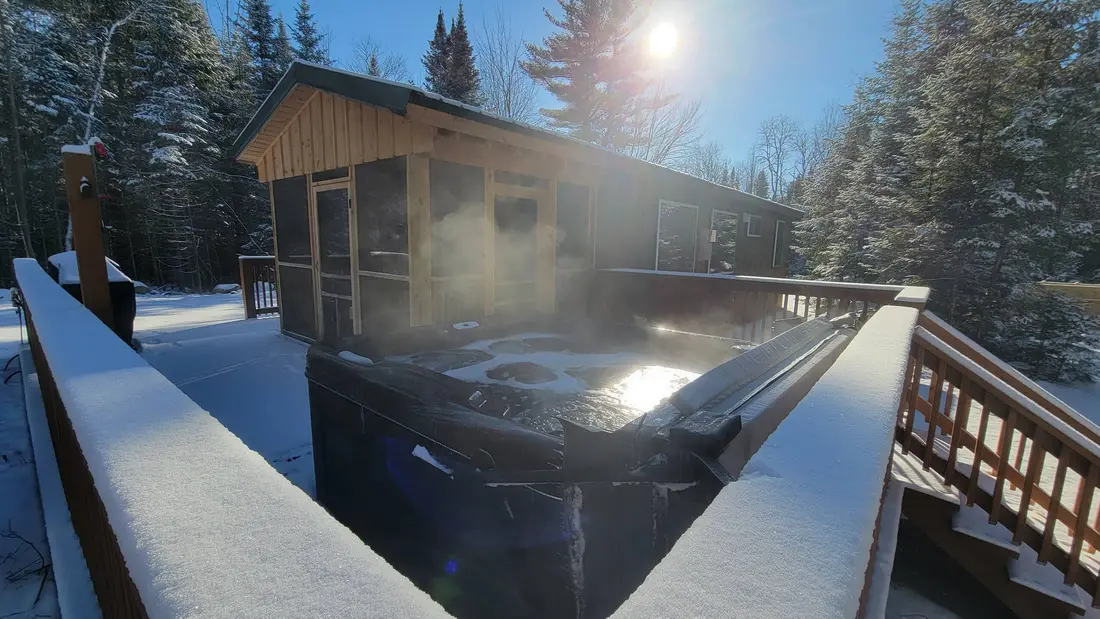
The aviation cabin: flight-themed décor, a Jøtul gas stove, a large open deck with its own hot tub, and a smokeless fire pit on the lawn.
 The AviatorCabin 3 · 2 bd · 1 ba · sleeps 4
More in Plan Your Trip
Sources
26 references, listed in full at the end of this guide: official park, state, tourism-office and business sources, checked October 2026.
Related guides


Photos on this page: 20170809-Saint-Bernard-de-Lacolle US-Canada (NY-Quebec) border crossing by Aude, CC BY-SA 4.0. Resized and cropped for this site. All photo credits