
Maple Syrup and Sugarhouses
How maple syrup is made, what the grades mean, sugarhouses from Malone to Lake Placid and West Chazy, the 2027 Maple Weekends and where to buy syrup.
Sugaring season in the northern Adirondacks runs from late winter into spring, and it happens all around the cabins. Titus Mountain's own sugarhouse, Moon Valley Maple, is about three and a half road miles away, and two Malone sugarhouses that opened for New York's 2026 Maple Weekends are about 9 and 12 road miles away. This guide covers how sap becomes syrup, what the grades on a label mean, the sugarhouses from Malone to Lake Placid and the Champlain Valley that welcome visitors, and where to buy a jug of syrup on the way back to the cabins.
How sap becomes syrup
In New York, maple syrup has a legal definition: syrup made only by evaporating pure sap, or sweet water, drawn by tapping a maple tree. Nothing is added, and there are no preservatives. The sap that drips from a tap hole is mostly water, about 2 percent sugar, and it has to be boiled down to about 66 percent sugar before it counts as syrup. State rules set the finished range at 66.0 to 68.9 percent soluble solids. Syrup that is too thin can spoil and grow mold, and syrup above 67 percent tends to form sugar crystals in the jug.
How much sap it takes depends on how sweet the sap is. Sugarmakers use the rule of 86: divide 86 by the sap's sugar percentage. Sap at 2 percent needs about 43 gallons for one gallon of syrup, sap at 2.5 percent about 34 gallons, and sap at 3 percent about 29. Cornell's maple program works on a rule of thumb of 40 gallons of sap to a gallon of maple syrup, and over three recent seasons its own maple averaged 37.
Boiling also makes the flavor. As the sap cooks down, a small share of the sugar caramelizes, and that gives syrup its robust taste; research has found that the maple flavor develops only with heat. Finished syrup boils at about 219°F, roughly 7.5 degrees above the boiling point of water, and that temperature tells the sugarmaker when to draw it off.
Tapping the trees
Tapping means drilling a small hole into the trunk of a maple each spring and setting a spout in it. Extension guidelines keep the practice easy on the trees: tap only trees at least 12 inches across, put one tap in a tree 12 to 18 inches across and no more than two in a larger one, use the small 5/16-inch or 19/64-inch spouts sugarmakers call health spouts, and drill no deeper than an inch and a half for those spouts.
A bucket hung on a spout is the oldest and simplest way to gather sap. It needs few materials, the buckets come down at the end of the season, and every one has to be emptied often while the sap runs. Larger farms run plastic tubing from tree to tree, so the sap flows to a single collection tank by gravity or with a vacuum pump, and vacuum can raise the yield. A common rule keeps no more than 30 trees on one 3/16-inch line before it feeds into a larger main line, and the collection tank goes at the lowest point of the woods. On Maple Weekend, New York's farms show both methods, the traditional hanging buckets and modern vacuum systems.
Sugaring works at any scale, from a few trees to thousands of acres. Paul Smith's College runs more than 2,000 taps in its own sugarbush. Cornell's research forest in Lake Placid runs 6,000 sugar maple taps and 600 birch taps on vacuum tubing. Trombley's Sugarhouse in Ellenburg Center has 8,000 taps, Moon Valley Maple at Titus reports 14,000, and Parker Family Maple Farm in West Chazy runs about 100,000.
Sugaring weather
Sap runs on a swing of temperature. During overnight freezes and daytime thaws, maple trees build positive pressure in their stems, and on days when that pressure is up, sap drips slowly out of the tap hole. The pattern sugarmakers wait for is a night in the 20s followed by a day in the 40s. Each spell of that weather brings a run of sap, and a season usually has eight to ten runs.
Malone's long-term normals for March are a high of 36°F and a low of 16°F; for April they are 51°F and 32°F. At Cornell's forest in Lake Placid, the 2019 maple season ran 35 days, and each tap gave an average of 12.5 gallons of sap.
The weather shows up in the color, too. Early in the season the sap is clear, and the syrup comes out light and delicate. As the weeks go by, the syrup turns darker and stronger, and once the buds open the flavor turns too strong to be good; the spring guide covers that turn and how the season has been moving earlier.
Inside the sugarhouse
Reverse osmosis takes much of the water out before any boiling starts. The machine pushes sap at high pressure through membranes that let water pass and hold the sugar back, and it cuts processing time and energy by 75 percent or more. Most commercial producers run their sap through it before the evaporator. Sap concentrated from 2 to 4 percent sugar this way needs about 21 gallons per gallon of syrup instead of about 43.
The concentrate then goes to the evaporator, a specialized pan over a fire. In a divided pan, dividers let the sap thicken as it moves toward the outlet, so new sap flows in at one end while finished syrup is drawn off at the other. Sugarhouses near the cabins fire them in different ways: Split Ridge Maple in Malone runs two, a vintage wood-fired evaporator and a newer oil-fired one, and Chazy Lake Maple and Heaven Hill Farm boil over wood fires.
Just before it is finished, the syrup is filtered to take out the fine particles sugarmakers call sugar sand; small producers use cheesecloth or coffee filters, and larger farms use vacuum filter presses. A visit is best on a day the sap is running, when the evaporator is boiling. On Maple Weekend several farms list boiling as weather permitting, and in 2026 The Wild Center told visitors to stop at its mobile sugar shack whenever smoke was rising from the stack.
Grades and color classes
Since March 2, 2015, the U.S. grade standards have had one grade for syrup sold at retail, Grade A, with four color classes, each paired with a taste. The class depends on how much light passes through the syrup, measured with a spectrophotometer. The change came from a petition by the International Maple Syrup Institute, which represents maple producers in the United States and Canada and wanted one set of grades on both sides of the border. New York uses the same four classes.
| Grade A class | Taste | Light transmittance |
|---|---|---|
| Golden | Delicate | 75.0 percent or more |
| Amber | Rich | 50.0 to 74.9 percent |
| Dark | Robust | 25.0 to 49.9 percent |
| Very Dark | Strong | Under 25.0 percent |
Under the old U.S. standards, the darkest syrup was labeled Grade B for Reprocessing and was not meant for retail sale, even as more people wanted it for cooking and for the table. Since 2015, that syrup is Grade A when it has no off-flavors, so it can be packed in retail containers under 5 gallons. Syrup that misses Grade A is Processing Grade, packed in containers of 5 gallons or more for commercial use, such as making other foods. New York does not allow it to be sold in retail food stores or directly to households.
Grade A syrup has to be clear and free of sediment, with no off-flavors such as woody, buddy, fermented, burnt or chemical notes, and its maple taste has to be as strong as its color class suggests. Golden is mild and subtle, sometimes described as nutty or buttery. Amber is full-bodied, Dark has a pronounced maple taste, and Very Dark is the strongest of the four.
Buying and storing syrup
A New York label on Grade A syrup has to show the color and taste class on the front panel, close to the words "maple syrup." Flavored syrups, such as bourbon barrel aged or cinnamon infused, must name the flavor in the product name, list their ingredients and leave the grade off the front. A farm that bottles only its own syrup, with nothing added, does not need a state food processing license, and it still has to meet the sanitation and labeling rules.
Two marks are worth knowing. NYS Grown and Certified covers nearly 100 maple producers who meet the program's food safety and environmental standards. Audubon's Bird-Friendly Maple program recognizes sugarbushes managed for birds: young trees and shrubs kept for warblers and thrushes, standing dead trees left for woodpeckers and nuthatches, and fallen trees left on the forest floor for birds such as the Ovenbird and Ruffed Grouse. Look for the Scarlet Tanager seal on the container.
Once a bottle is open, keep it in the refrigerator, where it will keep for months; frozen, it keeps for several years. If mold appears on syrup that was left out, bring it to a boil, take it off the heat right away, rinse the container and pour the syrup back in, without boiling it long, which turns it cloudy. Sugar crystals at the bottom of a jug do not change the flavor.
Sugarhouses near the cabins
The closest on the state maple association's map is at Titus. Moon Valley Maple started on the mountain's slopes in the 2012-13 ski season, and the Titus Mountain guide tells its story; the sugarhouse is at 215 Johnson Road, about three and a half road miles from the cabins. At Mountain Madness, the mountain's spring party, on Saturday, March 14, 2026, the sugar shack opened for free tours with samples from 11 a.m. to 1 p.m.; the events calendar has the next date.
Split Ridge Maple, 138 Porter Road in Malone, is about 9 road miles from the cabins, roughly 20 minutes. In 2026 it was open all four Maple Weekend days, from 9 a.m. to 4 p.m., with tours of the sugarhouse and its two evaporators and plenty of samples.
StMaple, 962 Limekiln Road in Malone, is about 12 road miles away, roughly 25 minutes. On the 2026 Maple Weekends it brought in food trucks and served maple ice cream, maple mini donuts and mini donut sundaes, with boiling demonstrations and its classic and newer maple products for sale.
Shamrock Maple, 907 Lake Ozonia Road, has a St. Regis Falls address but sits over the county line in the town of Hopkinton, St. Lawrence County, about 38 road miles west-southwest of the cabins, a little over an hour. It describes itself as an off-grid maple farm in the foothills of the Adirondacks. On the 2026 Maple Weekends it was open from 8 a.m. to 4 p.m. on all four days, with a pancake breakfast from 9 a.m. to 1 p.m., its organic maple products for sale, plenty of parking, easy accessible entry and an accessible bathroom.
The state maple producers' association lists more sellers around Malone, Burke, Chateaugay, North Bangor, Dickinson Center, St. Regis Falls and Saranac Lake on its Buy Maple map. The map gives names and addresses but no hours, and none of those farms was on the 2026 Maple Weekend list, so call ahead before you drive over.
Paul Smith's College and The Wild Center
Paul Smith's College teaches sugaring. Students tap the college's own sugarbush, more than 2,000 taps, in its maple class, and the college offers a minor in maple production and products that covers making syrup, managing a sugarbush and marketing. For Maple Weekend the college has opened its sugarbush at 322 White Pine Road, about 2.5 miles down White Pine Road, just past the bridge over the Jones Pond outlet stream. In 2026 it opened on the two Saturdays, March 21 and 28, from 9 a.m. to 1 p.m., with horse-drawn wagon rides from the parking area into the sugarbush, student-led tours of the sugarbush and sugarhouse, a tapping demonstration and a sugar-on-snow party. It is about 33 road miles from the cabins, under an hour, and the Saranac Lake and Paul Smiths guide has the rest of the area.
The Wild Center in Tupper Lake, about 57 road miles away, makes its own syrup, Tupper Tapper Maple Syrup, and fills March with maple programs. In 2026 it ran drop-in sugaring sessions on Saturdays and Sundays in March from 1 to 2 p.m., kept its mobile sugar shack going on the Maple Weekends, and held a Maple Pancake Brunch with pancake art on the first Maple Weekend Saturday. The programs came with admission. The Waterside Café served pancake breakfasts with the center's syrup at extra cost, and you did not need admission to eat there. Residents within five miles could join its Community Maple Program, tapping their own yard trees and getting 70 percent of the syrup back. The Wild Center guide covers the rest of a visit.
Cornell's Uihlein Maple Research Forest
Cornell University's maple research station is on Bear Cub Lane in Lake Placid, about 54 road miles from the cabins, roughly an hour and a quarter. The forest was established in 1965 with support from Mr. and Mrs. Henry Uihlein II of Lake Placid, and Cornell's Department of Natural Resources runs it as a sister site to its Arnot Forest. Its 200-plus acres hold 6,000 sugar maple taps and 600 birch taps on vacuum tubing, with modern processing equipment, and Cornell uses it to demonstrate modern syrup production.
Tours are available all year. The best time to see syrup being made and research under way is late February to late April, and because sugaring depends on the weather, production tours do not run every day, so call ahead at 518-523-9337. The station sells its syrup from a store and a self-serve box at 157 Bear Cub Lane, and the sales support Cornell's maple and agroforestry research and teaching. In October 2026 its price list ran from a half pint at $11 to a gallon at $75, with birch syrup, ground maple coffee and maple tea besides; prices can change, and shipped orders have a $50 minimum.
On the 2026 Maple Weekends the forest ran hands-on activities and tours of its sugaring and research, with free tastings and sugar on snow, and Cornell's maple staff answered questions about sugaring on a small scale. In 2022 Audubon New York named it one of the first six Bird-Friendly Maple producers in the state.
Birch syrup is the forest's second crop. Birch sap is far thinner than maple, averaging 0.86 percent sugar in Cornell's records, so a gallon of birch syrup takes about 104 gallons of sap. Birch sap rises on root pressure once temperatures hold at 50°F or more, so the forest taps its birches in mid-April and makes syrup into the first week of May, just as maple ends. The syrup is darker than maple, with fruity, tart and caramel flavors that recall raspberries, tart cherry juice, apple butter and molasses, and none of the wintergreen of birch beer, which comes from the bark.
Also on Bear Cub Lane, at number 302, Heaven Hill Farm, named by the Uihlein family, runs its own wood-fired sugarhouse. In 2026 it opened all four Maple Weekend days with tours of its bird-friendly sugaring operation, maple coffee and treats, and a chance to try tapping a tree. The two make one morning, and the Lake Placid day trip fills the afternoon.
Sugarhouses in Clinton County
East of the cabins, the association's Buy Maple map lists more than 20 maple sellers in Clinton County, nine of them in West Chazy alone and five around Mooers Forks. These five farms opened for the 2026 Maple Weekends.
Brandy Brook Maple Farm and Olde Tyme Winery, 439 Brandy Brook Road in Ellenburg Center, is about 32 road miles and 50 minutes from the cabins. The family has grown it since 2007 to five sugarbushes in two counties, making syrup, maple cream and maple sugar. In 2015 the family started a winery, and its red, white and fruit wines, in sweet, semi and dry styles, are made with real fruit and the farm's own syrup; it bills itself as New York's only maple winery. Farm tours and tastings are free, with wine for guests 21 and up. On the 2026 weekends it poured free tastings all four days and set out samples that included bourbon barrel-aged syrup. Its syrup is also on the shelf at the farm store near the cabins described below.
Trombley's Sugarhouse, 7180 Star Road, also in Ellenburg Center and about 35 road miles away, runs 8,000 taps. On the 2026 Maple Weekends it served an all-you-can-eat pancake breakfast from 8 a.m. to 1 p.m. and gave tours of the process from start to finish.
Chazy Lake Maple, on Wilfred King Road near Ellenburg Depot, about 50 road miles away, boils on a wood-fired evaporator, and on Maple Weekend visitors may bring snowshoes and walk the sugarbush.
Parker Family Maple Farm, 1043 Slosson Road in West Chazy, about 54 road miles and an hour and a quarter away, is the largest maple operation in New York and one of the largest in the country. It began in 1889 as a 60-acre dairy and sugaring farm, and four generations later it covers more than 1,000 acres, runs about 100,000 taps and makes more than 50,000 gallons of syrup a year. In 2026 it hosted the state's annual maple tree tapping. In March 2026 its pancake house served a breakfast buffet every weekend from 8 a.m. to 1 p.m.: buttermilk pancakes with the farm's syrup, sausage, bacon, eggs, home fries, biscuits with sausage gravy and maple cinnamon rolls, with gluten-free pancakes on request. Adults paid $16, cash only, with an ATM on site and no reservations. On the 2026 Maple Weekends there were wagon rides and tours, the sugarhouse sold maple cotton candy, soft serve, milkshakes and donuts on those weekends only, and the sugarhouse shop sold syrup, maple cream, candy and other maple products.
Bechard's Sugar House, 61 Sanger Lane in West Chazy, about 59 road miles away, opened a week before the state weekends in 2026, on March 14 and 15, and then for all four Maple Weekend days. Its 2026 breakfast, served from 8 a.m. to 2 p.m., was pancakes with sausage, ham, eggs, home fries and baked beans, and the sugarhouse poured free maple coffee and handed out samples such as maple-glazed walnuts and maple syrup cake. The Plattsburgh and Lake Champlain guide has the rest of a Champlain Valley day.
New York's Maple Weekends
For two weekends each March, sugarhouses across the state open their doors. The New York State Maple Producers' Association runs the event, with funding from its members and the state Department of Agriculture and Markets. It began in 1995 as a single day, Maple Sunday, and now spans four days on two weekends. In 2026, 160 farms took part, and each offered a presentation or a demonstration.
The 2027 weekends fall on Saturday and Sunday, March 13 and 14, and again on March 20 and 21. Farms open from 10 a.m. to 4 p.m. on those days, though many set their own hours, as the farms above show. Tours and samples are free at most farms, museums are the exception, and pancake breakfasts may be priced by the plate.
Each farm sets its own program, so plan with the producer map on the Maple Weekend website, where you enter a town or postal code to see who is open nearby. In early October 2026 the map still showed the 2026 farms, so look again in late winter for the 2027 list. The organizers recommend layers, closed-toe or insulated footwear and wool socks, because many farms are rustic, most are muddy and March weather is hard to predict. Malone averages about 15 inches of snow in March, and the winter driving guide covers the roads. The events calendar has the rest of March.
Where to buy syrup near the cabins
Cooks' Country Store, the farm store at The Cook Farm, 189 Ragged Lake Road in Owls Head, is about four road miles from the cabins. It runs on a self-checkout kiosk and stays open 24 hours a day, seven days a week, and Brandy Brook Maple Farm's syrup is among the local products it stocks. The groceries and supplies page covers the store and Malone's supermarkets.
At the sugarhouses, Maple Weekend is the easiest time to buy, since the farms are open. StMaple and Shamrock Maple had their products for sale on the 2026 weekends, and Parker's sugarhouse shop in West Chazy sold syrup, maple cream and candy. Moon Valley Maple at Titus, Split Ridge, StMaple and Shamrock are all on the association's map of maple retailers; call about hours outside the season before you go. In Lake Placid, Cornell's store and self-serve box sell the forest's syrup, and the station ships orders of $50 or more.
Maple foods to try
- Maple cream. Syrup boiled to about 24°F above the boiling point of water, cooled in cold water without stirring, then stirred slowly until it loses its gloss. It sets about as thick as peanut butter. Brandy Brook and Parker's both sell it.
- Maple sugar candy. Syrup boiled to about 32°F above the boiling point of water, cooled for three to five minutes and stirred until it turns opaque.
- Maple sugar. Brandy Brook makes maple sugar along with its syrup and maple cream.
- Maple cotton candy, soft serve and donuts. Parker's sold them in its sugarhouse only on the 2026 Maple Weekends, and StMaple served maple ice cream and maple mini donuts.
- Maple coffee. Bechard's poured it free and Heaven Hill served it on the 2026 Maple Weekends, and Cornell's Lake Placid store sells ground maple coffee.
- Maple wine and bourbon barrel-aged syrup. Both come from Brandy Brook in Ellenburg Center.
- Birch syrup. Cornell's Lake Placid forest sells it in small glass bottles, darker and fruitier than maple.
- Sugarhouse breakfasts. Parker's, Trombley's, Bechard's and Shamrock served pancakes on the 2026 Maple Weekends, and The Wild Center's café served pancakes with its own syrup.
Sugar on snow, syrup heated well past boiling and poured over packed snow until it sets chewy, has been a spring treat at sugarhouses for more than 200 years. Paul Smith's College and the Cornell forest served it on the 2026 Maple Weekends, and if a late snow falls while you are at the cabins, the après-ski post has the method for making it in the kitchen.
New York maple in numbers
New York is the second-largest maple state after Vermont, and it has the largest resource of tappable maple trees in the country. More than 2,000 sugarmakers work here, and the state has more family farms making syrup than any other. Since 2024, a state law has allowed state land to be leased for sap production.
| Season | Taps | Syrup per tap | Syrup made |
|---|---|---|---|
| New York, 2025 | 2.7 million | 0.307 gallons | 829,000 gallons |
| New York, 2026 | 2.6 million | 0.340 gallons | 884,000 gallons |
| Vermont, 2026 | 8.2 million | 0.377 gallons | 3.09 million gallons |
| United States, 2026 | 16.5 million | 0.357 gallons | 5.88 million gallons |
The state's crop has grown over the past decade; in 2016 New York producers made more than 700,000 gallons. Parker Family Maple Farm alone makes more than 50,000 gallons a year, more than 5 percent of the state's 2026 crop.
A maple weekend at the cabins
Here is one way to spend the first 2027 Maple Weekend, March 13 and 14, from the cabins. The farm days and hours below are from 2026, so check the producer map for the 2027 schedule before you set out.
Saturday morning. Drive about 33 road miles to Paul Smith's College for the wagon ride into the sugarbush, the student tours and sugar on snow; in 2026 the college opened only on the Saturdays, from 9 a.m. to 1 p.m. Back near Malone, stop at Split Ridge Maple, open until 4 p.m. on the 2026 weekends, to see its two evaporators.
Saturday evening. Every cabin has a full kitchen, a grill and a private hot tub. Soak off the mud, cook dinner on the grill and set out the new syrup for the morning.
Sunday. Have breakfast at Trombley's in Ellenburg Center, served from 8 a.m. to 1 p.m. in 2026, then drive to Brandy Brook Maple Farm, also in Ellenburg Center, for the sugarhouse and the winery. Bring a driver who is not drinking for the tasting. If anyone still wants maple ice cream, StMaple on Limekiln Road is about 12 road miles from the cabins.
On the second weekend, March 20 and 21, a Lake Placid day pairs the Cornell forest and Heaven Hill Farm on Bear Cub Lane, and a Champlain Valley day pairs Parker's and Bechard's in West Chazy. Either way you are back at the cabins for the hot tub. The winter guide has more for a late-winter stay, and the cabins page compares the three.
Questions
When are New York's Maple Weekends in 2027?
The 2027 Maple Weekends are March 13 and 14 and March 20 and 21. Farms open from 10 a.m. to 4 p.m. unless they set their own hours, and tours and samples are free at most of them; pancake breakfasts may cost extra. Look at the producer map on the Maple Weekend website in late winter to see which farms near Malone are taking part, and see the events calendar for the rest of March.
Which sugarhouse is closest to the cabins?
Moon Valley Maple, Titus Mountain's sugarhouse at 215 Johnson Road, about three and a half road miles away, is the closest on the state maple association's map. Split Ridge Maple on Porter Road in Malone, about 9 road miles, and StMaple on Limekiln Road, about 12, both opened for the 2026 Maple Weekends. For syrup at any hour, Cooks' Country Store in Owls Head, about four road miles away, is open around the clock and stocks Brandy Brook Maple Farm syrup.
Can we tour a sugarhouse outside Maple Weekend?
Yes, at Cornell's Uihlein Maple Research Forest in Lake Placid, about 54 road miles away. Tours are available all year, and late February to late April is the best time to see syrup being made. Production tours do not run every day, so call 518-523-9337 first. Its store and self-serve box at 157 Bear Cub Lane sell the forest's syrup. For other farms, check with each one before you go.
What do the maple syrup grades mean?
In New York, all maple syrup sold in stores is Grade A, in four color classes: Golden with a delicate taste, Amber with a rich taste, Dark with a robust taste and Very Dark with a strong taste. The class comes from how much light passes through the syrup. Syrup from early in the season tends to be lighter and late-season syrup darker. Very dark syrup that was once labeled Grade B is now Grade A when it has no off-flavors.
How much sap does it take to make a gallon of maple syrup?
It depends on the sugar in the sap. Divide 86 by the sugar percentage: sap at 2 percent needs about 43 gallons, sap at 3 percent about 29. Cornell uses 40 gallons as a rule of thumb, and its own maple averaged 37 gallons per gallon of syrup over three recent seasons. Birch sap is much thinner and takes about 104 gallons.
Where can we eat a pancake breakfast at a sugarhouse?
On the 2026 Maple Weekends, Trombley's Sugarhouse in Ellenburg Center served an all-you-can-eat breakfast from 8 a.m. to 1 p.m., Bechard's in West Chazy from 8 a.m. to 2 p.m., and Shamrock Maple from 9 a.m. to 1 p.m. Parker Family Maple Farm in West Chazy ran its pancake house every weekend in March 2026, cash only. That March The Wild Center's café in Tupper Lake also served pancakes with its own syrup.
What should we wear to a sugarhouse in March?
Dress in layers and wear closed-toe or insulated boots with wool socks, because many farms are rustic, most are muddy and March weather changes fast. Malone's March normals are a high of 36°F and a low of 16°F. The winter driving guide covers the roads, and the hot tub at the cabin is there when you get back.
Sources
Facts on this page were checked against these sources in October 2026. Hours, fees and schedules change; confirm before you go.
- mapleweekend.com mapleweekend.com/
- mapleweekend.com mapleweekend.com/producers/
- agriculture.ny.gov agriculture.ny.gov/node/35831
- governor.ny.gov governor.ny.gov/news/kick-maple-month-governor-hochul-highlights-new-y
- blogs.cornell.edu blogs.cornell.edu/cornellmaple/aboutmaplesyrup
- blogs.cornell.edu blogs.cornell.edu/cornellmaple/uihlein-research-forest
- blogs.cornell.edu blogs.cornell.edu/cornellmaple/uihlein-maple-product-sales
- blogs.cornell.edu blogs.cornell.edu/cornellmaple/about-birch-syrup
- blogs.cornell.edu blogs.cornell.edu/cornellmaple/about-cornell-maple-program
- govinfo.gov govinfo.gov/content/pkg/FR-2015-01-29/pdf/2015-01618.pdf
- agriculture.ny.gov agriculture.ny.gov/system/files/documents/2025/03/mapleconferenceprese
- esmis.nal.usda.gov esmis.nal.usda.gov/sites/default/release-files/795936/crop0626.txt
- cfaes.osu.edu cfaes.osu.edu/fact-sheet/consumers-guide-pure-maple-syrup
- extension.unh.edu extension.unh.edu/resource/maple-sugaring-tips-beginners-and-backyard-
- extension.usu.edu extension.usu.edu/forestry/publications/utah-forest-facts/044-maple-sa
- Titus Mountain titusmountain.com/moon-valley-maple
- Titus Mountain titusmountain.com/mountain-madness
- Paul Smith's College paulsmiths.edu/about/fun-facts/
- Paul Smith's College paulsmiths.edu/academics/programs/undergraduate-minors/
- The Wild Center wildcenter.org/press/2026-maple-season/
- audubon.org audubon.org/new-york/news/new-yorks-first-maple-producers-receive-bird
- audubon.org audubon.org/new-york/projects/bird-friendly-maple-new-york
- Lake Placid tourism (ROOST) lakeplacid.com/story/2012/03/its-sugaring-time-adirondack-maple-produc
- goadirondack.com goadirondack.com/entries/brandy-brook-maple-farm
- goadirondack.com goadirondack.com/event/pancake-breakfast-at-the-maple-farm
- nysmaple.com nysmaple.com/producers/
- cookfarmny.com cookfarmny.com/visit
- massmaple.org massmaple.org/about-maple-syrup/make-maple-syrup/making-candy-and-crea
- massmaple.org massmaple.org/about-maple-syrup/make-maple-syrup/sugar-on-snow/
In this guide
Stay nearby
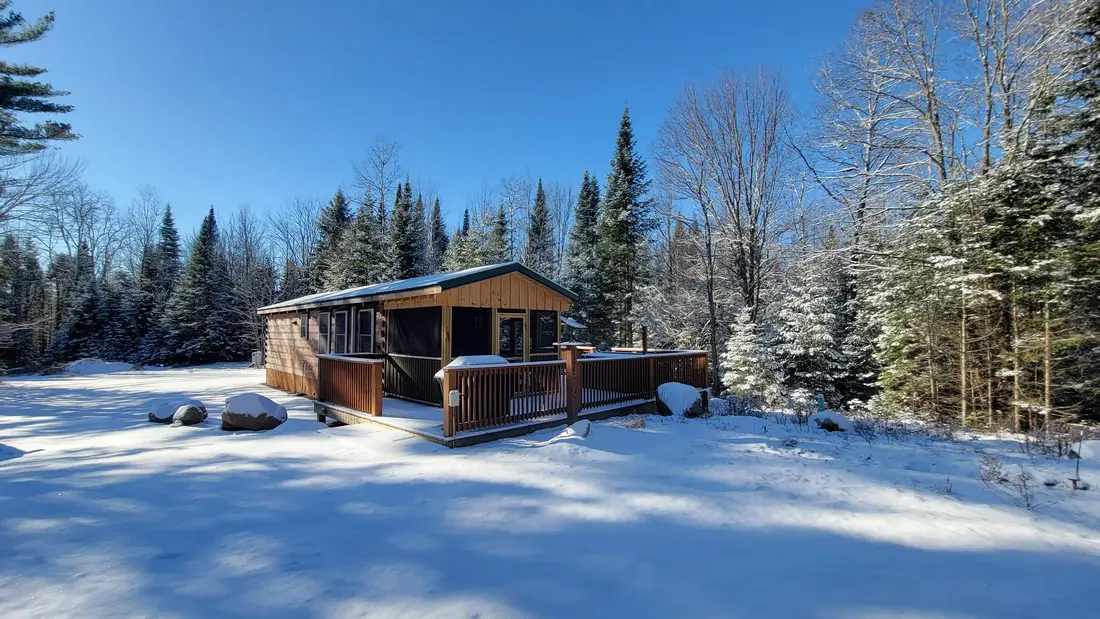
The après-ski cabin: a Jøtul gas stove between two picture windows, a large screened room on the deck, a hot tub open all year, and Titus Mountain minutes away.
 The Modern PineCabin 2 · 2 bd · 1 ba · sleeps 4
More in Food & Farms
Sources
29 references, listed in full at the end of this guide: official park, state, tourism-office and business sources, checked October 2026.
Related guides


Photos on this page: SaranacLakeIcePalace2020B by DanielPenfield, CC BY-SA 4.0; Wild Center 01 by Dclemens1971, CC BY 4.0. Resized and cropped for this site. All photo credits