
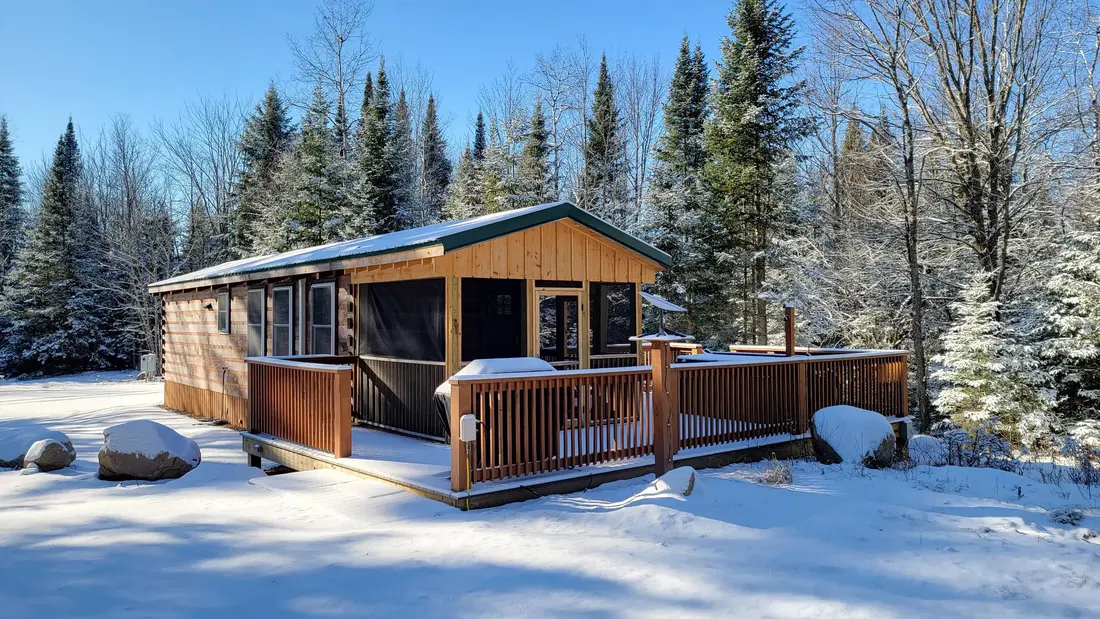
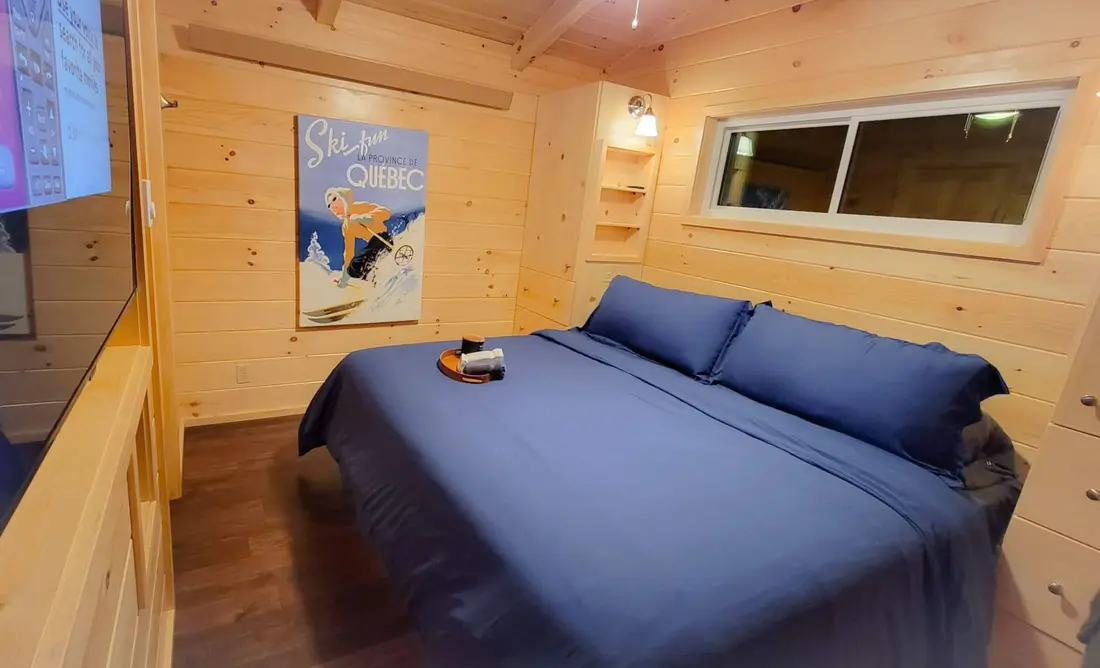
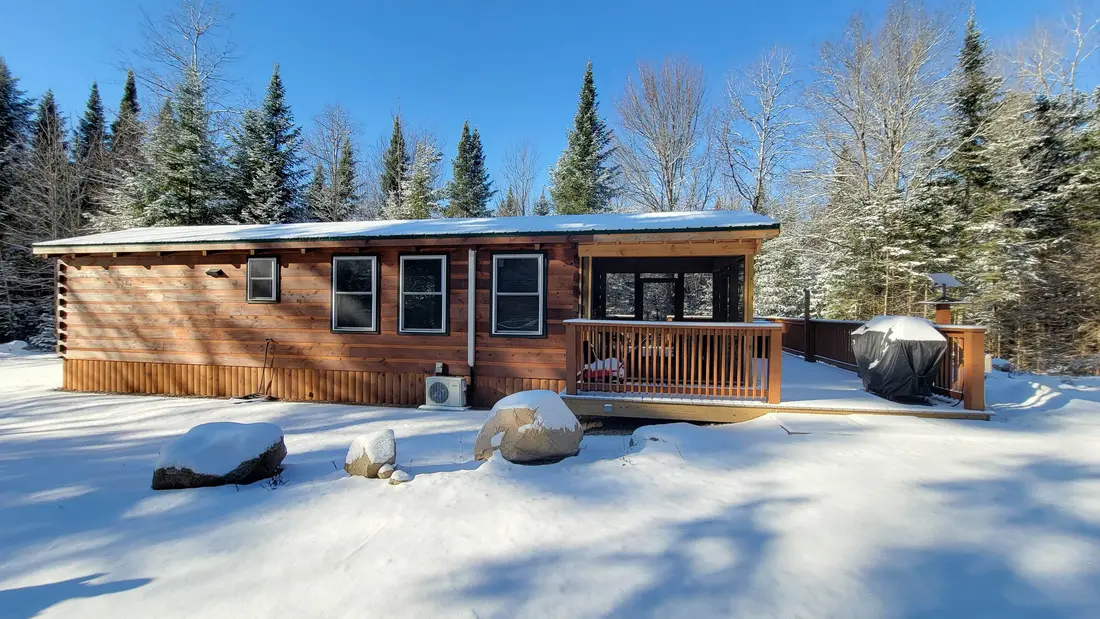
Après-ski is French for after skiing: the food, drinks and company at the end of a ski day. At The Modern Pine, the cabin the host dressed for skiing, it happens at home, about three and a half road miles from Titus Mountain's base lodge, with a Jøtul gas stove between two picture windows, a large screened room on the deck, a hot tub open 24 hours and a vintage Quebec ski poster in the main bedroom. This post covers where the custom comes from, the Quebec and Vermont ski history the poster points to, and how to run an evening at the cabin or go out near it.
What après-ski means
The word came into English in the early 1950s, from the French après, after, and ski. Dictionaries give it two shades of meaning: the period of relaxation that follows skiing, and the social activity after a day on the slopes. It caught on in the Alps during the commercial ski boom of the 1950s, when ski towns grew into travel destinations.
Each ski region has its own version. In St. Anton, in Austria's Arlberg, the Krazy Kanguruh is a legendary après-ski spot where the old sing-along tradition was reborn. Quebec, the subject of The Modern Pine's poster, has the cinq à sept: friends or colleagues meeting for a drink in the late afternoon, between about 5 and 7 p.m.
At The Modern Pine the custom moves to the cabin. The mountain is a few minutes away, the screened room takes the wet gear, the stove takes the chill off, the hot tub and the fire pit do the rest, and nobody has to drive home from a bar.
The cabin dressed for skiing
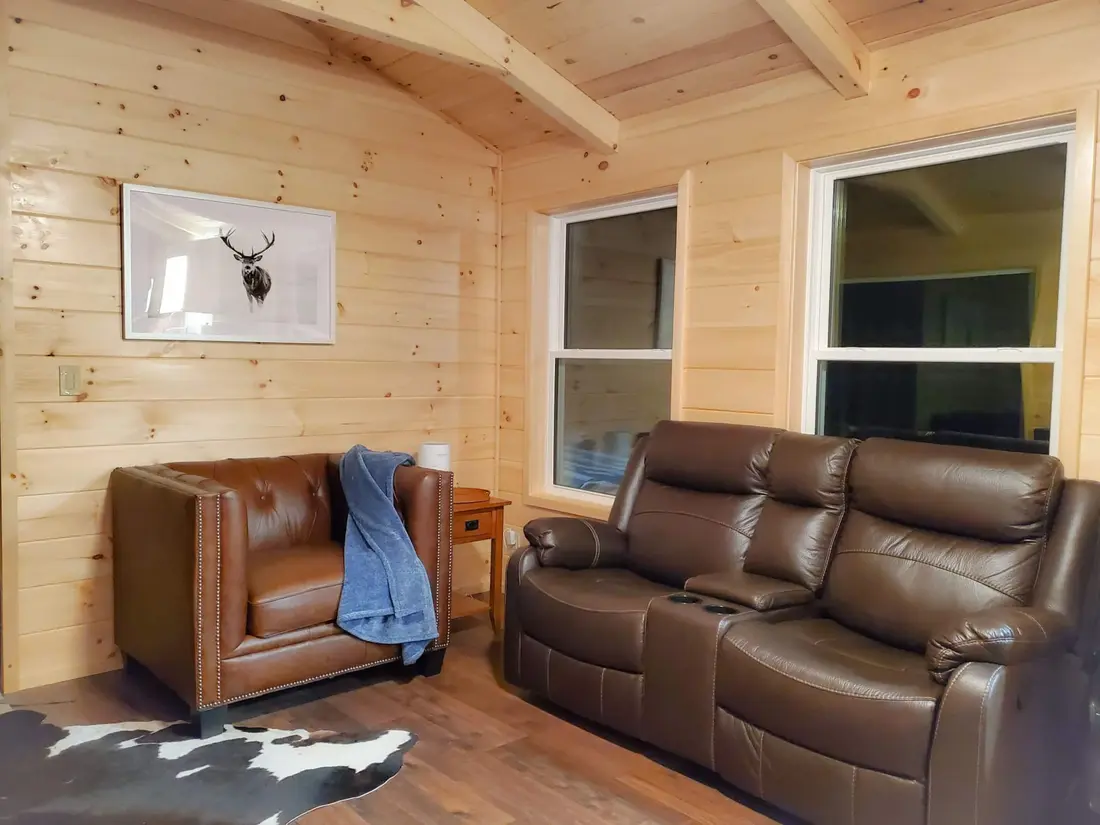
The Modern Pine is Cabin 2 of the three, a log cabin for four with a main bedroom, a bunk room and one bathroom. The host gave it an après-ski theme. Its listing calls it far from rustic, with quality furniture, linens, plush bath rugs, satellite TV and wifi, and two large picture windows looking out over the forest and the mountains.
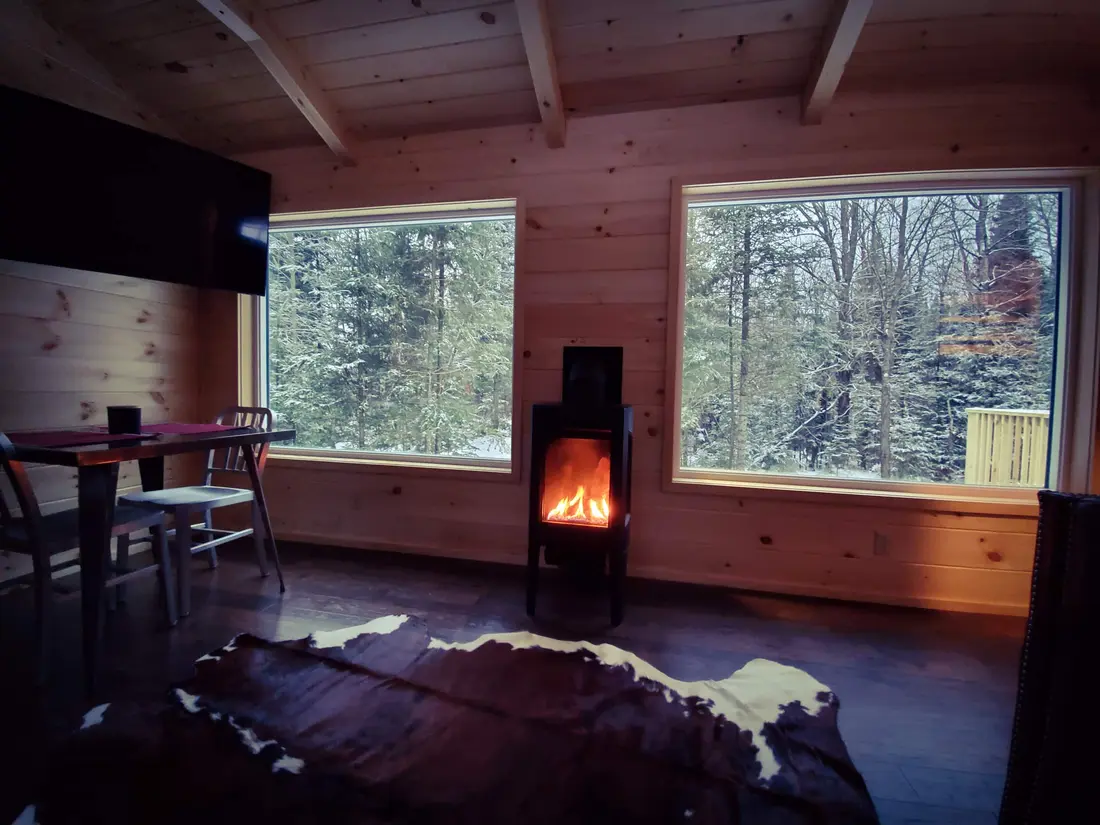
The Jøtul GF 160 DV gas stove stands between those two windows, and the living room has a leather reclining loveseat and an armchair. One guest "loved sitting inside in the recliners looking at the fire in the little fireplace and out the huge windows." Another wrote: "The big windows and stove place heater created a cozy environment to sit and watch the snow fall."
Outside, the deck holds the hot tub and the grill beside a large screened room with a roof over it, "the covered screened in porch," as one guest called it. The hot tub is open all year, 24 hours a day. The fire pit sits at the tree line with Adirondack seating around it, and a guest in December wrote: "Loved the hot tub and the firepit area tucked into the woods."
The poster in the main bedroom
On the wall beside the bed in the main bedroom hangs a vintage ski poster: a skier in a yellow jacket on a snowy slope under a blue sky, lettered "Ski-fun" and "La Province de Québec."
The original is a lithograph issued by the Province of Quebec Tourist Bureau to promote skiing in the province. McGill University Library keeps one in its rare books collection, alongside more than a hundred other Canadian travel posters issued by provincial agencies and by shipping and railroad companies, and reproductions are widely sold. The ski country it advertised grew up in the Laurentians, the hills north of Montreal where the city's skiers went, and that story passes close to the cabins.
Early skiing in the Laurentians
Montreal's skiers rode the train north. The Canadian National and Canadian Pacific railways started running ski trains to the Laurentians in 1927, and in the winter of 1938-39 they carried about 112,000 people on 300 trips. At the stations, horse-drawn sleighs met the weekend crowds from Montreal.
The region had a ski resort early. In 1914 Emile and Lea Cochand bought a one-storey cottage and 500 acres at Ste. Marguerite Station for $500, and their Chalet Cochand is remembered as North America's first ski resort. Emile had come from Switzerland as Canada's first professional ski instructor, sponsored by the Montreal Ski Club.
What is considered the first ski tow in North America went up at Shawbridge, now part of the town of Prévost. In the early 1930s Alex Foster rigged a 1928 Dodge engine to pull skiers up the Big Hill there, across from the lodge of the Laurentian Lodge Club. That club was founded in 1923, with Jackrabbit Johannsen among its founding members, became the Shawbridge Club in 1927, and is known as the oldest residential ski club in North America.
Cross-country skiers had Herman "Jackrabbit" Smith-Johannsen. In the 1930s he and his son Bob cut and marked the Maple Leaf Trail, which ran about 128 kilometers between Shawbridge and Labelle beside the line of the P'tit Train du Nord railway, with the Imperial Tobacco Company as its sponsor. Its markers were bright red with a dark green maple leaf, and Jackrabbit put them up himself with the help of volunteers. Volunteers are now working to restore the trail along its old route.
Then came a big mountain. A 1938 expedition climbed Mont Tremblant, and one of its members, Joe Ryan, founded Mont Tremblant Lodge, which opened in February 1939. Ryan also put in Canada's first chairlift there, only the second in North America, in time for the 1938-39 season. Another member of the expedition, the broadcaster Lowell Thomas, came back regularly and sent his radio newscasts live to the United States from Tremblant, and the resort's name traveled with them. Ryan loved horse racing, and Tremblant's World Cup trail, the Flying Mile, carries the name of his horse. Montreal is the nearest big city to the cabins; see the Montreal day trip and the drive from Montreal.
The Lake Placid connection
Jackrabbit Johannsen skied the Adirondacks too. Born in Horten, Norway, on June 15, 1875, he settled his family in Lake Placid, where they lived for a few years while he worked out of Montreal. He laid out trails around the village to build interest in skiing and was one of the founders of Lake Placid's Sno Birds Ski Club, which pioneered skiing in New York State. In 1929 he moved his family to Canada for good, and in 1932 they settled in Piedmont, in the Laurentians.
He lived to 111. He was named to the Order of Canada in 1972 and died in 1987. Lake Placid is about 52 road miles south of the cabins, and the Olympic sites guide covers what is there now.
Vermont's side of the story
Vermont's first ski tow came by way of Quebec. In January 1934 a group of skiers asked Robert and Elizabeth Royce, who ran the White Cupboard Inn in Woodstock, for a mechanized way up the hill, and pledged them $75 if something was in place when they came back in mid-February. The Royces tracked down a rumor that a ski club in Quebec had such a device, worked from a rough diagram the club gave them, and set up a tow on a sloping pasture they leased from the farmer Clinton Gilbert: 1,800 feet of rope, some pulleys and an old Model T Ford truck, for a total of $500, which the skiers paid. It was the first rope tow in the United States.
Stowe came next. The Lodge and the Toll House there opened for their first winter in 1935-36, Sepp Ruschp arrived from Linz, Austria, to teach skiing in 1936-37, and on November 17, 1940, Mt. Mansfield Lift, Inc. opened a single chairlift, the first chairlift in Vermont and, at 6,330 feet, the longest in the country at the time. A 3,000-foot T-bar was running by the winter of 1947.
New England's sugarhouses keep a sweeter tradition too: sugar on snow, hot maple syrup poured over packed snow, a spring favorite at sugarhouses and sugar camps for more than 200 years. Quebec makes the same treat and calls it tire sur la neige. Both are easy at the cabin, and the method is below. Burlington is about 115 road miles from the cabins; see the drive from Burlington.
Where to see the history
Two museums tell the story the poster comes from. The Musée du ski des Laurentides, the Laurentian ski museum, is at 6 avenue de la Gare in Saint-Sauveur, in the Laurentians north of Montreal. Its permanent exhibition, "À vos skis! Une histoire des Laurentides," opened in July 2025, with seven themed sections on how skiing drove the region's growth in the 20th century, from the first lifts to lit slopes, and large interactive maps of every ski area that has operated in the Laurentians. Its descent simulator is a pair of large doors you put your face into for a ski run with wind and scent effects as well as pictures. The museum opens Friday to Sunday from 11 a.m. to 5 p.m., and from Monday to Thursday by reservation. It is a trip across the border, so read the border guide before you go.
The Vermont Ski and Snowboard Museum is at 1 South Main Street in Stowe, with exhibits on Vermont's lost ski areas and the 10th Mountain Division, and a hall of fame. It opens Thursday to Sunday from noon to 5 p.m., asks a suggested donation of $5 for an adult, and closes from October 26 to November 26 and from April 20 to May 20. Its 2026 calendar included an après-ski fashion show in January. Check both museums' hours before you set out.
An evening at the cabin
On the days Titus closes at 4:30 p.m., which on its posted hours means Sundays and Monday through Thursday, you are back at the cabin at about a quarter to five, close to sunset in mid-January. This is the plan for those evenings. On Friday and Saturday nights, when the lights are on at the mountain, the ski-day post has the plan.
| Time | At the cabin |
|---|---|
| 4:45 p.m. | Skis and boards into the screened room, stove on |
| 5:00 p.m. | The first soak, as the light goes |
| 5:30 p.m. | Cinq à sept by the stove: hot drinks, cheese and sugar on snow |
| 7:00 p.m. | Dinner from the grill or the oven |
| 8:30 p.m. | The fire pit, if the wind is down |
| 9:45 p.m. | A late soak under the stars |
The screened room is the boot room. Knock off the snow, stand the skis and boards there, and take the boots, gloves and wet layers inside to dry, as the ski-day post explains. Then switch on the stove. It heats the room fast, so run it high to take the chill off and turn it down once the room is warm; the post on the Jøtul stoves explains why.
Soak before you drink. The health advice is no alcohol before or during hot tub use, and drinking in a hot tub can lead to drowning, so the first soak comes at five and the cinq à sept after it. In mid-January civil twilight ends at about 5:15, so that first soak sees the last of the light. The tub's hours help here: it is open all year, 24 hours a day, so the last soak can wait until the stars are out, and the next can come at 7 a.m., in the half hour before a mid-January sunrise. The Aviator, on the same property, keeps quiet hours from 10 p.m., so keep a late soak quiet.
Shopping in Malone for the evening
Malone, about ten road miles north, has the supermarkets, and the groceries guide lists them. In New York the supermarket sells beer but not spirits, so the brandy, vodka, sherry and port for the caribou below come from a liquor store; in Malone that means The Jug Store at 44 Finney Boulevard. Check its hours before the drive.
The syrup can come from the mountain. Titus makes its own maple syrup, Moon Valley Maple, at a sugarhouse at the ski area's address, 215 Johnson Road, and it offered the syrup at wholesale prices on the last day of the 2025-26 season. Call the mountain at (518) 483-3740 to ask about buying some.
Know the kitchen before you shop. It has a refrigerator, a freezer, a stove, an oven, a microwave, a toaster, a kettle, a coffee maker, a dishwasher and wine glasses, with pots and pans, oil, salt and pepper. Two guests left notes worth reading. One wrote that "the cookware is limited in the cabin - it is very basic. We brought an extra baking sheet and mixing bowls this year." Another found "wonderful (and VERY sharp) knives and great pots and pans, but no spices other than salt and pepper." Pack your spices, a baking sheet and a mixing bowl.
Sugar on snow
Sugar on snow is the one recipe here with a history on both sides of the border. Heat maple syrup to 22 to 28 degrees above the boiling point of water, which usually means about 234°F, then pour or drizzle it at once, without stirring, over packed snow or shaved ice. It sets into a thin, chewy, taffy-like sheet that you twirl up with a fork or a stick. The traditional sides are sour pickles, to cut the sweetness, and saltines or plain doughnuts.
Quebec's tire sur la neige is the same treat rolled onto a stick. One Quebec recipe boils a 540 ml can of maple syrup for about ten minutes in a large, high-sided pot until a candy thermometer reads 234°F, then ladles it onto the snow and rolls it up on a wooden stick. Without a thermometer, drop a little syrup into cold water: when it forms a soft ball, it is ready.
The kitchen has the stove and the pots, but no candy thermometer is listed, so bring one if you have it, along with the wooden sticks. Pack a large bowl with clean snow from away from the paths, or use shaved ice, and keep everyone back from the pot, since the syrup runs hotter than boiling water.
A caribou after the soak
Quebec's winter drink is the caribou. The version made today mixes brandy, vodka, sherry and port and is served hot. Its recipe was first made in the 1960s at chez Ti-Père, an establishment in Old Québec, and at the Quebec Winter Carnival people drink it from long plastic canes topped with the head of Bonhomme Carnaval. Fur traders get the credit for the idea, and early versions were said to be made with caribou blood, long since replaced by red wine. Some see it as a Canadian version of mulled wine, a drink Quebec came to know as immigrants arrived.
Buy the spirits at the liquor store, warm the mix gently in a pot, and drink it by the stove after the soak, never in the tub. Anyone driving later gets hot chocolate with a spoon of the Titus syrup. Saranac Lake, about 43 road miles south, holds a winter carnival of its own each February; see the carnival guide.
The grill on the deck
The grill sits on the open deck, and it works in winter if you keep to the basic rules. Use it only outside, where it stands, never under the screened room's roof or indoors. Keep a 3-foot safe zone around it and keep the dog out of it, open a gas grill's lid before you light it, and do not walk away from it while it is lit. If you cook over charcoal, put the cooled coals in a metal can with a lid. Clean the grates after each use, because leftover grease can start a fire.
Clean up the same night. The Modern Pine's listing asks guests to keep garbage secured because of wildlife, and The Aviator's asks that no food or garbage be left outside. Scrape the grill and bring the trash in.
The fire pit in the tree line
The fire pit sits at the edge of the trees, with Adirondack seating around it; the Adirondack chair post tells the story of the chair. Dress for the deck, not the living room, and bring the cocoa out with you.
New York's campfire rules are short. Burn only untreated wood or charcoal, keep the fire under 3 feet high and 4 feet across, keep water and a tool nearby, never leave it unattended, and skip windy nights, when a small breeze can spread it. To put it out, drown it until every ember, coal and stick is wet, stir the remains, add more water and stir again.
Firewood has rules of its own. Untreated firewood may not be brought into New York from any other state or country, and within the state it may not travel more than 50 miles from where it grew unless it has been heat-treated; bought firewood needs a receipt or label showing its source. Leave the woodpile at home and buy local, or ask the host about firewood. The border guide covers what else stays behind at the crossing.
One more thing to know: The Modern Pine's deck and screened room face The Aviator, the other cabin on the property, and a December guest who could see the neighbors' fire felt a little too exposed for comfort. How the two cabins share a property explains the layout.
Going out near Titus
For après-ski with a crowd, start at the mountain. Mo's Moon Valley Grill has table service on the main floor of the Lower Lodge seven days a week, the lodge has three fireplaces, and Titus has had a full bar there. On the last day of the 2025-26 season, Titus booked live music in the lodge from 1 to 4 p.m.
In Malone, the winter weekend guide covers two pubs, Mo's Pub & Grill on NY 11 and The Pines Tap and Table on Bare Hill Road, and the where to eat page lists the restaurants for a sit-down dinner. Hours change in winter, so call ahead. Whoever drives back to the cabin stays sober; the last miles are dark county roads, and the winter driving guide covers them.
The first evening and the last morning
Check-in at The Modern Pine is after 4 p.m., so the first evening of a ski trip is an après-ski evening by default. Shop in Malone on the way, unpack, turn on the stove and take the first soak before dinner. Checkout is before 11 a.m., which leaves room for one more: the tub is open 24 hours, so take a soak at first light, then coffee at the picture windows, then the checkout list, which the ski-day post walks through.
Booking the après-ski cabin
The listing puts The Modern Pine on more than 100 acres, with a second cabin on the property set so each keeps its privacy. The cabin is set up for adults. Its house rules say the booking guest must be at least 25, there are no parties, and the cabin is not suitable for children under 10. Dogs under 25 pounds are allowed for a fee and may not be left alone in the cabin.
For a group of eight, add The Aviator, the other cabin on the same property, which has the same Jøtul stove and its own hot tub. See The Modern Pine, couples' getaways and group stays, and book on the booking page.
Questions
What does après-ski mean?
It is French for after skiing: the relaxing, eating and drinking at the end of a ski day. The word came into English in the early 1950s and caught on in the Alps during that decade's ski boom. At The Modern Pine it happens at the cabin, with the stove, the hot tub and the fire pit, a few minutes from Titus Mountain.
Is The Modern Pine's hot tub open at night?
Yes. The listing keeps the private hot tub available all year and open 24 hours, so a soak can come before dinner, late at night or before first chair. Keep late soaks quiet, since The Aviator shares the property and keeps quiet hours from 10 p.m., and see the ski-day post for soak times and children.
What is the poster in The Modern Pine?
A vintage ski poster in the main bedroom, lettered "Ski-fun" and "La Province de Québec," showing a skier on a snowy slope. The original is a lithograph issued by the Province of Quebec Tourist Bureau to promote skiing in the province, and McGill University Library keeps one in its rare books collection. Reproductions are widely sold.
Can we have a fire in the fire pit in winter?
Yes, within New York's rules: untreated wood or charcoal only, a fire under 3 feet high and 4 feet across, water and a tool nearby, never unattended, and not on a windy night. Untreated firewood may not be brought into New York from another state or country, so buy local or ask the host about firewood.
Where can we buy beer, wine and spirits near the cabins?
In Malone, about ten road miles north. Supermarkets such as Price Chopper sell beer, and wine and spirits come from a liquor store, such as The Jug Store on Finney Boulevard, which may not sell beer. Check the store hours before you drive. See groceries and supplies.
Where can we go out after skiing near Titus?
At the mountain, Mo's Moon Valley Grill on the main floor of the Lower Lodge has table service seven days a week, and the lodge has three fireplaces. In Malone, about ten road miles north, the winter weekend guide covers Mo's Pub & Grill and The Pines Tap and Table, and where to eat lists the rest. Call ahead in winter and plan a sober driver.
Sources
Facts on this page were checked against these sources in October 2026. Hours, fees and schedules change; confirm before you go.
- dictionary.com dictionary.com/browse/apres-ski
- mentalfloss.com mentalfloss.com/culture/apres-ski-meaning-lifestyle-popular
- skiinghistory.org skiinghistory.org/article/st-anton-cradle-austrian-skiing
- skiinghistory.org skiinghistory.org/online-magazine/sunshine-my-shoulders-history-ski-mu
- vitrinelinguistique.oqlf.gouv.qc.ca vitrinelinguistique.oqlf.gouv.qc.ca/24798/lorthographe/cas-particulier
- blogs.library.mcgill.ca blogs.library.mcgill.ca/rbsc/?p=285
- skimuseum.ca skimuseum.ca/memorable-moments/maple-leaf-trail/
- qahn.org qahn.org/article/shawbridge-brief-history
- archivalcollections.library.mcgill.ca archivalcollections.library.mcgill.ca/index.php/shawbridge-laurentian-
- skimuseum.com skimuseum.com/honorary-members/laurentian-lodge-ski-club/
- skimuseum.ca skimuseum.ca/memorable-moments/canadian-skiing-firsts/
- qahn.org qahn.org/article/land-laurentians
- qahn.org qahn.org/article/herman-jackrabbit-smith-johannsen-1875-1987
- blogue.tremblant.ca blogue.tremblant.ca/tremblant-history-trail-names/
- vtdigger.org vtdigger.org/2022/02/06/then-again-fred-harris-and-the-woodstock-rope-
- vermontpublic.org vermontpublic.org/vpr-news/2015-08-18/slope-with-nations-first-ski-tow
- stowehistoricalsociety.org stowehistoricalsociety.org/new-page
- massmaple.org massmaple.org/about-maple-syrup/make-maple-syrup/sugar-on-snow/
- cuisinez.telequebec.tv cuisinez.telequebec.tv/recettes/6727/tire-sur-la-neige
- saq.com saq.com/en/content/inspiration/profiles/origins-caribou
- cdc.gov cdc.gov/healthy-swimming/safety/what-you-can-do-to-stay-healthy-in-hot
- govinfo.gov govinfo.gov/content/pkg/GOVPUB-Y3_C76_3-PURL-LPS51051/pdf/GOVPUB-Y3_C7
- nyc-business.nyc.gov nyc-business.nyc.gov/nycbusiness/description/liquor-store-license
- nyc-business.nyc.gov nyc-business.nyc.gov/nycbusiness/description/grocery-and-drug-store-be
- pricechopper.com pricechopper.com/stores/ny/malone/price-chopper-166.html
- Titus Mountain titusmountain.com/moon-valley-maple
- Titus Mountain titusmountain.com/_files/ugd/7205d4_b8d6043b823d4b5d94fe10dbd134421b.p
- tupperlake.com tupperlake.com/alpine-skiing/titus-mountain
- aa.usno.navy.mil aa.usno.navy.mil/api/rstt/oneday?date=2027-01-16&coords=44.77,-74.19&t
- Titus Mountain titusmountain.com/dining
- Titus Mountain titusmountain.com/night-skiing
- Visit Malone visitmalone.com/blog/2017/01/four-takes-titus
- mospubandgrill.com mospubandgrill.com/
- thepinestapandtable.com thepinestapandtable.com/
- New York State Department of Environmental Conservation dec.ny.gov/things-to-do/camping/fire-safety
- New York State Department of Environmental Conservation dec.ny.gov/nature/animals-fish-plants/invasive-species/terrestrial/fir
- usfa.fema.gov usfa.fema.gov/downloads/pdf/publications/grilling_fire_safety_flyer.pd
- museeduski.com museeduski.com/planifiez-votre-visite/
- journalacces.ca journalacces.ca/culture/musee-ski-laurentides-histoire/
- vtssm.org vtssm.org/visit
- vtssm.org vtssm.org/new-events
- The cabin's Airbnb listing airbnb.com/rooms/53628054
- The cabin's Airbnb listing airbnb.com/rooms/1168252128174283244


