
Upper Canada Village
Upper Canada Village in Morrisburg, Ontario: 1860s mills, trades and farms, the Lost Villages, Alight at Night, tickets in Canadian dollars and the drive.
Upper Canada Village is a living-history village on the St. Lawrence River just east of Morrisburg, Ontario, set in the year 1866, with working mills, farms, trades and more than 40 old buildings, many of them moved there before the Seaway flooded the river towns in 1958. It is about 60 road miles from the cabins, roughly an hour and a half each way plus the border, by NY 37 and the Seaway International Bridge at Massena and Cornwall. Go for a summer day among the mills and farm animals, or for an evening at PumpkInferno in October or Alight at Night in December.
What the village is
The village opened in 1961 and is run by the St. Lawrence Parks Commission, the Ontario agency that signs its sites as Parks of the St. Lawrence. Its sister sites include Fort Henry in Kingston. The street address is 13740 County Road 2, Morrisburg, east of the town and beside Crysler Park on the St. Lawrence.
The story the village tells is a rural English-Canadian community in 1866. Costumed staff work the mills, cook, farm and keep shops, and they talk to visitors about what they are doing and why. The buildings are real: houses, a church, a tavern, a hotel, a school, mills and barns gathered from the surrounding townships, with a few reconstructed. You walk the streets at your own pace, go inside the buildings that are staffed, and ride a horse-drawn wagon or a canal boat between the far corners.
For a guest at the cabins it makes a full history day to the west, and it pairs well with the 1860s farm life at the Almanzo Wilder Farm near Malone, the setting of Farmer Boy.
The Lost Villages and the Seaway
The village exists because of the St. Lawrence Seaway. Building the Seaway and its power dam required the flooding of about 8,000 hectares of Canadian shoreline between Iroquois and Cornwall, land that Loyalists had settled in the 1780s. Between 1955 and 1957 about 6,500 people were moved, many of them to two new towns built for the purpose, Ingleside and Long Sault. Crews moved houses, rerouted highways and rail lines, and rebuilt Iroquois and part of Morrisburg on higher ground.
On July 1, 1958, remembered locally as Inundation Day, the rising water of the new Lake St. Lawrence covered Aultsville, Farran's Point, Woodlands, Dickinson's Landing, Wales, Moulinette, Mille Roches and the farms on Sheek's Island. These are the Lost Villages. Many of the old buildings now standing at Upper Canada Village were taken from that strip of shore before the water came.
The Lost Villages Museum
The Lost Villages Historical Society keeps its own museum in Ault Park, on Fran Laflamme Drive about 3 kilometres east of Long Sault, with heritage buildings moved from the flooded villages and nearby townships: a log house, a schoolhouse, a church from Sandtown, a train station, a general store, a barbershop and the Stuart home among them. Its website says it is closed for the season and will reopen in summer 2027. An Ontario historical plaque titled Lost Villages of the St. Lawrence stands on the south side of Road 2 at the south end of Road 15 in South Stormont, on the way between Cornwall and the village.
The mills
Three working mills are the heart of a summer visit, and each one shows a different kind of power.
- Bellamy's Steam Flour Mills. Samuel Bellamy's mill stood in Augusta Township. It ran on water until a fire in 1863, and when it was rebuilt it ran on steam, which let it grind all year. The miller's pay was a share of the grain: one-twelfth of the wheat he ground.
- Beach's Sawmill. A water-driven mill with a single vertical blade of the type called a muley saw. The village gives its output as 2,000 feet of board in 24 hours.
- Asselstine's Woollen Factory. A family business that once employed up to 12 men and women making yarn, blankets, tweeds and flannels. It runs today as a working exhibit, so you can follow wool from the fleece to the cloth.
Ask at admissions which mills are running that day and start with those.
Trades and workshops
Walk the streets and you pass a row of 1860s trades, each in its own building:
- The blacksmith makes tools, shoes horses and oxen, and repairs mill machinery.
- The cabinetmaker restores the finer furniture in the village collection on a foot-powered lathe.
- The shoemaker makes men's brogues in a log home on Church Street. The 1860s census counted 221 boot and shoe makers in eastern Canada West.
- The tinsmith turns tin-plated iron sheets, imported from Britain in the period, into household and farm tinware.
- The broommaker makes round and flat brooms in a log cabin built in the 1820s.
- The dressmaker works from a stone house; by 1871, the village notes, the area had one dressmaker for every 200 women.
- The bakery bakes bread in a wood-fired brick oven twice a day, and the bread is sold in the Village Store.
- The Union Cheese Factory makes cheese by 19th-century methods on select days, Tuesday through Friday. The store sells the cheese too.
Spinning and weaving demonstrations happen in the McDiarmid home. If cheese-making matters to your group, plan a weekday visit.
The farms and the horses
The village farms show three ways of making a living from the land in the 1860s. The Loucks farm is the prosperous one, with big barns, livestock and horse-powered machinery. The Tenant Farm is smaller and works with oxen instead of horses; in the 1860s about 15 percent of the farmland in Canada West was worked by tenants. The Ross farm runs a wood yard with a horse-powered drag saw.
The village raises and trains more than 20 Canadian horses, a heritage breed, along with oxen, pigs and cows, and spring brings new calves. Special weekends have featured the horses; in 2024 a Horse Lovers' Weekend ran over the Labour Day holiday, and an 1860s Fall Fair with horse and cattle shows and a quilt show ran in mid-September. Check the events page for the 2027 calendar.
Houses, the church and the hotel
The other buildings are where the social history lives. A few to look for:
- Willard's Hotel. Built in the 1790s by Daniel Myers and bought by John Willard in the 1830s, it is restored to 1850 and still serves meals.
- Cook's Tavern and Livery. Michael Cook took out his first licence in 1804. The wagon rides and the canal boat leave from here.
- Crysler Hall. Built by John Pliny Crysler, a timber merchant, with Doric columns each made from one great pine tree. It houses the permanent Black History exhibit, unveiled in May 2024, with the stories of people from the area such as John Baker, Victoria Lewis, Private John Cosley and Elias Cooley.
- Christ Church. Built in 1837 in the Picturesque style and given by the miller Adam Dixson.
- Robertson House. Its parlour wallpaper was printed before 1820.
- The Lutheran pastor's home, built 1842 to 1844 for the Rev. William Sharts, and the physician's house, a neo-Grecian cottage that was first the home of Michael Cook, the man who first bred Holstein cattle in Canada.
- The school house, which tells the story of the publicly funded common schools Egerton Ryerson pushed for.
- The engine house, home of the fire engine Queen, built in 1851 by George Perry and Brothers of Montreal.
- The Masonic lodge, built in 1863 and moved to the village from Kars in 2008.
- Providence Chapel, a small log church open to any visiting preacher, usually the Methodist circuit riders.
The Discovery Centre has an audio-visual show about the Battle of Crysler's Farm and the War of 1812, plus a three-piece installation made with the Akwesasne artist Kanerahti:io (DJ) White that reflects the Akwesasne clans: Bear, Wolf, Turtle, Deer and Snipe. If you came through Akwesasne on the way, the Akwesasne Cultural Center in Hogansburg tells the community's story in its own words.
Rides around the village
Three rides help with the distances, which add up over a day.
- The horse-drawn wagon leaves from Cook's Tavern, rolls along the village streets and stops briefly at the Tenant Farm. It is included in admission.
- The tow scow is a canal boat that seats about 60 people and runs on the village canal between the dock behind Cook's Tavern and the Tenant Farm. It is also included in admission.
- The miniature train costs extra, $8 for anyone 5 and older, with tickets sold on site. It runs through Crysler Park with views of the river and an audio tour about the Battle of Crysler's Farm, and it is wheelchair accessible. It can close in bad weather or for maintenance.
Departure times change day to day, so check them at admissions when you arrive and plan the farm end of the village around a ride back.
Crysler's Farm battlefield
Next to the village is the Battle of Crysler's Farm National Historic Site, designated in 1920. On November 11, 1813, on John Crysler's farm, a British force of about 800 regulars, militia and Indigenous allies under Lieutenant-Colonel Joseph Morrison met an American force of about 4,000 under Brigadier-General John Boyd. After two hours of heavy fighting the Americans fell back toward Cornwall, and the defeat ended the American campaign against Montreal.
The real battlefield is under Lake St. Lawrence now. The 1895 monument, a granite obelisk with two flanking guns, was moved in 1955 to higher ground beside the village, ahead of the Seaway flooding, and stands on a grassy knoll built from earth taken from its original site. The miniature train's audio tour tells the story as you ride past. The Friends of Crysler's Farm Battlefield hold a Remembrance Day ceremony there each year.
Season and hours
The daytime village is a summer attraction. Listings for the 2026 season gave May 9 to September 20, open daily from 9:30 a.m. to 5:00 p.m. The village's own site does not post the daytime dates for 2027 yet, so check uppercanadavillage.com or call (613) 543-4328 before you set out; the dates shift a little from year to year.
After the summer season the village opens on select evenings for its two lights events, covered below. For a visit with the trades, mills and farms all working, come between June and early September, and pick a weekday if you want to see the cheese factory at work.
PumpkInferno and Alight at Night
Both evening events made Festivals and Events Ontario's 2026 list of the province's Top 100 festivals and events. Tickets for both are sold only online and in advance through the Parks of the St. Lawrence booking site, entries are limited by time slot, and most nights sell out. Tickets are non-refundable.
PumpkInferno in October
PumpkInferno fills the village with thousands of carved, lit artificial pumpkins, each molded from a real one, set out in themed displays, with new exhibits each year. The 2026 run is on select nights from October 2 to October 31: October 2 to 4, 8 to 12, 15 to 18 and 22 to 31. The Accessibility Nights on October 6, 14 and 21 are a 30-minute driving tour for guests with limited mobility or sensory needs, who stay in their vehicles. Evenings start at 7:00 p.m. through October 12 and at 6:30 p.m. from October 15; the last entry slot is 9:00 to 9:30 p.m., and the event page gives closing as both 10:00 and 10:30 p.m. Tickets are C$23 for adults 19 to 64, C$22 for seniors, C$21 for students and youth, and free for children 4 and under, plus tax. It runs rain or shine.
Alight at Night in December
Alight at Night strings more than one million lights through the village. The 2026-27 season runs on select nights from November 27, 2026 to January 2, 2027: November 27 to 29, December 3 to 6, 10 to 13 and 17 to 23, and December 26 to January 2, with Accessibility Nights on December 2, 9 and 16. The date listings give 5:00 to 9:00 p.m., while another line on the event page says 8:00 p.m., so check your ticket for the closing time.
The evening program lists a sound and light show at Crysler Hall, carolling at Christ Church, photos with Santa and activity stations. Tickets are C$18 for adults 25 to 64, C$17 for seniors, C$16 for students 13 to 17 and C$15 for youth 5 to 12, with children 4 and under free, plus tax. A horse-drawn carriage package costs C$200 for up to four people and includes a 30-minute ride and four day tickets for 2027. The toy train is C$8 and sold on site only. Arrive no earlier than 15 minutes before your time slot. The event is outdoors, and closures for weather are posted on the village's social media and emailed to ticket holders.
The drive home from Alight at Night is about an hour and a half after dark in December, with a border stop. The winter driving guide has what to carry, and the hot tub is waiting at the end.
Tickets and passes
Daytime admission for the 2026 main season, in Canadian dollars before tax:
| Ticket | 2026 price |
|---|---|
| Adult, 25 to 64 | C$26 |
| Young adult, 18 to 24 | C$26 |
| Senior, 65 and over | C$24 |
| Student, 13 to 17 | C$20 |
| Youth, 5 to 12 | C$17 |
| Child under 5 | Free |
| Family, 2 adults or seniors and 3 under 18 | C$80 |
Ontario's 13 percent harmonized sales tax is added to these prices. The wagon and the tow scow are included; the miniature train is C$8 extra. The village sells a season pass (C$50 for an adult) that also covers Fort Henry, and a ONePass for the commission's other sites. Support persons and caregivers get in free.
In summer 2026 the village took part in the Canada Strong Pass, a federal program that ran from June 19 to September 7, 2026: free admission for anyone 17 and under and half price for ages 18 to 24, open to international visitors as well as Canadians. Whether it returns in 2027 is up to the federal government, so check before you count on it. Prices above are for 2026; the village sets new ones each year.
Eating at the village
You can spend the whole day without leaving for food. Willard's Hotel is a full-service restaurant with costumed staff serving period-style meals, and it serves afternoon tea from 2:30 to 5:00 p.m. in the summer season; it is licensed for beer and wine, and reservations go through 613-330-9266. The Harvest Barn serves grilled food and lunch specials and is also licensed. The Village Cafe inside the Village Store is known for grilled cheddar sandwiches on the village's own bread, with soup, lemonade and coffee, and there is a BeaverTails stand for the hot Canadian pastry. Willard's and the Harvest Barn post special menus for PumpkInferno and Alight at Night. All the dining spots are wheelchair accessible.
Bread from the bakery and cheese from the cheese factory are for sale in the Village Store and make a good dinner back at the cabin; the kitchens are full kitchens.
Staying overnight
The village rents two houses that each sleep eight, the Guest House, a farmhouse in the evergreens on the river, and the Montgomery House, a log home at the edge of the village, booked through the Parks of the St. Lawrence reservations site. Most guests from the cabins will make it a day trip, and the houses are worth knowing about if you combine the village with Ottawa or Kingston on a longer swing.
The drive from the cabins
The village is about 60 road miles from the cabins. Allow about an hour and a half each way for the driving, plus the time at each border booth.
- To Malone. County Route 25 north about ten road miles into Malone. Fill the tank and pick up anything you need here; the Malone town guide has the stores.
- West on NY 37. From Malone, NY 37 runs west through Fort Covington and Akwesasne to the bridge plaza at Rooseveltown, east of Massena village, about 38 road miles from the cabins.
- Over the bridge. The Seaway International Bridge, also called the Three Nations Crossing, is two bridges. The South Channel Bridge, a high suspension span over the Seaway shipping channel, carries you onto Kawehno:ke, Cornwall Island, part of Akwesasne. The low-level North Channel Bridge, opened in January 2014, carries you into the City of Cornwall, and the Canadian border office and the toll plaza sit at its foot. The car toll has been C$5.25 since April 1, 2025, posted as US$3.75 in American money; the bridge reviews the U.S. figure twice a year.
- West to Morrisburg. From Cornwall, Highway 401 west to exit 758, Upper Canada Road, is the quick way. County Road 2 west of Cornwall is the slower river road and passes the Lost Villages plaque in South Stormont.
Coming home, you reverse the route and report to U.S. Customs and Border Protection at Massena, which is open 24 hours. Do not plan on the Trout River crossing on NY 30 north of Malone for the trip home: it has been closed to U.S.-bound traffic since June 1, 2026 for reconstruction, with completion targeted for about May 2028. The journal post on the closure has the story.
The border crossing guide covers every port near the cabins, wait-time apps and the Ogdensburg bridge farther west.
Documents both ways
Going north, Canada's border agency recommends a valid passport for U.S. citizens; a NEXUS card or a U.S. enhanced driver's license also works, and NEXUS holders are advised to carry a passport as well. Coming home, U.S. citizens show a passport, passport card, enhanced driver's license or trusted traveler card (NEXUS, SENTRI or FAST) under the Western Hemisphere Travel Initiative; U.S. and Canadian citizen children under 16 need only a birth certificate or other proof of citizenship at the U.S. booth. An ordinary driver's license is not enough in either direction. U.S. permanent residents show their green card.
For anyone under 18, carry their ID, and if one parent or another adult is driving them, bring a consent letter from the parent who is not there with that parent's full name, address and telephone number; Canada recommends it be notarized. The border guide has the full rules for children, NEXUS and long stays.
The border guide also covers food, firewood and cannabis. The village allows no pets except service animals, so plan this one as a day without the dog; the dog guide has ideas for days when the dog comes along.
Money, cards and bottles
Prices in Ontario are in Canadian dollars, and the 13 percent harmonized sales tax, a 5 percent federal part and an 8 percent provincial part, is added at the till. The evening events are sold only online in advance, so you will pay for those by card before you leave the cabins. A card with no foreign transaction fee keeps the day simple, and the bridge toll can be paid in either currency.
The village store sells bread, cheese and gifts. Before you buy Canadian beer, wine, cider or spirits to carry home, check CBP's current guidance: a U.S. ban on imports of more than 30 kinds of Canadian-made alcohol in retail packaging took effect September 29, 2026. It is not yet clear how it applies to a traveler's own bottles; the Canadian Snowbird Association tells travelers to declare all alcohol, and a trade lawyer expects bottles to be seized. The border guide has the duty-free allowances, and the breweries guide lists what you can buy on the New York side.
Getting around on foot
The village spreads from the admissions building out to the farms, and a full loop is a lot of walking. Wear comfortable shoes, and use the wagon and the tow scow to get to the Tenant Farm and back. Parking is free on site, with 15 accessible spaces near the admissions building. The dining rooms and the miniature train are wheelchair accessible, and PumpkInferno and Alight at Night each set aside Accessibility Nights. The Parks of the St. Lawrence accessibility page lists the rest.
Families visiting the cabins with children 10 and up will find the trades, the horses and the canal ride a good fit; youth tickets cover ages 5 to 12 and student tickets 13 to 17.
A day plan from the cabins
- 7:30 a.m. Leave the cabins with passports in hand. Coffee and fuel in Malone.
- 8:45 a.m. Cross the Seaway International Bridge and clear the Canadian booth in Cornwall. Take County Road 2 west for a look at the river and the Lost Villages plaque.
- 9:45 a.m. Arrive soon after the gates open. Start at the Discovery Centre, then walk to the mills while they are running.
- 11:30 a.m. Trades row: the blacksmith, the tinsmith and the bakery. Check the wagon and scow times.
- 12:30 p.m. Lunch at the Harvest Barn or Willard's Hotel.
- 1:30 p.m. Tow scow to the Tenant Farm, the Loucks barns and the horses; wagon back.
- 3:30 p.m. Crysler Hall and the Black History exhibit, then the miniature train past the battlefield monument.
- 4:30 p.m. Village Store for bread and cheese for supper. Leave by 5:00.
- About 7:00 p.m. Back at the cabins after the U.S. booth at Massena, with the fire pit and the hot tub to finish.
For an evening event, shift the plan: leave the cabins after lunch, stop at the Eisenhower Lock in Massena on the way out (the Massena guide has the details), and book an early time slot so you are home before midnight.
Pairing it with other trips
The same bridge serves two more long days from the cabins. Ottawa is about 104 road miles by the Cornwall crossing, and Kingston and the Thousand Islands lie farther west along the river. The Ottawa day trip and Thousand Islands guides have those plans. For a museum day that stays in New York, the museums guide lists every museum within about 90 minutes, and the Akwesasne Cultural Center is right on NY 37 on the way. To pick a cabin for the trip, see the cabins.
Questions
How far is Upper Canada Village from the cabins?
About 60 road miles, roughly an hour and a half each way plus the border. The route runs north on County Route 25 to Malone, west on NY 37 through Akwesasne to the Seaway International Bridge at Massena, into Cornwall, then west on Highway 401 to exit 758. The border guide covers the crossing.
When is Upper Canada Village open?
The daytime village is a summer attraction: listings for 2026 gave May 9 to September 20, daily 9:30 a.m. to 5:00 p.m. After that it opens on select evenings for PumpkInferno in October and Alight at Night from late November to January 2. Dates change each year, so check the village's website before you go.
How much are tickets?
For the 2026 season, daytime admission was C$26 for adults, C$24 for seniors, C$20 for students 13 to 17, C$17 for youth 5 to 12, free under 5, and C$80 for a family, plus Ontario's 13 percent HST. Alight at Night 2026-27 is C$18 for adults. Evening tickets are sold online only and often sell out.
Do I need a passport?
Canada recommends a valid passport for U.S. citizens. Coming home, CBP accepts a passport, passport card, enhanced driver's license or a NEXUS, SENTRI or FAST card. An ordinary driver's license is not enough. Children under 16 need proof of citizenship such as a birth certificate. The border guide has the details.
Can I use the Trout River crossing to get home?
No. The Trout River port on NY 30 north of Malone has been closed to U.S.-bound traffic since June 1, 2026 for reconstruction, with completion targeted for about May 2028. Come home over the Seaway International Bridge at Massena, which is open 24 hours. The journal post explains the closure.
Can I bring Canadian wine or beer back to the cabins?
Check CBP's current guidance first. A U.S. ban on imports of more than 30 kinds of Canadian-made beer, wine, cider and spirits in retail packaging took effect September 29, 2026. It is not yet clear how it applies to a traveler's own bottles; travelers are being told to declare all alcohol, and a trade lawyer expects bottles to be seized. Buy on the New York side instead; the breweries guide lists local makers.
Can I bring my dog to Upper Canada Village?
No. The village does not allow pets, only service animals, and that includes the evening lights events. Plan it as a day without the dog. The dog guide has outings where dogs are welcome.
Sources
Facts on this page were checked against these sources in October 2026. Hours, fees and schedules change; confirm before you go.
- uppercanadavillage.com uppercanadavillage.com/
- uppercanadavillage.com uppercanadavillage.com/the-village/about-the-village/
- uppercanadavillage.com uppercanadavillage.com/visit/admissions/
- uppercanadavillage.com uppercanadavillage.com/event/alight-at-night/
- uppercanadavillage.com uppercanadavillage.com/event/pumpkinferno/
- uppercanadavillage.com uppercanadavillage.com/visit/dining/
- uppercanadavillage.com uppercanadavillage.com/visit/lets-take-a-ride/
- uppercanadavillage.com uppercanadavillage.com/visit/stay-overnight/
- uppercanadavillage.com uppercanadavillage.com/newsroom/
- 613today.ca 613today.ca/places/upper-canada-village
- choosecornwall.ca choosecornwall.ca/news-english/explore-upper-canada-village-with-the-c
- lostvillages.ca lostvillages.ca/
- ontarioplaques.com ontarioplaques.com/Plaques_STU/Plaque_Stormont33.html
- pc.gc.ca pc.gc.ca/apps/dfhd/page_nhs_eng.aspx?id=424
- cbsa-asfc.gc.ca cbsa-asfc.gc.ca/travel-voyage/td-dv-eng.html
- U.S. Customs and Border Protection cbp.gov/travel/us-citizens/western-hemisphere-travel-initiative
- canada.ca canada.ca/en/news/archive/2014/09/cbsa-officially-opens-new-improved-p
- choosecornwall.ca choosecornwall.ca/news-english/community/cornwall-bridge-to-open-janua
- federalbridge.ca federalbridge.ca/temporary-closure-of-the-south-channel-bridge-between
- sibc.ca sibc.ca/the-seaway-international-bridge-corporation-ltd-announces-toll
- indiantime.net indiantime.net/story/2010/10/21/news/3-nations-bridge-project-update-t
- U.S. Customs and Border Protection cbp.gov/about/contact/ports/massena-new-york-0704
- cp24.com cp24.com/news/canada/2026/10/08/do-not-bring-canadian-alcohol-across-t
- ontario.ca ontario.ca/document/ontarios-tax-system/interest-rates-and-tax-rates
- parks.on.ca parks.on.ca/accessibility/
- sdgcounties.ca sdgcounties.ca/node/9804
In this guide
Stay nearby
The aviation cabin: flight-themed décor, a Jøtul gas stove, a large open deck with its own hot tub, and a smokeless fire pit on the lawn.
 The AviatorCabin 3 · 2 bd · 1 ba · sleeps 4
More in Day Trips
Sources
26 references, listed in full at the end of this guide: official park, state, tourism-office and business sources, checked October 2026.
Related guides
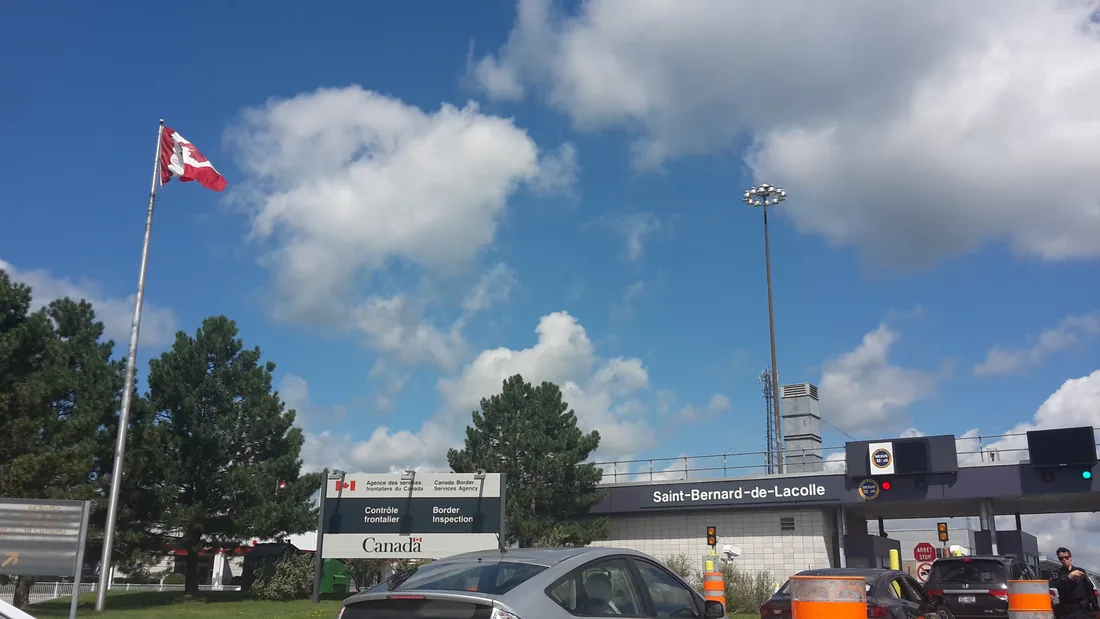


Photos on this page: 20170809-Saint-Bernard-de-Lacolle US-Canada (NY-Quebec) border crossing by Aude, CC BY-SA 4.0. Resized and cropped for this site. All photo credits