
Akwesasne Cultural Center
The Akwesasne Cultural Center in Hogansburg: Mohawk black ash and sweetgrass baskets, the Wolf Belt, a library since 1971, hours and the drive.
The Akwesasne Cultural Center on NY 37 in Hogansburg keeps the Akwesasne Library on its upper floor and a museum of Mohawk life below it, under one roof with a small gift shop. It is about 35 road miles northwest of the cabins, about an hour through Malone and Fort Covington, and the drive stays in New York the whole way. Go for the black ash and sweetgrass baskets, the room of wampum belts that holds the Wolf Belt, returned to Akwesasne in 2010, and a library that has served the community since 1971.
The center and who runs it
The center is a library, a museum and a gift shop in one building at 321 State Route 37. The library opened in 1971 and moved into the present building in 1987, with the library upstairs and the museum on the floor below. The museum was founded, in its own words, "to bring awareness and show pride in our Native identity as Akwesasne Mohawks." The gift shop sits with the museum and sells work by Akwesasne artists and basketmakers.
A board of directors governs the center. It meets on the third Monday of the month in the library's study area, and its bylaws, policies, annual report and meeting notes are posted on the center's own site. A federal grant record from 2005 describes the center, made up of the Akwesasne Library and Museum, as a community organization dedicated to the preservation of Kanienkehaka, or Mohawk, culture.
The Saint Regis Mohawk Tribe, the federally recognized government of the Saint Regis Mohawk Reservation at Akwesasne, lists the center in its own directory, with one phone line for the library and another for the museum. The Tribe has also received federal museum grants for the center, from a 2005 grant to send basket makers to the Smithsonian to a 2016 grant for rethinking how the center is organized and laid out.
The center is open and active in 2026. It posted newsletters in May, June and July 2026, announced new year-round hours in July, listed craft classes for the summer, and its board met through June 2026 with more meetings set for October, November and December.
Akwesasne and its name
Akwesasne straddles the border between the United States and Canada, on both banks of the St. Lawrence River, where New York, Ontario and Quebec meet. In Kanien'kéha, the Mohawk language, the name means "land where the partridge drums." A Blueway Trail sign on Gray Street in Hogansburg tells the story behind it: the Long Sault Rapids on the St. Lawrence sounded like partridges beating their wings, loudest in winter when the water pounded against the underside of the ice. After 1958, the St. Lawrence Seaway project changed the river and the rapids stopped drumming.
Three governments serve the community. The Saint Regis Mohawk Tribe, led by an elected council of three chiefs, three sub-chiefs and a clerk on staggered three-year terms, has jurisdiction south of the border. The Mohawk Council of Akwesasne has jurisdiction over the lands to the north. The Mohawk Nation Council of Chiefs is the traditional government, with chiefs, sub-chiefs, clan mothers and faith keepers chosen by clan, and it is recognized by the Grand Council of the Haudenosaunee.
The people of Akwesasne call themselves Akwesasró:non. The Mohawk people are the Kanien'kehá:ka, one of the six nations of the Haudenosaunee, the people of the longhouse. Clan membership passes through the mother's line, and the Tribe's own history notes that archaeological finds at Garoga in Fulton County place Mohawk people in what is now New York State since at least 1600.
Hogansburg is a hamlet in the Town of Bombay in Franklin County, the same county as the cabins, and the center's mailing address reads Akwesasne, New York. Most of what a visitor needs on this trip, the center, the casino, the art market grounds and the road to Massena, sits along NY 37.
What the museum holds
The museum tells the story of Akwesasne through images, objects and interactive displays, from the point of view of the Mohawk people who live there. The collection holds more than 2,000 photographs and more than 700 ethnographic objects. The largest group of any one kind is about 300 black ash splint and sweetgrass baskets.
Paintings by Akwesasne artists show the Mohawk creation story and other cultural symbols. The collection also takes in historic canoes, wampum belts, cornhusk dolls and kastowas, the traditional men's headdress. A renovation added a virtual reality experience and interactive exhibits, and the center's own site now announces a makeover: improved exhibits, artwork by community members and new audio and video displays about Akwesasne's culture.
The guided cultural tour that the Tribe's tourism office runs at the center gives a good outline of what a visit covers:
- A welcome to Akwesasne.
- The Haudenosaunee creation story, told through art by Akwesasne artists.
- Life before contact: longhouse living, the clan structure and the food systems that fed the people.
- The historic wampum belts, as living records of history, agreements and treaties.
- Traditional arts, basketmaking above all, and the Mohawk place in lacrosse.
- Time for questions and for looking around on your own, then the gift shop.
The Wolf Belt and the wampum room
The museum's climate-controlled wampum room holds 14 wampum belts, the Wolf Belt among them, with several replica belts on display. The Wolf Belt is made of 14 rows of white and purple wampum beads, 32.5 inches long and 4.4 inches wide. The purple beads show two human figures with joined hands, flanked by wolf-like figures facing outward, with short stripes at each end. It is strung on leather warps with plant-fiber cordage.
The center describes the belt as more than two hundred years old and made "in the spirit of Friendship, Protection, and Understanding." When it was collected, it was reported to record a treaty from the middle of the 1700s between the French and the Mohawks. The uneven size and shape of the beads point to the middle or late 1700s, and traces of red paint on some of the newer white beads suggest they were reused from an earlier belt.
How the belt came home
Museum records show that Harriet Maxwell Converse of New York City bought the belt "from a St. Regis Indian" on July 24, 1898, and the New York State Museum in Albany acquired it from her. A federal notice in July 2004 gave the state museum's intent to return it under the Native American Graves Protection and Repatriation Act. It found the belt to be an object of cultural patrimony, central to the community, and recorded the community's position that no individual ever had the right to sell a community-owned wampum belt. The notice named the St. Regis Band of Mohawk Indians of New York, representing the whole Akwesasne Mohawk community and its three governments, to receive it.
On Friday, September 17, 2010, the center held a commemoration day for the return of the Wolf Belt to Akwesasne. Today the belt is in the museum's wampum room on NY 37, back in the community 112 years after it was sold.
Black ash and sweetgrass baskets
Black ash splint and sweetgrass basketry is, in the museum's words, one of the defining features of Akwesasne Mohawk identity, and Akwesasne has more basket makers than any other single community in the Haudenosaunee Confederacy. No one knows when Mohawk people first wove splint baskets. Splint fragments found in the northeastern United States date back about 3,000 years.
The ash
Black ash grows in wet ground, and basketmakers usually harvest their own, a skill they often learn from elders or older relatives. A tree can take up to 50 years to mature. Black ash is the wood of choice because it pounds into thin, flexible splints that stay strong. The maker pounds the log with the back of an axe until the growth rings separate into splints, then peels them into thinner strips, trims them, soaks them and weaves. Splints keep for more than 20 years in storage, and a soak in water makes them flexible again.
The sweetgrass
Sweetgrass binds and trims many baskets. Makers prize it for its scent, its pale color and how easily it bends. It is cut in summer, never pulled up by the root, so it grows back for the next maker. Dyes can be natural or synthetic, and some makers today weave in bright colors and ombre bands.
Work baskets and fancy baskets
The first baskets were working baskets: bags, fish traps, containers for storing and washing corn, laundry hampers. Later, makers wove decorative baskets to trade with settlers, and these "fancy baskets" are what most gift shops carry today. They are tightly woven and sturdy, trimmed with curls and flowers, and some carry motifs such as strawberries and plants that tie back to the Mohawk creation story. Makers today also weave purses and backpacks.
Basketmaking is considered sacred in Akwesasne, and most of its techniques are not taught to people outside the community. A visitor's part is to look closely, ask questions at the desk or on a tour, and buy from the makers.
The basketmakers and the programs that carry the craft
Mary Kawennatakie Adams, born on Kawehnoke (Cornwall Island) in 1917, learned to make splint ash and sweetgrass baskets from her mother at the age of six and was active in the Akwesasne community and at St. Regis church. She made more than 25,000 baskets and supported a large family with them. Her Wedding Cake Basket, made in 1986 for one of her children's 25th wedding anniversary, is in the Smithsonian American Art Museum, and in 1980 she made a basket for Pope John Paul II to mark the beatification of Kateri Tekakwitha. Her work is also held at the Iroquois Indian Museum and in New York State's governor's art collection. She died in 1999.
A 2005 federal museum grant paid to send 14 Akwesasne basket makers to the 2006 Smithsonian Folklife Festival in Washington for its program Carriers of Culture: Living Native Basket Traditions. The grant record calls basketry the best-known traditional art form of the community.
The center has its own showpiece: Onkwátherékó:wa, "our big basket," made in 2017 by about 30 basket makers and displayed in the museum.
Classes at the center
The center runs traditional arts classes so that community members keep the skills alive. The subjects include baskets and fancy baskets, cornhusk dolls, feather fans, raised beadwork, moccasins, beaded crowns, beaded yokes and beaded skirts, and cradleboards. The New York State Council on the Arts and other grants pay for them. The July 2026 newsletter listed a baby moccasin class, a beaded frame class and a ribbon tote bag class.
Makers working today
Among Akwesasne's working basketmakers are Carrie Hill of Chill Baskets, who learned from her aunts, now weaves full time and also makes woven jewelry; Ann Mitchell of Dream Weaver Basketry, known for colorful modern baskets, hats, vases and flowers, some of them on display at the center; and Mohawk Made, founded by Sheila Ransom, Debbie Cook-Jacobs and Nanci Ransom, who have a combined 60 years of experience. Angello Johnson, a basketmaker who also works for the Tribe's forestry program, teaches workshops through his business, Good Mind Design. Prices depend on the maker's experience and how intricate the basket is, and you can buy from the center's gift shop, from other local shops, or by commission from the artist.
Black ash and the emerald ash borer
The emerald ash borer, an invasive beetle from Asia first found in Michigan in 2002, reached the forests of Akwesasne in 2016. The beetles burrow under the bark, chew through the soft tissue and cut off the flow of water and nutrients. An infected tree has about two years left, and a dying tree puts on paper-thin growth rings that are no good for splints.
The Saint Regis Mohawk Tribe's forestry crew, four full-time workers and two seasonal ones, works to keep black ash in the community's hands. The team injects some healthy trees with an insecticide that protects them for up to four years, collects seed and ships it to underground seed banks in Colorado, and searches remote forests the beetle has not reached. Black ash produces healthy seed only every five to seven years, so each good seed year matters. The Tribe hopes to replant black ash once the beetle is no longer a threat.
Stored splints help bridge the gap. A dry splint keeps for more than 20 years and comes back in a soak of water, so ash cut from healthy trees now can be woven for years to come. Teaching matters as much as wood. In the 1960s and 1970s many families had two or three dedicated basketmakers; at one recent workshop Angello Johnson taught, only three of the 20 people there had made a basket before.
The Akwesasne Library
The Akwesasne Library opened in 1971 as the first Native American library east of the Mississippi River. It moved into the present building in 1987 and fills the upper floor. Besides books it lends large print books, audiobooks, DVDs, magazines and newspapers. The children's, juvenile and adult areas each have a Native section focused on Mohawk and Iroquois history and culture, with material on other Native peoples too.
The library belongs to the Clinton-Essex-Franklin Library System. Through the system, card holders get downloadable books and magazines, language study material and reference resources, and staff will order a book from another library in the system when the shelves here do not have it. Visitors and community members get free internet access, with public computers and free wi-fi, and there are faxing, photocopying, scanning and laminating for a small fee and a small meeting area patrons can reserve.
The library is a good place to follow up a question the museum raises. The staff's reading picks in the July 2026 newsletter ran from fantasy and comics to Native history, including Ned Blackhawk's The Rediscovery of America and Kim TallBear's Native American DNA.
Exhibits beyond the building and plans for a new one
The museum's work travels. We Are From Akwesasne, an exhibit paid for by the federal Institute of Museum and Library Services, was put together by Akwesasne young people working with designers and museum staff, and shown at The Wild Center in Tupper Lake in the summer of 2018. The Wild Center guide covers that museum, about 57 road miles south of the cabins.
In 2016 the Tribe received a $45,626 grant from the same institute to rethink how the center is organized and to reconfigure its space, through board and staff discussions, community talks and surveys, with the aim of making the center more welcoming and its collections easier to reach. The museum's own page still describes that work and speaks of the effects of residential schools and other historical trauma that the community still feels.
In 2019 the National Endowment for the Arts announced a $25,000 award to the Mohawk Nation at Akwesasne, through the Tribe, for public art and workshops on Akwesasne Mohawk culture. Plans described at the time called for a new complex with a heritage center, museum, library, archives and visitor center, with proper climate control, storage and preservation space for a collection then kept in a basement. For now the library and museum keep their hours in the 1987 building on NY 37.
Hours, admission and tours
The library, the museum and the gift shop keep the same hours, posted in July 2026 as year-round:
| Day | Hours |
|---|---|
| Monday to Friday | 9 a.m. to 6 p.m. |
| Saturday | 10 a.m. to 2 p.m. |
| Sunday | No hours posted |
The center closes for holidays and emergencies. Its list of holiday closures: New Year's Day, Martin Luther King Jr. Day, Presidents' Day, Memorial Day, Juneteenth, Independence Day, Labor Day, Indigenous Peoples Day, Veterans Day, Thanksgiving, Indigenous Peoples Heritage Day, Christmas Eve and Christmas Day. Hours change, so check the center's site or call the library at 518-358-2240 before you set out, especially on a Saturday or near a holiday.
Admission
No admission fee is posted. The center asks visitors to support it with donations, so bring a few dollars to leave as a donation or plan to spend them in the gift shop. The library is on the upper floor and the museum on the floor below; if stairs are a concern for anyone in your group, call ahead and ask about access.
Tours
You can walk through the museum on your own during open hours, or book a guided tour in advance. The tourism office, Akwesasne Travel, has listed free guided tours for visitors who call ahead. It also sells a two-hour guided cultural tour of the center, listed at $31 per person plus a 15 percent hospitality fee, with transportation not included; check the current price and times when you book. School groups can call the tourism office at 518-358-4238 for a group rate. Food and drink are not allowed inside the museum.
The gift shop
The shop specializes in black ash and sweetgrass baskets by Kanien'kehá:ka basketmakers and also carries jewelry, books, music, greeting cards and DVDs. Stock and prices vary with what the makers bring in. The shop takes orders by phone at 518-358-2461, handy if you think of a gift after you are home.
Visiting with respect
Akwesasne's tourism office posts a short list of visitor rules. They are easy to keep, and they make the day go well for everyone:
- Watch for signs and follow the community's own rules and regulations.
- Weapons, drugs and misuse of alcohol are not tolerated.
- Respect the privacy of residential neighborhoods.
- Ask before you photograph or record a person, an event or an activity.
- Do not take photos, video or sound recordings of ceremonies without prior permission from the person or group.
- Do not pick up or remove artifacts or objects.
- Burial grounds and religious ceremonies are sacred and are not to be entered.
- Elders are held in the highest regard: be courteous and listen when elders are speaking.
The center does not post its own photography policy, so ask at the desk before you take pictures in the galleries. Mohawk people prefer to be called by their own nation's name, so Mohawk or Kanien'kehá:ka are the words to use, and Haudenosaunee for the confederacy. Akwesasne spans the border, and the community asks visitors to report to the right customs agency at each crossing, including the crossings into the villages of Kanatakon (St. Regis) and Tsi Snaihne (Snye) on the Quebec side, which have no staffed posts. If your day takes you onto Cornwall Island or the Canadian side, read the border guide before you go.
Language is part of the visit too. The center's July 2026 calendar is titled Ohiarihkó:wa, the Mohawk name for July, and the Tribe's news release on the 2026 art market carried the same name in its dateline.
Events open to visitors
The Akwesasne Art Market
The Akwesasne Art Market is a summer weekend of Native art, presented by Akwesasne Travel, the tourism initiative of the Saint Regis Mohawk Tribe, based in the Tribe's Office of Economic Development. The fifth market ran on July 17 and 18, 2026. On the Friday evening, a juried show at the Akwesasne Mohawk Casino Resort judged about 80 works of Native art in nine categories, with a Best of Show award and the first People's Choice Award. On the Saturday, from 10 a.m. to 4 p.m., more than 100 artists and vendors filled Generations Park at 559 NY 37, with demonstrations of basket-making, cornhusk dolls and flowers, beadwork, weaving, painting and lacrosse stick stringing, plus music, dancing and food. Admission and parking were free, and a free shuttle ran from the casino. The market sits on grass, so wear shoes for a field. Watch the Akwesasne Travel site for the 2027 dates and check them before you book.
The Akwesasne Pow Wow
Across the river in Cornwall, Ontario, the Akwesasne Pow Wow ran on September 12 and 13, 2026, at Lamoureux Park, with gates at 10 a.m., Grand Entry at noon each day, traditional drumming and dancing, and the Iroquois Smoke Dancers. It went ahead rain or shine. Day admission was $10, with a $15 weekend pass. It is in Canada, so bring a passport or other border document and plan the crossing with the border guide. Check the next year's dates and prices before you plan around it.
At the center
The center posts a monthly calendar and a newsletter on its site, with classes and library programs. Many of these are meant for community members; if one interests you, call and ask whether visitors are welcome before you drive up. The site's events calendar has the rest of the year around the cabins.
The drive from the cabins
The center is about 35 road miles from the cabins, about an hour each way. Take County Route 25 north into Malone, jog onto Main Street, and leave the village on Fort Covington Street, which becomes NY 37. Follow NY 37 about 12 miles northwest to Fort Covington, then west about 10 miles through the Town of Bombay into Akwesasne. You pass the casino first; the center comes about two miles later.
The drive stays in the United States from start to finish, so no passport is needed for the center itself. Fuel, coffee and groceries are easiest in Malone, which has two Stewart's Shops on Main Street. The groceries and supplies guide has the rest, and where to eat covers dinner in Malone on the way home.
In winter, give yourself extra time and read the winter driving guide. The center keeps the same hours all year, which makes it a good trip for a gray winter day or a rainy day. For the last miles back to the cabins after dark, the directions page has the turns.
Nearby in Akwesasne and Massena
Where the Hogansburg Dam stood
The Blueway Trail sign on Gray Street stands at the site of the old power dam on the St. Regis River. In 2016 the Saint Regis Mohawk Tribe, as co-licensee, decommissioned and removed the 87-year-old Hogansburg Dam, the first barrier to fish on the river. The Tribe counts it as the first hydroelectric dam removal in New York and the first time a tribe removed a federally licensed dam. The removal reconnected up to 555 miles of river and stream habitat for migratory fish such as walleye, lake sturgeon, muskellunge, salmon and American eel, and the project lands returned to Mohawk community ownership after 200 years, now open for community members to enjoy a free-flowing river.
The casino
The Akwesasne Mohawk Casino Resort, owned by the Saint Regis Mohawk Tribe, stands on NY 37 about two miles east of the center.
Massena and the Eisenhower Lock
About ten road miles farther west, the Seaway Visitor Center at the Eisenhower Lock, 76 Barnhart Island Road in Massena, lets you watch international freighters pass through the U.S. lock from an observation deck, try a ship simulator and watch the Seaway's story in a 12-seat theater. The Seaway opened in 1959; its construction is what quieted the drumming rapids that gave Akwesasne its name. Admission is free and a visit runs about an hour and a half. From Memorial Day to Labor Day it opens daily from 9 a.m. to 5 p.m.; the rest of the year, Wednesday to Sunday, 9 a.m. to 5 p.m. A recorded line, 315-769-2422, gives the day's projected lockage schedule, so call before you leave the center. Pets are not allowed on the grounds; service dogs are.
The bridge to Cornwall
For the bridge between Massena and Cornwall, the border guide's section on Massena, Cornwall and Ogdensburg covers the toll and the ports.
A day out from the cabins
On a weekday, leave the cabins around 8:45 a.m., stop in Malone for fuel and coffee, and reach the center by about 10. Give the museum an hour and a half, two with the guided cultural tour, then spend some time upstairs in the library and in the gift shop. Pack a lunch for the car, since food stays out of the museum, then drive on to the Eisenhower Lock and call the lockage line to see when a ship is due. Head home on NY 37 through Fort Covington and Malone, with dinner in the village before the last ten miles south.
On a Saturday, the center closes at 2 p.m., so go in the morning and keep the lock for the afternoon. On a Sunday the center has no posted hours; save it for another day.
For a history day closer to the cabins, the Franklin County Historical and Museum Society's House of History in Malone offers museum tours by appointment; the Malone history museum guide has the details. In the other direction, about 40 road miles south of the cabins, the Six Nations Indian Museum in Onchiota is a museum of Haudenosaunee history and culture; the two make a good pair on separate days. The towns and history guides and the day trips page have more ideas, and the cabins page has the three places to come home to.
Questions
Is the Akwesasne Cultural Center open in 2026?
Yes. The center posted new year-round hours in July 2026: Monday to Friday 9 a.m. to 6 p.m. and Saturday 10 a.m. to 2 p.m., with the library, museum and gift shop on the same hours. It closes on holidays and for emergencies, so call the library at 518-358-2240 before a long drive.
How far is the center from the cabins?
About 35 road miles, about an hour each way: County Route 25 north into Malone, then NY 37 through Fort Covington and the Town of Bombay to Hogansburg. The route stays in New York, so no passport is needed. The directions page has the last miles home.
Is there an admission fee?
No admission fee is posted. The center asks visitors to support it with donations. You can walk through the museum on your own or book a guided tour in advance; the tourism office also sells a two-hour guided cultural tour of the center, so check its current price when you book.
Can I take photos in the museum or at events?
Ask first. The community's visitor rules ask you to get permission before photographing or recording a person, an event or an activity, and never to record ceremonies without prior permission from the person or group. The center posts no photography policy of its own, so ask at the desk.
Where can I buy a black ash basket?
The center's gift shop specializes in black ash and sweetgrass baskets by Kanien'kehá:ka basketmakers and takes phone orders at 518-358-2461. Baskets are also sold at other local shops, by commission from the makers, and at the Akwesasne Art Market, held in July in 2026. Prices depend on the maker's experience and how intricate the basket is.
What else can I see on the same day?
The Seaway Visitor Center at the Eisenhower Lock in Massena is about ten road miles farther west, free, with an observation deck over the U.S. lock. The border guide covers the bridge to Cornwall, and Malone's House of History is on the way home by appointment.
Sources
Facts on this page were checked against these sources in October 2026. Hours, fees and schedules change; confirm before you go.
- akwesasneculturalcenter.org akwesasneculturalcenter.org/
- akwesasneculturalcenter.org akwesasneculturalcenter.org/2026/07/15/july-newsletter/
- akwesasneculturalcenter.org akwesasneculturalcenter.org/home/museum/
- akwesasneculturalcenter.org akwesasneculturalcenter.org/home/library/
- akwesasneculturalcenter.org akwesasneculturalcenter.org/home/about/
- akwesasneculturalcenter.org akwesasneculturalcenter.org/home/gift-shop/
- akwesasne.travel akwesasne.travel/partners/museum/
- akwesasne.travel akwesasne.travel/?p=3303
- akwesasne.travel akwesasne.travel/plan-your-visit/
- akwesasne.travel akwesasne.travel/?p=5308
- akwesasne.travel akwesasne.travel/a-cultural-tour/
- akwesasne.travel akwesasne.travel/?p=4801
- akwesasne.travel akwesasne.travel/2025-art-market/
- akwesasne.travel akwesasne.travel/partners/akwesasne-mohawk-casino-resort/
- srmt-nsn.gov srmt-nsn.gov/
- srmt-nsn.gov srmt-nsn.gov/about
- srmt-nsn.gov srmt-nsn.gov/about/cultural-preservation
- srmt-nsn.gov srmt-nsn.gov/news/akwesasne-art-market
- srmt-nsn.gov srmt-nsn.gov/environment/hogansburg-dam-removal
- govinfo.gov govinfo.gov/content/pkg/FR-2004-07-16/pdf/04-16147.pdf
- imls.gov imls.gov/grants/awarded/mn-00-05-0027-05
- imls.gov imls.gov/grants/awarded/mn-00-16-0027-16
- americanart.si.edu americanart.si.edu/artist/mary-kawennatakie-adams-26
- thenarwhal.ca thenarwhal.ca/mohawk-basketweaving-emerald-ash-borer/
- colorlines.com colorlines.com/articles/new-center-will-celebrate-heritage-mohawk-nati
- hmdb.org hmdb.org/m.asp?m=177551
- seaway.dot.gov seaway.dot.gov/explore/seaway-visitor-center
- cornwalltourism.com cornwalltourism.com/event/akwesasne-pow-wow-2026/
In this guide
Stay nearby
The first of the cabins: a big stone fire pit you see as you walk up, a screened corner of the deck, direct trail access, and a short walk to an observation deck over the pond.
 The Modern Tiny HomeCabin 1 · 2 bd · 1 ba · sleeps 4
More in Towns & History
Sources
28 references, listed in full at the end of this guide: official park, state, tourism-office and business sources, checked October 2026.
Related guides
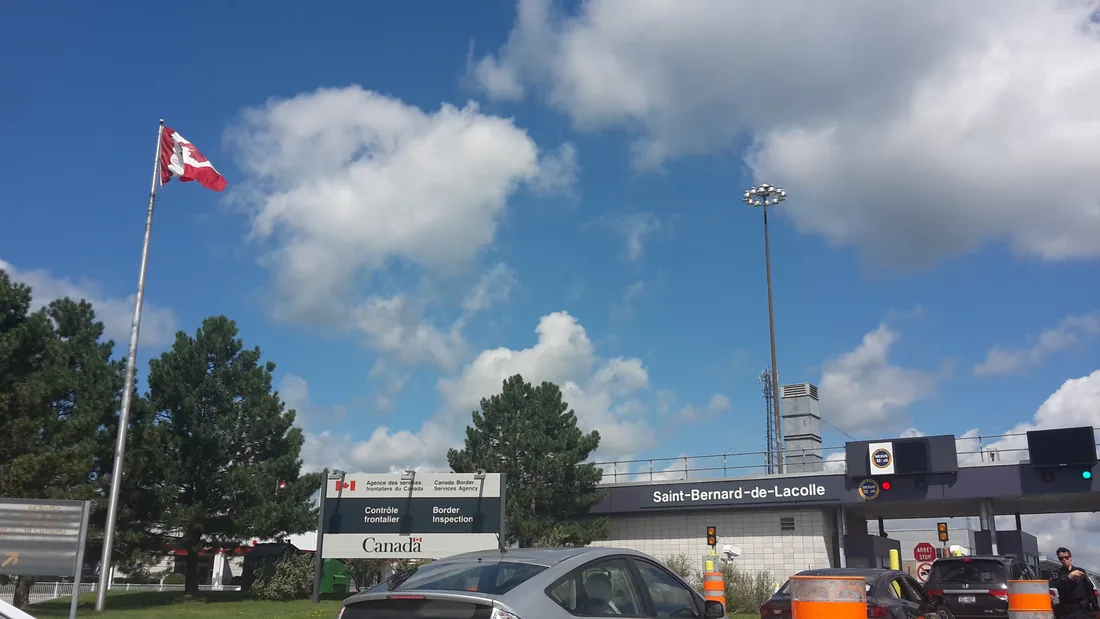


Photos on this page: 20170809-Saint-Bernard-de-Lacolle US-Canada (NY-Quebec) border crossing by Aude, CC BY-SA 4.0. Resized and cropped for this site. All photo credits