
Malone's History and the House of History
Malone history from the 1802 settlement: the 1814 British raid, the Fenian raids, Vice President Wheeler, the 1935 Schultz trial and the House of History.
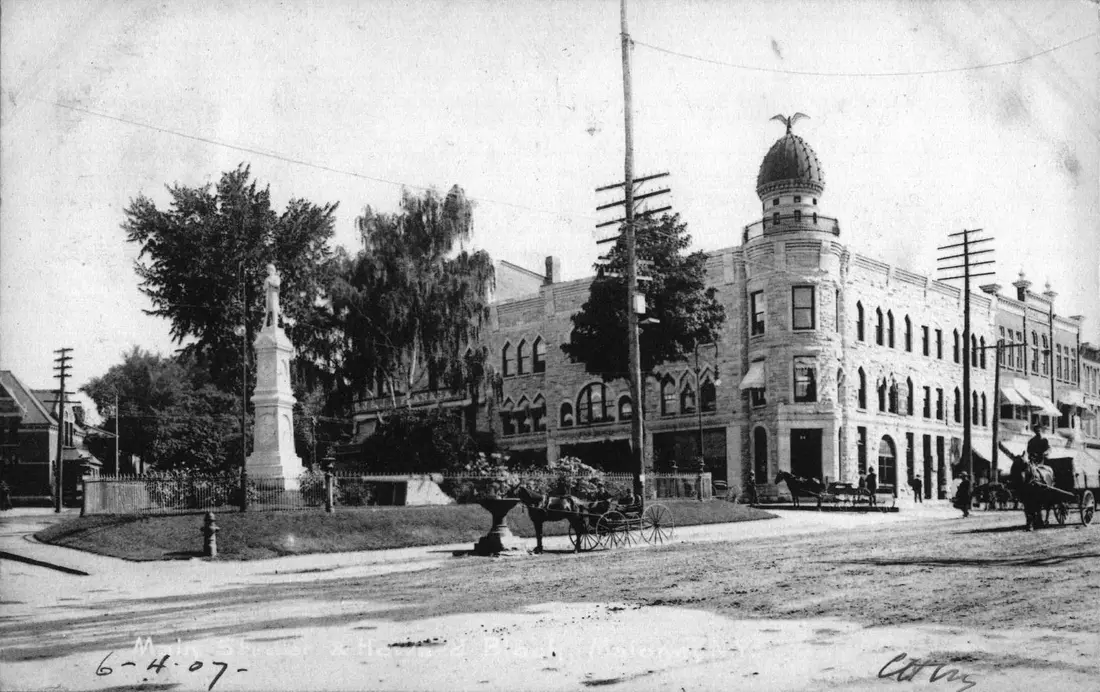
Malone turns up in American history more often than most villages its size. A British column took it over in 1814, Irish veterans massed here twice to invade Canada, a vice president was born, worked and was buried here, the boy in Farmer Boy came to town here, and in 1935 a Malone jury acquitted Dutch Schultz. Most of the sites are a few blocks apart, ten road miles north of the cabins, and the House of History on Milwaukee Street keeps the county's collections and records. The Modern Tiny Home carries small touches of that history in its decor; this page is the story behind them, and the practical side of town is on the Malone town guide.
A settlement on the Salmon River
In 1791 Alexander Macomb bought 3.6 million acres of northern New York from the state and sold pieces of it to friends and partners, among them Richard Harison. In 1802 the first settlers, the brothers Enos, Nathan and John Wood of St. Albans, Vermont, settled beside the Salmon River at a spot people called The Center, and many more Vermonters followed. Potash, made by burning trees and processing the ashes for shipment to Europe, was the first thing the settlement sold to the outside world.
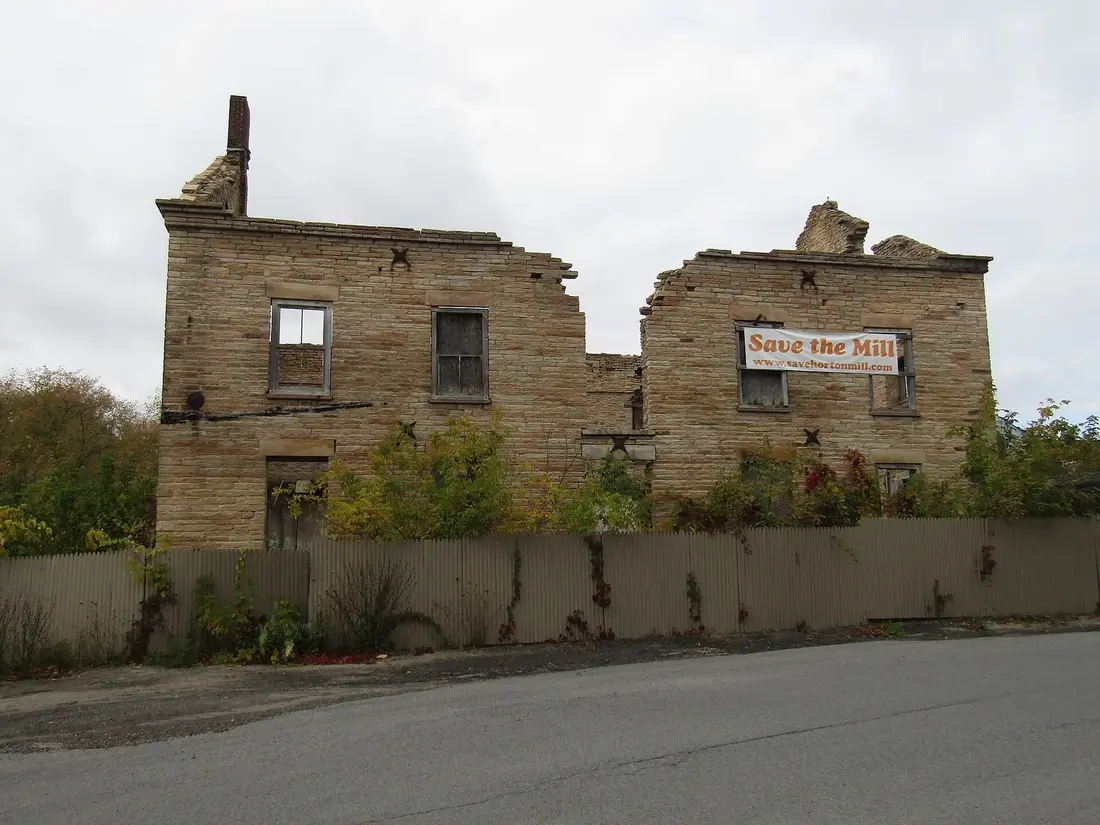
The river supplied the power. Hiram Horton, who came from Springfield, Massachusetts, in 1808, bought the mill rights on both banks and built the first mills worth the name; he went on to serve as town supervisor, county treasurer and judge. By the 1820s the village had tanneries, distilleries, sawmills, carding and fulling mills, a hat factory and gristmills, and in 1820 it got its first newspaper. In 1817 a stone arch bridge replaced the wooden one where Main Street crosses the river.
The roads were the problem. When President James Monroe toured the northern border in 1817, he stopped to admire the stone bridge then going up over the river, but he found the way to Malone barely passable, and back in Washington he ordered soldiers at Plattsburgh to work on the Military Turnpike, which was finished from Plattsburgh to Malone in 1820. A stage line then ran through Malone to Ogdensburg, and travel, mail and goods all got faster and cheaper.
Harison, Ezraville and Malone
The town was formed out of Chateaugay on March 2, 1805, and named Harison after its proprietor. On April 8, 1808, the name changed to Ezraville, in honor of Harison's friend Ezra L'Hommedieu of Long Island, and in June 1812 the whole town took the name Malone, which already belonged to one of its two townships; the other township was called Shelah. The original owners in this part of Macomb's purchase were almost all Irishmen, and most of the township names came from places in Ireland.
For nearly three quarters of a century nobody seems to have asked where the name came from. In 1885 William A. Wheeler, by then a former vice president, decided it honored a Malone Constable, supposedly a daughter of William Constable, and the story stuck. Later, Dr. C. W. Collins, looking into it for the historical society, found there had never been a Malone Constable, and a descendant of Richard Harison told him the township was named for Edmond Malone, the Irish Shakespeare scholar and critic, who was Harison's friend.
Malone started out enormous, more than three quarters of a million acres, and every town in Franklin County except Bellmont, Burke, Chateaugay and Franklin was carved out of it, directly or indirectly. The cabins sit in Bellmont, one of the four that was not. In February 1808 Clinton County residents petitioned for a new county to be called Norfolk; less than a month later, on March 11, 1808, the legislature created Franklin County. A law of 1809 placed the courthouse in Malone, on rising ground a few rods west of the bridge where Noah Moody's house stood, and Moody built the first courthouse there, a wooden building finished in 1813 with the jail in its basement. The village was incorporated in 1853, when it counted 2,039 people.
The War of 1812
Malone was a border town in a border war. In 1812 land in the village was deeded to the state for a militia parade ground, and a stone arsenal went up on it. After the battle of Crysler's Farm in 1813, the ailing General Wilkinson was carried on a horse litter from French Mills, now Fort Covington, to Malone, and spent the winter in the house of Francis L. Harison, the proprietor's son, with his own guard posted around it. Foot's Tavern, the old academy, the arsenal, the guardhouse and a distillery became hospital wards, and on February 1, 1814, there were 450 sick soldiers in the village.
That February the army pulled out suddenly and left the government stores behind. A British force of 1,200 regulars and 400 Canadian militia under Colonel Scott came down to collect them, pressing local teams and sleighs to haul away the flour and crackers. Scott ordered private property left alone, and the regulars obeyed; the militia who came a few days later took what they could reach. When militiamen and their Native allies tore the windows and gratings out of the arsenal and set it on fire, leading townspeople appealed to Scott, who ordered it saved, posted a guard and handed the building over to the village for educational use. His own government is said to have censured him for it.
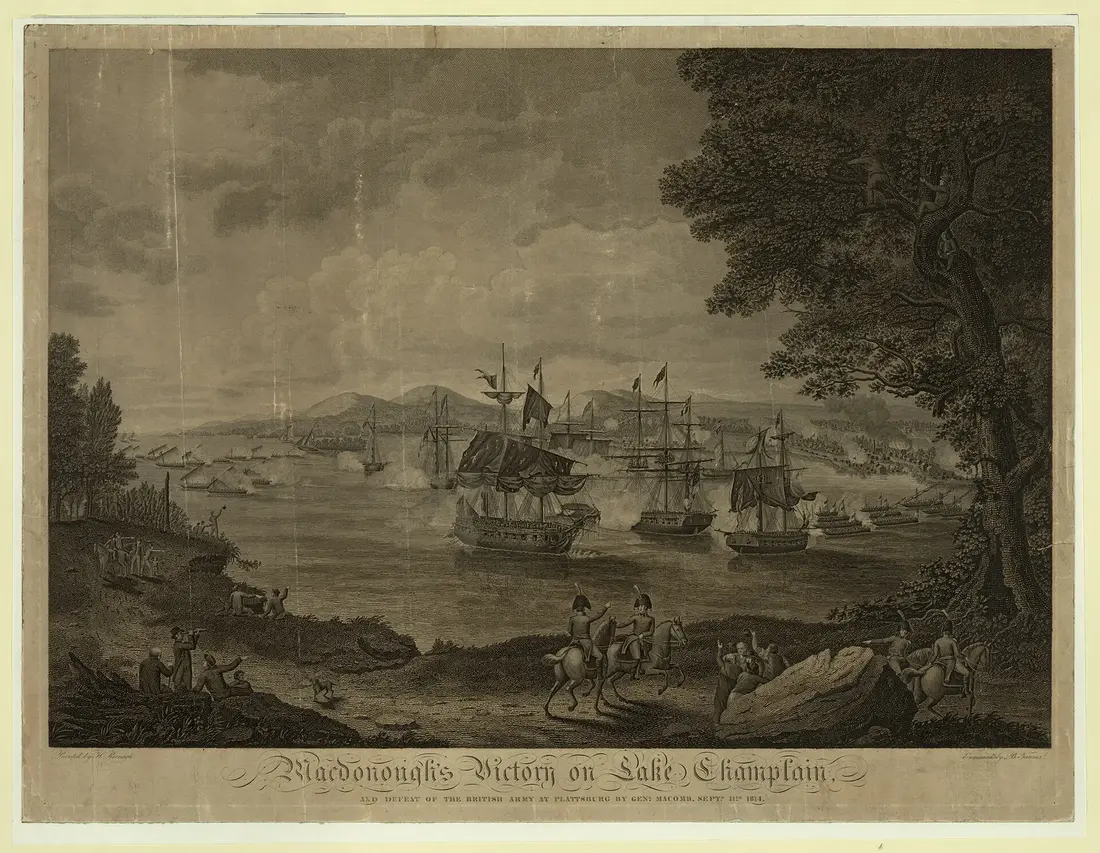
One local man got the last word. Jehiel Barnum, a Revolutionary War gunsmith living in Bangor, was pressed into service with his sleigh and two British soldiers to haul a load of stores to French Mills. His young team kept crowding the sleighs ahead, so he got permission to turn off on a back road that he said would come out right. Several miles later he drove up to his own front door and persuaded his two guards to stay. The arsenal outlived the war; the state sold it in 1850, and the parade ground is Arsenal Green today, with a 1932 state marker at East Main and Clay streets. Seven months after the raid, the British were beaten on Lake Champlain at Plattsburgh; see Plattsburgh and Lake Champlain.
Mills, rails and Main Street
On October 1, 1850, the first trains of the Northern Railroad ran into Malone on the line from Rouses Point on Lake Champlain to Ogdensburg on the St. Lawrence. Hiram Horton of Malone had sat on the railroad's first board, and William A. Wheeler built its stone shops and large covered depot in the village that year. The Malone Freight Depot on Railroad Street dates from 1852. In 1892 two more lines arrived. In January the first passenger train ran from Malone to Valleyfield and Montreal, and in July, after the people of Malone raised a $30,000 bonus to bring it, William Seward Webb's railroad through the Adirondacks ran its first train from Malone south to Saranac Lake, through Bellmont, the town the cabins are in. Webb's line crossed the old Northern at Malone Junction on outer Elm Street.
Lumber mattered close to the cabins. From 1856 to 1865 Samuel C. Wead and B. H. Man ran a lumber business with a large gang sawmill at Titusville, eight and a half miles up the river from the village; Titusville is the hamlet now called Chasm Falls, about two road miles from the cabins. They sold out to James H. Titus of New York, a land and lumber dealer who owned tracts in Malone, Bellmont, Duane and Franklin and in 1854 had dammed the river and built a gang mill just above the village. His successors shipped most of their lumber by rail to New England. Wead's widow, Mary Kasson Wead, later endowed the village's Wead Library in memory of him and of his son, Colonel Frederick Fuller Wead.
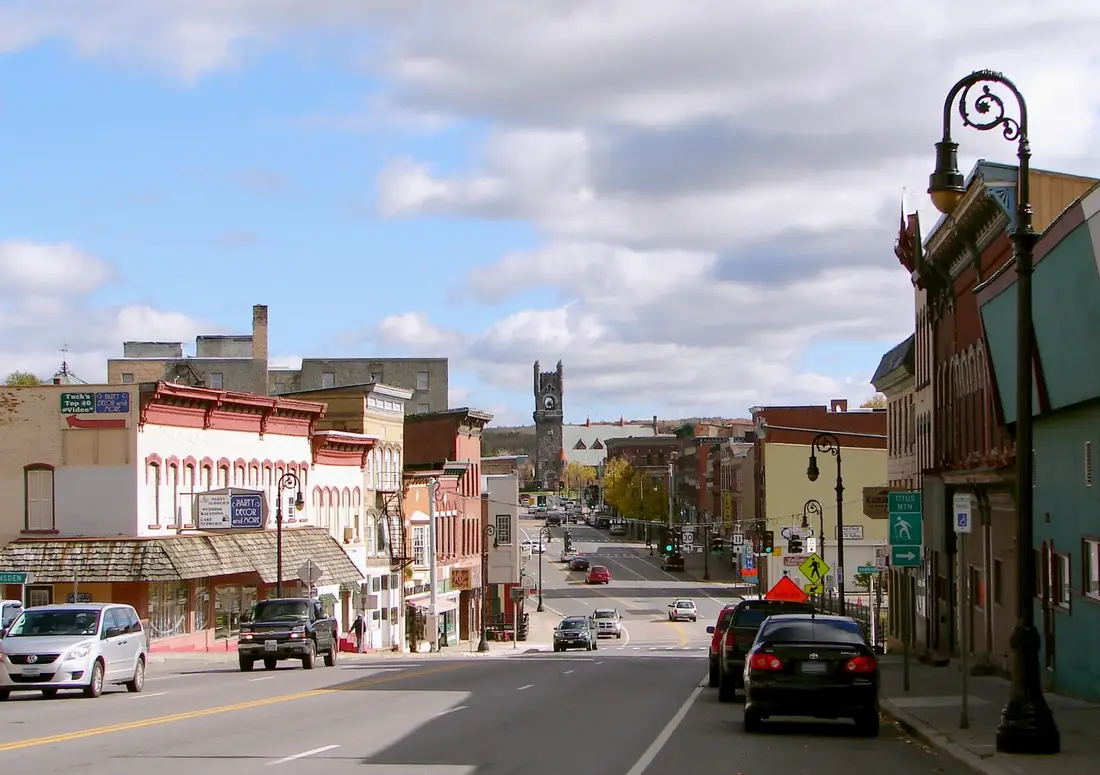
Fire shaped Main Street. On October 20, 1879, the worst fire the village had yet seen started in the Webster brothers' tannery on Mill Street and crossed the river to burn the Lincoln and Miller tannery on the other bank. In the railroad years that followed, burned blocks came back as stone or brick buildings four stories tall, older stores got new fronts, and the side streets filled with big frame houses with porches and columns. That is the Main Street you walk today. The stone Horton Gristmill by the Main Street crossing dates from 1853; the Salmon River guide covers the mill and the river.
The Fenian raids
After the Civil War, the Fenians, an Irish nationalist movement in the United States, planned to capture Canada and use it to force Britain to free Ireland. Many of their men were Civil War veterans. Malone, a railroad town close to the border, was their headquarters twice.
In the first days of June 1866, Fenians arrived in Malone by train under General Michael J. Heffernan, with Generals Murphy and O'Reilly, planning to attack Cornwall on the St. Lawrence. Estimates ran from about 1,000 men in the village to 3,000 across Malone, Potsdam and the surrounding counties. They took over the old military barracks and ran the town to suit themselves, but federal officers had already seized much of their arms at Malone and other railroad towns. General George Meade reached Malone on June 8, with about 1,000 regular soldiers in the village, and told the Fenian generals he would fight them to enforce the neutrality laws. On June 9 he ordered the expedition to disband, with transportation home for men who could not pay for it.
In May 1870 they tried again, with Malone and St. Albans, Vermont, as the bases. On May 25 a column under Generals Starr and Gleason crossed about a mile and a half into Quebec along the Trout River and dug rifle pits in front of a hop field. On the morning of May 27, British regulars of the 69th Regiment, the Huntingdon Borderers and the Montreal Garrison Artillery under Colonel Bagot marched out from Huntingdon toward Holbrook's Corners, and after three Fenian volleys and a bayonet charge the Fenians ran back across the border. Three Fenians were killed; the Canadians lost no one. In Malone the Fenians' stockpiled arms were seized and the men arrested. The road north from Malone to the border at Trout River is NY 30 today, and that crossing is closed to U.S.-bound traffic until about May 2028; see the Trout River closure.
The Underground Railroad
The border also meant freedom. The Franklin Anti-Slavery Society was organized in 1836, and its member list includes many of the village's leading citizens, among them the Rev. Ashbel Parmelee, pastor of the First Congregational Church, where antislavery meetings were held. The present church on Main Street at Clay Street is on New York's Underground Railroad Heritage Trail, and by local tradition people escaping slavery were hidden in the basement of its earlier building. The best-known Malone story is family memory that Frederick Seaver recorded in his 1918 county history: Major Dimick, who lived nearly two miles north of the village on the Fort Covington road, was remembered by his daughter as hiding people in his cellar and driving them into Canada at midnight in a lumber wagon under hay or straw. No record from the time names him, and a house on Route 37 built around 1820 is pointed out locally as his. What the records show, and what was only remembered, is sorted out in the Underground Railroad in the North Country. The Malone Revitalization Foundation, which publishes a self-guided walking tour of the northern neighborhoods, has been working on a second tour of the southern neighborhoods that will tell this history.
William A. Wheeler
William Almon Wheeler was born in Malone on June 30, 1819. His father, Almon Wheeler, a lawyer who also served as the village postmaster, died at 37 when William was eight, leaving a wife and three children. He went to the University of Vermont but left without a degree to support the family, read law with Asa Hascall, joined the bar in 1845 and served as Franklin County district attorney from 1846 to 1849. Throat trouble pushed him from the courtroom into banking in 1851, and he rose to president of the Northern Railroad.
He served in the State Assembly and State Senate, in Congress during the Civil War, and in Congress again from 1869 to 1877, and he presided over New York's constitutional convention of 1867. In Congress he worked out the Wheeler compromise of 1875, which kept a Republican governor in Louisiana after a disputed election while most of the contested seats in its legislature went to Democrats. When Rutherford B. Hayes heard that Wheeler might be his running mate in 1876, he wrote to his wife, "I am ashamed to say, who is Wheeler?" Wheeler's wife, Mary King Wheeler, died suddenly on March 3, 1876, and he served as vice president from 1877 to 1881 as a widower.
After a failed run for the U.S. Senate in 1881, he retired to Malone and died there on June 4, 1887. He is buried in Morningside Cemetery beside Mary. His house on Elm Street is now the Malone Elks Lodge, and a 1932 state marker stands at Elm Street and Wheeler Avenue. The House of History has original furnishings and belongings of his, and the top hat he wore at the inauguration has been part of its collection.
Franklin Academy and Farmer Boy
Malone had a school called Harison Academy from 1806, a two-story frame building of timber cut and hewn on the spot, but it was never chartered, because the state required a guaranteed yearly income that the town could not raise. The fix came in 1831. Seventy-three men mortgaged their homes and farms, pledging from $15 to $225 each at seven percent interest for twenty years, which guaranteed the new Franklin Academy just under $300 a year. Hiram Horton and the tanner Anselm Lincoln, whose 1830 house is on Duane Street, were among them. The charter came on April 28, 1831, and the academy opened that December with one teacher, Simeon Bicknell, and eighty pupils in its first year.
After a fire in 1835, the academy moved in 1836 into a three-story stone building, with students lodging in rooms upstairs. That is the school where Royal, Eliza Jane and Alice Wilder went, the older brother and sisters of Almanzo Wilder, whose boyhood on a farm in Burke from 1857 to about 1875 became Laura Ingalls Wilder's Farmer Boy. Whether Almanzo himself enrolled is not documented, though it is likely. The stone building came down in 1868; its brick replacement burned in December 1880 and was rebuilt, and that 1881 building has housed Malone's middle school. The fair in the book is the Franklin County Fair, and the historical society's collection has held papers, letters and keepsakes of Laura Ingalls Wilder. The farm itself is on the Almanzo Wilder Farm guide, and Farmer Boy country ties the book to the land around the cabins.
The Chinese Exclusion years
The Chinese Exclusion Act of 1882 barred Chinese laborers from the United States. Around the turn of the twentieth century, Malone was one of only four ports of entry for Chinese immigrants, and the one for those headed to New York City. Many sailed from China to Vancouver, paid a $500 head tax to enter Canada, and rode the Canadian Pacific east. When their trains crossed into the United States at Malone, the men were arrested and held for hearings before a federal commissioner, first in the county jail and, from July 1903, in a barn the county converted into a detention house for $3,410. At times more than 200 men were held in the jail and 300 to 400 in the detention house, and the federal government paid the county $3 a week for each.
Almost all were released after testimony that they had been born in the United States. Malone attorney Robert M. Moore represented many of them and took one case, United States v. Sing Tuck, to the U.S. Supreme Court, which ruled against him. The detentions in Malone went on until 1911, and Congress repealed the Exclusion Act in 1943.
The 1935 Dutch Schultz trial
Federal judge Frederick H. Bryant, a Malone lawyer appointed by President Coolidge in 1927, often held summer court in his hometown instead of Syracuse. In 1935 that brought the tax-evasion case against Arthur Flegenheimer, the New York bootlegger known as Dutch Schultz, to the Franklin County Courthouse, after his first trial, in Syracuse that April, ended with a hung jury. A week before the new trial, Schultz checked into a suite at the Flanagan Hotel, bought meals and drinks for everyone in local restaurants and nightspots, and went riding on a bridle path along the Salmon River with the teenage son of one of his two Malone defense lawyers.
The jury was sworn on July 23, 1935. On August 1, at 8:55 p.m., after 28 hours and 20 minutes of deliberation, it found Schultz not guilty, and a cheer went up inside the courtroom and out on the street. Judge Bryant told the jurors their verdict "shakes the confidence of law abiding people in the reliability of juries," and the U.S. Attorney General called it a terrible miscarriage of justice. The foreman said the government had not proved its case. Schultz was shot dead in Newark, New Jersey, that October. The courthouse on West Main Street, built in 1930 on the site of the three before it, is the one where the trial was held, and its main courtroom was restored to its original look in 2009. The Flanagan was torn down in April 2026.
Snowmobile town
Malone got into snowmobiles early. In 1962 Leon "Duke" Elliot and Dee Hutchins of Malone, who had sold Bombardier's full-size half-track machines, became one of the first three Ski-Doo distributors in the United States, and with Al Dufrane of Dufrane Motor Distributors in Malone they were the first dealers of modern snowmobiles in northern New York. One of the earliest snowmobile races in the state was held at the Malone Winter Carnival in late January 1963, organized by the local Amvets post, and when Malone hosted the Northeastern United States Snowmobile Championships in 1969, local newspapers were calling it the snowmobile capital of the world.
Part of the old railroad network lives on as trail. In Malone, the former rail bed that runs north and south near the east side of the Salmon River has carried snowmobiles in winter. The cabins sit near the C7 corridor; see snowmobiling the C7.
Buildings on the National Register
| Building | Built | Listed | Where and what to know |
|---|---|---|---|
| Horton Gristmill | 1853 | 1975 | Mill Street on the river; a roofless stone shell, seen from Main Street |
| Anselm Lincoln House | About 1830 | 1975 | 49 Duane Street, on a bluff over the river; a private home, seen from the street |
| Paddock Building | About 1848 | 1976 | 34 West Main Street; lost in the 2017 downtown fire. The plans for Harison Place, the apartment building that opened on the fire site in 2024, called for sandstone blocks salvaged from it |
| Malone Freight Depot | 1852 | 1976 | 99 Railroad Street, a freight house from the first years of the railroad |
| U.S. Post Office | 1934 | 1989 | East Main and Washington streets; Classical Revival, yellow brick, from the Treasury's architect Louis A. Simon |
| First Congregational Church | 1880s | 1991 | 2 Clay Street; Romanesque church by Tristram Griffin, the congregation's third building on the site |
| Malone Armory | 1891 to 1892 | 1995 | West Main Street; armory by Isaac G. Perry, used by the Guard until 2003 and home to the Malone YMCA since 2004 |
| Malone Downtown Historic District | Late 1800s to early 1900s | 2021 | The commercial core, roughly Brewster, Main, Church and Elm streets and Wheeler Avenue |
| Malone Residential Historic District | About 120 years of houses | 2025 | From the Salmon River to Fourth Street and east to Prospect and Morton streets |
The two districts put the downtown commercial blocks and the old neighborhoods east of the river on the Register, along with the single buildings. The houses in the residential district cover about 120 years of building, from Greek Revival and Gothic Revival through Second Empire, Queen Anne, Colonial Revival, Craftsman and the American Foursquare to Minimal Traditional. The Malone Revitalization Foundation has published a self-guided walking tour of the northern residential area, the North Malone Walking Tour, on the STQRY app, with 35 stops and an audio option; search for Malone in the app before you go.
The House of History
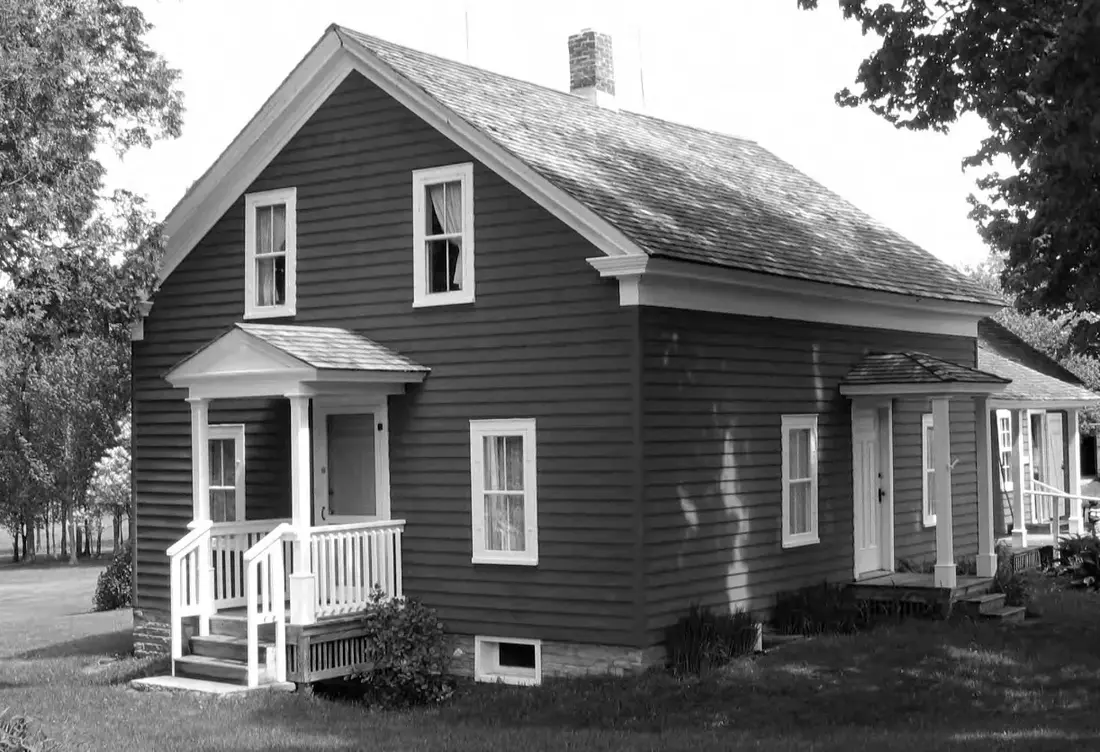
The Franklin County Historical and Museum Society keeps its museum in the House of History at 51 Milwaukee Street, a Tuscan-style brick house a short walk south of Arsenal Green. Nathan Knapp built it in 1863 and 1864 on land once owned by Judge Hiram Horton, and Martha P. Soper bought it new in 1864 for $3,250 and lived there until 1892. Later owners included a minister and the Crooks family, and Elizabeth Crooks Kirk lived there until her death in 1973.
The society was incorporated in 1903 and reorganized in 1963. The county legislature has designated it the official Franklin County historian, and it is also the town and village historian for Malone. Downstairs, the rooms are furnished the way the house's owners would have had them, among them a dining room and a kitchen called Grandma's kitchen; upstairs are exhibit rooms of earlier eras and local history displays. The collection has included a deerskin chest from about 1833, a broom-making machine, hand looms and old baby carriages, along with the Wheeler pieces. The country store in the house sells books and keepsakes. Fourth graders come on school trips to make cookies, clothespin people, candles, brooms and woven pieces, with molasses cookies and milk in the formal dining room at the end.
Museum tours are by appointment only, and admission is $5. The office keeps posted hours of Tuesday to Friday, 11 a.m. to 3 p.m.; call 518-483-2750 or email fcohms@northnet.org to set up a visit. Since 1964 the society has published the Franklin Historical Review, sixty volumes through 2026, and it offers them through its website.
The Schryer Center and family research
In 2008 the old carriage house behind the main building was renovated into a research and archive area, and the society's research center, the Schryer Center, shares the 51 Milwaukee Street address. It holds Franklin County resources and local family collections, with trained genealogists on hand, and the society will do genealogy research on request for a small charge. It is open Tuesdays and Thursdays from 10 a.m. to 3 p.m., or by appointment; email research@northnet.org with the names, dates and places you are after before you come. The society also holds verbatim reports of nineteenth-century trials that the county's legal history cites, and its resource list includes the 1880 county history by D. Hamilton Hurd and an index of the county's War of 1812 veterans.
A history walk downtown
From the cabins it is about ten road miles to the House of History. Park near the courthouse on West Main Street and allow about two hours on foot, more with a museum tour.
- Franklin County Courthouse, 355 West Main Street: the 1930 courthouse of the Schultz trial, on the site chosen in 1809. It is a working courthouse, and court business comes first.
- Anselm Lincoln House, a short detour south on Duane Street to number 49: the 1830 house on its bluff, a private home.
- The Main Street crossing: the Salmon River below, the Whittlesey Dam, and the Horton Gristmill beside the river. At the small overlook at the east end of the bridge, the Historic Malone marker covers the 1802 settlement at The Center, the mills and the railroads.
- First Congregational Church and Arsenal Green, at East Main and Clay streets: the Underground Railroad church and the old parade ground, each with a 1932 state marker.
- House of History, 51 Milwaukee Street, south of the green by way of Clay Street, if you booked a tour.
- Post office, East Main and Washington streets: the 1934 building.
- Wheeler's house on Elm Street, now the Elks Lodge, with the state marker at Wheeler Avenue; the Wead Library is a few steps away at 64 Elm.
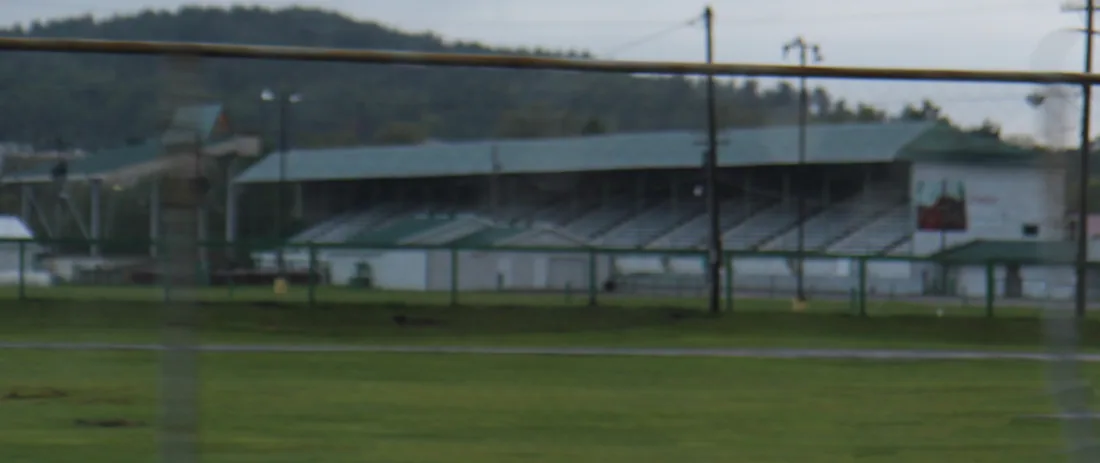
By car, add the armory on West Main Street, now the YMCA, and the Franklin County Fair marker at East Main and Raymond streets, which notes the fairgrounds as a Fenian marshalling ground and the fair of Farmer Boy. For food and errands around the walk, see the town guide; for the state forest that carries the Titusville name, see Titusville Mountain State Forest.
Questions
When is the House of History open?
Museum tours are by appointment only, and admission is $5. The society's office keeps posted hours of Tuesday to Friday, 11 a.m. to 3 p.m.; call 518-483-2750 or email fcohms@northnet.org a few days ahead. The house is at 51 Milwaukee Street, about ten road miles from the cabins. For lunch and errands nearby, see the Malone town guide.
Can I research my family history in Malone?
Yes. The society's Schryer Center, next to the House of History, holds Franklin County resources and local family collections and has trained genealogists. It is open Tuesdays and Thursdays from 10 a.m. to 3 p.m. or by appointment, and the society will do genealogy research on request for a small charge. Write to research@northnet.org first with the names and dates you are after.
Where was the Dutch Schultz trial held?
In the Franklin County Courthouse on West Main Street in Malone, the 1930 building that is still the county courthouse. A jury there acquitted Schultz on August 1, 1935, after more than 28 hours of deliberation. The Flanagan Hotel, where he stayed before the trial, was torn down in April 2026.
Is Malone named after Edmond Malone?
Yes. In 1812 the town took the name of one of its townships, Malone, which a descendant of the proprietor Richard Harison said was named for Edmond Malone, the Irish Shakespeare scholar and Harison's friend. An 1885 theory that it honored a Malone Constable was disproved; no such person existed. The town was called Harison from 1805 and Ezraville from 1808.
Did Almanzo Wilder go to school in Malone?
His older brother Royal and sisters Eliza Jane and Alice attended Franklin Academy in Malone, in its 1836 stone building. Whether Almanzo enrolled there too is not documented, though it is likely. His boyhood farm in Burke, the setting of Farmer Boy, is open to visitors in summer; see the Almanzo Wilder Farm.
Where is Vice President William A. Wheeler buried?
In Morningside Cemetery in Malone, beside his wife, Mary King Wheeler. He was born in Malone in 1819, served as vice president under Rutherford B. Hayes from 1877 to 1881, and died in Malone in 1887. His house on Elm Street is now the Elks Lodge, with a state marker at Elm Street and Wheeler Avenue.
What happened in Malone during the War of 1812?
The village was a hospital town for General Wilkinson's army in the winter of 1813 to 1814. After the army left in February 1814, a British force of 1,200 regulars and 400 Canadian militia came to carry off the stores. Its commander, Colonel Scott, saved the village's stone arsenal from burning; the site is Arsenal Green today. For the battle that followed that September, see Plattsburgh.
Sources
Facts on this page were checked against these sources in October 2026. Hours, fees and schedules change; confirm before you go.
- franklinhistory.org franklinhistory.org/
- franklinhistory.org franklinhistory.org/house-of-history
- franklinhistory.org franklinhistory.org/schryer-center
- franklinhistory.org franklinhistory.org/field-trips-enrichment
- franklinhistory.org franklinhistory.org/resources
- history.nycourts.gov history.nycourts.gov/wp-content/uploads/2019/07/County-Legal-History_F
- history.nycourts.gov history.nycourts.gov/figure/william-wheeler/
- archive.org archive.org/details/historyofclinton00hurd
- archive.org archive.org/details/historicalsketch00seav
- gutenberg.org gutenberg.org/ebooks/19599
- gutenberg.org gutenberg.org/files/39021/39021-h/39021-h.htm
- dos.ny.gov dos.ny.gov/system/files/documents/2019/05/malonesii.pdf
- northcountryundergroundrailroad.com northcountryundergroundrailroad.com/franklin-county.php
- museum.dmna.ny.gov museum.dmna.ny.gov/armories-arsenals/malone-arsenal
- museum.dmna.ny.gov museum.dmna.ny.gov/armories-arsenals/malone-armory-west-main-street
- hmdb.org hmdb.org/m.asp?m=78997
- hmdb.org hmdb.org/m.asp?m=57265
- hmdb.org hmdb.org/m.asp?m=57264
- hmdb.org hmdb.org/m.asp?m=78983
- hmdb.org hmdb.org/m.asp?m=57179
- hmdb.org hmdb.org/m.asp?m=57266
- npgallery.nps.gov npgallery.nps.gov/AssetDetail/NRIS/75001188
- npgallery.nps.gov npgallery.nps.gov/AssetDetail/NRIS/75001189
- npgallery.nps.gov npgallery.nps.gov/AssetDetail/NRIS/76001218
- npgallery.nps.gov npgallery.nps.gov/AssetDetail/NRIS/76001217
- npgallery.nps.gov npgallery.nps.gov/AssetDetail/NRIS/88002350
- npgallery.nps.gov npgallery.nps.gov/AssetDetail/NRIS/91000627
- npgallery.nps.gov npgallery.nps.gov/AssetDetail/NRIS/95000089
- nps.gov nps.gov/subjects/nationalregister/weekly-list-2021-03-05.htm
- home.nps.gov home.nps.gov/subjects/nationalregister/weekly-list-2025-03-21.htm
- governor.ny.gov governor.ny.gov/news/governor-hochul-announces-37-nominations-state-an
- livingnewdeal.org livingnewdeal.org/sites/post-office-malone-ny/
- hcr.ny.gov hcr.ny.gov/news/governor-hochul-announces-start-construction-22-millio
- governor.ny.gov governor.ny.gov/news/governor-hochul-announces-completion-40-unit-mixe
- plattsburghymca.org plattsburghymca.org/Malone/About-Malone
- newyorkalmanack.com newyorkalmanack.com/2022/01/snowmobile-racing-in-new-york-state-some-h
- pioneergirl.com pioneergirl.com/blog/archives/5068
- senate.gov senate.gov/about/officers-staff/vice-president/VP_William_Wheeler.htm
- bioguide.congress.gov bioguide.congress.gov/search/bio/W000341
- Visit Malone visitmalone.com/blog/2016/02/william-wheeler-pillar-integrity
- Visit Malone visitmalone.com/blog/2016/05/house-where-history-lives
- weadlibrary.com weadlibrary.com/about
- wcax.com wcax.com/2026/04/13/demolition-starts-former-north-country-hotel-vacan
- northcountrypublicradio.org northcountrypublicradio.org/news/story/53361/20260429/demolition-of-fl
- mymalonetelegram.com mymalonetelegram.com/top_stories/malone-revitalization-foundation-unve
In this guide
Stay nearby
The first of the cabins: a big stone fire pit you see as you walk up, a screened corner of the deck, direct trail access, and a short walk to an observation deck over the pond.
 The Modern Tiny HomeCabin 1 · 2 bd · 1 ba · sleeps 4
More in Towns & History
Sources
45 references, listed in full at the end of this guide: official park, state, tourism-office and business sources, checked October 2026.
Related guides


Photos on this page: Ruins of Horton Grist Mill, Malone, NY Front View by OneEagle, CC BY-SA 4.0; Franklin County Fairgrounds Malone by Royalbroil, CC BY-SA 4.0; Malone NY by P199, CC BY-SA 3.0. Resized and cropped for this site. All photo credits