
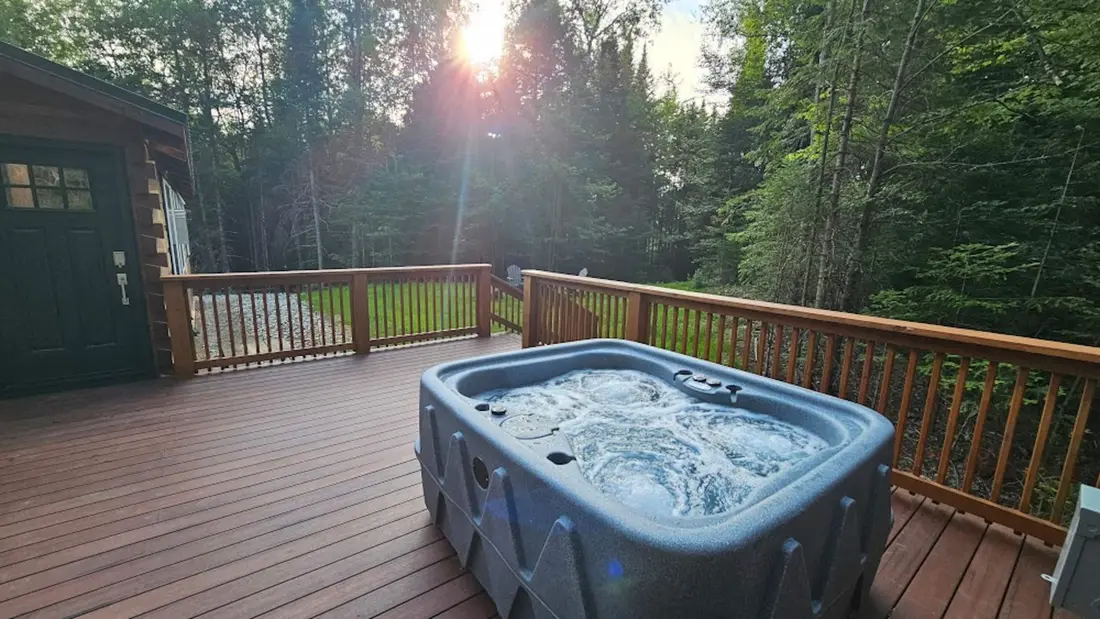
The northern lights reach the sky over the cabins a few nights a year, and the current solar cycle has run stronger than the official forecast. Nobody can book an aurora. You can be ready for one: know which forecasts matter, which way to face from your deck, how to set a phone, and how to turn a long night of waiting into a long soak in your own hot tub.
How far north the cabins sit
On an ordinary map the cabins sit at about 44.8 degrees north, near the hamlet of Owls Head and about ten road miles south of Malone. Portland, Oregon, and Bordeaux, France, sit at nearly the same latitude. The aurora follows a different map. It is guided by Earth's magnetic field, and the north pole of that field, in its simplest dipole form, sat at 80.85 degrees north and 72.76 degrees west in 2025. Seen from the cabins, that point lies within half a degree of due north.

Measured from that pole, the cabins sit at about 54 degrees magnetic latitude, 53.9 on the British Geological Survey's calculator for the current field model. Portland comes out near 51 and Bordeaux near 47. Those degrees are what count. NOAA's Space Weather Prediction Center (SWPC) gives a rule of thumb: the southern edge of the auroral oval sits near 66 degrees magnetic latitude when the Kp index is 0 and moves about 2 degrees toward the equator for each step up the scale, to about 48 degrees at Kp 9. From a spot with a clear view north, a bright aurora can be seen even when it is 1,000 kilometers (600 miles) farther north.
Apply that rule to the cabins, at about 69 miles to a degree, and you get this:
| Kp | NOAA storm level | Edge of the oval | Where that edge sits |
|---|---|---|---|
| 4 | below storm level | about 58 degrees | about 280 miles north of the cabins |
| 5 | G1, minor | about 56 degrees | about 145 miles north |
| 6 | G2, moderate | about 54 degrees | about overhead |
| 7 | G3, strong | about 52 degrees | about 130 miles south |
| 8 | G4, severe | about 50 degrees | about 270 miles south |
| 9 | G5, extreme | about 48 degrees | about 410 miles south |
At Kp 6 the oval reaches the cabins' magnetic latitude, and from Kp 7 up it passes to the south, which is when the aurora can climb overhead; at Kp 8 and 9 it may be seen directly overhead across the northern states. At Kp 4 and 5 the oval stays north, inside that 600-mile range, so a bright display can show as a glow low in the north. Northern states can see auroras when Kp is as low as 4; places farther south need more. The real oval is lumpier than any rule, so read the table as odds.
How often the aurora shows up here
A National Weather Service meteorologist in Albany said in 2023 that the aurora is visible from the Adirondacks several times a year. The storm records agree. We went through the three-hour Kp values from the GFZ German Research Centre for Geosciences, which provides the index, and counted the nights when storms reached G2 or stronger in the three overnight blocks, 8 p.m. to 5 a.m. Eastern daylight time (7 p.m. to 4 a.m. in winter):
| Year | G2 or stronger | G3 or stronger | G4 or stronger |
|---|---|---|---|
| 2023 | 11 nights | 3 nights | 2 nights |
| 2024 | 10 nights | 6 nights | 2 nights |
| 2025 | 17 nights | 9 nights | 2 nights |
| 2026, through October 8 | 6 nights | 4 nights | none |
Ten to seventeen storm nights a year is the busy end of the cycle, and the sky has to be clear on the right one. On October 10, 2024, the storm held at G4 levels from late morning until after sunrise the next day, and in parts of the northern Adirondacks clouds still hid the show until about 3 a.m. The people who chase the aurora tell the same story. A Saratoga County photographer caught about two dozen auroras in 2024, a big number for the Adirondack Park, and said most of the time the lights were too faint to see without a camera. In quieter years, dedicated chasers might see it a few times, if at all.
NOAA's long-run averages fill in the rest. Over an 11-year cycle there are about 100 severe G4 storms, spread over some 60 days, and about 4 extreme G5 storms. Most aurora nights at the cabins come with moderate and strong storms instead, and the surest way to improve the odds is to stay longer and keep an eye on the forecasts.
The May 2024 storm
The storm most people remember began at 12:06 p.m. Eastern on Friday, May 10, 2024. NASA counted at least seven coronal mass ejections, clouds of solar material and magnetic field, headed for Earth. NOAA rated the storm G5, extreme, the first G5 since October 31, 2003. The magnetic disturbance peaked at 5:24 p.m., still daylight in New York, and the aurora was waiting when it got dark: Kp reached 9, the top of the scale, between 8 and 11 p.m. Eastern and stayed at 8 or above until after dawn.
The display lit Adirondack skies and was reported as far south as Florida. NASA's scientists rank it the strongest geomagnetic storm in two decades and possibly among the strongest displays of auroras on record in the past 500 years, with reports from as low as 26 degrees magnetic latitude, about half the cabins' figure. Two things from that night matter for a stay here. The storm started in the middle of the day, so by dusk it was already in full swing; check the Kp chart before dark, not after. And it ran all night, which is where the hot tub plan below comes in.
The October 2024 storm and the 3 a.m. clearing
October 2024 showed how much warning a big storm gives. A fast coronal mass ejection left the sun on the evening of Tuesday, October 8, at an estimated 1,200 to 1,300 kilometers per second. SWPC posted a G4 watch for October 10 and 11 on Wednesday morning. The cloud arrived at 11:15 a.m. Eastern on Thursday, October 10, at nearly 1.5 million miles an hour, and the storm held at G4 levels from late morning until after sunrise on Friday. That is about a day of notice from the watch, and about a day and a half from the eruption.
The New York City area saw it that evening, from Queens to Long Island. In the northern Adirondacks the storm was strong all night and the sky was not. The Adirondack Explorer's multimedia reporter went out with his camera around 8 p.m. and found clouds. At 3 a.m. the sky cleared near Paul Smiths, about 31 road miles from the cabins, and green rays and waves of light stayed visible to the naked eye for the next couple of hours. An amateur photographer who had spent the evening driving the roads north of Saranac Lake under clouds took a nap in his Jeep at the Upper St. Regis Lake boat launch, woke a little after 3 a.m. to a clear sky and photographed greens, reds and purple until dawn.
It was the third aurora night that week. On Sunday evening red aurora showed over the southwestern Adirondacks, and from Monday evening into Tuesday morning a G3 storm gave an Old Forge photographer the best show he had seen, with rays so high he could aim his camera south and still catch them. Three nights in one week is more than some Northeast photographers see in a year. The lesson for a stay at the cabins: when the numbers are high and the sky is cloudy, set an alarm and look again. The Saranac Lake and Paul Smiths guide covers that country by daylight.
The solar cycle in 2026 and 2027
The sun's roughly 11-year cycle drives all of this, and Solar Cycle 25 began in December 2019. In 2019 an international panel predicted a modest peak, a smoothed sunspot number of 115 in July 2025. The sun beat it: the smoothed number topped out at 160.9 in October 2024. It has been falling since. Monthly counts ran in the high 70s in July and August 2026 and dropped to about 60 in September. SWPC's prediction puts the smoothed number near 88 through the winter of 2026 and 2027, about 61 by December 2027 and under 50 by the middle of 2028.
A falling count still brings storms. Fairly significant ones, while less frequent, often come during the declining phase of a cycle, and this one has kept producing them: storms reached G4 at 8:20 p.m. Eastern on November 11, 2025, and at 2:38 p.m. on January 19, 2026, and G3 at 7:28 p.m. on March 20, 2026. History points the same way. The Halloween storms of October 2003, which put the aurora over California, Texas and Florida, came two years after Solar Cycle 23 peaked, when the smoothed sunspot number was 89, about half its peak and close to where SWPC expects it this coming winter.
The quieter years add a different kind of storm. Coronal holes on the sun send out fast streams of solar wind that can bring minor to moderate storms. A single hole can last through several 27-day rotations of the sun, so the same stream can come back about four weeks later, and coronal holes are more common in the years around solar minimum. Our read for guests: the winter of 2026 to 2027 and the one after should bring fewer big storms than 2024 and 2025, with good nights still in the mix.
Forecasts from a month out to the last hour
Space weather forecasts come in layers, and each one answers a different question.
- The 27-day outlook comes out every Monday with the largest Kp expected on each of the next 27 days. Recurring coronal-hole streams show up in it; a fresh eruption cannot. Glance at it when you pick dates.
- Storm watches for G1 through G4 and above go out up to 72 hours ahead. Their timing and strength carry less confidence. In practice a day or two of notice is the best anyone gets.
- The 3-day forecast is a one-page text issued twice a day, at 0030 and 1230 UTC, with the expected Kp for every three-hour block and a G label beside any storm-level number.
- Warnings go out minutes to a couple of hours ahead, based on the solar wind measured upstream, and carry higher confidence than watches. Alerts go out when a K-index level is reached.
- The 30-minute aurora forecast runs SWPC's OVATION model on the upstream solar wind to map where the aurora is and how bright it should be 30 to 90 minutes ahead. Its green oval turns red where the aurora is forecast to be more intense.
- The experimental tonight and tomorrow night maps run the same model on the highest Kp forecast between 6 p.m. and 6 a.m. Central time. The viewline once drawn on these maps was removed in May 2026, so older advice to check it is out of date.
The 3-day forecast is written in UTC. Here is how its blocks line up with the clock in the cabin. Daylight time runs until 2 a.m. on November 1, 2026, and returns on the second Sunday of March.
| Forecast block (UTC) | Eastern daylight time | Eastern standard time |
|---|---|---|
| 21-00 | 5 to 8 p.m. | 4 to 7 p.m. |
| 00-03 | 8 to 11 p.m. | 7 to 10 p.m. |
| 03-06 | 11 p.m. to 2 a.m. | 10 p.m. to 1 a.m. |
| 06-09 | 2 to 5 a.m. | 1 to 4 a.m. |
| 09-12 | 5 to 8 a.m. | 4 to 7 a.m. |
Kp itself is a three-hour index, so it trails what is happening overhead and will not tell you the minute to step outside. That job belongs to the solar wind.
Reading the solar wind on the night
Spacecraft at the L1 point, about a million miles toward the sun, measure the solar wind before it reaches Earth. NOAA's SOLAR-1, launched in September 2025, entered operational service in 2026 and sends its readings to the ground within five minutes, taking over from DSCOVR and ACE, which have supplied the data since 2016 and 1998. The wind then takes somewhere between a quarter of an hour and an hour and a half to cover the last million miles, depending on its speed. That is all the warning anyone gets of a display's exact timing.
Four numbers on SWPC's real-time solar wind page, or in most aurora apps, tell you nearly all you need:
- Bz is the north-south direction of the magnetic field the wind carries, and it matters most. South, shown as a negative number, lets the wind's energy into Earth's field. Readings of minus 10 nanotesla or lower that hold are a good sign a storm could build.
- Bt is the field's total strength: above 10 is moderately strong, 20 strong and 30 very strong.
- Speed normally runs around 300 kilometers per second. A coronal mass ejection can push it past 500 or even 1,000, and speeds above 700 help the aurora reach the lower middle latitudes.
- Density above about 20 particles per cubic centimeter is a good start for a strong storm, though density alone guarantees nothing.
The Saratoga County photographer above learned this the slow way. Early on he spent seven hours on the shore of Great Sacandaga Lake waiting on a Kp forecast that never came true; now he watches wind speed, density and the field's direction, all published by NOAA. Our version for the deck: when Bz swings well south and stays there while the speed climbs, put your boots on.
Alerts and apps
A display that peaks at 2 a.m. does you no good if you sleep through it. Set up one or two of these before the trip:
- SWPC email. The subscription service at pss.swpc.noaa.gov sends watches, warnings and alerts within moments of their release. For the cabins, the K-index 6 and 7 alerts and the storm watches are the ones worth having.
- Aurorasaurus. A NASA citizen-science project running since 2012. Sign in and it sends free alerts when people near you report the aurora. Its live map of the oval and recent sightings updates every 30 minutes, and you can file your own report from the deck.
- My Aurora Forecast & Alerts. A free, ad-supported app with the current Kp, a world map built on SWPC's OVATION forecast and push notifications when activity is expected to be high.
- SpaceWeatherLive. Run by Parsec, a Belgian nonprofit, with real-time solar wind charts, Kp, alerts and apps for iPhone and Android. A paid Pro version removes the ads.
Chasers in New York also trade reports in Facebook groups and chats that run from dusk to dawn, and a local online group is worth joining before a trip. Each cabin has wifi. If your phone silences notifications overnight, add the aurora app to the ones allowed through.
Where to look from the decks
Face north. A magnetic compass here points about 13 degrees west of true north, so turn a little to the right of the needle, or find the North Star the way the stargazing post describes. At this latitude the aurora often shows close to the northern horizon: a pale arc or glow, sometimes with rays standing up from it. Red often tops the display, for reasons the next section explains. In the biggest storms the display climbs overhead and spreads into the southern sky.
Each cabin gives you a different place to stand:
- The Aviator has a large open deck with no screen, the easiest place to watch and shoot from the hot tub.
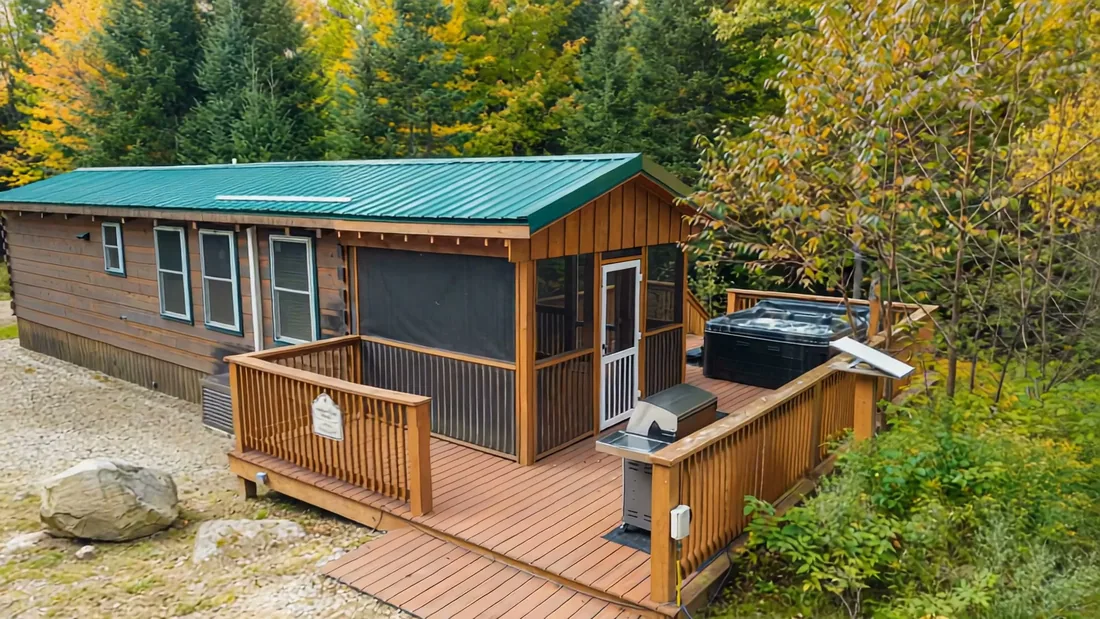
- The Modern Pine has a large screened room on its deck. Step out from behind the screens to look and to shoot.
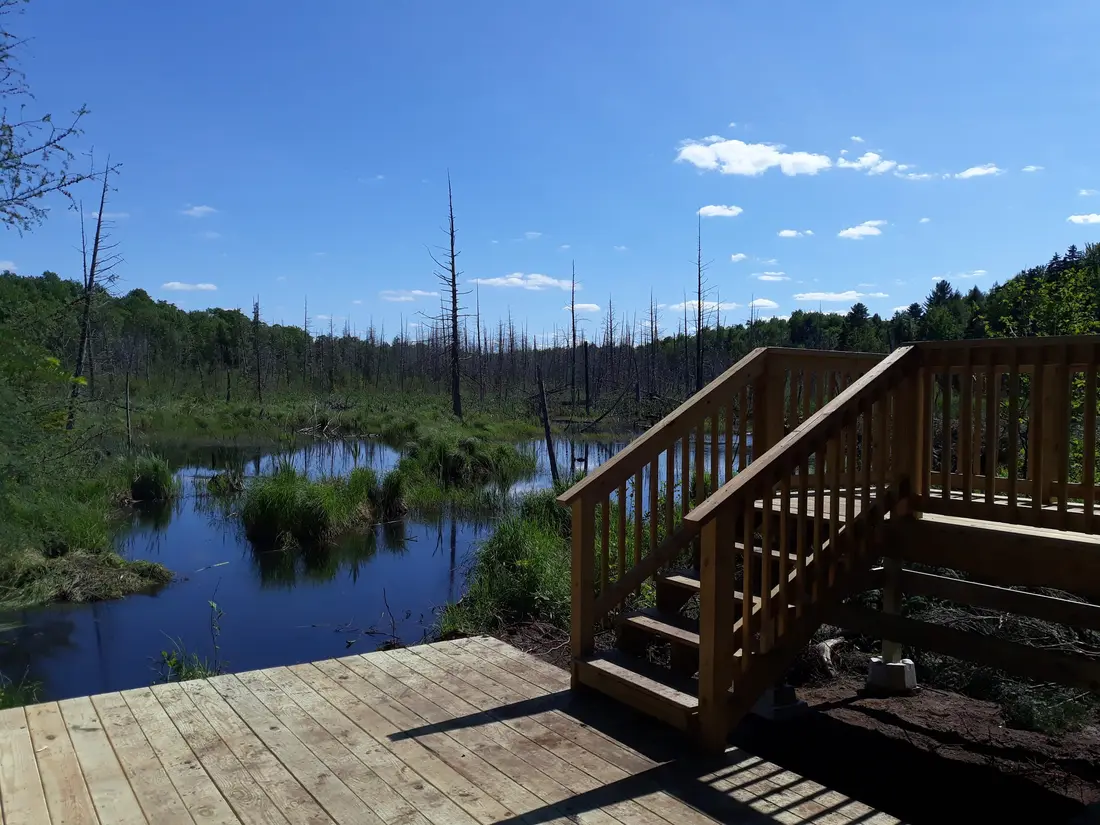
- The Modern Tiny Home has a small screened corner on its deck, and a short trail to an observation deck over a pond. Walk the trail by day before you try it at night with a headlamp. The trail and the pond deck are shared when the neighboring cabin is occupied.
Pick your spot by daylight: the lowest tree line to the north, a flat surface or clamp for the phone, and a seat where the yard lights stay out of your eyes. The cabins sit on wooded properties of 100 acres or more at the northern edge of the Adirondack Park, with the park and the Deer River State Forest to the south, so the view you want looks away from the mountains, toward Malone, a village of about 5,500 people ten road miles north.
What a display looks like from here
The first sign is often subtle. A faint aurora can look like the glow of a distant town. In March 2023, during a G4 storm, a woman at the Batchellerville Bridge over Great Sacandaga Lake knew the glow was the aurora only because her iPhone showed its colors on the screen. Around 10:50 p.m., as she and her husband got into the car to leave, green light flashed across the sky, and for about 20 minutes it rose in pillars and swept across the sky in waves.
The colors come from gases high in the atmosphere. Green, the most common color overall, is atomic oxygen about 120 to 400 kilometers (80 to 250 miles) up. Deep red is also oxygen, from above 300 kilometers (180 miles). Nitrogen gives a purplish lower border at 120 to 200 kilometers and adds blues and pinks, and the colors blend into yellow and white. Because the oxygen that glows red sits highest, red is the color seen most often at lower latitudes. A faint display can also look pale white, because the eye picks out brightness first and sees the true greens and reds only when the aurora is fairly bright.
The shapes follow a rough schedule. In the evening, arcs can stretch from horizon to horizon. Around midnight they tend to twist and sway, and on active nights a series of substorms can brighten them into swirls that fill the sky, on and off for several hours. Toward morning the aurora often breaks into soft, dimmer patches that pulse on and off, each pulse taking about 10 seconds, sometimes for hours until sunrise.
Phone settings for the aurora
The most useful gear is something that holds the phone still, such as a small tripod or a clamp on the deck rail. After that, the settings depend on the phone.
- iPhone 11 or later. Open the Night mode controls and drag the slider above the shutter button to Max for the longest capture. Keep the flash and Live Photos off, because turning on either one turns Night mode off.
- Google Pixel. Use Night Sight with the flash off, since the flash stops automatic Night Sight. Rested on something steady, the camera switches to its astrophotography mode and counts down a long exposure, which suits a slow glow better than a fast-moving display. A 3-second self-timer keeps your tap from shaking the shot.
- Samsung and other Android phones. Look for Pro mode, found on Samsung phones in the camera's list of modes. It lets you set ISO, shutter speed, white balance and focus yourself. Not every model has it.
A good starting point for any phone or camera with manual controls: ISO 1600 or 3200; a shutter of 8 to 15 seconds depending on brightness, cut to 1 to 3 seconds when the aurora moves fast; white balance at 3500K for natural, consistent color; manual focus set to infinity; RAW files if offered; and a self-timer or remote so pressing the button doesn't shake the frame. Use the shortest exposure that still shows the aurora, because long ones smear moving rays into a haze.
Two habits help on the deck. Take a test frame toward the north on your first clear night, so you know what an ordinary sky looks like on your screen; on a storm night, a green or red cast that wasn't there before is your answer. And mind the hot tub: steam drifts into the frame and fogs a cold lens, so set the phone upwind of the water and wipe the lens between bursts.
Batteries on a winter night
The longest nights come in the coldest months. Malone's average low is 4°F in January, 6°F in February and 13°F in December. iPhones are designed for use between 32°F and 95°F; colder air can shorten battery life for a while and even shut the phone off, and a cold phone may not charge. The battery comes back once the phone warms up. Cold batteries lose power quickly, so keep the phone in an inside pocket between shots and a charged battery pack in another. A red headlamp keeps your night vision while you set up, and gloves that work on a touchscreen save fumbling at 2 a.m.
The hot tub as a waiting room
Every cabin has its own private hot tub on its deck, and on a storm night it earns its keep. Aurora watching is mostly waiting: for full dark, for the clouds to break, for the next burst. The tub keeps you warm through all of it. The Modern Pine's listing describes its hot tub as available all year and open 24 hours.
Here is how we would run it:
- Soak in shifts. One person stays dressed and dry on watch, with the phone on its stand pointed north and the aurora app open. Swap often.
- Keep the lights inside the cabin off while you watch, and take the seat where the yard lights are least in your eyes. Dark-adapted eyes pick up a much fainter aurora.
- On winter nights, wear a knit hat in the water. With January lows near 4°F, wet hair freezes fast.
- Keep dry towels, boots and a robe from home within reach, and put the cover back on between soaks to hold the heat.
- Let the fire pit burn down before the watch starts. Firelight spoils night vision the way a porch light does.
For limits on long soaks, water temperature and drinks, read the section on soaking safely in the stargazing post before a long night. All three cabins are on the hot tub cabins page.
A storm night, hour by hour
Say a G3 watch goes out on the Wednesday of your stay for Thursday night. Here is the plan.
- Thursday afternoon. Read the 3-day forecast and convert its blocks to Eastern time with the table above. Check the clouds next: the National Weather Service's hourly graph for the cabins' location shows sky cover hour by hour, and Environment Canada's astronomy forecast maps cloud cover across North America hour by hour, up to 84 hours ahead.
- Before dark. Find north from your deck, set the phone on its stand, take the test frame and charge everything. Eat early.
- After dark. Open the 30-minute forecast and the solar wind. If Bz is south and the speed is up, start the hot tub shifts. If the cloud from the sun has not arrived yet, watch for the warning; the timing in a watch can slip by hours.
- Late evening into the small hours. Watch the north for a brightening glow and for rays.
- An alarm for 3 a.m. Storms can run all night. In May 2024, Kp stayed at 8 or above until dawn, and in October 2024 the sky near Paul Smiths only cleared at 3 a.m.
- First light. Morning aurora is soft and patchy. If you are up, take a last look and a last photo.
Choosing dates for an aurora try
You can't book an aurora, so book the cabins and stack the odds:
- Long nights. After the September equinox the nights outlast the days until March, and geomagnetic activity tends to peak near the spring and fall equinoxes.
- The moon. The stargazing post lists the new and full moons for 2026 and 2027; a dark week beats a bright one.
- More nights. In a strong year, storm nights come ten to seventeen times; four nights give you four chances.
- The 27-day outlook, once when you book and again a week out.
Pair the try with the rest of the season. The fall and winter pages have what runs when, the packing guide covers the clothes, and the cabin comparison lines up the three decks. If a storm tempts you onto the roads at night, read the winter driving guide first; the deck has the same sky.
Questions
How many nights a year does the aurora reach the cabins?
A few nights a year, more in an active year, and only when the sky is clear. A National Weather Service meteorologist in Albany puts Adirondack sightings at several a year. In the GFZ Kp record, storms of G2 or stronger reached the overnight hours on 10 nights in 2024 and 17 in 2025. Treat the aurora as a bonus on any stay; the stargazing post covers the rest of the night sky.
What Kp index does it take to see the aurora at the cabins?
The cabins sit near 54 degrees magnetic latitude. By SWPC's rule of thumb, the edge of the auroral oval reaches that latitude around Kp 6 and passes south of it at Kp 7 and above, when the aurora can climb overhead. At Kp 4 or 5 a bright display may show as a glow low in the north, often clearer on a phone screen than to the eye.
Which way should I look from the deck?
North. From the cabins the geomagnetic pole lies within half a degree of true north. A magnetic compass here points about 13 degrees west of true north, so face a little to the right of the needle. The aurora usually starts as a glow or arc low on the northern horizon and climbs higher only in strong storms, so pick a spot with the lowest tree line to the north.
Are 2026 and 2027 still good years for the northern lights?
Good, with fewer big storms than 2024 and 2025. The smoothed sunspot number peaked at 160.9 in October 2024, and SWPC predicts about 88 for the winter of 2026 and 2027. Strong storms have kept coming after the peak, including G4 storms in November 2025 and January 2026, and the Halloween storms of 2003 struck at a similar point in Solar Cycle 23.
How do I get an alert if the aurora starts in the middle of the night?
Sign up for NOAA SWPC's email alerts at pss.swpc.noaa.gov and pick the K-index 6 and 7 alerts and the storm watches. Aurorasaurus, a NASA citizen-science project, sends alerts when people near you report the aurora, and apps such as My Aurora Forecast & Alerts push a notice when activity is expected to be high. Let the app through your phone's overnight quiet mode.
What phone settings work for photographing the aurora?
Use a tripod or a clamp. On an iPhone, use Night mode with the slider at Max and the flash and Live Photos off. On a Pixel, use Night Sight with the flash off. With manual controls, start at ISO 1600 to 3200 and 8 to 15 seconds, cut to 1 to 3 seconds when the aurora moves fast, and set white balance near 3500K and focus at infinity.
Can you see the northern lights with the naked eye from the cabins?
On a clear night in a strong storm, yes. In October 2024, green rays and waves over the northern Adirondacks stayed visible to the naked eye for a couple of hours once the clouds cleared. In weaker displays the aurora can look like the faint glow of a distant town, and a phone camera shows the color better than your eyes. Keep the lights inside the cabin off and give your eyes time in the dark.
Sources
Facts on this page were checked against these sources in October 2026. Hours, fees and schedules change; confirm before you go.
- The cabin's Airbnb listing airbnb.com/rooms/53628054
- The cabin's Airbnb listing airbnb.com/rooms/41023086
- The cabin's Airbnb listing airbnb.com/rooms/1168252128174283244
- NOAA ncei.noaa.gov/products/wandering-geomagnetic-poles
- geomag.bgs.ac.uk geomag.bgs.ac.uk/data_service/models_compass/coord_calc.html
- gifs-api.bgs.ac.uk gifs-api.bgs.ac.uk/geomagnetic-coordinates/point?latitude=44.769&longi
- geomag.bgs.ac.uk geomag.bgs.ac.uk/web_service/GMModels/igrf/14/?latitude=44.769&longitu
- National Weather Service spaceweather.gov/content/tips-viewing-aurora
- usgs.gov usgs.gov/faqs/how-much-distance-does-a-degree-minute-and-second-cover-
- National Weather Service spaceweather.gov/noaa-scales-explanation
- National Weather Service spaceweather.gov/products/planetary-k-index
- science.nasa.gov science.nasa.gov/feature/nasas-guide-to-finding-and-photographing-auro
- Adirondack Explorer adirondackexplorer.org/general/northern-lights-aurora/
- kp.gfz.de kp.gfz.de/en/
- kp.gfz.de kp.gfz.de/app/json/?start=2024-01-01T00:00:00Z&end=2024-12-31T21:00:00
- kp.gfz.de kp.gfz.de/app/json/?start=2024-05-10T00:00:00Z&end=2024-05-11T23:59:59
- kp.gfz.de kp.gfz.de/app/json/?start=2024-10-10T00:00:00Z&end=2024-10-11T21:00:00
- Adirondack Explorer adirondackexplorer.org/recreation/adirondacks-aurora-borealis/
- Adirondack Explorer adirondackexplorer.org/recreation/missed-your-chance-to-see-northern-l
- Adirondack Explorer adirondackexplorer.org/recreation/northern-lights-put-on-a-show-in-the
- usgs.gov usgs.gov/programs/geomagnetism/science/may-10-2024-magnetic-disturbanc
- science.nasa.gov science.nasa.gov/science-research/heliophysics/how-nasa-tracked-the-mo
- National Weather Service spaceweather.gov/news/g4-severe-storm-watch-10-11-october
- National Weather Service spaceweather.gov/news/cme-arrival-earth-has-occurred-and-warnings-have
- National Weather Service spaceweather.gov/news/g4-severe-geomagnetic-storm-levels-continue-be-o
- nbcnewyork.com nbcnewyork.com/news/local/photos-northern-lights-dazzle-in-nyc-and-aro
- National Weather Service spaceweather.gov/products/solar-cycle-progression
- NOAA services.swpc.noaa.gov/json/solar-cycle/observed-solar-cycle-indices.j
- NOAA services.swpc.noaa.gov/json/solar-cycle/predicted-solar-cycle.json
- science.nasa.gov science.nasa.gov/science-research/heliophysics/nasa-noaa-sun-reaches-m
- National Weather Service spaceweather.gov/news/g4-severe-storm-levels-reached
- National Weather Service spaceweather.gov/news/g4-severe-geomagnetic-storm-levels-reached-19-ja
- National Weather Service spaceweather.gov/news/g3-strong-geomagnetic-storm-alerts-issued
- NOAA ncei.noaa.gov/news/great-halloween-solar-storm-2003
- National Weather Service spaceweather.gov/phenomena/coronal-holes
- National Weather Service spaceweather.gov/products/27-day-outlook-107-cm-radio-flux-and-geomagn
- National Weather Service spaceweather.gov/forecasts
- National Weather Service spaceweather.gov/content/subscription-services
- National Weather Service spaceweather.gov/products/3-day-forecast
- NOAA services.swpc.noaa.gov/text/3-day-forecast.txt
- National Weather Service spaceweather.gov/products/aurora-30-minute-forecast
- National Weather Service spaceweather.gov/products/aurora-viewline-tonight-and-tomorrow-night-e
- nist.gov nist.gov/pml/time-and-frequency-division/popular-links/daylight-saving
- NOAA noaa.gov/news-release/noaas-solar-1-enters-new-era-of-space-weather-mo
- National Weather Service spaceweather.gov/products/real-time-solar-wind
- National Weather Service spaceweather.gov/content/aurora-tutorial
- spaceweatherlive.com spaceweatherlive.com/en/help/the-interplanetary-magnetic-field-imf.htm
- spaceweatherlive.com spaceweatherlive.com/en/help/the-solar-wind.html
- science.nasa.gov science.nasa.gov/citizen-science/aurorasaurus/
- aurorasaurus.org aurorasaurus.org/
- apps.apple.com apps.apple.com/us/app/my-aurora-forecast-alerts/id1073082439
- spaceweatherlive.com spaceweatherlive.com/
- National Weather Service spaceweather.gov/phenomena/aurora
- support.apple.com support.apple.com/en-us/102519
- support.google.com support.google.com/pixelcamera/answer/9708795?hl=en
- samsung.com samsung.com/ae/support/mobile-devices/how-to-use-the-cameras-pro-mode-
- weather.metoffice.gov.uk weather.metoffice.gov.uk/learn-about/space-weather/auroras
- support.apple.com support.apple.com/en-us/118431
- National Weather Service forecast.weather.gov/MapClick.php?lat=44.769&lon=-74.192&unit=0&lg=eng
- weather.gc.ca weather.gc.ca/astro/index_e.html

