
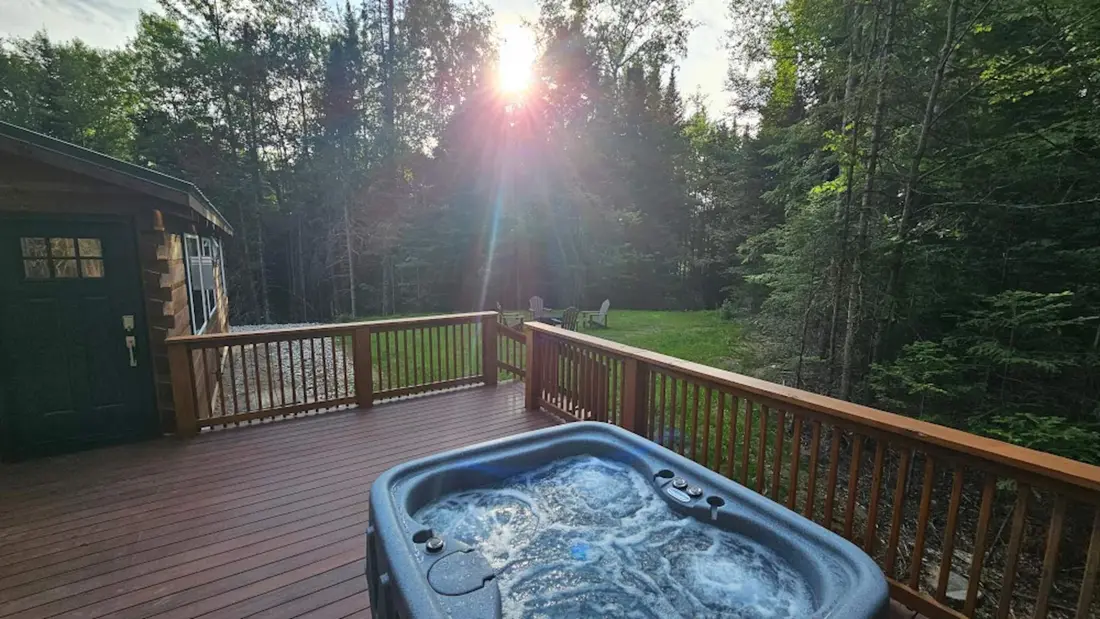
Each of the three cabins has a private hot tub on its deck, about ten road miles south of Malone at the northern edge of the Adirondack Park, and on clear, moonless nights guests have watched the Milky Way from the water. This post is a plan for those nights: how to pick them through 2027, what to look for in each season, how to work with the yard lights and your own eyes, what it takes to catch the northern lights this far south, and how to keep a long soak safe.
What guests see from the water
The listings set it up. The Modern Tiny Home's tells guests to hit the slopes or trails "and then come back and relax under the stars in the hot tub!" The Aviator's suggests taking in the night sky from its tub, and The Modern Pine's lists its tub as available all year and open 24 hours. Each tub belongs to one cabin. The Aviator's listing spells it out: the hot tub and the fire pit at each cabin are for that cabin's guests only.
Guests take them up on it. Of the 253 guest reviews the three cabins had in early October 2026, 15 mention the stars or the night sky. Eight were written in July or August, six between October and February and one in September, so the sky draws comments in the cold months as well as the warm ones. At The Modern Tiny Home, one guest wrote that "the stars looked like a planetarium!" A family with two teenagers that spent eight weeks there one summer wrote that they "soaked up the milky way on dark nights in the hot tub." A guest who lives just outside a city wrote, "I have never seen the center of the milky way in the sky before and was able to see it for the first time."
The other two cabins get the same reports. At The Modern Pine, one guest "had one spectacular night of star gazing from the hot tub," and another, back from a day on the trails, found that relaxing in the tub "under the stars after a long day of hiking was incredible." At The Aviator a guest wrote, "Stargazing while soaking in the hot tub at night was the perfect way to end each day." The rest of this post is about getting a night like those on purpose instead of by luck.
How dark it gets
Light pollution hides the Milky Way from eight in ten Americans, a finding of the New World Atlas of Artificial Night Sky Brightness, published in 2016. The nearest village to the cabins, Malone, is about ten road miles to the north, and Montreal is about 78. To the south the listings point to the Adirondack Park and the large Deer River State Forest, and the nearest villages that way, Saranac Lake and Lake Placid, are 43 and 52 road miles off. So the nearest town lights are to the north.

A guest at The Modern Tiny Home in September 2026 put it in one line: "It gets really dark at night, which is great for sky watching," and in the same review said they liked the bright lights around the property too. Two things can brighten a dark sky: the moon, and lights close by. The moon has its own section below, with dates. The close lights are the cabins' own.
The lights in the yard
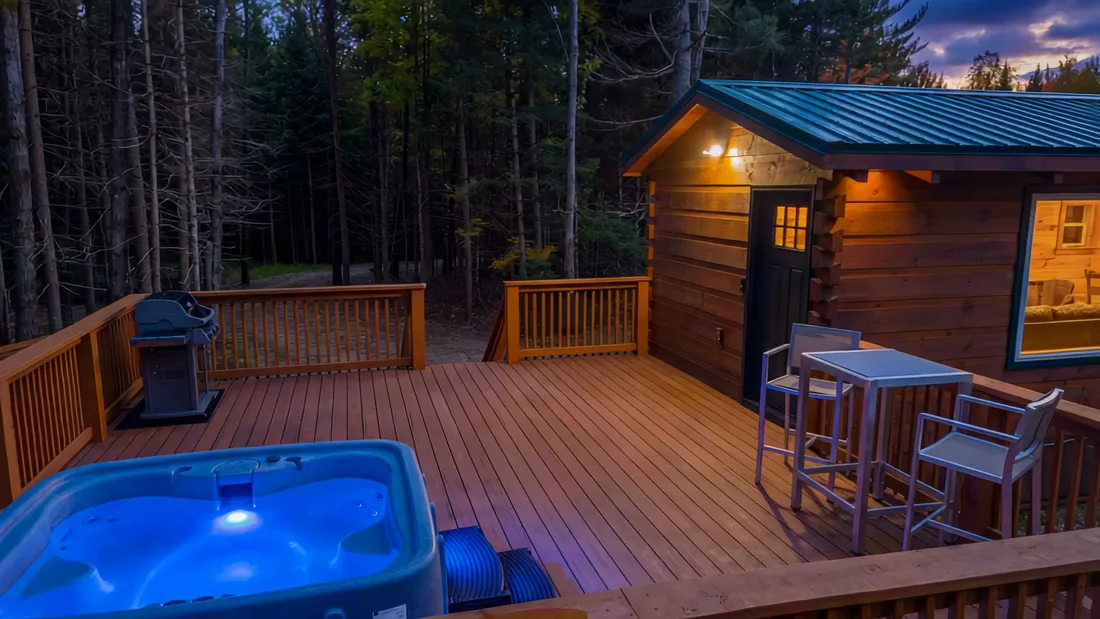
The yards are lit at night on purpose. The host has put landscape lighting in the tree line around each cabin's yard and fire pit, and the cabins are lit up after dark. Guests notice it at more than one cabin. A June 2024 guest at The Modern Pine wrote, "We enjoyed the huge windows looking into the woods, and there was some accent lighting outside at the foot of several trees to enhance the woods at night." At The Modern Tiny Home another wrote, "I know the lights in the back are for practical reasons, but I can't get over how dramatic it makes the woods look." The same guest signed off with "Don't forget to look at the stars!"
The lights sit at the foot of the trees and shine up into them, so the bright part of the view is the tree line around the yard, low and all around you. The stars are above it. The tubs light up blue at night as well, as the photographer's dusk pictures of The Aviator and The Modern Tiny Home show. What the lights cost you is some of your eyes' adjustment, if you keep looking at them. A few habits help:
- Sit with your back to the brightest stretch of the tree line and keep your eyes up. The trees hide the bottom of the sky anyway, and most of what is worth seeing is higher.
- Switch off the lights inside the cabin so the windows don't throw light across the deck.
- Give your eyes their full half hour, below, before you decide how dark the night is.
Giving your eyes time
Eyes need 20 to 30 minutes in the dark to reach their best. Once they are in the dark they begin making a chemical called rhodopsin, and the process starts over each time you look at something bright: a streetlight, a phone screen, a tablet, even the moon. White light from flashlights, phones and car headlights does the damage.
Red light is the exception. It has the longest wavelength of all the colors and is the gentlest on eyes that have adjusted to the dark, so a red headlamp or flashlight lets you find the steps without starting over. Many headlamps and flashlights have a red setting, and red cellophane over a white light works too. If you use a star-chart app, look for a red mode in its settings and turn it on before you go out.
For the hot tub the routine is short. Turn the lights off inside, walk out with a red light, get in, and give it half an hour before you look for anything faint. Keep the phone face down in the meantime. By the end of that half hour, stars will have filled in that weren't there when you got in.
Moon dates for 2026 and 2027
The moon's schedule is fixed months ahead. A new moon rises and sets with the sun and is up during the day, so the nights around it are the darkest. After a new moon, a thin waxing crescent sets in the evening not long after the sun, a little later each night; a first-quarter moon is high in the evening and sets around the middle of the night. A full moon rises around sunset and sets around sunrise, lighting the whole night. On the way back down, a last-quarter moon rises around the middle of the night, so the evenings of the week before a new moon stay dark until then. The whole cycle takes about 29.5 days.
For a stay built around the sky, aim for the week before a new moon through two or three days after it. Here are the new moons through 2027 in Eastern time, with the time on that date when the sky over the cabins becomes fully dark. That is the end of astronomical twilight, when the center of the sun is 18 degrees below the horizon and its scattered light is fainter than starlight.
| New moon | Day | Fully dark by | Worth knowing |
|---|---|---|---|
| October 10, 2026 | Saturday | 7:58 p.m. | Saturn reached opposition on October 4 and is up for much of the night |
| November 9, 2026 | Monday | 6:15 p.m. | The Northern Taurids peak on November 11 and 12 |
| December 8, 2026, evening | Tuesday | 6:01 p.m. | The Geminids peak on December 13 and 14 |
| January 7, 2027 | Thursday | 6:18 p.m. | Orion and the winter stars in the southern sky |
| February 6, 2027 | Saturday | 6:52 p.m. | The Saranac Lake Winter Carnival begins February 5 |
| March 8, 2027 | Monday | 7:31 p.m. | Daylight saving time begins March 14 |
| April 6, 2027 | Tuesday | 9:14 p.m. | April nights in Malone average a low of 32°F |
| May 6, 2027 | Thursday | 10:08 p.m. | The eta Aquariids peak on May 5 and 6, before dawn |
| June 4, 2027 | Friday | 11:03 p.m. | Nights near their shortest; the Milky Way's core is highest around 2 a.m. |
| July 3, 2027, night | Saturday | 11:13 p.m. | The core is highest around midnight |
| August 2, 2027 | Monday | 10:25 p.m. | The core is highest just before full dark; the Perseids are already active |
| August 31, 2027 | Tuesday | 9:21 p.m. | The Summer Triangle is high at nightfall |
| September 29, 2027, night | Wednesday | 8:19 p.m. | The Summer Triangle stands overhead by mid-evening |
| October 29, 2027 | Friday | 7:28 p.m. | The Andromeda Galaxy is well placed in the evening |
| November 27, 2027, night | Saturday | 6:03 p.m. | Thanksgiving weekend |
| December 27, 2027 | Monday | 6:09 p.m. | Between Christmas and New Year's |
Full moons, the brightest nights, fall on October 26, November 24 and December 23, 2026, and in 2027 on January 22, February 20, March 22, April 20, May 20, June 18, July 18, August 17, September 15, October 15, November 13 and December 13. A night or two either side of a full moon is a night for the fire pit, not the stars.
The summer Milky Way
From a dark place the summer Milky Way is a pale, cloudy band across the sky. Its brightest, thickest part, low in the south, marks the direction of the center of our galaxy, one of its most crowded regions, where countless stars glow behind dark clouds of dust. To find it, start with Scorpius, a hook of stars that looks like a scorpion's tail, low in the southern sky late on July evenings. Next to it is the Teapot in Sagittarius, a group of stars with a handle, a lid and a spout. On an especially dark night a haze rises from the spout like steam, and the thickest part of that steam is the direction of the galaxy's center.
From the cabins it never climbs high. The center of the galaxy sits 29 degrees south of the celestial equator, and the cabins are at about 44.8 degrees north, so at its highest it stands only about 16 degrees above the southern horizon. A fist held at arm's length covers about 10 degrees, so look a fist and a half above the horizon. Trees around a yard can hide that much sky, so look for the core through the openings in the tree line to the south, and catch it when it is highest: around midnight in early July and around 10 p.m. in early August. By the end of August it has already passed its highest point when the sky gets fully dark, and it slides lower toward the southwest through the evening.
Overhead is a landmark that needs no special darkness. The Summer Triangle is three bright stars in three constellations: Vega in Lyra, Deneb in Cygnus and Altair in Aquila. It climbs the eastern sky on late June and July evenings, stands from the south to overhead by mid-evening in September, and does the same by early evening in October. The Milky Way runs through the middle of it, with Deneb sitting in the band, so on a moonless night the Triangle is the place to lean back and look straight up.
In 2027 the best summer windows come at the new moons. Around July 3 the sky is fully dark by 11:13 p.m. and the core is highest around midnight. Around August 2 it is dark by 10:25 p.m., about half an hour after the core has passed its highest point. Summer evenings bring mosquitoes too; the bugs guide has what works, and the summer page has the rest of the season.
Fall and winter stars
Fall nights get dark early and stay dark long, which suits a soak before bed. In October the Summer Triangle is still high in the early evening, and Saturn, which reached opposition on October 4, 2026, is visible for much of the night. Fall is also the season of the Andromeda Galaxy, the Milky Way's largest neighbor, about 2.5 million light-years away. It becomes prominent as autumn arrives, and from a dark site the eye alone picks out a surprising amount of it. Binoculars show its bright core and a little of its disk. Cassiopeia and the Great Square of Pegasus are the guides to finding it.
Winter is the season of bright stars. Orion's Belt is a line of three stars, with Betelgeuse, one of the brightest stars in the sky, at the hunter's shoulder and blue-white Rigel at his foot. The faint, fuzzy patch in his sword is the Orion Nebula. Below and to the left of the belt is Sirius, in Canis Major, the brightest star in the night sky, and February is one of the best months for Orion. Six bright stars make the Winter Hexagon: Rigel, Sirius, Procyon, Pollux with Castor beside it, Capella and Aldebaran.
In Taurus, the Bull, are the Pleiades, the Seven Sisters, a star cluster about 400 light-years away. They show even from a city, but how many of the stars you can count depends on how dark the sky is and how good your eyes are, which makes the Pleiades a fair test of the night. Count once when you get in and again half an hour later.
Some stars never set from here. The Big Dipper and the Little Dipper stay above the horizon all year this far north, circling the North Star. The two stars at the end of the Big Dipper's bowl, Dubhe and Merak, point to Polaris, and Polaris stands as high above the northern horizon as your latitude: about 45 degrees at the cabins, halfway between the horizon and straight overhead. That is the direction to watch for the northern lights. Around the new moons from November through January the sky is fully dark between about 6 and 6:20 p.m., so a stargazing soak fits before dinner; the winter page has what else the season brings.
Meteor showers through 2027
A meteor shower suits a hot tub. You lean back, you look up and you wait. The trick is matching the peak night with the moon. Here are the showers from now through the 2027 Perseids, with the hours that are dark at the cabins on each peak night. The events calendar sets them alongside everything else happening in the area.
| Shower | Peak night | Moon | Dark hours at the cabins | What to expect |
|---|---|---|---|---|
| Orionids | October 21 to 22, 2026 | 74% lit | After moonset, about 3:10 a.m., until dawn twilight at about 5:45 a.m. | 10 to 20 meteors an hour at the peak |
| Northern Taurids | November 11 to 12, 2026 | 4% lit | All night; the crescent sets before the sky is dark | Sometimes extra fireballs while both Taurid showers are active |
| Leonids | November 16 to 17, 2026 | 39% lit | After moonset, about 10:45 p.m. | Best known for the meteor storms of some past years |
| Geminids | December 13 to 14, 2026 | 15% lit | After moonset, about 8:35 p.m., until about 5:40 a.m. | Usually the strongest shower of the year, with good rates before midnight |
| Quadrantids | January 3 to 4, 2027 | 18% lit | All night; the moon rises at about 5:15 a.m. | About 25 an hour on average in a dark sky, but a peak only about six hours long |
| Eta Aquariids | May 5 to 6, 2027 | 2% lit | The hours before dawn twilight, which starts at about 3:40 a.m. | 10 to 30 an hour from northern latitudes, just before dawn |
| Perseids | August 12 to 13, 2027 | 79% lit | After moonset, about 2 a.m., until dawn twilight at about 4 a.m. | 30 to 50 an hour at the peak from rural places |
Two of these stand out for a soak. The Geminids on December 13 to 14, 2026 are the one major shower with good activity before midnight, because Gemini is well placed from 10 p.m., and with the moon down by about 8:35 p.m. the whole evening is dark. In December the tub is a warm place to watch it from. The Perseids on August 12 to 13, 2027 are the warm-night shower, but a moon 79 percent lit stays up until about 2 a.m. Set an alarm and go out for the two dark hours before dawn.
The Orionids, which peak on October 21 and 22, 2026, are debris from Halley's Comet. The moon is bright that week, so look before dawn, after it sets around 3:10 a.m. The Quadrantids in early January have a short, sharp peak, and in 2027 it is due around 10:30 p.m. Eastern time on January 3, a time that favors watchers in Europe and western Asia, so count on fewer here than the shower's average.
For any shower, give it at least an hour, with breaks out of the water as described below. Lean back to see as much sky as you can, and keep the phone away; one look at a bright screen undoes the eyes' adjustment.
Northern lights
The northern lights do reach northern New York, but only during a geomagnetic storm, and nobody can book one. NOAA rates these storms from G1 to G5. In a minor G1 storm the aurora is commonly visible at high latitudes, such as northern Michigan and Maine. In a moderate G2 storm, a planetary K-index of 6, it has been seen as far south as New York and Idaho, and in a strong G3 storm, a K-index of 7, as far south as Illinois and Oregon. Over an average 11-year solar cycle NOAA counts about 600 G2 storms spread over some 360 days, about 200 G3 storms over 130 days, and far fewer of the severe and extreme kind.
The sun's cycle reached its maximum period in 2024; NASA and NOAA announced it on October 15 that year, after a storm in May 2024 had already made the aurora visible to more people. If a storm is forecast during your stay, NOAA's Space Weather Prediction Center posts a 30-minute aurora forecast and the current K-index. On NOAA's scale, sightings as far south as New York go with a K-index of 6.
The best aurora usually comes within an hour or two of midnight, between 10 p.m. and 2 a.m. local time. You need an open view to the north, away from the brightest of the yard lights, and a full moon dims a display. Use Polaris and the Big Dipper to find north. Phone cameras are more sensitive to light than eyes, so on a clear storm night point one at the northern sky; it may record a glow you can't see.
The space station and a phone camera
The International Space Station crosses the sky often, and it is easy to tell from a plane. It looks like a very bright star moving across the sky, with no flashing lights, and it never changes direction. Every sighting comes within a few hours before or after sunrise or sunset, when sunlight still reaches the station against a darker sky, which makes the first soak of the evening a good time to catch one. NASA's Spot the Station app and website list upcoming sightings by city.
A phone can take a decent picture of the night sky if it holds still. On an iPhone 11 or later, Night mode turns on by itself in low light, a number beside its icon shows how many seconds the shot will take, and the results are best with the phone on a solid surface or a tripod. Since 2019 Google's Pixel phones have had an astrophotography setting in Night Sight that exposes for up to four minutes on a Pixel 4, split into frames of no more than 16 seconds so the stars stay sharp points, and it works only with the phone propped on a tripod, a rock or something else steady. On the deck, a railing or a table well back from the water does the job. Keep the phone out of reach of the splashing.
What to bring out to the deck
- A red light. A headlamp with a red setting, or a flashlight with red cellophane over the lens, for the steps and the cover.
- A star chart. An app with a red mode, set up before dark, or a printed chart.
- Binoculars. The cabins don't list any, so bring a pair from home. They show detail the eye can't, from the core of the Andromeda Galaxy to the Pleiades.
- A robe and footwear from home for the walk between the door and the tub and for breaks on the deck. The listings don't mention robes.
- Water to drink between soaks. Leave the beer and wine for later.
- Warm layers for anyone watching from a deck chair instead of the water. The packing guide has the full list by season.
Soaking safely on a long night
A meteor shower, or a night of waiting for the Milky Way's core, can mean hours outside, and hot water has limits. The Consumer Product Safety Commission and the CDC both put the ceiling for hot tub water at 104°F, and a hot tub's thermostat can be off by as much as four degrees, so look at the temperature before you settle in. Water hotter than the body can cause drowsiness, and drowsiness in a hot tub can lead to unconsciousness and drowning. On a late night that is the risk to plan around. Split the time into spells in the water and breaks sitting up on the edge or out on the deck in a robe, drink water, and skip alcohol before and during a soak. The sky doesn't stop while you are out of the water.
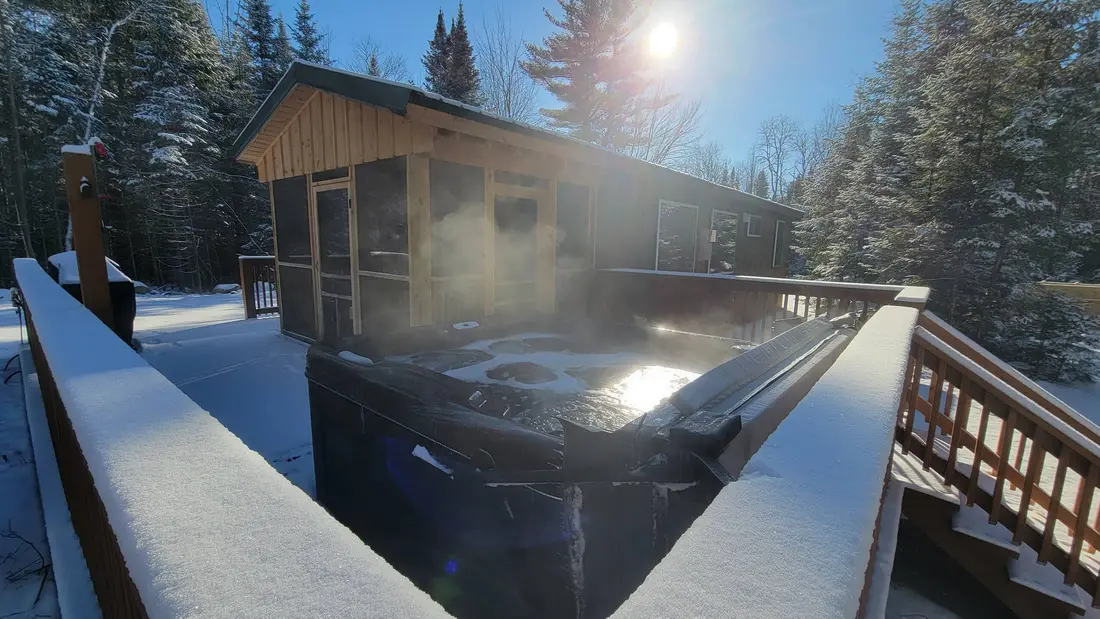
The rest of the rules, from medicines and pregnancy to the warning signs of overheating, are on the hot tub cabins page. In winter, wear something on your feet for the walk out, since the boards and steps between the door and the tub can ice over. When you are done, put the cover back on. None of the three tubs has a gate or a lock; The Modern Pine's cover has clips, and its listing asks guests to close the cover and clip it whenever the tub is not in use. If a dog comes along, the pet rules apply, and they don't allow a pet to be left alone in the cabin; bringing your dog has the rest. The cabins are not suitable for children under 10. In an emergency call 911; the health and safety page has the hospital in Malone.
Which cabin for the sky
All three tubs are private, and guests have written about the stars from each: eight reviews at The Modern Tiny Home, five at The Modern Pine and two at The Aviator. The counts follow the listings' ages. The Tiny Home's reviews go back to February 2020, The Modern Pine's to December 2021 and The Aviator's to July 2024.
- The Aviator has the large open deck, with no screen around it, and it is the far cabin on its property.
- The Modern Pine is the one whose listing puts its tub's hours in writing: all year, around the clock. It also has a large screened room on the deck for buggy summer evenings.
- The Modern Tiny Home has the most star reviews, a small screened corner on its deck, and the big stone fire pit for warming up afterward.
Each property has a second cabin. The Modern Pine and The Aviator share one, and The Modern Tiny Home shares its property with a cabin that isn't one of these three, so keep voices low on a late watch; two cabins, one property explains the layout. For everything else, see the cabins side by side. For a big sky, the night you pick matters more than the cabin.
A clear night, start to finish
- Afternoon. Check the National Weather Service's hourly forecast graph for the cabins' location, which comes from its Burlington, Vermont, office and has a sky-cover line, and check the moon in the table above. On a storm night, check NOAA's aurora forecast too.
- Dinner early. Around the new moons from November through January the sky is fully dark by about 6:20 p.m.; around the July new moon, not until after 11.
- Half an hour before. Lights off inside, the phone in red mode or put away, and a red light for the walk out.
- First soak. Your eyes finish adjusting while you find the landmarks: the Big Dipper, then Polaris, then the season's bright stars. Watch for the space station if one is due.
- A break. Robe and footwear on the deck, water to drink, binoculars out.
- Second soak. Back in, now with the faint stars filled in.
- Last step. Cover back on and secured, then inside to warm up. At The Modern Pine and The Aviator, the Jøtul stove is the place for that.
For a look through a telescope on another night, the Adirondack Sky Center & Observatory in Tupper Lake has a roll-off-roof observatory whose public openings depend on the weather; the Wild Center guide has the details.
Questions
Can you see the Milky Way from the cabins?
Yes, on a clear night without the moon. Guests at all three cabins have written about the stars from the hot tub, and one saw the center of the Milky Way for the first time. The bright core sits low in the south in summer, highest around midnight in early July and around 10 p.m. in early August, so pick a night near a new moon.
What are the best dates for stargazing in 2026 and 2027?
The nights around each new moon. The next ones fall on October 10, November 9 and December 8, 2026, then on January 7, February 6, March 8, April 6, May 6, June 4, July 3, August 2, August 31, September 29, October 29, November 27 and December 27, 2027. A full moon washes out all but the brightest stars.
Can you see the northern lights from the cabins?
Sometimes, during a geomagnetic storm. On NOAA's storm scale, a moderate G2 storm, a planetary K-index of 6, has brought the aurora as far south as New York. Watch NOAA's 30-minute aurora forecast, look north between about 10 p.m. and 2 a.m., and treat a display as a bonus rather than a reason to book.
Are the yards dark at night?
No. The host has put landscape lighting in the tree line around each cabin's yard and fire pit, and the cabins are lit up after dark. The lights sit at the foot of the trees and shine up into them, and guests at The Modern Tiny Home have still seen the Milky Way from the hot tub. Sit with your back to the brightest stretch, switch off the lights inside and give your eyes half an hour.
Is it safe to stay in the hot tub for a whole meteor shower?
Plan on breaks. Keep the water at 104°F or below and check it, since a thermostat can be off by as much as four degrees. Hot water can make you drowsy, and drowsiness in a hot tub can lead to drowning, so split the night between spells in the water and breaks on the deck, and skip alcohol before and during a soak. The hot tub cabins page has the full rules.
Do the cabins have binoculars or a telescope?
The listings don't show either, so bring binoculars from home; they bring out the core of the Andromeda Galaxy and more of the Pleiades. For a telescope, the Adirondack Sky Center & Observatory in Tupper Lake opens its roll-off-roof observatory when the weather allows; the Wild Center guide has the details.
Which meteor showers are coming up?
The Orionids peak on October 21 to 22, 2026, best before dawn after the moon sets. The Geminids, usually the year's strongest, peak on December 13 to 14 with the moon down by about 8:35 p.m. Then come the Quadrantids on January 3 to 4 and the Perseids on August 12 to 13, 2027. The events calendar lists the rest.
Sources
Facts on this page were checked against these sources in October 2026. Hours, fees and schedules change; confirm before you go.
- The cabin's Airbnb listing airbnb.com/rooms/41023086
- The cabin's Airbnb listing airbnb.com/rooms/53628054
- The cabin's Airbnb listing airbnb.com/rooms/1168252128174283244
- nps.gov nps.gov/subjects/nightskies/newworldatlas.htm
- nps.gov nps.gov/articles/000/idkt_stargazing.htm
- nps.gov nps.gov/dino/planyourvisit/stargazing.htm
- science.nasa.gov science.nasa.gov/moon/moon-phases/
- aa.usno.navy.mil aa.usno.navy.mil/api/moon/phases/year?year=2026
- aa.usno.navy.mil aa.usno.navy.mil/api/moon/phases/year?year=2027
- aa.usno.navy.mil aa.usno.navy.mil/calculated/rstt/year?ID=AA&year=2026&task=4&lat=44.77
- aa.usno.navy.mil aa.usno.navy.mil/calculated/rstt/year?ID=AA&year=2027&task=4&lat=44.77
- aa.usno.navy.mil aa.usno.navy.mil/api/rstt/oneday?date=2026-12-13&coords=44.77,-74.19&t
- aa.usno.navy.mil aa.usno.navy.mil/faq/RST_defs
- science.nasa.gov science.nasa.gov/solar-system/skywatching/whats-up-july-2026-skywatchi
- science.nasa.gov science.nasa.gov/solar-system/skywatching/whats-up-september-2026-skyw
- science.nasa.gov science.nasa.gov/solar-system/skywatching/whats-up-october-2026-skywat
- science.nasa.gov science.nasa.gov/solar-system/whats-up-february-2026-skywatching-tips-
- chandra.harvard.edu chandra.harvard.edu/photo/2001/0204flare/
- earthsky.org earthsky.org/astronomy-essentials/sky-measurements-degrees-arc-minutes
- earthsky.org earthsky.org/favorite-star-patterns/summer-triangle-asterism-vega-dene
- earthsky.org earthsky.org/astronomy-essentials/summer-triangle-on-autumn-evenings/
- nightsky.jpl.nasa.gov nightsky.jpl.nasa.gov/news/416/
- science.nasa.gov science.nasa.gov/image-article/apod-2019-december-26-the-northern-wint
- science.nasa.gov science.nasa.gov/image-article/apod-2021-november-24-pleiades-the-seve
- earthsky.org earthsky.org/tonight/use-big-dipper-to-locate-polaris-the-north-star
- scientificamerican.com scientificamerican.com/article/what-exactly-is-the-north/
- American Meteor Society amsmeteors.org/calendar/
- National Weather Service spaceweather.gov/noaa-scales-explanation
- National Weather Service spaceweather.gov/content/tips-viewing-aurora
- National Weather Service spaceweather.gov/news/joint-solar-maximum-announcement-nasa-and-noaa
- svs.gsfc.nasa.gov svs.gsfc.nasa.gov/14683/
- wavy.com wavy.com/news/national/northern-lights-fomo-try-this-phone-camera-tric
- nasa.gov nasa.gov/spot-the-station/
- support.apple.com support.apple.com/en-us/102519
- research.google research.google/blog/astrophotography-with-night-sight-on-pixel-phones
- cpsc.gov cpsc.gov/Newsroom/News-Releases/1996/CPSC-Issues-Warning-for-Pools-Spa
- cpsc.gov cpsc.gov/Newsroom/News-Releases/1980/CPSC-Warns-Of-Hot-Tub-Temperature
- cdc.gov cdc.gov/healthy-swimming/safety/what-you-can-do-to-stay-healthy-in-hot
- National Weather Service forecast.weather.gov/MapClick.php?lat=44.769&lon=-74.192&unit=0&lg=eng
- adirondackskycenter.org adirondackskycenter.org/

