John Brown Farm
John Brown's 1855 farmhouse, grave and Timbuctoo exhibit by the Lake Placid ski jumps, 54 road miles from the cabins: history, trails, hours, dogs.
John Brown Farm State Historic Site, at the end of John Brown Road on the edge of Lake Placid, is the home and grave of the abolitionist John Brown. The state keeps his 1855 farmhouse, the family burial plot, the barn and almost four miles of easy trails beside the Olympic ski jumps, and admission is free. It is about 54 road miles from the cabins, an hour and a quarter by NY 30 and NY 86 through Saranac Lake, and Main Street in Lake Placid is about two and a half miles away.
Who runs the farm
The New York State Office of Parks, Recreation and Historic Preservation runs the site as part of its Saratoga-Capital Region, under a 1975 memorandum of understanding with the Department of Environmental Conservation, which holds title to the land. The historic site covers 213 acres of the Brown farm. The rest of the original lot belongs to DEC's Saranac Lakes Wild Forest, and the site is protected as forever wild under Article XIV of the state constitution.
The whole original farm, about 270 acres, was listed on the National Register of Historic Places on June 19, 1972, and designated a National Historic Landmark on August 6, 1998. More than 60,000 people visit in a year. The site's friends group, John Brown Lives!, was founded in 1999 and works with the park staff on many of the events here. The site office is at 115 John Brown Road, Lake Placid, NY 12946, phone (518) 523-3900.
Brown was one of America's most complex and controversial activists. The fight against slavery cost him his life and the lives of three of his sons, and he used violence in that fight.
John Brown before the Adirondacks
John Brown was born on May 9, 1800, in Torrington, Connecticut, to Owen and Ruth Mills Brown. In 1805 the family moved to Hudson, in Ohio's Western Reserve, where he learned his father's trade of tanning. At 16 he went east to study for the ministry. Lack of money and an eye condition sent him home.
He married Dianthe Lusk in 1820. They had seven children, five of whom lived to adulthood. In 1826 the family moved to Richmond, Pennsylvania, where he built a tannery with a hidden room for people escaping slavery, organized a church and served as postmaster. Dianthe died in 1832, and in 1833 he married Mary Ann Day, who bore thirteen children; six lived to adulthood. Of his twenty children, eleven grew up.
From 1835 to 1846 he farmed, tanned, surveyed, speculated in land and raised stock, with little lasting success. The first written record of his aims comes from 1834, when he wrote to his brother that he and his wife hoped to take a Black boy into the family and bring him up as one of their own. In 1837, two weeks after the abolitionist editor Elijah Lovejoy was killed in Alton, Illinois, Brown stood up at the end of a prayer meeting and pledged his life to ending slavery.
In 1844 he became a partner of Simon Perkins of Akron, Ohio, and in 1846 the two went into the wool brokerage business. In 1847 Brown moved the family to Springfield, Massachusetts, where he ran the firm's office. Springfield was a center of Underground Railroad work, and Brown took part in it. The wool business made little money, and a trip to sell the firm's wool in England in 1849 failed.
Gerrit Smith's land and Timbuctoo
In the 1840s New York let white men vote without owning property and required a Black man to own $250 worth of land before he could vote. Gerrit Smith of Peterboro, in Madison County, a wealthy abolitionist and once one of the largest landowners in the state, answered in 1846 with a plan he called a scheme of justice. He would give about 120,000 acres of Adirondack land in Essex and Franklin counties to about 3,000 free Black New Yorkers, in lots of 40 acres meant to help them meet the property test. Frederick Douglass helped attract families, and Willis Hodges led some of them north.
Most of the land was never farmed. Most grantees were city people who had worked as cooks, coachmen and barbers, and few had the money to move north and work the land. The first Black settlers reached North Elba in late 1847. By 1850 the census counted about 33 people in the settlement Brown called Timbuctoo, and there may have been as many as 60. Census reports from 1850 to 1870 list 13 Black families in North Elba; by 1871 there were two.
The family that stayed for good was the Eppes family. Lyman Eppes was one of Smith's 1846 grantees, and he and Anna Eppes moved to their 40 acres in the spring of 1849 and farmed there for the rest of their lives. Lyman Eppes helped the Browns build their farmhouse, and Lyman Eppes Jr. died in 1942. A William G. Pomeroy Foundation marker placed in 2021 at 4 Church Street in Lake Placid names Lyman Eppes and the other Black New Yorkers who settled nearby. As of 2021 no remains of the settlement's homes had been found.
Blacksville at Loon Lake
Part of Smith's land lay in Franklin County, much closer to the cabins. In 1848 Willis Hodges, a Brooklyn editor born to a free Black family in Virginia, led families to Smith land near Loon Lake, beside a bay later called Hodges' Bay. Hodges had founded The Ram's Horn, an antislavery paper that Brown offered to support, and Brown sent the settlers pork and flour for their first winter. Hodges was back in Brooklyn after 1851 and died in Virginia in 1890. A Pomeroy Foundation marker put up in 2023, with Paul Smith's College as the grant recipient, stands at 3154 County Route 26 in Vermontville, about 23 road miles from the cabins on the same county road as the Loon Lake Mountain trailhead.
The Browns in North Elba
Brown visited Smith at Peterboro in 1848 and went to see the North Elba settlement that fall. He offered to settle among the new farmers, clear a farm of his own and show his neighbors how the work was done. In June 1849 he moved Mary and seven of the children into a house he rented from Cone Flanders near the settlers. He surveyed his neighbors' lots and taught them to clear land and build cabins.
With his sons Jason and Owen, Brown bought Lot 95 of Township 12 of the Old Military Tract from Smith, 244 acres on the deed, for $244, a dollar an acre. The lot survives with its 1849 boundaries; the town's 1993 tax map measured it at 270.6 acres.
Money pulled him away. In March 1851 he moved Mary and the younger children to Akron, Ohio, and his daughter Ruth and her husband, Henry Thompson, stayed to work the land. The family came back in June 1855, and that year Henry Thompson, a carpenter, built the farmhouse that stands today. Brown hardly settled in. In August 1855 he left for Kansas, where five of his sons had gone to homestead, and after that he came home to North Elba for only six short visits before 1859. By 1855 the Black settlement had dropped to no more than ten families.
Kansas and Harpers Ferry
The Kansas-Nebraska Act had made Kansas a battleground over the spread of slavery. On May 24, 1856, Brown led a party that killed five pro-slavery settlers at Pottawatomie. On August 30, 1856, Brown and his men fought a larger force of Missourians at Osawatomie, the fight that earned him the name John Brown of Osawatomie, and his son Frederick was shot dead in Kansas that year.
In the years that followed, Brown traveled the East and the Midwest raising money and support, with the backing of six prominent abolitionists later called the Secret Six; there is evidence that Gerrit Smith supported the raid. On July 3, 1859, Brown arrived near Harpers Ferry, Virginia, and rented the Kennedy farm, about five miles away on the Maryland side of the Potomac, under the name Isaac Smith.
On the night of October 16, 1859, he led his men into town. There were 21 raiders besides Brown, 16 white men and five Black men, and three of his sons, Owen, Watson and Oliver, were among them. By 10 p.m. they held the bridges, the federal armory and arsenal, and the rifle works. They took hostages, among them the slaveholders Lewis Washington and John Allstadt, and freed the people those men held. At 1:25 a.m. on October 17, as a train stopped at the bridge, Heyward Shepherd, a free African American railroad worker, was shot and mortally wounded.
Townspeople and militia fired on the raiders through the day, and in the afternoon militiamen forced Brown and his men into the armory's fire engine house. Col. Robert E. Lee arrived with 90 U.S. Marines late on October 17, and at about 7 a.m. on October 18 the Marines stormed the engine house after Brown refused to surrender to Lt. J.E.B. Stuart. Sixteen people were killed during the raid, ten of them Brown's men, Watson and Oliver among them. Owen escaped, the only one of the three sons to survive.
Brown was jailed at Charles Town and tried for murder, for conspiring with enslaved people to rebel and for treason against Virginia. The trial began October 27, and the jury took 45 minutes to find him guilty. He was sentenced on November 2 and hanged at Charles Town on December 2, 1859. That day he wrote a last note warning that the crimes of this guilty land "will never be purged away but with blood." Four of his men were hanged on December 16, and Aaron Stevens and Albert Hazlett on March 16, 1860. A newspaper of the day wrote that the raid had advanced the cause of disunion more than any other event, and within three years the nation was at war.
The burial and the graves
The funeral
Brown had asked to be buried at North Elba under his grandfather's headstone. Mary Brown claimed his body and brought it home on a five-day journey by way of Philadelphia, New York City and Vermont, and Black and white mourners gathered along the route. He was buried on December 8, 1859, at the foot of a large glacial boulder in front of the house. About half the people at the burial were Black, and they did most of the singing.
Mary and the surviving children stayed on the farm until 1863, when the family moved to California. Mary sold the farm in 1866 and kept the quarter-acre burial plot, which the family still held when the farm passed to the state.
The boulder and the headstone
The plot sits inside a gated wrought iron fence put up around 1900 to replace a wooden one. Brown's name is carved into the south face of the boulder, and two bronze tablets are set into its west face. At the base of the rock is Brown's grave, marked by the old headstone of his grandfather, Capt. John Brown, who served in Colonel Pettibone's regiment of the Connecticut militia and died in 1776. In the spring of 1857, on a lecture tour in Connecticut, Brown took the stone from Canton, where it had been replaced by a larger memorial, and sent it to North Elba to be inscribed for his son Frederick.
Below the grandfather's lines is Brown's own inscription, with his birth on May 9, 1800, and his execution in Virginia on December 2, 1859. Before he died he asked that Oliver's and Watson's names go on the stone as well. In 1941 the John Brown Memorial Association set the stone in a metal and glass case to protect it from the weather and from souvenir hunters.
The raiders' grave
Two more graves lie just north of Brown's. Watson Brown's body was taken to the Winchester Medical College in Virginia, and in 1882 it was recovered and buried in the middle grave, beside his father.
The third grave holds ten men. On July 29, 1899, Dr. Thomas Featherstonhaugh, a Washington civil servant and Brown collector, found where eight of the raiders killed at Harpers Ferry, Oliver Brown among them, had been buried in two boxes on the bank of the Shenandoah River. James Foreman, an elderly man who had seen the burial, showed him the place. Prof. Orin G. Libby, a Brown scholar, carried the remains north by train. Aaron Stevens and Albert Hazlett, buried in New Jersey after their hanging, were brought north too.
The town of North Elba appealed for money for a silver-handled casket, and on August 30, 1899, the 43rd anniversary of the fight at Osawatomie, the ten were buried together beside Brown. Katherine McClellan, a Saranac Lake photographer, chaired the arrangements, and a detachment of soldiers came from the Plattsburgh barracks.
One tablet on the boulder, placed in 1916 through the efforts of Byron B. Brewster of Lake Placid, says twelve followers lie buried with Brown: Watson and Oliver Brown, William and Dauphin Thompson of North Elba, John Henri Kagi, William Leeman, Jeremiah Anderson, Stewart Taylor, Dangerfield Newby and Lewis Leary, killed at Harpers Ferry, and Aaron Stevens and Albert Hazlett, hanged in 1860. The National Historic Landmark record counts eleven followers in the graves, Watson and the ten men of 1899. The extra name on the tablet is Jeremiah Anderson, whose body was taken by the Winchester Medical College after the raid.
The other tablet, added in 1946, honors the wives and daughters of the Brown family, who were left to raise children and carry on alone.
The farm becomes a memorial
Kate Field and the John Brown Association
Visitors kept coming after the family left. In 1870 a group led by the journalist and lecturer Kate Field bought the farm and formed the John Brown Association, perhaps the earliest effort to preserve a place tied to Brown. The association cared for the property and kept it open to visitors until 1896, the year of Field's death, when it deeded the farm to the State of New York. Just outside the iron fence, at the southeast corner, the granite Donor's Monument carries the names of the twenty members of the association who made the gift.
The state moved the barn in 1921 from the north side of the house to its present spot south of the house. A caretaker's cottage went up in 1922 and its garage in 1923. In 1958, while the farmhouse was being restored, a small dam made the fire pond just southwest of the house.
The statue
In 1922 Dr. J. Max Barber, a Philadelphia dentist and one of the founders of the Niagara Movement and the NAACP, came to lay a wreath at the grave in the name of Black Americans. A pilgrimage committee formed the next year and grew into a new John Brown Memorial Association, with early chapters in Philadelphia, New York City and Brooklyn, and it held annual pilgrimages to the farm for many years. Through the Depression the association raised $5,000 for a monument, the full sum in hand by 1934.
The statue, by the New York City sculptor Joseph P. Pollia and cast by the Roman Bronze Works, shows Brown with his arm around a Black boy. It was dedicated on May 9, 1935, Brown's 135th birthday, before more than 2,000 people. The bronze stands a little larger than life on a granite base marked with his name and the years 1800 to 1859, in the middle of the circular drive north of the graves, and it faces north. Men of Civilian Conservation Corps Company 257 graded and planted the circle, with shrubs from the Lake Placid Club. At the dedication Barber called the site "our signpost to the generations to come."
The farmhouse
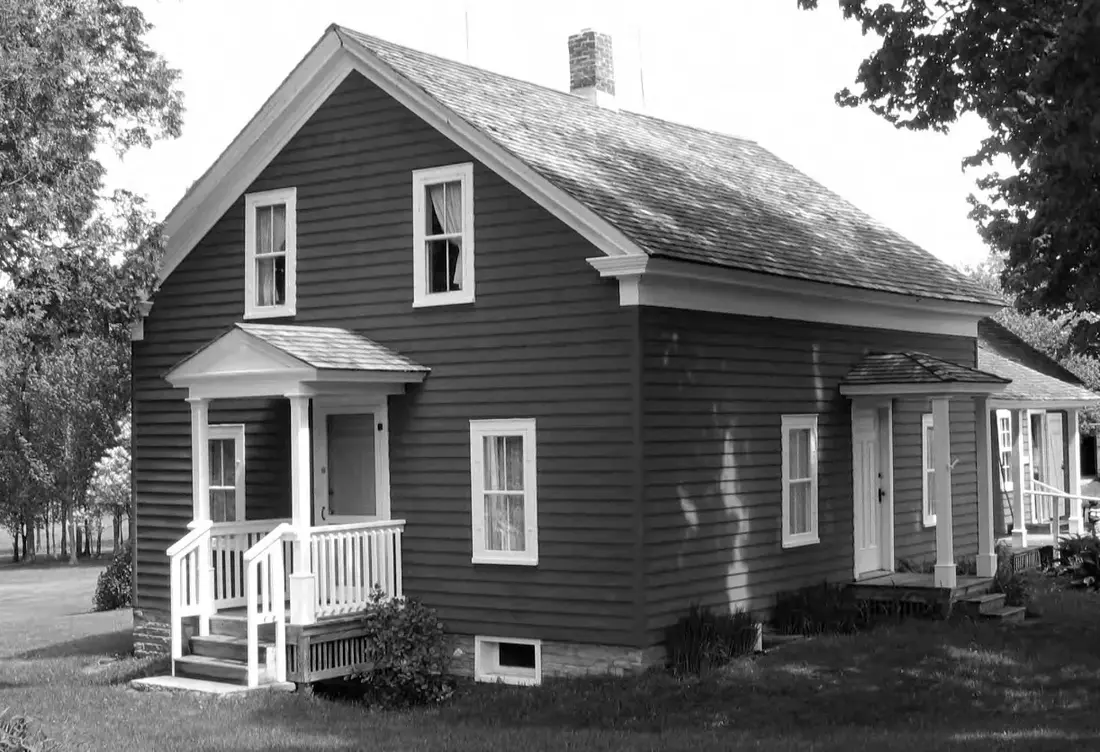
The farmhouse is a one-and-a-half-story timber-frame house on a fieldstone foundation, with weatherboard siding, a wood shake roof and a brick chimney at each gable end. Inside are two main rooms downstairs, divided by a straight central stair that climbs to a sleeping loft under the roof. Later owners added to it and changed it. Between 1957 and 1959 the State Education Department took off the additions and porches and returned the house to its look at the time of the funeral, working from pictures of the cottage printed in the popular press before 1860.
The rooms are furnished with mid-19th-century pieces, and only a few of them have a direct tie to Brown or his family; ask the guide which ones. The house is seen on a guided tour of the homestead and the gravesite, and in season tours start on the hour from 10 a.m. to 4 p.m. Behind the house is the woodshed, about 26 by 30 feet, which looks to be the same one seen in late-19th-century photographs, and on the hillside west of the barn is the old spring house.
The barn and the Timbuctoo exhibit
The barn is a 19th-century timber-frame barn, 40 by 30 feet, moved to its present place in 1921. The first floor holds the visitor center. The upper barn holds Dreaming of Timbuctoo, the permanent exhibit on Smith's land grants and the Black families who came to the Adirondacks to claim them, the story that brought Brown to North Elba.
John Brown Lives! created the exhibit in 2001 with historian Amy Godine as curator, and a traveling version went twice to the New York State Fair. The permanent version, designed by Karen Davidson Seward and paid for with donations through Adirondack Gives, has been in the barn since 2016. It is a series of panels with enlarged historic photographs and documents covering the voting law, Smith's plan, and the settlers who tried to make farms in the woods.
The first-floor visitor center is closed for renovation and a new exhibit from October 16, 2026, with reopening planned by about November 10. The farmhouse and the Dreaming of Timbuctoo exhibit upstairs stay open during the work. Check the site page before a fall visit.
Trails on the grounds
The site has about 3.8 miles of trails, open year-round from dawn to dusk at no charge. The park's trail map marks four of them, with map colors matching the trail blazes:
| Trail | Length |
|---|---|
| Yellow Trail | 0.4 mile |
| Blue Trail | 0.5 mile |
| Potato Field Loop | 1.8 miles |
| Ski Jump Trail | 1.1 miles |
Most of the trails are easy, with gentle grades, and a few are moderate. They begin at the edge of the field on both sides of the road, and the trail register is behind the family home; there is a small dirt parking area on the left as you drive in. The farm sits at about 1,850 feet. The ground is mostly flat, with moderate hills on the east and west sides and a steep drop on the east to the West Branch of the Ausable River, about 470 feet of which runs through the site. The trails look out to Algonquin Peak and other mountains, and to the ski jumps.
The fields and woods carry the usual Adirondack wildlife: black bear, mink, snowshoe hare and red squirrel, ruffed grouse, black-capped chickadees and wood thrushes, wood frogs and eastern newts. The park map asks you to stay on the trail; the land around the site is state Forest Preserve.
In winter the same trails are open for cross-country skiing and snowshoeing, and winter trail runners use them too. Bring your own gear; the cabins do not supply skis or snowshoes. The cross-country skiing and snowshoeing guide covers the ski centers nearby.
Nearby on Bear Cub Road, the Heaven Hill trails of the Henry and Mildred Uihlein Foundation cross an old farm: the 0.9-mile Big Field Loop, the 1.4-mile Old Orchard Loop and the 1.5-mile Bear Cub Loop, all fairly flat, open to the public and left ungroomed in winter for snowshoes and skis. The historic site has led history hikes there.
Hours, season and fees
The grounds, the trails and the grave are open every day of the year from dawn to dusk. From May through October the site is open six days a week, closed Tuesdays, from 10 a.m. to 5 p.m., and farmhouse tours run on the hour from 10 a.m. to 4 p.m. From November through April the visitor center and barn exhibits are open Tuesday through Saturday from 10 a.m. to 3 p.m., closed Sunday and Monday, and farmhouse tours are by appointment through the park office at (518) 523-3900.
Admission to the farmhouse is free. Tour buses pay $75. Hours on some tourism listings are out of date; the state's own page is the one to trust, and with the visitor center renovation this fall it pays to check it the week you go.
Events at the farm
The farm's calendar follows Brown's own dates. The John Brown Memorial Association began its annual pilgrimages to the farm in the 1920s, and today John Brown Day is held each year around his May 9 birthday. John Brown Lives! marks it with the Spirit of John Brown Freedom Awards. In 2026 it was on Saturday, May 9, from 2 to 4 p.m., free, with the theme John Brown America 250: Renewing the Revolution, and the organizers asked people to arrive by 1:30 because parking fills quickly.
In June the farm hosts a Juneteenth celebration with partners including the North Star Underground Railroad Museum, John Brown Lives! and New York State Parks. The 2026 Colors of Freedom program, on Sunday, June 21, from noon to 2:30 p.m., was free, with live music from the Jamcrackers, art, children's activities, a food truck and the Juneteenth Community Award. The park also lists I Love My Park Day and a First Day Hike on New Year's Day, and for Sunday, March 1, 2026, it listed a guided snowshoe history hike of two to three miles on part of the Jackrabbit Ski Trail, following the old road Brown traveled. The farm has also hosted a free blues concert, Blues at Timbuctoo; check whether it is on the calendar for your dates.
This fall an outdoor exhibit by the artist Ren Seward on the long struggle over voting rights, The Right to Vote: Spiraling Around the Promise, is on the grounds from October 9 to November 3, 2026, except October 17. The Lyman and Anna Eppes Land Grant Hike, on November 13, 2026, tells the story of the Eppes family and their 40 acres from Smith's grants. For dates near your stay, see the park's event list and our events calendar.
Dogs and accessibility
Dogs are welcome on the trails. The state's planning documents list dog walking among the things people come here to do, and the Lake Placid tourism office's trail page asks you to keep your dog on a leash and clean up after it. Ask at the visitor center or the site office before you take a dog near the farmhouse or the barn. The dog guide has the cabins' pet policy and more dog-friendly places.
The farmhouse is an 1855 house, and the Timbuctoo exhibit is on the barn's upper floor. If anyone in your group uses a wheelchair or has trouble with steps, call the site office at (518) 523-3900 before you go and ask what they can reach.
Getting there from the cabins
From the cabins, take the county roads out to County Route 25 and follow it to NY 30, about seven miles. Follow NY 30 south past Meacham Lake to Paul Smiths, about 31 road miles from the cabins, and turn east on NY 86 to Saranac Lake, about 43 miles. Stay on NY 86 toward Lake Placid for about six miles, take Old Military Road for about three and a half miles, then John Brown Road to its end, about half a mile.
That is about 54 road miles, an hour and a quarter, and you do not need to drive through Lake Placid village. From the junction of NY 73 and NY 86 in the village instead, follow NY 73 toward Keene for 1.75 miles, turn right on John Brown Road and follow it 0.75 mile to its end. The Saranac Lake and Paul Smith's guide covers the stops on the way. In winter, read the winter driving guide before a late drive home.
Pairing the farm with the Olympic sites
The farm and the Olympic Jumping Complex are neighbors, about a mile apart by road, and the farm can be seen from the top of the ski jump tower. The Olympic sites guide has the venues, passes and hours, and the Lake Placid and Whiteface day trip covers Main Street, Mirror Lake and the mountain.
| Time | Plan for a day from May to October (not a Tuesday) |
|---|---|
| 8:30 a.m. | Leave the cabins for the farm, about 54 road miles. |
| 10:00 a.m. | The first farmhouse tour, then the grave, the tablets and the statue. |
| 11:15 a.m. | Dreaming of Timbuctoo in the upper barn, then the Potato Field Loop or the Ski Jump Trail. |
| 1:00 p.m. | Drive about a mile to the ski jumps for the Skyride and the observation deck; its hours change with the season. |
| 3:00 p.m. | The Olympic Museum at the Olympic Center, then dinner on Main Street. |
| Evening | Home by NY 86 and NY 30, about 52 road miles from the Olympic Center. |
In winter, ski or snowshoe the farm trails in the morning, see the barn exhibit before it closes at 3 p.m. from Tuesday to Saturday, and save the Olympic Center for the afternoon.
More of this history near the cabins
The same fight over slavery reached Franklin County. Malone's Underground Railroad sites are covered in the Malone history guide, and the Blacksville marker on County Route 26 near Loon Lake, about 23 road miles from the cabins, marks Willis Hodges's settlement on Smith land. The North Star Underground Railroad Museum at Ausable Chasm tells the story of the Champlain Line, the route north through the Champlain Valley toward Quebec and Ontario. In 2026 it was open Fridays to Sundays from May 22 to October 11, free; the Ausable Chasm day trip has the way there.
For another side of 19th-century North Country farm life, the Almanzo Wilder Farm in Burke is about 13 road miles from the cabins. The cabins make a quiet base for a history trip like this: see the three cabins, or book direct.
Questions
Is there a fee to visit John Brown Farm?
No. Admission to the farmhouse is free, and the grounds, the grave and almost four miles of trails are open every day from dawn to dusk at no charge. Tour buses pay $75. Hours change with the season, so check the state's site page before you go.
How far is John Brown Farm from the cabins?
About 54 road miles, an hour and a quarter. Take County Route 25 to NY 30, NY 30 south to Paul Smiths, NY 86 through Saranac Lake, then Old Military Road and John Brown Road. You do not need to drive through Lake Placid village. The getting here guide covers the roads near the cabins.
When can you tour the farmhouse?
From May through October, tours run on the hour from 10 a.m. to 4 p.m. every day except Tuesday. From November through April the house is shown by appointment through the site office at (518) 523-3900. The visitor center on the barn's first floor is closed for renovation from October 16, 2026, with reopening planned by about November 10; the farmhouse and the upstairs Timbuctoo exhibit stay open.
Who is buried at John Brown Farm?
John Brown, buried in front of his house on December 8, 1859; his son Watson, reburied beside him in 1882; and ten men reburied together in 1899: his son Oliver and seven others killed at Harpers Ferry, and Aaron Stevens and Albert Hazlett, hanged in 1860. The 1916 tablet names twelve followers, Jeremiah Anderson among them; the National Historic Landmark record counts eleven in the graves.
Why did John Brown live in the Adirondacks?
In 1846 Gerrit Smith offered about 120,000 acres of Adirondack land in 40-acre lots to about 3,000 free Black New Yorkers so they could meet the state's $250 property test for voting. Brown moved his family to North Elba in 1849 to farm beside the settlers of Timbuctoo and help them clear their land.
Can I bring my dog to John Brown Farm?
Yes, on the trails: the state lists dog walking among the uses of the grounds, and the Lake Placid tourism office asks you to keep your dog leashed and clean up after it. Ask the site office before taking a dog near the farmhouse or the barn. The dog guide has the cabins' pet policy.
Can you cross-country ski or snowshoe at John Brown Farm?
Yes. The farm's trails, including the 1.8-mile Potato Field Loop and the 1.1-mile Ski Jump Trail, are open in winter for cross-country skiing and snowshoeing from dawn to dusk at no charge. Bring your own gear; the ski and snowshoe guide lists other trails.
Sources
Facts on this page were checked against these sources in October 2026. Hours, fees and schedules change; confirm before you go.
- New York State Parks parks.ny.gov/visit/historic-sites/john-brown-farm-state-historic-site
- New York State Parks parks.ny.gov/historic-sites/29/details.aspx
- npgallery.nps.gov npgallery.nps.gov/NRHP/GetAsset/NHLS/72000840_text
- New York State Parks parks.ny.gov/documents/inside-our-agency/MasterPlans/JohnBrownFarmStat
- New York State Parks parks.ny.gov/documents/historic-sites/JohnBrownFarmTrailMap.pdf
- home.nps.gov home.nps.gov/articles/john-browns-raid.htm
- nps.gov nps.gov/people/john-brown.htm
- battlefields.org battlefields.org/learn/articles/john-browns-raiders
- johnbrownlives.org johnbrownlives.org/abolitionist-john-browns-ties-to-the-adirondacks-wh
- johnbrownlives.org johnbrownlives.org/project/dreaming-of-timbuctoo/
- archive.wvculture.org archive.wvculture.org/History/jbexhibit/jbchapter2.html
- archive.wvculture.org archive.wvculture.org/History/jbexhibit/jbchapter14.html
- Saranac Lake tourism saranaclake.com/story/2015/10/john-browns-other-bodies
- hmdb.org hmdb.org/m.asp?m=46521
- cantonmuseum.org cantonmuseum.org/reference/research/john-browns-canton-connections/
- theadkx.org theadkx.org/timbucto-african-american-history-in-the-adirondacks/
- wgpfoundation.org wgpfoundation.org/historic-markers/timbuctoo/
- wgpfoundation.org wgpfoundation.org/historic-markers/blacksville/
- Lake Placid tourism (ROOST) lakeplacid.com/hiking/john-brown-farm-state-historic-site
- Lake Placid tourism (ROOST) lakeplacid.com/hiking/heaven-hill-trails
- ADK Taste adktaste.com/adirondack-events/john-brown-day-lake-placid-2026
- ADK Taste adktaste.com/adirondack-events/colors-of-freedom-juneteenth-john-brown
- northcountryundergroundrailroad.com northcountryundergroundrailroad.com/museum.php
- emergingcivilwar.com emergingcivilwar.com/2026/02/24/john-brown-in-lake-placid/
- wvencyclopedia.org wvencyclopedia.org/exhibits/20/sections/374
- ADK Taste adktaste.com/adirondack-events/john-brown-farm-snowshoe-history-hike
In this guide
Stay nearby
The aviation cabin: flight-themed décor, a Jøtul gas stove, a large open deck with its own hot tub, and a smokeless fire pit on the lawn.
 The AviatorCabin 3 · 2 bd · 1 ba · sleeps 4
More in Towns & History
Sources
26 references, listed in full at the end of this guide: official park, state, tourism-office and business sources, checked October 2026.