
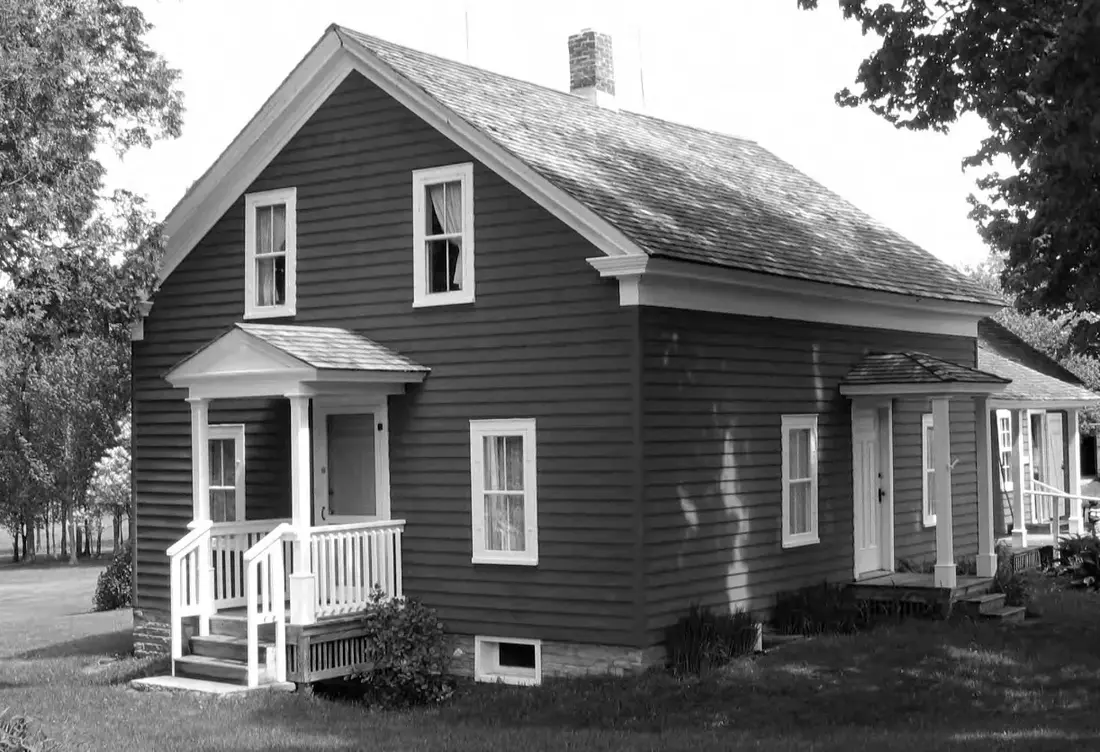
Farmer Boy is the Little House book set in New York, and its farm, its town and its county fair all lie within half an hour of the cabins. This post builds one family day on the book for readers ten and up: what to read before you come, the morning tour at the Almanzo Wilder Farm, lunch and a walk through the Malone the book describes, the fair if it is August, and supper and a fire back at the cabin. Along the way it sets out what historians have found the book gets right about farm life here in the 1860s, and what it leaves out.
Why the book is set near Malone
Almanzo Wilder grew up on his father's farm on Stacy Road in the Town of Burke, and Malone was the town his family drove to. His wife, Laura Ingalls Wilder, grew up farther west and never lived here. She wrote Farmer Boy from his memories before her first book came out, and it became the second Little House book in print, in 1933. The Almanzo Wilder Farm guide tells the family's story and the farm's; this post is about the day.
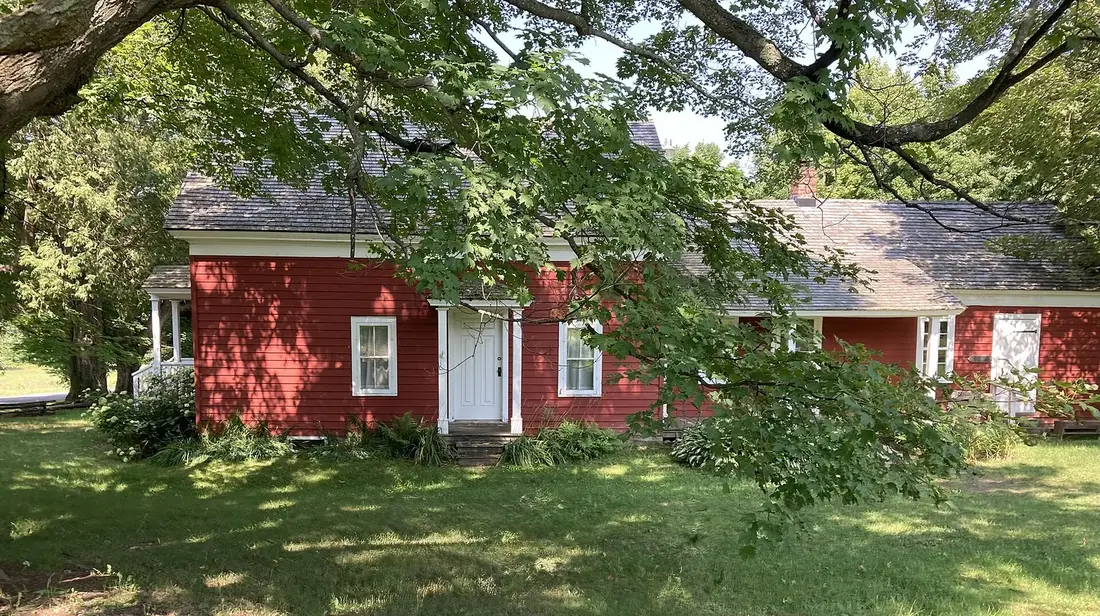
The land explains a good deal of the book. Burke, Chateaugay, Franklin and Bellmont, the town the cabins stand in, make up the Old Military Tract. The state set it aside in 1786 as bounty land for soldiers of the Revolution, but not one soldier ever claimed an acre of it, because the military tracts in central New York and Ohio looked better, and the state sold it off to land speculators instead. James Wilder paid $342 for 88 acres of it in November 1840. Settlers came from Vermont and Canada, Almanzo's grandfather Abel Wilder among the Vermonters. Farms in the county then grew rye, wheat, corn, oats, potatoes and flax and kept cattle and sheep, and families made most of their own cloth.
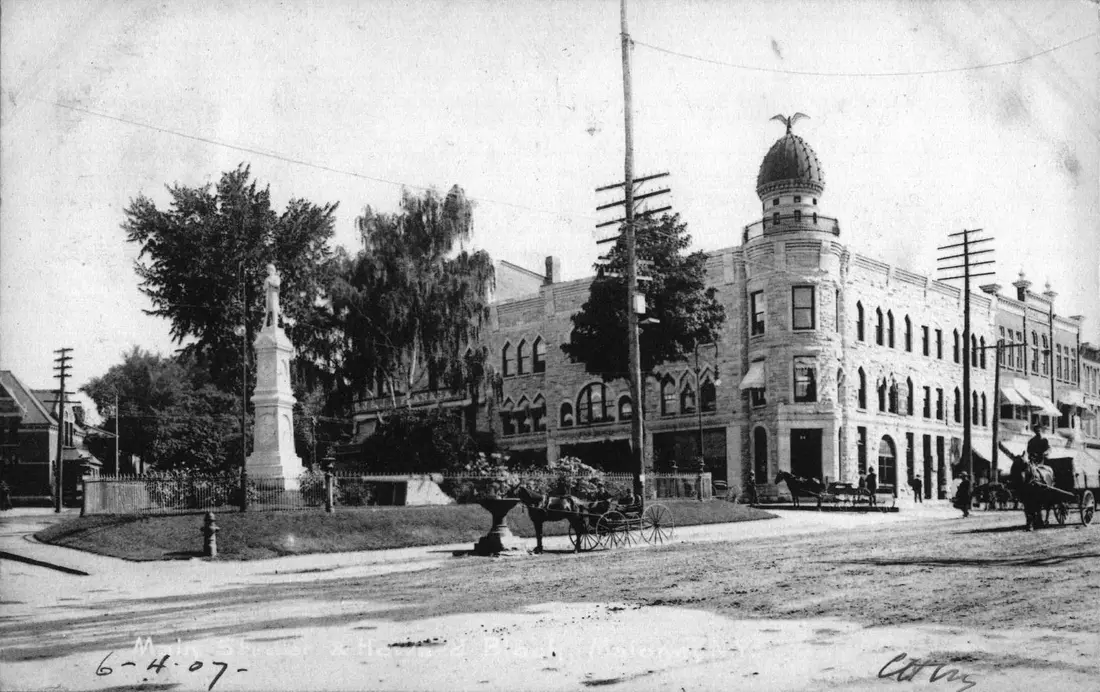
The railroad reached the county around 1850 and gave farms like the Wilders' a market for everything they could spare. That is why the book has buyers from New York City in it, one for potatoes, one for horses and one for butter. Rose Wilder Lane, Almanzo and Laura's daughter, came to Malone herself before she edited the Farmer Boy manuscript. She stayed at the Hotel Franklin, which had grown out of the old Methodist chapel where the Wilders had worshipped, and mailed her father a postcard of it. The hotel was torn down in May 1997.
Reading it together before the trip
The book follows about a year on the farm in 29 short chapters. Almanzo turns nine in chapter 5, and the year runs on past Christmas in chapter 26. The farm puts the book's reading level and content at fourth grade, and that matters for planning, because the cabins take children 10 and up. The Modern Pine's and The Modern Tiny Home's listings say they are not suitable for children under 10, and all three listings carry Airbnb's flag that they are not suitable for children and infants. If your Farmer Boy reader is younger than ten, read it at home now and save the trip for a year or two. A ten- or eleven-year-old who has just finished the book is the reader this day suits best.
At a chapter a night the book takes four weeks, so start a month before you leave. If that is too long, the unabridged audiobook from HarperCollins, read by Cherry Jones, runs 6 hours and 27 minutes, about the length of the drive up from New York City or Boston with a stop or two. A plan that works: read the first half aloud at home and play the rest in the car.
Read it by place as well as in order. Malone, the town, turns up in ten of the 29 chapters: 2, 5, 8, 10, 12, 13, 15, 16, 21 and 23. Sunday, chapter 8, takes the family to church in town, Independence Day, chapter 16, takes them to the celebration there, and County Fair, chapter 21, is the Franklin County Fair. The rest is the farm and the school, with the seasons setting the order: cutting ice in winter, planting and sheep-shearing in spring, harvest in summer and fall, threshing and hauling wood as the year closes. Reread the town chapters the week before you come, because the afternoon in this plan walks through them.
Give each reader one thing to listen for. The animals make a good start: Almanzo's calves Star and Bright, the colt Starlight, the pig Lucy, the cows Blossom and Bossy, and the workhorses Bess and Beauty. And ask someone to keep a list of everything the Wilders sell. It grows long by the end of the book, and the history further down this page explains why.
Morning at the Wilder farm
The Almanzo Wilder Farm is at 177 Stacy Road, about 13 road miles from the cabins, a little under half an hour. In 2026 it gave tours Wednesday to Sunday from Memorial Day weekend through August 30, at 10 a.m., noon and 2 p.m., then on Saturdays and Sundays in September, with tours by appointment into mid-October. The 2027 schedule had not been posted in early October 2026, so check the farm's tours page before you build the day around it. Take the 10 o'clock tour. It leaves the afternoon for town, and in July and August the morning is the cooler time to walk the barns.
The tour takes in the farmhouse, the barns and sheepfold, the pump house and the museum, with a walk through the woods to a replica one-room schoolhouse and a path to the Trout River. The farm guide covers the buildings, the prices and the events, so they are not repeated here. Two points for this day: dogs are not allowed on the farm grounds, so leave yours at the cabin, and the farm has a covered picnic area if you would rather eat there than in town.
On the grounds, let the children lead. Have them match the chapters to the buildings and ask the guide the questions the book raises, such as why the barns stand so close behind the house and which way Almanzo walked to school. The farm belongs to the Almanzo and Laura Ingalls Wilder Association, a volunteer-run nonprofit that bought it in 1987 and restored it with the book as its reference.
Lunch in Malone
From the farm, Malone is a short drive west on Route 11. Three places suit a Farmer Boy day, and all three were open in 2026. Small-town hours change with the season, so check before you go.
- Bokie's Drive-In, 3960 US Route 11, on the way into town from the farm. It has sold burgers, hot dogs, fries, poutine and ice cream since 1956, opens at 11 a.m. and is closed on Mondays. It is a seasonal stand, so make sure it is open before you count on it.
- Cafe Nouveau, 367 West Main Street, next to the courthouse and a short walk from the Methodist church in the next section. It serves breakfast and lunch from 8 a.m., with dinner on some evenings, and in the fall of 2026 it was closed on Tuesdays and Wednesdays.
- Foothills Lodge and Cafe, a small lodge in a restored historic schoolhouse in the village, with a cafe on its first floor that was open daily from 7 a.m. to 2 p.m. in 2026. After a morning in the replica schoolhouse at the farm, it is a good table for comparing notes.
Hosler's Family Restaurant at 609 East Main Street closed for good on September 20, 2026, after the building was sold, so skip any older list that sends you there. On a Wednesday from mid-May to early October, the Malone Farmers Market sets up from noon to 5 p.m. under the pavilion at the Malone Town Office, across Route 11 from Walmart; in 2026 it ran May 13 to October 7. Pick up vegetables for the cabin supper there. For more places to eat, see where to eat and the Malone town guide.
The Malone of Farmer Boy on foot
Park near the Franklin County Courthouse on West Main Street and walk. The village has changed in 160 years, but the book's town can still be traced in a few blocks, and the brick church the Wilders knew still stands.
The church with the bell
The Wilders were Methodists. When Almanzo was small, the congregation met in Hedding Chapel, a wooden building on a stone basement at Main and Fort Covington streets, on a lot given to the church in 1835. It had no bell. In 1866, the year the book is set, the congregation began a brick church at Main and Brewster streets, and it was dedicated on August 21, 1867, with a clock tower and a bell. In the book the church bell rings as the family climbs the steps, so the church Almanzo described to Laura was most likely the new one. It still stands as Centenary United Methodist Church, 345 West Main Street.
The church in the pictures
Garth Williams, who illustrated the series in the 1950s, drew a different church: the old red-brick Congregational church in Malone, perhaps because he assumed the Wilders went there. That building is gone. The stone First Congregational Church that replaced it in the 1880s stands at Main and Clay streets, east across the Salmon River, on a site whose earlier church was a stop on the Underground Railroad.
Franklin Academy
Royal, Eliza Jane and Alice, Almanzo's older brother and sisters, went to Franklin Academy, the Malone Academy of the book, in a three-story stone building from 1836, and Almanzo most likely went too. The 1836 building came down in 1870. The academy's 1881 building now houses Malone Middle School at 15 Francis Street, and the name lives on at the village high school, Franklin Academy, on Husky Lane. Both are working schools, so look from the street.
The bank, the mills and the fairgrounds
The book's town has a bank with a cashier, and so did Malone: the Bank of Malone from 1851, followed by the National Bank of Malone in 1865. Mother Wilder sends the family's wool to the carding machine in town, and Malone's first carding mill was Hiram Horton's, on the Salmon River. The stone shell of the Horton Gristmill still stands beside the river, in sight of Main Street; the Salmon River guide covers it. The fairgrounds, in a valley east of the village in the book's day, are still on East Main Street.
For the rest of the old village, from the War of 1812 to the Fenian raids, see Malone's history. The county historical society's House of History on Milwaukee Street has held papers, letters and keepsakes of Laura Ingalls Wilder, and its museum opens by appointment only, so call ahead if you want it in the day.
If your day falls in fair week
The Franklin County Fair is the fair of the book, held on the same grounds since the 1850s and now nine days long in August; in 2026 it ran August 8 to 16. In the book the fair comes in the fall, after the harvest chapters, and the fair guide explains why, along with what the newspapers of 1866 say about Almanzo's prize pumpkin.
For a Farmer Boy reader, start at the barns. In 2026 the 4-H youth beef show was on Friday, August 14, at 10 a.m. and the youth dairy show that afternoon at 1, the nearest thing at the fair to Almanzo breaking his calves in chapter 9. Then find the Vegetable Hall, open from about 10 a.m. to 8 p.m. during the 2026 fair. The pumpkin is still a contest there: the farm produce classes had one for a pumpkin of any variety and one for the largest pumpkin, open to Franklin County growers, with $4 for first place. A full August day runs like this: the 10 a.m. farm tour, lunch at Bokie's, which stands on Route 11 between the farm road and the fairgrounds, an afternoon rest at the cabin, then back to the fair for the midway and the grandstand in the evening. The farm is about four road miles from the fairgrounds. Dogs were not allowed on the fairgrounds during fair week in 2026, so they stay at the cabin for this one too.
Supper and a fire at the cabin
Farmer Boy is famous for its meals, so cook one from it. Almanzo's favorite dish, fried apples 'n' onions, turns up while he and Royal are filling the ice-house in chapter 6, and Barbara M. Walker's The Little House Cookbook has a recipe for it. All three cabins have full kitchens with a range, an oven and a microwave, and a grill outside, so a pan of apples and onions next to pork chops from the grill makes an easy supper. Popcorn, which the Wilders ate by the fire on winter evenings, finishes it.
Then take the book outside. Each cabin has its own fire pit: a big stone ring with Adirondack chairs at The Modern Tiny Home, a smokeless fire pit on the lawn at The Aviator, and a fire pit set into the tree line at The Modern Pine. Save the last two chapters, Mr. Thompson's Pocketbook and Farmer Boy, for the fire. At The Modern Tiny Home, walk the short trail to the observation deck over the pond before dark; the listing recommends it for watching wildlife, from birds to beavers, and the trail and deck are shared when the other cabin on that property is occupied. Every cabin has a private hot tub, and stargazing from the hot tub covers the night sky. Each sleeps four, in a main bedroom and a bunk room, which suits a family with two older children; the three cabins compared sets them side by side.
What the book gets right
Farmer Boy is a novel, but much of its farm life checks out against the newspapers, censuses and county histories of the time. Here are six details a family can talk over on the drive home.
Butter for the city
The book's butter buyer comes from New York City, and that trade was real. The Northern Railroad through Burke carried farm butter out of the county from its first years; on one run in 1850, eight tons of it left Burke. The county's first creamery did not open until 1869, so in 1866 butter was still made in farm kitchens, as Mother Wilder makes hers.
Wool, the carding mill and the sheep
Mother Wilder sends the family's wool to the carding machine in Malone in chapter 15 instead of carding it all at home, and that is the mix the county figures show. In 1845 Franklin County families made 83,309 yards of cloth at home, with all of the work done in the house except some of the carding. Sheep were everywhere then: the county counted 47,790 of them in 1845. By 1910 it had 5,223.
Threshing with a flail
In chapter 25 Father turns down the threshing machine and flails his grain on the barn floor through the stormy winter days. It looks old-fashioned, and by 1866 it was, but he had expert advice on his side. In 1857, the year Almanzo was born, the New York State Agricultural Society held that flailed wheat made far better seed than machine-threshed wheat, because the machines left at least a tenth of the kernels cracked, bruised or stripped of the germ.
Planting by the moon
Almanzo stays home from school to plant pumpkins at the dark of the moon in May, in chapter 15. In 1866 few farmers would have questioned planting by the moon, and the date works: if the year is 1866, the new moon fell on May 14.
A brand-new coin
On Independence Day, in chapter 16, Almanzo's cousin Frank has a nickel. The five-cent nickel was new that summer; the first ones were made in late June 1866, days before the Fourth. Laura and Rose probably never knew how timely that coin was.
Potatoes and starch
The book's potato buyer from New York fits too. Potatoes the shippers would not take went to starch factories, the only market for small potatoes and culls in districts far from the railroad. Franklin County once had forty of them, and Almanzo's uncle Andrew Day owned the one in Burke.
What the book leaves out or changes
Hops
The Wilders' cash crop was hops, and the published book leaves them out. The surviving manuscript has a scene of picking hops for a neighbor; it was cut. Hops were a gamble in Franklin County. Growing on a large scale began about 1850, prices swung from 40 or 50 cents a pound in good years to 3 or 4 cents in bad ones, and in 1864 mould and vermin destroyed the crop completely. Frederick Seaver's 1918 county history describes hop growers as living "in a fever of optimistic expectation or in the deeps of anxiety and gloom." Failed hop crops, along with relatives who had already gone west, are what moved the Wilders to Minnesota.
The move west
The book ends before any of that. The family stayed in Franklin County until the early 1870s, then went to Spring Valley, Minnesota, and James and Angeline Wilder sold the 88-acre farm in April 1875 for $5,000. The surviving manuscript has pages on the family deciding to leave, and they were cut, along with a description of Uncle Andrew's starch factory in Burke.
Mr. Paddock and the cobbler
Some characters changed between draft and print. In the handwritten manuscript Mr. Paddock runs a hardware store that competes with Mr. Case's, and he offers to take Almanzo on as a tinsmith's apprentice after watching the boy study the tinsmith at work; another man, Mr. Babcock, stands up for Almanzo in the pocketbook story. The published book folds both into Mr. Paddock the wagon maker. Malone had real wheelwrights then: William Robb and Oren Cornish advertised their shop in the Malone Palladium in January 1868. The cobbler changed too. In print he whittles new lasts from measurements of Almanzo's feet; in the manuscript he adjusts larger lasts he already has.
The pumpkin and the plenty
Almanzo's milk-fed pumpkin wins first prize at the fair, and the fair guide has what the newspaper of 1866 reported instead. The meals may be the larger change. The first two Little House books came out in the middle of the Great Depression, and Barbara Walker, who wrote The Little House Cookbook, called Farmer Boy Laura's own fantasy of a youth surrounded on all sides by food. Read the dinner scenes with that in mind.
Tips by age
The cabins take guests 10 and up, so this day is planned for older children, teenagers and grown-ups who read the books as children.
Readers from ten to twelve
A ten-year-old is a year older than Almanzo in the book, and a fourth-grade book is well within reach at this age, so let them read it on their own. Then hand them the day: choosing the tour time, carrying the book, keeping the list of what the Wilders sell and ordering lunch at the drive-in. Hand them one sum to work out. Almanzo's reward in chapter 28 is $200, and his father paid $342 for the whole 88-acre farm in 1840, so the reward came to more than half the price of the land.
Teenagers
Teenagers who have outgrown the story can take on the history behind it. Ask them to work out the year the book is set from Almanzo's age, then read about that June, when evening trains loaded with Fenians, Irish nationalists planning to invade Canada, rolled into Malone; the fairgrounds of the book were a marshalling ground for two of their raids. The hop gamble, the scenes cut from the manuscript and Rose Wilder Lane's work as editor make a good argument over supper about how true a true story has to be. Malone's history has the Fenian story in full.
Grown-up readers
Couples and friends who grew up on the books can take the day slower, and the shoulder season helps. In September 2026 the farm gave its regular tours on Saturdays and Sundays and tours by appointment on Thursdays and Fridays at 10 a.m. and 12:30 p.m., and in October it gave appointment tours on weekends into the middle of the month. Appointments are made by email at least two weeks ahead. A Thursday appointment tour, lunch at Cafe Nouveau and the walk to the Methodist church make a quiet fall day, with color on the drive back; the fall foliage guide has the timing.
Planning the day
- When. The farm keeps its fullest schedule from Memorial Day weekend through August, Wednesday to Sunday, and Wednesday adds the farmers market. Avoid Mondays, when the farm and Bokie's are both closed, and Tuesdays, when the farm is. Check the 2027 schedule before you book.
- Driving. The farm is about 13 road miles from the cabins. Downtown Malone is a few miles west of the farm on Route 11, and from Malone back to the cabins is about ten road miles, some 20 minutes on County Route 25.
- Who. Children 10 and up, teenagers and adults. Each cabin sleeps four, and two families traveling together can take The Modern Pine and The Aviator, which share one property; see family trips and group stays.
- Dogs. Not on the farm grounds, and not at the fair during fair week in 2026. All three cabins take pets for a fee; see bringing your dog.
- A longer stay. A week at the cabins sets this day inside a summer week.
Questions
Is Farmer Boy a true story?
Mostly. Laura Ingalls Wilder built it from her husband Almanzo's memories of his boyhood on his father's farm near Malone, and the farm, the town and the county fair are real. She changed some characters, gave Almanzo a fair prize the old newspapers do not show, and left out the family's hop crop and its move to Minnesota in the early 1870s. The farm guide has the family's story.
Can children stay at the cabins for a Farmer Boy trip?
Yes, from age 10. The Modern Pine's and The Modern Tiny Home's listings say they are not suitable for children under 10, and all three listings carry Airbnb's flag that they are not suitable for children and infants. The farm rates the book at a fourth-grade level, so a reader of ten to twelve fits both the book and the cabins. Each cabin sleeps four, in a main bedroom and a bunk room.
Which day of the week is best for a Farmer Boy day?
In the 2026 summer season the farm gave tours Wednesday to Sunday, so plan for one of those days and take the 10 a.m. tour. Wednesday adds the Malone Farmers Market, noon to 5 p.m., from mid-May to early October. Monday is the worst choice: the farm and Bokie's Drive-In are both closed. Check the farm's 2027 schedule before you book.
Where did the Wilders go to church in Malone?
They were Methodists. When Almanzo was small they worshipped at Hedding Chapel, which had no bell; the congregation's brick church at Main and Brewster streets, begun in 1866 and dedicated in August 1867, had a bell, and the book's church bell points to it. It still stands as Centenary United Methodist Church at 345 West Main Street. See Malone's history for the rest of the village.
Can we see Franklin Academy, the school in Farmer Boy?
Not the building Almanzo's brother and sisters knew: the academy's 1836 stone building is gone. Its 1881 building now houses Malone Middle School at 15 Francis Street, and the name lives on at Franklin Academy, the high school on Husky Lane. Both are working schools, so look from the street.
What should we cook for a Farmer Boy supper at the cabin?
Almanzo's favorite, fried apples 'n' onions, from the ice-house chapter; Barbara M. Walker's The Little House Cookbook has a recipe. Each cabin has a full kitchen with a range and an oven, plus a grill outside, so add pork chops or sausages from a Malone grocery and finish with popcorn by the fire pit. Groceries and supplies lists the stores.
Sources
Facts on this page were checked against these sources in October 2026. Hours, fees and schedules change; confirm before you go.
- Almanzo & Laura Ingalls Wilder Association almanzowilderfarm.com/tours
- Almanzo & Laura Ingalls Wilder Association almanzowilderfarm.com/about
- pioneergirl.com pioneergirl.com/blog/archives/5028
- pioneergirl.com pioneergirl.com/blog/archives/5068
- pioneergirl.com pioneergirl.com/blog/archives/8286
- pioneergirl.com pioneergirl.com/blog/archives/16272
- pioneergirl.com pioneergirl.com/blog/archives/11974
- pioneergirl.com pioneergirl.com/blog/archives/14735
- pioneergirl.com pioneergirl.com/blog/archives/12426
- pioneergirl.com pioneergirl.com/blog/archives/11419
- pioneergirl.com pioneergirl.com/blog/archives/9141
- pioneergirl.com pioneergirl.com/blog/archives/12333
- pioneergirl.com pioneergirl.com/blog/archives/6013
- archive.org archive.org/details/historicalsketch00seav
- neh.gov neh.gov/humanities/2014/julyaugust/feature/reading-laura-ingalls-wilde
- dos.ny.gov dos.ny.gov/system/files/documents/2019/05/malonesii.pdf
- umc.org umc.org/en/find-a-church/church?id=001Um00000PFKV9IAP
- nces.ed.gov nces.ed.gov/ccd/schoolsearch/school_detail.asp?Search=1&County=Frankli
- maloneschools.org maloneschools.org/o/fa/news
- franklinhistory.org franklinhistory.org/
- Visit Malone visitmalone.com/blog/2016/05/house-where-history-lives
- bokiesdrivein.com bokiesdrivein.com/
- cafenouveauny.com cafenouveauny.com/visit-us
- foothills-lodge.com foothills-lodge.com/
- Franklin County tourism (Always Franklin) alwaysfranklin.com/listing/foothills-cafe
- adirondackfarmersmarket.com adirondackfarmersmarket.com/malone-farmers-market
- nny360.com nny360.com/news/malone/hosler-s-closes-after-sale-of-restaurant/articl
- ADK Taste adktaste.com/adirondack-events/franklin-county-fair-malone-ny-2026
- frcofair.com frcofair.com/entries
- hmdb.org hmdb.org/m.asp?m=57179
- thereaderskitchen.com thereaderskitchen.com/fried-apples-and-onions/
- audiobooksnow.com audiobooksnow.com/audiobook/farmer-boy/1557829/
- adirondacksusa.com adirondacksusa.com/fall-foliage-reports
- The cabin's Airbnb listing airbnb.com/rooms/53628054
- The cabin's Airbnb listing airbnb.com/rooms/41023086
- The cabin's Airbnb listing airbnb.com/rooms/1168252128174283244


