
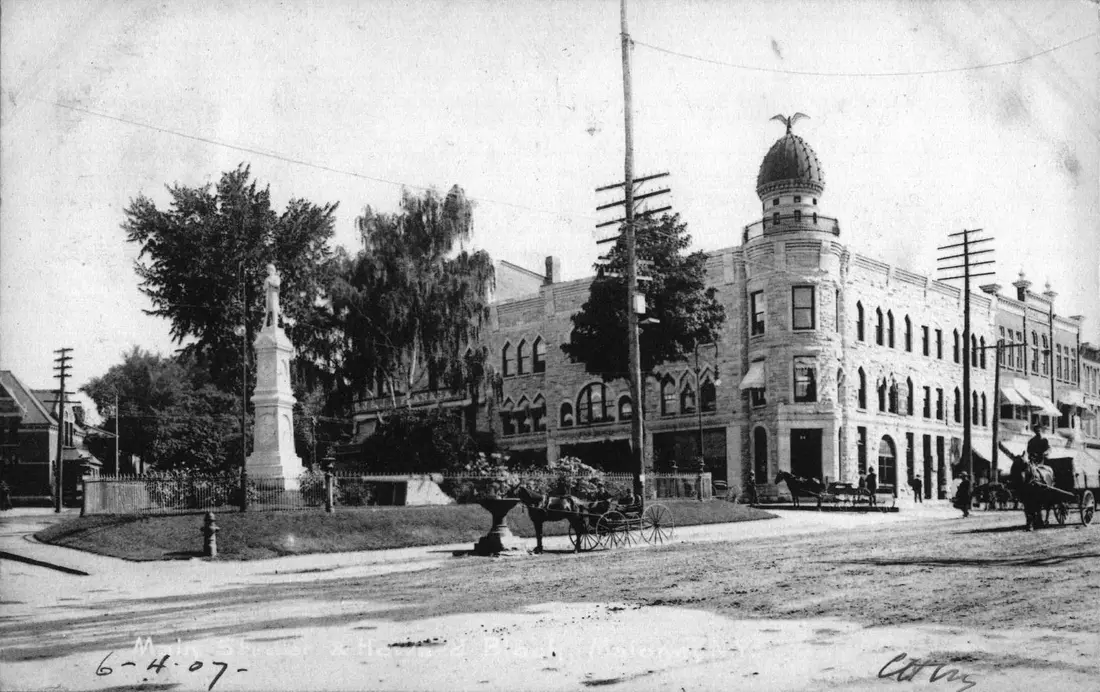
Before the Civil War, the counties around the cabins were the last stretch of American ground for many people escaping slavery on their way to Canada. The main route came up the Hudson and Lake Champlain and crossed near Champlain or into Vermont; a smaller, quieter line passed through Malone, and a Fort Covington lawyer kept a refuge half a mile from the line. This post follows those routes, sorts what the records show from what local tradition says, and plans a day to see what is left, starting ten road miles from the cabins at a Malone church and reaching the North Star Underground Railroad Museum near Ausable Chasm.
Why the border mattered
The line between New York and Canada meant something very different in 1850 than it does to a skier driving up from Montreal today. Slavery ended across the British Empire on August 1, 1834, when the Slavery Abolition Act took effect, and that included the colonies that are now Quebec and Ontario. On the American side, a person who had escaped from Maryland or Virginia could live in Troy or Malone for years and still be seized and sent back. Canada was the place where that could not happen.
The North Country Underground Railroad Historical Association, the group based at Ausable Chasm that has done most of the research on this region, counts Underground Railroad agents in western Vermont and in seven northeastern New York counties: Washington, Saratoga, Warren, Essex, Clinton, Franklin and St. Lawrence. The cabins sit in Franklin County. The association gives the years from 1830 to 1860 as the defining ones, and Frederick Seaver, who wrote the standard history of Franklin County in 1918, put the busiest period between 1840 and 1860.
The numbers are estimates, because the whole point was to leave no paper trail. The association's own figures are about 100,000 Americans who escaped slavery before the Civil War and about 40,000 who found refuge in Canada. The Government of Canada puts the number who reached Canada by the Underground Railroad at over 30,000, most of them settling in southern Ontario. Some of them passed through the counties around the cabins.
The Champlain Line
Historians call the main route through this corner of the state the Champlain Line. Don Papson, the association's founding president, describes it as a network whose trunk was the Hudson River, with its main branch running up the Champlain Canal and Lake Champlain to Quebec and side branches reaching east into New England and west into Ontario. Geography made it work. Lake Champlain drains north into the Richelieu River, which leads toward Montreal, and a fairly flat plain along the Vermont shore of the lake let travelers go around the Adirondacks.
The Champlain Canal opened in 1823 and connected the upper Hudson with the south end of the lake at Whitehall. From there, steamers ran north to the lake's northern ports. People escaping slavery traveled on canal packet boats, barges and steamboats, on the stage and rail lines that linked Albany and Troy with Vermont and Montreal, and on foot through the woods. The association's history of the Champlain Line of the Champlain Line also marks stops at Rouses Point, St. Albans and Burlington in Vermont, and St. Johns, now Saint-Jean-sur-Richelieu, on the Canadian side.
The north end of the lake has its own marker of this history. In 2009 the National Park Service recognized the old pier and steamboat landing at Rouses Point, at the north end of the lake by the border, and a wayside panel was dedicated there in 2011. Rouses Point is about 61 road miles from the cabins.
Albany and Troy
Many people came north to the Capital District from Washington and Baltimore. Albany had a Committee of Vigilance that Papson's history calls the most efficient Underground Railroad organization in the state, and the house of the abolitionist Stephen Myers and his wife Harriet on Livingston Avenue is now the Underground Railroad Education Center. From Albany some people stayed, some went west along the Erie Canal toward Canada, and some went north toward Lake Champlain or east into New England.
Troy, across the Hudson, was another center. On April 27, 1860, a man named Charles Nalle, who had escaped slavery, was arrested in Troy and held at the commissioner's office at First and State streets. Harriet Tubman was in the city that day. She got into the building, called down to the crowd outside, and held on to Nalle on the stairs as officers brought him down, and the crowd got him to the river. He was rowed across to West Troy, arrested again, freed again and hidden in Schenectady, and about a month later fifty-one people from Troy paid his former owner for his freedom.
Stephen Keese Smith, the Quaker farmer in Peru whose recollections are one of the fullest first-hand accounts from this region, named the chain that fed his farm: stations at Albany, Troy and Glens Falls, and then Peru.
Peru, Keeseville and the Quakers
The Clinton County end of the Champlain Line ran through a Quaker farming community in the hills west of Lake Champlain, between Keeseville and Peru, known as the Quaker Union. Quakers first settled the valley of the Little Ausable River there in 1789, and the Keese family was at the center of the antislavery work.
Samuel Keese, a Quaker farmer, headed what the association calls the Peru depot. His first wife, Hannah, was president pro tem of the Peru Female Anti-Slavery Society. His second wife, Catharine Robinson Keese, a Philadelphia schoolteacher, took in people on the run, and after her death in 1860 Samuel published her memoirs. The association connects Samuel to a documented case: in 1844, a 17-year-old who had escaped from Maryland reached Ferrisburgh, Vermont, was probably sent across the lake to Samuel, and went on to Toronto.
Organized antislavery came early. The first men's antislavery society on the New York side of Lake Champlain started in West Peru in 1837, and the same year Peter Keese signed a petition calling for a Clinton County Anti-Slavery Society. Abram Haff, a Methodist minister and the son of a slaveholder, sat on that society's executive committee. In Keeseville, Wendell Lansing, publisher of the Essex County Republican, helped people on their way north.
Stephen Keese Smith and the barn in Peru
Stephen Keese Smith was Samuel Keese's nephew. On June 3, 1887, long after the war, he set down his memories of the work, and a transcript survives at SUNY Plattsburgh. He wrote that he had known the work for twenty years or more before the Civil War, alongside Samuel's son John Keese and Wendell Lansing. "I had large buildings and concealed the Negroes in them," he wrote, and he remembered that people came through the woods "nearly famished." He fed them, often gave them shoes and clothing, kept them a day or two, and then sent them to Noadiah Moore in Champlain, who took them across the border and helped them find work in Canada. "I presume I have spent a thousand dollars," he wrote, and an old Plattsburgh newspaper reported the same figure.
In 1852 Smith bought a farm that had been homesteaded by John Haff, a slaveholder, and later owned by Haff's abolitionist son Abram. The association calls the barn on that farm Clinton County's best-documented Underground Railroad site. In its lower level is a stone-walled room that is believed to have hidden people. The association stabilized the barn in 2010, and students from SUNY Plattsburgh and SUNY Potsdam made a first archaeological dig at the farm the same year. In June 2026 a reporter for WCAX saw the room with its original floorboards overhead and the hinges still at its entrance. Madison estimates Smith helped about 400 people; nobody knows the exact number.
The farm is private. A new owner is restoring it and plans to share its history, including the slavery that took place there before Smith owned it, and the barn is not open to the public for safety reasons. The way to see it is on the association's guided tours, described below.
The St. Lawrence routes
West of the cabins, the St. Lawrence River was the border. Ogdensburg sat at the narrowest point of the river, with a steam ferry to the Canadian side, and the association treats it as a terminal for people headed to the Black communities of Canada West between Toronto and Windsor. On September 18, 1850, the first through train from Lake Champlain reached Ogdensburg, and in 1851 a swing bridge across the lake completed the rail line from Boston.
A newspaper story from 1837 shows how it worked. The Colored American printed an account, passed to the abolitionist Alvan Stewart by two St. Lawrence County men, of a man who had escaped from the South, came up the Champlain Canal and headed for Ogdensburg. About thirty miles short of it he stopped to chop wood for a mail carrier. The mail carrier came across a notice describing the man, addressed to the Ogdensburg postmaster, and instead of turning him in he showed him a route of about fifteen miles to the river. The man crossed the St. Lawrence as the sun went down. He is never named, which is typical.
The same year, the St. Lawrence County Anti-Slavery Society was organized in Potsdam, on August 15, 1837, and Thomas Canfield, an antislavery lecturer from Franklin County, toured the eastern towns of that county. A house in Brasher Falls, the Hurlburd House, has a space that is believed to have been a hiding place; the association lists it as an alleged stop.
What the records show for Malone and Franklin County
This is the part a guest staying ten miles south of Malone most wants to know, and it calls for care, because the county's best history was written after most of the witnesses had died. Seaver, writing in 1918, said a part of the story "must be merely conjecture." The Malone history guide covers the village's Underground Railroad sites; what follows separates the evidence by kind.
Documented in the records
The Franklin Anti-Slavery Society was organized in 1836, and Seaver had its original record of organization and the minutes of its annual meetings through 1848 on his desk as he wrote. Jabez Parkhurst, a Fort Covington lawyer, was its president for several terms and ran for the Assembly on the Liberty Party ticket in 1843. Seaver printed the society's member list. It includes the Rev. Ashbel Parmelee, pastor of Malone's First Congregational Church, whom the association calls the village's leading abolitionist, and George A. Cheney of Fort Covington. Antislavery meetings were held in Parmelee's church, and the present church at Main and Clay streets, about ten road miles from the cabins, is on the state's Underground Railroad Heritage Trail.
Seaver also described two lines through the county. One, which he said "was considerably used," ran east to St. Albans, Vermont. The other passed through Malone, and he concluded from the scarce evidence that Malone "was a station that was only infrequently used," on a line whose start and route nobody could trace. He admitted he had proved its use in only a few cases.
Remembered by people who were there
Much of Seaver's chapter comes from old residents he talked to or wrote to around 1918, people who had seen things as children. Marshall Conant wrote that at Parkhurst's house many a runaway was "harbored and fed." David Streeter, who grew up on the same street, told Seaver he had seen people there himself, two or three at a time, and remembered wagons rumbling past late at night while neighbors said a train was moving on the underground railroad. Parkhurst's stone house stood about half a mile from the border, a short night's drive from Dundee, the first village on the Canadian side.
Seaver recorded one couple who stopped running and settled in Malone: Henry Jones, a harness maker who served as sexton of St. Mark's Church for many years, and his first wife. In Seaver's words, the Joneses were the only fugitives "who risked locating in Malone." Cheney's son wrote to Seaver that his father, Parkhurst and Daniel Noble were the three principal abolitionists of Fort Covington, though as far as he knew his father gave money and advice and did not move people himself.
Family memory and local tradition
The Malone stories that guests hear most often rest on family memory, and they are worth knowing as such. Major Dimick lived nearly two miles north of the village on the Fort Covington road. Seaver called him an extreme and militant antislavery man and printed what his daughter, Mrs. Charles Fury, remembered as a girl: people hidden in the cellar for a few hours or a day or more, one man with the marks of a whipping on his back, and her father driving them into Canada at midnight in a lumber wagon under hay or straw. Asahel Beebe told Seaver he had heard the major and two neighbors talk over his days as a station agent and conductor. That is family and neighborhood memory written down decades later; no record from the time names him. Carlos Taylor, who lived about a mile from Dimick, is in the same category: his daughter remembered that when she was small a man on foot, with no guide, asked for a night's lodging, and her father sent him on toward Fort Covington.
The tunnels under the Congregational church are real; they survive from the building it replaced. That people were hidden in them is a belief, and the association words it that way: the basement is where fugitives were "believed" to be hidden, and the tunnels "may have been used." The story of slave catchers who came for John Thomas at Franklin Falls and turned back when they were told he was armed and would not be taken alive is local tradition; Seaver said only that it "used to be current" in Franklin Falls, Vermontville and Bloomingdale.
None of this makes the Malone stories false. It means the documented core of Franklin County's part is a county antislavery society that met for twelve years, a lawyer's house by the border at Fort Covington, a well-used line toward Vermont, a rarely used one through Malone, and at least two people who escaped slavery and made their homes in the county.
John Thomas, a farmer near Bloomingdale
The best-documented person in Franklin County's part of this history is a man who escaped slavery himself. John Thomas was born into slavery in Queen Anne's County on Maryland's Eastern Shore, around 1810. After his enslaver sold his wife and children, he escaped, about 1840, with help he later credited to "Friendly Quakers, and others." He reached Troy and lived there about seven years. In Troy he heard Gerrit Smith speak at the Rev. Henry Highland Garnet's Liberty Street church, and on September 1, 1846, Smith deeded him forty acres in Township 9 of the Old Military Tract in Franklin County.
The first lot, at Franklin Falls, was deep woods far from neighbors, church and school, and Thomas sold it and went back to Troy. He returned and bought land near Bloomingdale, built it into a farm, and by 1872 owned 200 acres. That year, on August 26, he wrote to Smith about his family and farm; the letter is in the Gerrit Smith Papers at Syracuse University. He died on April 30, 1894, at 83, at the home of his daughter Charlotte Morehouse, and he is buried beside his wife Mary in Union Cemetery in Vermontville. In 2007 the association found two of his great-great-grandsons still living in the area, and in 2023 a brook that had carried a racist name was renamed John Thomas Brook in his honor.
Vermontville is about 43 road miles south of the cabins. Seaver names another man who escaped slavery and stayed, Alexander Hazard, who lived undisturbed for many years near Bloomingdale, and he notes that John Thomas was the grandfather of Henry Jones's second wife, a Morehouse from the town of Franklin.
Gerrit Smith's land and North Elba
Thomas's forty acres came from the same plan that brought John Brown to the Adirondacks. Starting in 1846 Smith gave land to Black New Yorkers so they could meet the $250 property requirement for Black voters, and Brown moved his family to North Elba in 1849 to help the settlers there. The John Brown Farm guide tells that story, Timbuctoo and the graves included. Two details belong here. The association records that Cyrus Thomas, who had escaped slavery in Florida, followed the Browns from Springfield and lived with them at the farm they first rented on Cascade Road. Whether people on the run sheltered at the Brown farm itself is a question the association leaves open, noting that some say they did and some say they did not.
Closer to the cabins, the Blacksville marker on County Route 26 near Loon Lake, about 23 road miles away, marks the settlement the Brooklyn editor Willis Hodges started on Smith land in 1848. Hodges's son said his father sheltered fugitives at his Loon Lake cabin; that is a family account. After Brown was hanged in December 1859, his body was carried home to North Elba by way of Elizabethtown, where, the town records, it lay in state at the Essex County Courthouse.
The Fugitive Slave Act of 1850
The law that made the border matter most was signed on September 18, 1850. It set up federal commissioners to hear claims, and the alleged fugitive could not speak for himself: "In no trial or hearing under this act shall the testimony of such alleged fugitive be admitted in evidence." The commissioner earned ten dollars for each person he sent south and five dollars when he set someone free. A marshal who refused to serve a warrant could be fined $1,000, and "all good citizens" were commanded to help. Anyone who hid or helped a fugitive faced a fine of up to $1,000, up to six months in prison, and $1,000 in damages for each person lost.
For the farmers and lawyers of Peru and Fort Covington, that turned hospitality into a federal crime. For people who had escaped years earlier and settled in the North, it meant they could be sent back, and many moved on to Canada.
The new law reached this region within months. On February 15, 1851, Shadrach Minkins, a waiter at Taft's Cornhill Coffee House in Boston, was seized on papers brought by a constable from Norfolk, Virginia. A group led by Lewis Hayden pulled him out of the courtroom. He went by wagon to Concord and Fitchburg and by train across Vermont, possibly through Burlington and St. Albans, and on February 28 he wrote from Montreal that the four-day trip had been very severe and that they had crossed the ice twice, once for nine miles.
Crossing into Canada
The names on the map changed while this was going on. Upper Canada passed a law in 1793 that made it the first British colony to move against slavery, and in 1841 the Act of Union joined Upper and Lower Canada as one Province of Canada, with Canada West (today's Ontario) and Canada East (today's Quebec). A traveler who crossed at Champlain, Fort Covington or Dundee stepped into Canada East. Slavery had existed there too: the historian Marcel Trudel counted about 4,200 enslaved people in New France and the Canadas between 1671 and 1831, about a third of them of African descent, until the 1834 law ended it.
Montreal was the nearest city, and some refugees preferred it. Minkins stayed there for the rest of his life. He worked as a waiter, ran his own lunch shop, married, had children and later made his living as a barber. Most refugees went on to Canada West, to Toronto, Hamilton, St. Catharines, Windsor and the Chatham area, where the Black communities were larger.
Freedom in Canada meant the law would not send a person back. A Black man who met the property requirement could vote and own land, and some settlements sold land at reduced prices and ran schools. Henry Bibb started the newspaper Voice of the Fugitive in 1851, and Mary Ann Shadd Cary started the Provincial Freeman in 1853. Freedom did not mean equal treatment. Refugees met racism and segregation, and some white residents of Canada West started a petition to close the border to new Black immigrants. After the Emancipation Proclamation, many went back to the United States; the Canadian Museum of Immigration at Pier 21 puts it at about two thirds. Canada's House of Commons voted unanimously in 2021 to mark August 1 as Emancipation Day.
The North Star Underground Railroad Museum
The museum in the region given over to this history is the North Star Underground Railroad Museum, in the Town of Chesterfield Heritage Center at 1131 Mace Chasm Road, Ausable Chasm. The North Country Underground Railroad Historical Association runs it and keeps its offices and research collection there. It had its grand opening on May 21, 2011.
The exhibits tell the hidden history of the Champlain Line. The centerpiece is a multimedia telling of John Thomas's story, from Maryland to his own farm in the mountains. Another section covers how the fight over slavery split the churches, built around a leg iron found in a Quaker home nearby. A regional display covers the safe houses and the people who opposed slavery, from petitions to the war.
The 2026 season runs on Fridays, Saturdays and Sundays from May 22 through October 11, from 11 a.m. to 4 p.m., and until 5 p.m. in July and August. Admission is free, and donations are welcome. The museum can also open for private tours by appointment at any time of year; the museum's page has the contact. The 2027 season had not been posted when this was written; expect a similar late-May to mid-October run, and check the museum's page before you go.
The association also runs guided tours. On June 20, 2026, for the Juneteenth weekend, its bus tour left the museum at 10 a.m. and ran from Keeseville and Peru to Beekmantown and Plattsburgh, stopping at churches that took part in the antislavery fight and at old cemeteries, with reenactors along the way, one of them a great-great-grandson of Stephen Keese Smith. Watch the association's site in spring for the 2027 date; registration is online.
From the cabins the museum is about 74 road miles, an hour and three quarters, most easily by way of Plattsburgh. The gorge is a mile down the road, so the day pairs naturally with the Ausable Chasm day trip, and Plattsburgh is on the way.
A day on the Champlain side
This is a long day, so start early and come back for the hot tub. It works best on a Friday, Saturday or Sunday in the museum's season. The road miles are measured from the cabins.
| Time | Stop | Road miles from the cabins |
|---|---|---|
| 8:30 a.m. | Leave the cabins for Malone; US 11 east through Chateaugay toward Plattsburgh | 0 |
| 9:00 a.m. | Optional stop at the First Congregational Church in Malone, Main and Clay streets | about 10 |
| 11:00 a.m. | North Star Underground Railroad Museum, 1131 Mace Chasm Road, when it opens | about 74 |
| 12:30 p.m. | Lunch in Keeseville or at the chasm | about 75 |
| 2:00 p.m. | Ausable Chasm, if there is time and energy for the trails | about 74 |
| 4:30 p.m. | Head home through Plattsburgh, with dinner there or in Malone | about 61 back from Plattsburgh |
The Keese homestead stands at Harkness and Union roads between Keeseville and Peru, with the Smith farm nearby. Both are private property, so take them in from the road or on one of the association's tours, and do not walk onto the land. Champlain, where Noadiah Moore took people over the line, is about 57 road miles from the cabins on US 11, and the border crossing guide covers today's crossings there.
A shorter day close to the cabins
Franklin County's sites are closer and quieter. None of them is a museum, and the history is in the places themselves.
- The First Congregational Church in Malone, about ten road miles north. Look at it from the street; the church is an active congregation, so call the church office before asking to see inside.
- Fort Covington, about 25 road miles northwest by way of Malone and NY 37. Parkhurst's stone house stood about half a mile from the border here, and Dundee is just across the line. The Fort Covington crossing is open around the clock; the Trout River crossing post explains why that matters in 2026.
- The Blacksville marker on County Route 26 near Loon Lake, about 23 road miles south, then on toward Vermontville, about 43 road miles, where John Thomas farmed and is buried.
- The John Brown Farm in Lake Placid, about 54 road miles, with the Dreaming of Timbuctoo exhibit in the upper barn.
For family records and the county's own files, the Franklin County Historical and Museum Society's Schryer Center at the House of History in Malone is open for research on Tuesdays and Thursdays from 10 a.m. to 4 p.m. or by appointment; the Malone history guide has the details. The Malone town guide covers lunch and fuel in the village.
Reading more before you go
Three books make a good start. Tom Calarco's The Underground Railroad in the Adirondack Region (McFarland, 2004) draws on abolitionist newspapers from the 1840s and local archives and follows the region's workers down to their contacts in Albany and New York City. Don Papson and Tom Calarco's Secret Lives of the Underground Railroad in New York City (McFarland, 2015) annotates the record of fugitives that the antislavery editor Sydney Howard Gay kept for more than two years of the work he and his close associate Louis Napoleon did in the city. Frederick Seaver's Historical Sketches of Franklin County (1918) has the Underground Railroad chapter quoted above, with its candid admission of how much had already been lost.
The association's website has county-by-county pages for Clinton, Essex, Franklin and St. Lawrence counties. Historic Saranac Lake's online wiki carries part of Seaver's chapter and a full page on John Thomas, and the whole book can be read free online.
Visiting with care
Most Underground Railroad sites in the North Country are private houses, barns and churches, and the people who live in them did not sign up to be a museum. Stay on the road or the sidewalk, do not knock to ask about hiding places, and join one of the association's tours to see more. In cemeteries, walk the paths and leave the stones as you found them.
The people who made these crossings worked hard not to be recorded, and what survives is mostly what their helpers and their helpers' children remembered decades later. A hiding room that is "believed" to have been used is still worth seeing.
Back at the cabins, the hot tub is waiting, and the drive home from the lake takes a little under two hours. For other days out, the day trips page and the towns and history guides have the rest.
Questions
Did the Underground Railroad run through Malone?
A little. Frederick Seaver's 1918 county history found that a line through Malone was used only rarely, while a busier one ran east to St. Albans, Vermont. The Franklin Anti-Slavery Society met from 1836 to at least 1848, and a Fort Covington lawyer, Jabez Parkhurst, sheltered people half a mile from the border. The Malone history guide has the village sites.
Can you visit the Stephen Keese Smith barn in Peru?
Not on your own. The barn with its hidden stone room is on a private farm, and in 2026 it was closed to the public for safety while a new owner restores it. The North Country Underground Railroad Historical Association includes Peru on its guided bus tours; watch its website in spring for dates.
When is the North Star Underground Railroad Museum open?
In 2026 it was open Fridays, Saturdays and Sundays from May 22 to October 11, 11 a.m. to 4 p.m., until 5 p.m. in July and August, with free admission. Private tours are possible by appointment. Check the museum's page for the 2027 season before you drive the 74 road miles from the cabins.
How far is the North Star museum from the cabins?
About 74 road miles, an hour and three quarters by way of Malone, US 11 and Plattsburgh. It is a mile from Ausable Chasm, so most guests make a day of both; the Ausable Chasm guide has the drive in detail.
Was John Brown's farm a stop on the Underground Railroad?
That is unsettled. The local historical association says some believe people on the run stayed at the North Elba farm and some do not. It is documented that a man who had escaped slavery in Florida, Cyrus Thomas, lived with the Browns at the farm they first rented. The John Brown Farm guide covers the site.
What did reaching Canada mean for people escaping slavery?
The law would not send them back. Slavery ended in the British Empire in 1834, and in Canada a Black man who met the property rules could own land and vote. Many still met racism and segregation, and after the Emancipation Proclamation about two thirds went back to the United States, by one museum's count.
Sources
Facts on this page were checked against these sources in October 2026. Hours, fees and schedules change; confirm before you go.
- northcountryundergroundrailroad.com northcountryundergroundrailroad.com/museum.php
- northcountryundergroundrailroad.com northcountryundergroundrailroad.com/champlain-line.php
- northcountryundergroundrailroad.com northcountryundergroundrailroad.com/champlain-line.php?page=2
- northcountryundergroundrailroad.com northcountryundergroundrailroad.com/clinton-county.php
- northcountryundergroundrailroad.com northcountryundergroundrailroad.com/clinton-county.php?page=2
- northcountryundergroundrailroad.com northcountryundergroundrailroad.com/franklin-county.php
- northcountryundergroundrailroad.com northcountryundergroundrailroad.com/franklin-county.php?page=2
- northcountryundergroundrailroad.com northcountryundergroundrailroad.com/st-lawrence-county.php
- northcountryundergroundrailroad.com northcountryundergroundrailroad.com/essex-county.php
- northcountryundergroundrailroad.com northcountryundergroundrailroad.com/canada.php
- northcountryundergroundrailroad.com northcountryundergroundrailroad.com/accomplishments.php
- wiki.historicsaranaclake.org wiki.historicsaranaclake.org/index.php/Underground_Railroad
- wiki.historicsaranaclake.org wiki.historicsaranaclake.org/index.php/John_Thomas
- avalon.law.yale.edu avalon.law.yale.edu/19th_century/fugitive.asp
- canada.ca canada.ca/en/canadian-heritage/campaigns/emancipation-day.html
- pier21.ca pier21.ca/research/immigration-history/immigration-from-united-states-
- thecanadianencyclopedia.ca thecanadianencyclopedia.ca/en/article/act-of-union-plain-language-summ
- wcax.com wcax.com/2026/06/19/physical-reminders-slavery-north-country-juneteent
- hartcluett.org hartcluett.org/rensselaer-county-blog/charlesnalle
- albany.edu albany.edu/news-center/news/2023-ualbany-summer-history-major-research
- elizabethtown-ny.gov elizabethtown-ny.gov/history
- wgpfoundation.org wgpfoundation.org/historic-markers/blacksville/
- goadirondack.com goadirondack.com/event/a-bus-tour-of-underground-railroad
- mcfarlandbooks.com mcfarlandbooks.com/?p=20907
- mcfarlandbooks.com mcfarlandbooks.com/?p=21327
- archive.org archive.org/details/cu31924079502492
- adirondacklife.com adirondacklife.com/2023/04/12/silent-as-the-grave-a-forgotten-quaker-b
- search.worldcat.org search.worldcat.org/title/53215764


