
Every cabin's fire pit has a ring of Adirondack chairs around it, and the chair began about 87 road miles away, in Westport on Lake Champlain, where a summer visitor named Thomas Lee built the first one around 1903. This post follows it from Lee's plank chair through Harry Bunnell's 1905 patent, the cure porches of Saranac Lake and the slatted version of 1938, then shows how to tell the styles apart, what makes one comfortable, where to see the old ones, and how to spend a day in Westport.
The chairs at the cabins
All three listings mention them. The Modern Tiny Home's says, "There is a beautiful fire pit with Adirondack seating." The Modern Pine's adds one word: "There is a beautiful fire pit with authentic Adirondack seating." The Aviator's puts a smokeless fire pit and Adirondack chairs on its lawn and suggests fireside stories and s'mores there.
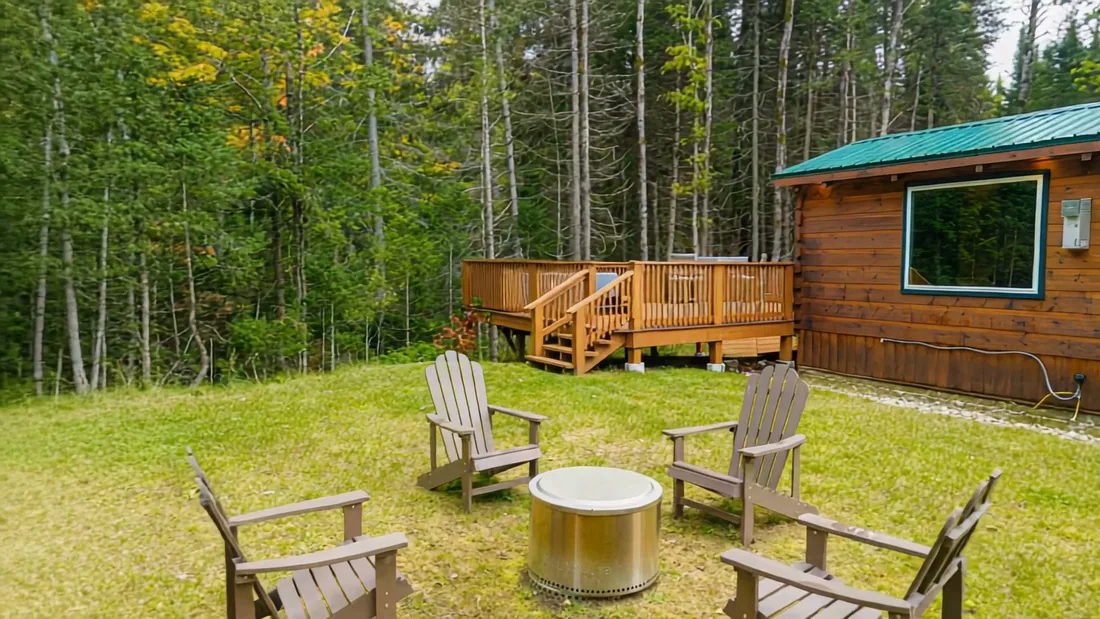
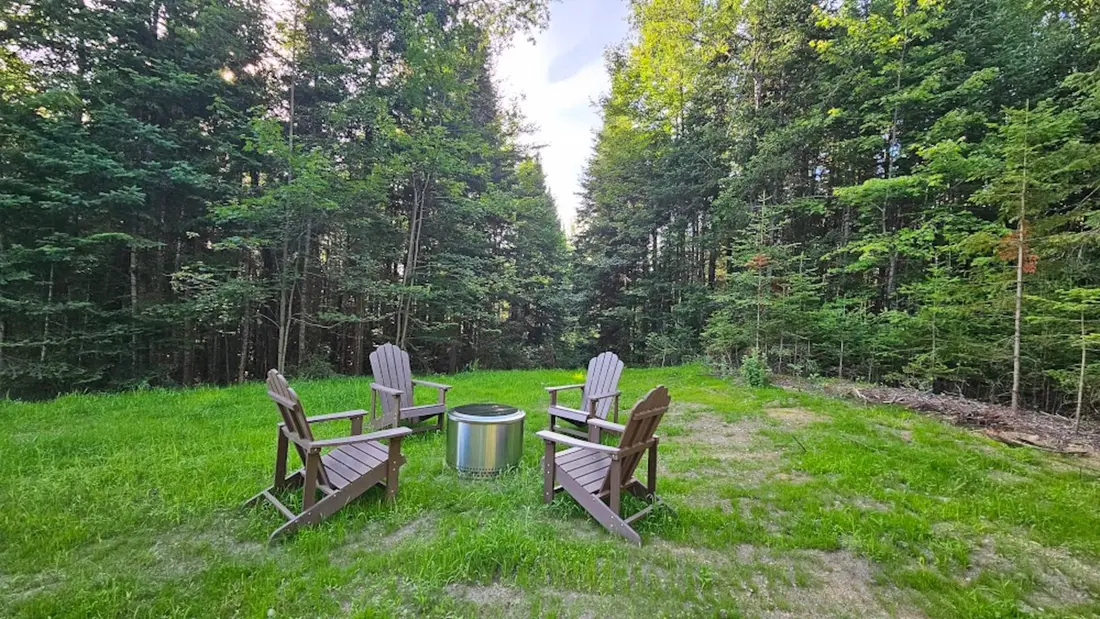
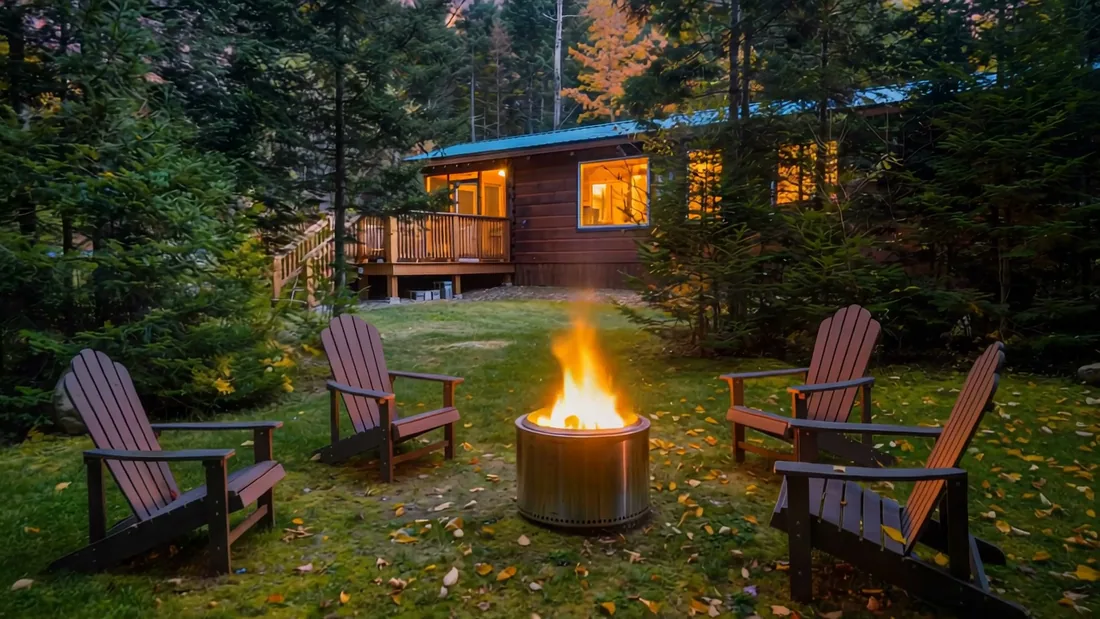
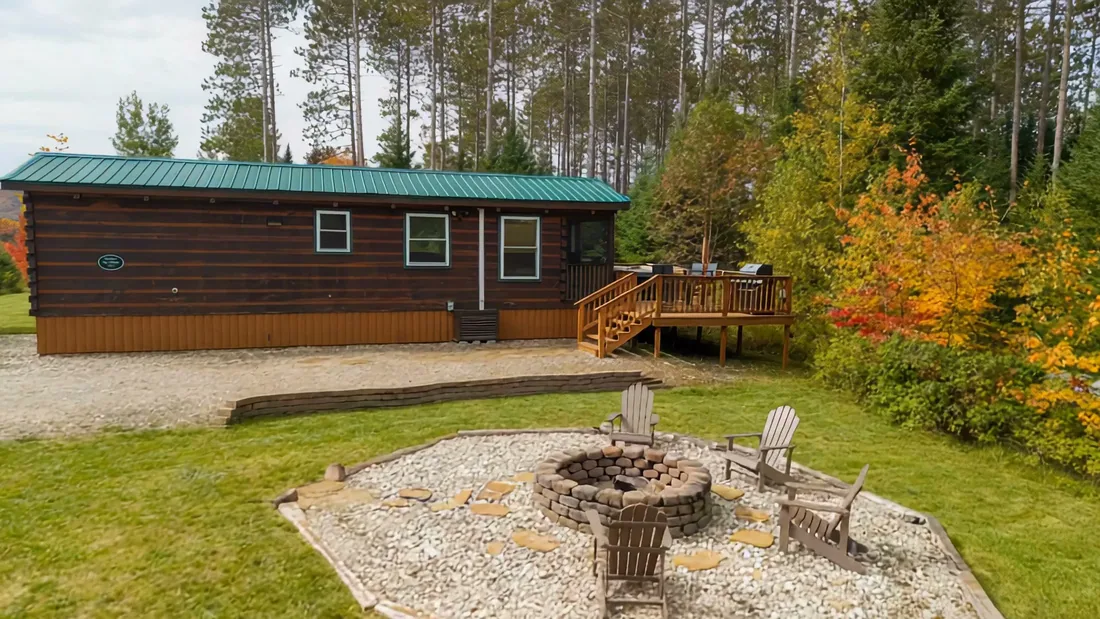
The photographer's pictures from fall 2026 show how each one is set. At The Aviator, four chairs face a stainless-steel smokeless fire pit on the grass beside the cabin and its deck. At The Modern Pine, four more sit around the same kind of fire pit on the lawn at the edge of the woods. At The Modern Tiny Home, the chairs ring the big stone fire pit, set in a bed of gravel in front of the cabin, four of them in the daytime picture and five at dusk. Each cabin sleeps four, so there is a chair at the fire for every guest. In every one of those pictures the chairs have backs of narrow slats that spread out toward a rounded top, broad flat arms and seats that tip you back, the shape most people picture when they hear the words Adirondack chair.
Guests use them. One who stayed at The Modern Tiny Home in the summer of 2020 wrote, "Love the chairs provided around the campfire." Another, in 2022, roasted marshmallows there and found that "the pit is a great size that we all had plenty of space for roasting." The chairs have a long history for something so plain, and it starts with a single wide board.
Thomas Lee's chair in Westport
Westport is a lakeside town on the western shore of Lake Champlain. It was settled in the 18th century, destroyed during the Revolutionary War and, in the 19th century, a popular resort. Thomas Lee, a Boston native, had a summer home there, and in the first years of the 1900s he set out to make a simple, comfortable chair from which his family could look out over Lake Champlain from behind the house. The family's account is that he spent 1900 to 1903 trying different woods, shapes, sizes and positions before he settled on an angled chair.
His chair used 11 boards. It was wide, with a back of one solid pine plank set at roughly a right angle to a seat that sloped down toward the back, so the whole chair leaned you back, and its armrests were broad. A 2009 newspaper account has Lee building prototypes one summer for the 22 family members staying in Westport and asking all of them which was the most comfortable. Lee's design, which he called the Westport chair, dates to 1903. More than a century later, his great-great-grandniece has said she can sit in one for hours, and sleep in one too.
Harry Bunnell and the 1905 patent
The chair might have stayed in one family's yard. Instead Lee let a local carpenter, Harry Bunnell, borrow one of his chairs as a model so he could build copies to sell; Bunnell said he was badly short of money. Bunnell went further. Without asking Lee, he applied on April 1, 1904, for a patent on the chair, and on July 18, 1905, he received U.S. Patent 794,777 under his own name.
The patent describes "a chair of the bungalow type adapted for use on porches, lawns, at camps," built strong and durable to stand rough use and the weather, and convertible into an invalid's chair. Its frame is two solid side boards, each shaped roughly like a diamond, with a straight bottom edge that stands on the floor. The back is one solid board that leans up and back between them. The seat rests on the sides with its back edge against the back board, and two front legs hold up the arms, which are wide at the front. Bunnell added things Lee's chair didn't have: cushions for the seat and the back, a hinged footrest, and a compartment under the seat with a hinged section of seat above it. For an invalid, a board slid into that compartment to hold "a vessel or receptacle of any desired kind."
He called it the Westport Plank Chair. Bunnell built the chairs in a basement workshop, sold them for $4 from a store on the town's main street, and kept making them until about 1930, along with variations that included a two-seat tête-à-tête version and one that turned into a rocking chair. One of his chairs, made of hemlock, is in the Yale University Art Gallery, stamped near the top of the back "PAT. JULY. 18. 1905 / MFG. BY. H. C. BUNNELL / WESTPORT.N.Y." It measures 38 3/8 inches high, 39 1/2 inches wide and 40 inches deep, and the gallery acquired it at the Farmington Antiques Show in 2002. By the time Bunnell died of pneumonia in March 1933, the design had found its way beyond northern New York.
A chair for the cure
Bunnell had a market in mind. In those years hundreds of people with tuberculosis came to the Adirondacks for weeks of quiet rest and fresh air on the porches of sanatoriums and cure cottages, and they needed furniture fit for convalescents. A sturdy outdoor chair that could be fitted out for an invalid suited them. By 1912 a version called the Adirondack Bungalow Chair was on sale at W.C. Leonard's department store in Saranac Lake, where residents rented out their homes to patients as cure cottages. The furniture maker and author Daniel Mack goes as far as to write that without tuberculosis, "It's unlikely that there would have been an Adirondack chair."
The chairs patients spent their days in were often a different design, the cure chair, a kind of chaise longue built as a more practical alternative to resting in bed. Its back could be moved from upright to flat, it had a thick mattress over coil springs held by steel straps, and it rolled on casters. Saranac Lake had its own makers: George L. Starks & Company built the Rondack Reclining Chair there, and once had an order from the U.S. Public Health Service for 1,000 of them. Patients were encouraged to spend as much time outdoors as they could, and the cure chair on the porch is where they spent it. When the tuberculosis years ended, a lot of cure chairs went straight to the dump. In 2021 the executive director of Historic Saranac Lake still owned one, used it for reading and called cure chairs good napping chairs, which fits the Adirondack chair as well.
The Adirondack Experience, the museum at Blue Mountain Lake, keeps both cure chairs and Westport chairs in its collection, and Historic Saranac Lake shows a cure chair set up the way a patient used it. The Saranac Lake guide tells the story of the cure itself.
From planks to slats
Lee's and Bunnell's chairs depended on wide, clear boards; Lee's original used knot-free wood, and Bunnell's back and sides were each a single solid piece. The change that produced today's chair came from New Jersey. On April 12, 1938, Irving Wolpin of Lakewood received design patent D109,239 for a "lawn-chair or similar article," filed that February 2. His chair kept the Westport form but used slats where Lee and Bunnell had used planks, with a fan-shaped back. It is essentially the Adirondack chair sold today, and the one around every fire pit at the cabins.
The names trace the same path. Bunnell's patent called his design a chair of the bungalow type, a Saranac Lake store sold a version in 1912 as the Adirondack Bungalow Chair, and Wolpin's 1938 drawings were filed as a lawn chair. Lee's own name for it, the Westport chair, is the one the town still uses for the giant chairs on its walking trail.
Makers have kept adjusting it since. A 2018 Fine Woodworking plan, for one, cuts a curve into the seat and the back for comfort and miters the arm so it ends in a drink holder. Plastic came along too. In 2016 the head of POLYWOOD said the company was recycling milk jugs into its outdoor furniture and that its Adirondack chair, designed about 25 years earlier, was still its best-selling piece. In 2017 Loll Designs brought back Lee's 11-piece plank chair as a Westport chair in recycled plastic instead of knot-free wood, with a bottle opener under the right arm.
The Muskoka chair
Cross the border and the same chair has another name. In Canada it is the Muskoka chair, after the district of Muskoka in central Ontario, which borders Georgian Bay. The Dictionary of Canadianisms on Historical Principles defines it as a slatted wooden chair, generally for outdoor use, with a straight, fan-shaped back and broad armrests. It notes that similar chairs in the United States are called Adirondack chairs, and says the style likely comes from the Westport chair. The Canadian Oxford Dictionary marks the term as Canadian. The earliest citations the Dictionary of Canadianisms gives for the name are from the late 1980s: wooden "Muskoka" chairs in the Globe and Mail in 1987, and a 1988 description of the big wooden chair coming back onto the market as the Muskoka chair. A 2021 article in Thousand Islands Life notes that the Adirondack chair "is commonly referred to north of the 49th parallel" as the Muskoka chair.
Guests who drive down from Ottawa or Toronto will know the shape on sight. At the cabins, two hours from Westport, it goes by its American name.
How to tell the styles apart
| Style | When | Back | Frame and seat | Where to see one |
|---|---|---|---|---|
| Lee's Westport chair | About 1903 | One wide plank, set at about a right angle to the seat | 11 boards, a seat sloping toward the back, broad arms | Westport's Chair Trail, in oversized painted versions |
| Bunnell's Westport Plank Chair | Patented 1905, made until about 1930 | One solid board leaning back | Two solid side boards standing on the floor, front legs under the arms; the patent adds cushions, a hinged footrest and a compartment under the seat | The Yale University Art Gallery, by appointment |
| Cure chair | The tuberculosis cure years in Saranac Lake | Adjusts from upright to flat | A mattress over coil springs and steel straps, on casters | The Saranac Laboratory Museum; the Adirondack Experience collection |
| Slatted Adirondack chair | From Wolpin's 1938 design on | Narrow slats that fan out | A slatted seat on legs; some modern plans curve the seat and back | The fire pits at all three cabins |
| Muskoka chair | The Canadian name, cited from 1987 | A straight, fan-shaped back of slats | The slatted chair under another name | Ontario's cottage country |
| Recycled plastic | POLYWOOD's from the early 1990s; Loll's plank Westport from 2017 | Slats or a plank, depending on the maker | Recycled plastic in place of wood | Furniture stores and makers' own sites |
Three quick tests sort most chairs. Look at the back first: one wide board means a Westport, many slats mean the later Adirondack. Then look at the sides: a chair that stands on two solid side boards, with no back legs to speak of, is built on Bunnell's pattern. And if you come across an old plank chair, look high on the back for a stamp like the one on the Yale chair, which reads PAT. JULY. 18. 1905 and MFG. BY. H. C. BUNNELL.
What makes one comfortable
The comfort is in the tilt. Lee set the back at roughly a right angle to a seat that slopes toward the back, so the body leans back in one piece, and Bunnell's back board leans up and back between the sides. Lee's armrests were 9 1/2 inches wide and set high enough to lift the chest when you rest your elbows on them, and Mack has said that the chair "opens your chest up when you sit in it." The arms were broad enough that nobody needed a table for a plate or a glass.
The same tilt makes it a hard chair to get out of. Slide forward to the front edge first, get your feet under you, and push up on both arms. Anyone with stiff knees may be happier in one of the deck chairs; all three listings show outdoor seating on the deck.
The measurements matter. Lee's great-great-grandniece, reclining in a replica outside Westport's Heritage House in 2021, put it this way: "There's no comparison, if they don't have the right dimensions." If a weekend in them leaves you wanting one for home, do what Lee's family did and sit in several before you choose. A few things to check:
- The arms should be wide and flat enough to hold a plate or a glass, as Lee's were.
- A curve cut into the seat and the back, as in the Fine Woodworking plan, makes a long sit easier. Bunnell's patent offered cushions for the seat and the back and a hinged footrest, and a cushion still helps.
- Decide on wood or recycled plastic before you look. A plank Westport is the historic choice; recycled plastic is the other common one.
- Measure the porch or patio. Bunnell's chair at Yale is 39 1/2 inches wide and 40 inches deep, a little more than a square yard of floor for one chair.
For new rustic furniture from the people who make it, the Rustic Fair at the Adirondack Experience brings makers together each September; it is described below with the museum.
Sitting by the fire at the cabins
The chairs are set for a fire, and an evening by one has a natural order. Light it while there is still some daylight, so you can see what you are doing. Pull the chairs in to where the heat reaches you and the sparks don't. The Aviator's listing suggests fireside stories and s'mores on its lawn, and each cabin's barbecue utensils include skewers. After dark you won't be sitting in the dark, because the host's landscape lights shine from the trees around every yard and fire pit, and the photographer's dusk pictures of The Modern Pine and The Modern Tiny Home show the chairs in the glow of a lit fire.
Each cabin's fire pit has its own setting. The Modern Tiny Home's is the big stone ring you see as you walk up, on a gravel bed with room for everyone to roast; one guest wrote, "We also had time to relax around the campfire!" The Modern Pine's sits at the edge of the trees, and four guests there in August 2024 summed up their stay: "Very private, the hot tub was relaxing, fire pit was great." The Aviator's is a smokeless fire pit on the open lawn beside its deck, and a guest there in January 2026 wrote that "The hot tub and fire pit were a true highlight" and said they would love to return.
New York's campfire and firewood rules are on the après-ski post. When the fire burns down, the hot tub is a few steps away; stargazing from the hot tub covers the sky above it. To compare the three yards and their fire pits, see The Modern Tiny Home, The Modern Pine and The Aviator.
Where to see the old chairs
A few places show the old chairs or their close relatives, and one of them holds a yearly fair where makers sell new rustic furniture.
- The Adirondack Experience, The Museum on Blue Mountain Lake, 9097 State Route 30, about 89 road miles from the cabins, roughly two hours. Its collection includes both Westport chairs and cure chairs; what is on display changes, so ask at the desk. Its permanent exhibition, Life in the Adirondacks, opened in 2017 in the 19,000-square-foot former Roads and Rails building as every visitor's starting point, and coverage of the opening pictured a cure chair from the Trudeau Sanitarium, made between 1900 and 1920. The 2026 season runs from May 22 to October 12, daily from 10 a.m. to 5 p.m.; check the 2027 dates before you plan. Each September the museum holds the Rustic Fair, its longest-running and largest annual event, which began in 1987 as a small demonstration by six local makers; in 2017 it drew more than 40 dealers from around the country. Makers bring furniture, furnishings, architectural pieces and art made in the rustic style, and admission to the museum covers it; in 2026 it ran on September 12 and 13.
- The Saranac Laboratory Museum, 89 Church Street, Saranac Lake, about 43 road miles away. It is part of Historic Saranac Lake's museum campus, which grew in August 2026 with the restored Trudeau Building at the corner of Main and Church streets. Historic Saranac Lake shows a vintage cure chair at the laboratory museum, fitted out with everything a patient needed, from reading matter to a stoneware "pig" filled with hot water for warmth. The campus opens Tuesday to Saturday, 10 a.m. to 5 p.m., year-round; check before you go.
- The Yale University Art Gallery, 1111 Chapel Street, New Haven, Connecticut, free and open to the public and closed on Mondays. Its Bunnell chair is seen by appointment in the gallery's Hume Furniture Study.
A day in Westport
Westport is about 87 road miles from the cabins, roughly two hours each way. The route runs south on NY 30, east on NY 86 through Saranac Lake toward Lake Placid, then on NY 73 through Keene, and down NY 9N through Elizabethtown to the lake. The first half is the same drive as the Lake Placid day trip.
The reason to go is the Westport Chair Trail, a 2.3-mile walking loop past eight larger-than-life Westport chairs, inspired by the chairs of the early 1900s and painted in bright colors by local artists and community members. An online map shows where each one stands. A ninth chair, the Satellite Seat, sits at the Toll Gate house of DaCy Meadow Farm on Route 9N, where the Champlain Area Trails add 3.5 miles of hiking through meadows and woods.
Start at the Westport Heritage House, 6459 Main Street, a former Gothic-style church from the 1870s that is now the town's visitor center, with local history exhibits. For coffee there is JAMBS, in the historic district, and for lunch the Mountain Dog Restaurant & Pub, known for its smashed burgers. Hours change with the season, so check before you count on either. In summer the town adds more: the Depot Theatre, a professional Equity company in the old train station, and weekly concerts and drive-in-style movies in Ballard Park. Westport also has a stop on Amtrak's Adirondack line between New York and Montreal; getting to the cabins has the train times.
A day built around the chairs runs like this:
- Morning. Leave the cabins by 9 for the two-hour drive to Westport.
- Late morning. Start at the Heritage House on Main Street, then walk the 2.3-mile Chair Trail loop and find all eight chairs.
- Lunch. The Mountain Dog for a burger, or coffee at JAMBS.
- Afternoon. Drive out Route 9N to the Satellite Seat at DaCy Meadow Farm's Toll Gate house and walk part of the Champlain Area Trails there.
- Home. Go north along the lake, past Ausable Chasm, to Plattsburgh, which is about 61 road miles from the cabins, for a different road back.
The day trips page has the other drives from the cabins.
Questions
Who invented the Adirondack chair?
Thomas Lee, a Boston native who summered in Westport, New York, on Lake Champlain, designed it around 1903 as the Westport chair, with a one-plank back and broad arms. A local carpenter, Harry Bunnell, patented his version in 1905 as U.S. Patent 794,777 and sold it as the Westport Plank Chair until about 1930.
What is the difference between a Westport chair and an Adirondack chair?
The Westport chair has a back made of one wide board, and Bunnell's version stands on two solid side boards. The Adirondack chair most people know has a back of narrow slats that fan out and a slatted seat, the form Irving Wolpin of New Jersey patented in 1938. The chairs at the cabins are the slatted kind.
Why is it called a Muskoka chair in Canada?
The name comes from the district of Muskoka in central Ontario, which borders Georgian Bay. The Dictionary of Canadianisms on Historical Principles has citations for it from 1987 on and says the style likely comes from the Westport chair; in the United States the same kind of slatted chair is called an Adirondack chair.
Do all three cabins have Adirondack chairs?
Yes. The Modern Tiny Home's listing describes a fire pit with Adirondack seating, The Modern Pine's a fire pit with authentic Adirondack seating, and The Aviator's a smokeless fire pit on the lawn with Adirondack chairs. The photographer's fall 2026 pictures show a ring of them at each fire pit; see the cabin comparison.
Where can I see an original Westport chair?
The Yale University Art Gallery in New Haven owns a hemlock Westport chair stamped by Bunnell, which you can see by appointment in its Hume Furniture Study. The Adirondack Experience at Blue Mountain Lake has Westport chairs and cure chairs in its collection; its 2026 season ends October 12, so check the 2027 dates.
How far is Westport from the cabins, and what is there to see?
About 87 road miles, roughly two hours each way by NY 30, NY 86, NY 73 and NY 9N. The Westport Chair Trail is a 2.3-mile walking loop past eight larger-than-life Westport chairs painted by local artists and community members, with a ninth at DaCy Meadow Farm on Route 9N. Start at the Heritage House, 6459 Main Street.
Why are Adirondack chairs hard to get out of?
The seat slopes down toward the back and the back leans with it, so you sit low and reclined, which is what makes the chair comfortable for a long evening. To get up, slide forward to the front edge, plant your feet under you and push up on both arms. Anyone with stiff knees may prefer the outdoor seating on the deck.
Sources
Facts on this page were checked against these sources in October 2026. Hours, fees and schedules change; confirm before you go.
- The cabin's Airbnb listing airbnb.com/rooms/41023086
- The cabin's Airbnb listing airbnb.com/rooms/53628054
- The cabin's Airbnb listing airbnb.com/rooms/1168252128174283244
- patents.google.com patents.google.com/patent/US794777A/en
- patents.google.com patents.google.com/patent/USD109239S/en
- artgallery.yale.edu artgallery.yale.edu/collections/objects/88156
- artgallery.yale.edu artgallery.yale.edu/visit
- smithsonianmag.com smithsonianmag.com/innovation/how-adirondack-chair-became-feel-good-re
- sevendaysvt.com sevendaysvt.com/arts-culture/take-a-seat-2137890/
- lakechamplainregion.com lakechamplainregion.com/arts-culture/westport-chair-trail
- lakechamplainregion.com lakechamplainregion.com/nature-and-historic-walks/westport-chair-trail
- lakechamplainregion.com lakechamplainregion.com/story/36-hours-in-westport-ny
- I LOVE NY iloveny.com/listing/westport-heritage-house-%26-visitors-center/5901/
- Saranac Lake tourism saranaclake.com/story/2016/03/saranac-lake-classic-cure-chair
- historicsaranaclake.org historicsaranaclake.org/visit
- dailygazette.com dailygazette.com/ade/historic-saranac-lake-opens-new-museum-campus/art
- theadkx.org theadkx.org/visit/
- theadkx.org theadkx.org/exhibitions-events/life-in-the-adirondacks/
- theadkx.org theadkx.org/event/the-rustic-fair/2026-09-13/
- theadkx.org theadkx.org/rustic-fair-vendor-application/
- antiquesandthearts.com antiquesandthearts.com/adirondack-experience-debuts-life-in-the-adiron
- dchp.arts.ubc.ca dchp.arts.ubc.ca/entries/Muskoka%20chair
- thousandislandslife.com thousandislandslife.com/cottage-chairs/
- finewoodworking.com finewoodworking.com/2018/03/13/adirondack-chair-plans
- lolldesigns.com lolldesigns.com/blogs/news/westport-adirondack-chair-revisioned-loll
- abc57.com abc57.com/news/made-in-michiana-polywood-furniture
- router.project-osrm.org router.project-osrm.org/route/v1/driving/-74.192,44.769;-73.433112,44.
- router.project-osrm.org router.project-osrm.org/route/v1/driving/-74.192,44.769;-74.4331435,43
- Amtrak content.amtrak.com/content/timetable/Adirondack.pdf


