
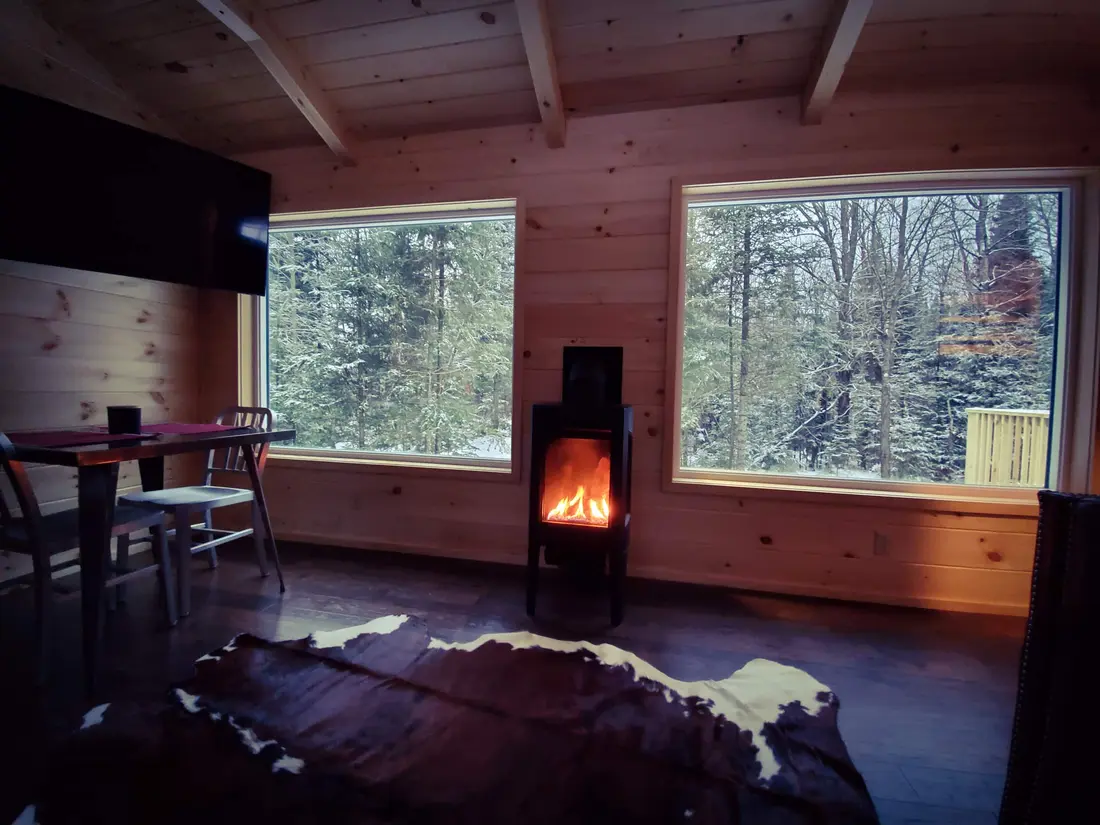
Two of the three cabins, The Modern Pine and The Aviator, warm their living rooms with a Jøtul GF 160 DV, a cast-iron gas stove on three legs with glass on three sides, and guests at both cabins mention the fire in their reviews. This post explains the stove: the Norwegian company behind it, how a direct-vent gas stove works and why it suits a small cabin, how much heat it gives, how to run it as a guest and stay safe around the hot glass, and how the third cabin, The Modern Tiny Home, stays warm without one.
The stove in two of the cabins
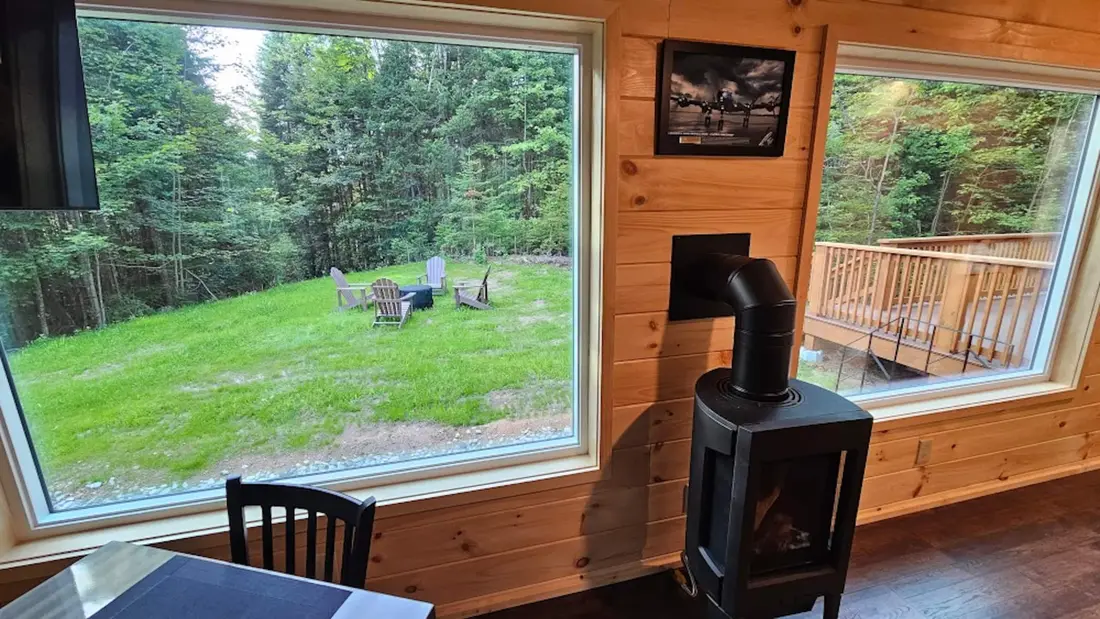
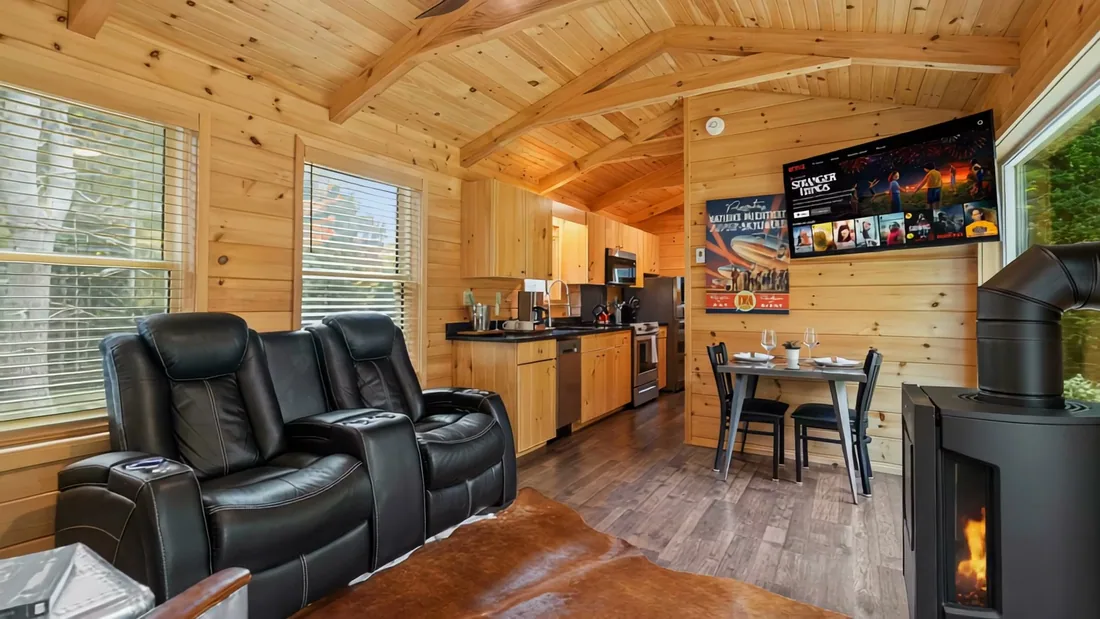
The Modern Pine's listing describes a gas fireplace in the living room and two large picture windows overlooking the forest and mountains "while your fireplace sets the mood." The Aviator's listing shows an indoor fireplace too. In both cabins it is the same model, the Jøtul GF 160 DV. In the listing photos it stands on its three legs against the living-room wall beside the windows, matte black, with the vent pipe rising from its top and turning into the wall behind it. At The Modern Pine it faces a brown leather reclining sofa and a leather armchair; at The Aviator it faces a black reclining sofa with blue lights in its cup holders.
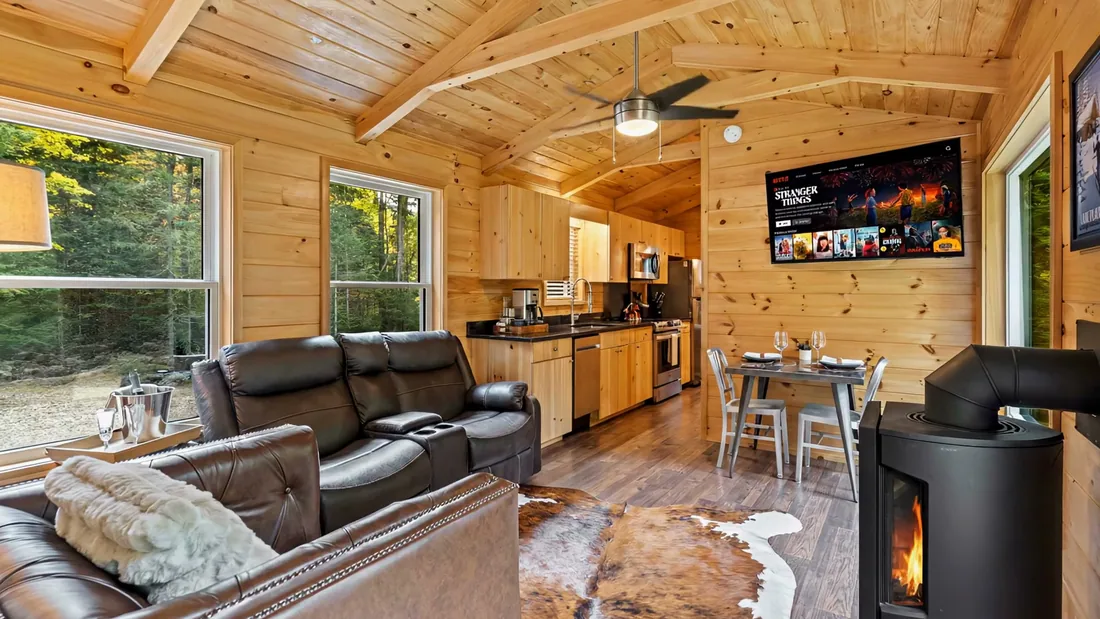
The GF 160 DV is Jøtul's compact gas stove, inspired by its GF 370, with the same three-sided view of the fire on a three-legged base. It stands 35.5 inches tall, measures 17.75 inches wide and deep, and weighs 260 pounds. The body is cast iron, with ceramic glass in front and on both sides. Jøtul makes it in matte black and in a white enamel; both cabins have the black.
Jøtul sells the stove in two versions. The plain GF 160 DV needs no electricity to run. The GF 160 DV IPI plugs into house power, lights itself and comes with a handheld remote and a wall bracket for it. The listings don't say which version either cabin has, so this post covers both, and the instructions the host leaves are the final word on yours.
Guests notice it from the sofa. A guest at The Modern Pine in November 2024 "loved sitting inside in the recliners looking at the fire in the little fireplace and out the huge windows." Another, in January 2022, wrote, "The big windows and stove place heater created a cozy environment to sit and watch the snow fall."
The company behind the stove
Jøtul's story starts in Norway in 1853, when Oluf Onsum, a farmer's son, founded an iron foundry, Kværner Jernstøberi, at Loelva. It made cast-iron goods, and by about 1900 it was one of the largest wood stove foundries in Norway. In 1916 the stove works was sold to Herman Anker, then 26, and renamed Kværner Ovnsstøperi. Anker cared about quality and design and saw the value of marketing, and the Jøtul brand grew out of his company. When the economic crisis of the 1920s threatened the business, Johannes Gahr steered it out of the crisis and into a new period of growth.
Jøtul kept growing after the Second World War, even as oil, kerosene and electricity cut the demand for wood stoves, and by the 1970s fireplaces that burned liquid fuel had long been its main source of income. Then the oil shortages of the 1970s made the demand for wood stoves explode. The Gahr family sold Jøtul to the international corporation Norcem in 1977, and the company turned to exports, buying foundries and import companies in the United States and Europe. Today its slogan is "Fighting the cold since 1853," it sells in 43 countries on six continents, and its melting plant is at Kråkerøy in Fredrikstad.
Cast iron is the material Jøtul built its name on. Its cast-iron parts are hard-wearing and simple to replace, they keep their shape after many years of use, and the metal suits products that must take high temperatures and rapid temperature changes. A stove's working life is exactly that: lit, hot, switched off and cooling, over and over.
Jøtul in North America
Jøtul stoves have been imported into the United States since the early 1970s. Jøtul North America was founded in Maine in 1980, added product development and gas heater assembly in 1998, and in July 2005 moved into a former shoe factory in the Gorham Industrial Park, in Gorham, Maine. In September 2014 the company announced that all the Jøtul wood and gas stoves, inserts and fireplaces sold in North America would be built in Gorham, with the cast-iron parts shipped from Norway for assembly. At the time it employed about 75 people and sold about 17,000 wood and gas stoves and fireplace inserts a year across North America.
The GF 160 DV is one of its products. Jøtul North America, at 55 Hutcherson Drive in Gorham, makes and distributes it, and the stove is certified as a vented gas fireplace heater under the American and Canadian standards, tested and listed by Intertek.
How a direct-vent stove works
DV stands for direct vent. A direct-vent stove burns its gas in a sealed firebox, takes the air for the fire from outdoors through one sealed pipe, and sends the exhaust back outdoors through a second sealed pipe. The fire uses none of the air in the room, and the exhaust goes outside. On the room side, the glass is the seal, which is why the stove must never run with its door open or a glass panel cracked.
The two pipes can be built as one. DuraVent's DirectVent Pro, one of the vent systems approved for this stove, is a pipe inside a pipe: the inner pipe carries the exhaust out, and the space around it brings outside air in for the fire. The GF 160 DV's flue is 4 by 6 5/8 inches and leaves from the top of the stove. The vent may run straight up through the roof or out through a wall, and in both cabins the listing photos show it turning from the top of the stove into the wall behind. Every direct-vent stove needs its own vent; it may never be connected to a chimney that serves another appliance.
The heat comes off the hot glass and cast iron, and from air that warms as it passes through the stove's convection passages; a blower is an option. On the IPI version, IPI stands for intermittent pilot ignition: an electronic igniter lights a small pilot flame only when the stove is called on for heat, and the pilot lights the burner. That version can also be set to keep its pilot burning, and if nobody calls for heat for seven days, it puts the pilot out on its own.
Why it suits a small cabin
A sealed stove avoids the trouble an open fire brings into a small, tight building. With the air supply and the exhaust both piped outdoors, there is no risk of backdrafting, which matters most in airtight, efficient houses. There is no chimney and no wood to carry in. Nothing solid is ever burned in it, since the stove runs on natural gas or propane only, so there are no sparks on the floor and no ash in the morning.
Both versions are built to keep the fire going in a power cut. The plain GF 160 DV needs no electricity at all. The IPI version runs on house power, with a backup pack of four AA batteries that keeps the burner under the remote's control during a power failure, though its accent light goes dark. On that version the pilot sparks for up to a minute before the burner lights, the flame steps down through six levels between high and low, and the remote can run the stove as a thermostat, including a mode that lowers the flame as the room nears the temperature you set. Power cuts are worth planning for in the country: a couple who honeymooned at The Modern Pine lost power for about an hour during a storm. If it happens to you, ask the host before you rely on the stove.
How much heat it gives
Both versions burn up to 24,000 BTU an hour at their highest setting, on natural gas or propane. The lowest setting is 15,800 BTU on natural gas and 19,800 on propane, and the listings don't say which fuel the cabins use. Jøtul rates the stove to heat up to about 1,000 square feet.
For the IPI version, efficiency comes as three numbers. Its steady-state efficiency is 74.5 percent on natural gas, and its AFUE is 66.6 percent. On Canada's fireplace-efficiency test, CSA P.4.1, the rating behind the country's EnerGuide labels, it scores 67.9 percent on natural gas and 68.5 percent on propane. Gas fireplaces on the Canadian market rate between 30 and 70 percent on that test, so this stove sits near the top of the range. The propane results on the other two measures are within a point of the natural gas ones, and the plain version's steady-state efficiency is 73.9 percent.
In a cabin for four, that is plenty of heat. A guest at The Modern Pine in October 2023 wrote, "As the guide states, it does heat up the home fast and can get very hot inside, so you don’t need it on for long." Run it high to take the chill off after a day outside, then turn it down or switch it off.
Running the stove as a guest
Start with the host's instructions. The listings don't say how either stove is switched on, and the IPI version alone can be set up three ways: a mode switch behind a small door for simple on and off, the handheld remote, or the remote acting as a thermostat. Whatever your cabin uses is in the instructions the host leaves, which a guest at The Aviator in January 2025 called concise. It can take a minute the first time. "The gas fire place took some time to figure out but once we got it going there wasn’t an issue," a guest at The Modern Pine wrote in October 2023.
Each time you light it, the routine is short. Before lighting, smell around the stove for gas, near the floor as well. Check that the front door is shut and that the glass and its screens are whole. Clear the area of anything that can burn. Then light it the way the host's instructions describe and watch for the flame; on the IPI version the pilot can spark for up to a minute before the burner comes on.
If your cabin's stove runs from a remote set as a thermostat, set the temperature you want and let the stove cycle on its own. In the remote's smart mode the flame steps down as the room gets close to the set temperature and steps back up as it cools, which gives steadier heat than switching the fire on and off yourself. The remote also shows the room temperature, which is useful on a January night.
A few things are normal. The glass can fog with condensation each time the stove lights, and the fog clears as the glass heats. Cast iron and steel expand and contract as they heat and cool, so expect creaks and pings. A stove set to run on a thermostat can light itself when the room cools and can be very hot with no flame showing, so treat it as hot whenever it is switched on.
A few things are never done. Nothing goes into it: no paper, no wood, no trash. It never runs with the front door open or ajar, or with a glass panel cracked, broken or missing; if you see a crack, switch it off and call the host. Don't strike or slam the glass, which can shatter if hit. Clothing, gloves, blankets and anything else that can burn stay off the stove and away from it. Leave the furniture where the host put it, too: because it runs so hot, the stove is meant to stand out of the way of foot traffic and clear of furniture and curtains. Leave cleaning the glass to the host, since it must never be cleaned hot or with ammonia-based cleaners. And nobody who hasn't read the instructions should run it.
Whether to leave it running overnight or while you are out is a question for the host. The stove and its vent must be inspected every year by a qualified gas technician, and that is the host's side of the arrangement.
The stove is not the only heat in either cabin. The Modern Pine's listing shows heating as a separate amenity, along with a ductless split system for cooling, and The Aviator's shows heating and air conditioning as well, so on a mild evening you can leave the fire off. If the cabin's heat ever gives trouble, call the host. A guest at The Aviator in January 2026 wrote that the host "came over to assist with the heating unit!"
When it won't light
The IPI version tries four times to light its burner when it is called on for heat, and if it still fails, it locks itself out. Switching the burner off, or turning the thermostat down, cancels the call and clears the lockout. Warm weather, very cold weather, high wind and a long vent run can all make its electronic ignition less reliable, and the cure for that, keeping the pilot burning, is a setting for the host to choose. Whichever version your cabin has, if the stove won't light after a try or two, or goes out and won't come back, switch it off and call the host. Don't open the stove, and on the IPI version never try to light the pilot yourself. If your stove has a remote, a low-battery sign on it is a call to the host too.
Hot glass
The glass is the part that burns. The glass fronts of gas fireplaces can reach 500°F or even 1,000°F, severe burns can happen in seconds, and the glass stays hot long after the flame goes out. To protect children and others from those burns, every newly made glass-fronted gas fireplace and heater whose glass gets hotter than 172°F has had to come with a protective barrier since January 1, 2015.
Both versions of the GF 160 DV have that barrier built in. The front door and side glass carry integrated safety screens, certified barriers that must stay in place at all times. The stove must not run if a screen is damaged or missing, so if one is bent, loose or gone, switch the stove off and tell the host. The warning that comes with the stove is short: hot glass will cause burns, do not touch the glass until it has cooled, and never let children touch it.
Older children, teenagers and dogs
The cabins are not set up for small children. The Modern Pine's and The Modern Tiny Home's listings say they are not suitable for children under 10, and all three listings, The Aviator's included, carry Airbnb's flag for not suitable for children and infants. For older children and teenagers, the stove rules are the adult rules. Everyone in the cabin should know that the glass and the iron burn, that they stay hot after the flame is out, and that the stove can come on by itself when it runs on a thermostat. Nobody who hasn't read the instructions should run it, and if your cabin's stove works from a remote, keep the remote with an adult; the IPI version's remote has a child-safety lock.
Dogs are allowed at all three cabins for a fee, and pets need watching around a stove even with a screen in place. The listings set a 25-pound limit for pets, The Aviator's allows one pet, and all three say a pet may not be left alone in the cabin, so a dog is never alone with a hot stove. Give the dog's bed a spot across the room from the stove. The pet-friendly stays page and bringing your dog have the rest.
Carbon monoxide and the smell of gas
Any appliance that burns fuel can produce carbon monoxide when combustion goes wrong, and fireplaces, wood stoves and gas appliances are among the common sources. You cannot see, smell or taste it. Its early symptoms are easy to mistake for the flu: headache, fatigue, nausea, dizziness and confusion. New York has required carbon monoxide alarms since February 22, 2010, under Amanda's Law, named for Amanda Hansen, a Buffalo teenager who died of carbon monoxide poisoning from a defective boiler in January 2009. The law covers new and existing one- and two-family homes, multifamily buildings and rentals that have a fuel-burning appliance, system or attached garage.
Every cabin's listing shows a carbon monoxide alarm and a smoke alarm, along with a fire extinguisher and a first aid kit. Leave the alarms alone. If the CO alarm sounds, stay calm; most alarms are not life-threatening. Ask everyone whether they feel ill, with flu-like symptoms such as headache, nausea or dizziness. If anyone does, get everyone outside and have someone call the fire department at 911; fresh air is the best first treatment. If nobody does, turn off the stove and every other fuel-burning appliance, open the windows and try resetting the alarm. If it won't reset or sounds again, call the host to have the appliances checked, and if anyone starts to feel ill at any point, get everyone out and call 911.
A gas smell is more urgent. The rule that comes with the stove is to put out any open flame, light nothing, touch no electrical switches and use no phone inside the building. Leave the cabin right away, and from outside, well away from it, call the host and the fire department at 911. Some gas is heavier than air and settles near the floor, so a smell low in the room counts.
One more winter check is outdoors. The vent ends on the cabin wall, snow piled around it can affect how a direct-vent stove runs, and vents should be kept clear of blockages. If a drift or a plow bank has covered the vent cap outside the living-room wall, tell the host before you light the stove.
How the Tiny Home stays warm
The Modern Tiny Home, the first of the three cabins to take guests, has no stove. Its listing shows heating, air conditioning, a ceiling fan and portable fans, and no indoor fireplace. In the winter months it asks guests to leave the heater set to 60 when they check out rather than turn it off, because turning it off risks frozen pipes. Guests write that it holds its heat. One in December 2024 wrote that "the insulation in the home allowed for it to keep in heat and remain nice and warm throughout our stay." Another, in September 2022, said "it keeps very warm and the wood smells amazing," and a third, in March 2025, summed it up as "So warm, cozy and peaceful."
Its fire is outside: the big stone fire pit in front of the cabin, ringed with Adirondack chairs. The Tiny Home also has a small screened corner on its deck and a short trail to an observation deck over the pond. If an indoor fire matters to your trip, book The Modern Pine or The Aviator; if the pond and the stone fire pit matter more, the Tiny Home is the one. The cabin comparison sets them side by side.
The best hour for the fire
In winter the stove earns its place at the end of the day. Guests who came to The Aviator for a weekend of cross-country skiing in January 2025 drove up to find "the lights were on and the fire was burning." At The Modern Pine a guest in February 2026 wrote that "The fireplace made the evenings especially cozy." Light it when you come in, start dinner, and save the hot tub for after dark; the stargazing post has the sky.
It earns its place in spring and fall too. In Malone the average low is 44°F in May, 47°F in September and 36°F in October, so a fire after dinner is welcome long after the ski season. The fall and spring pages have those months, the après-ski post has a winter evening at The Modern Pine, and the snowmobile season post has what to do with wet riding gear, which never goes on the stove.
Questions
Which cabins have a Jøtul gas stove?
The Modern Pine and The Aviator each have a Jøtul GF 160 DV, a cast-iron direct-vent gas stove with glass on three sides. The Modern Tiny Home has no stove; its listing shows heating and air conditioning, and it has a big stone fire pit outside. See the cabin comparison.
How do I turn the gas stove on?
Use the instructions the host leaves in the cabin, since the listings don't say which version of the stove each cabin has or how it is switched on. The IPI version lights its own pilot from a switch or its remote, and its pilot must never be lit with a match. If the stove won't light after a try or two, switch it off and call the host.
How hot does the glass get?
The glass fronts of gas fireplaces can reach 500°F or even 1,000°F and stay hot long after the flame goes out. The GF 160 DV has safety screens built over its glass, but nobody should touch the glass until it has cooled.
Is the stove a concern with children or dogs?
The cabins are not for small children: The Modern Pine's and The Modern Tiny Home's listings say they are not suitable for children under 10, and all three carry Airbnb's not suitable for children and infants flag. Older children and teenagers should know the glass burns and stays hot after the flame is out. Watch dogs around it too; the listings never allow a pet to be left alone in the cabin.
What should we do if the carbon monoxide alarm sounds?
Ask everyone whether they feel ill. If anyone has a headache, nausea or dizziness, get everyone outside and call 911. If nobody does, turn off the stove and other fuel-burning appliances, open the windows, try resetting the alarm and call the host. Every cabin's listing shows a CO alarm and a smoke alarm.
Can I dry wet gloves on the stove?
No. Clothing and anything else that can burn should never go on or near it. Every cabin has a washer and dryer instead, and the snowmobile season post covers drying riding gear.
How much heat does the Jøtul GF 160 DV give?
Both versions burn up to 24,000 BTU an hour on high, and the low setting is 15,800 BTU on natural gas or 19,800 on propane. Jøtul rates the stove to heat up to about 1,000 square feet, so in a cabin for four it warms the living room quickly.
Does the stove work in a power cut?
It is built to. The plain GF 160 DV needs no electricity, and the IPI version has a backup pack of four AA batteries that keeps the burner under the remote's control. The listings don't say which version each cabin has, so ask the host before you count on the stove in an outage.
Sources
Facts on this page were checked against these sources in October 2026. Hours, fees and schedules change; confirm before you go.
- Jøtul jotul.com/products/gas-stoves/gf-160-dv-ipi
- jotul-static-content.s3.amazonaws.com jotul-static-content.s3.amazonaws.com/usa/Current_Manuals/UPDATED%20MA
- Jøtul jotul.com/press-release/165-year-long-norwegian-adventure
- Jøtul jotul.com/jotul
- Jøtul jotul.com/us/press-release/jotul-north-america-expands-operation-inclu
- businessnorway.com businessnorway.com/articles/jotul-is-highlighting-over-170-years-of-tr
- rockymountainstove.com rockymountainstove.com/jotul-gf-160-gas-stove/
- basc.pnnl.gov basc.pnnl.gov/resource-guides/direct-vent-equipment?existing_homes=573
- duravent.com duravent.com/product/directvent-pro
- natural-resources.canada.ca natural-resources.canada.ca/energy-efficiency/product-energy-ratings/e
- onsafety.cpsc.gov onsafety.cpsc.gov/blog/2014/12/19/protect-young-children-from-burns-on
- members.hpba.org members.hpba.org/Consumer-Information/Fireplace-Stove-Heater/Glass-Fro
- hpbacanada.org hpbacanada.org/consumer-resources/product-safety/
- dhses.ny.gov dhses.ny.gov/carbon-monoxide-virtual-toolbox
- dhses.ny.gov dhses.ny.gov/system/files/documents/2022/11/cobrochureforweb.pdf
- usclimatedata.com usclimatedata.com/climate/malone/new-york/united-states/usny0854
- The cabin's Airbnb listing airbnb.com/rooms/53628054
- The cabin's Airbnb listing airbnb.com/rooms/1168252128174283244
- The cabin's Airbnb listing airbnb.com/rooms/41023086
- Jøtul jotul.com/us/products/gas-stoves/jotul-gf-160-dv
- Jøtul jotul.com/us/products/gas-stoves/jotul-gf-160-dv-ipi
- blazingembers.com blazingembers.com/jotul-gf160-dv-gas-stove/
- mainepublic.org mainepublic.org/business-and-economy/2014-09-18/jotul-moving-wood-stov


