Black Flies, Mosquitoes and Ticks
When black flies, deer flies, mosquitoes and ticks bite near Malone, NY, what keeps them off, how to remove a tick, and when to see a doctor.
The northern Adirondacks have three biting seasons that overlap: black flies from mid-May into early July, deer flies and mosquitoes through the summer, and ticks from March into November. The cabins sit at the northern edge of the Adirondack Park, about ten road miles south of Malone, with a pond a short walk from The Modern Tiny Home and the High Falls of the Salmon River about five road miles away, so all of them turn up here. This guide covers when each one is out, what keeps it off you, what to do after a tick bite, and how to plan a stay so the bugs cost you as little as possible.
The biting season month by month
The dates move a little with the weather each year. This is the usual pattern around Malone and the northern Adirondacks.
| Months | Black flies | Mosquitoes | Deer and horse flies | Ticks |
|---|---|---|---|---|
| March and April | Not yet | Not yet | Not yet | Adult blacklegged ticks out on mild days |
| May | Out from about mid-May, building to the peak late in the month | Starting | The first ones can appear | Adults, then nymphs from mid-May |
| June | Peak in the first half, thinning by late June | Out at dusk and dawn near standing water | Deer flies arrive | Nymph season; most Lyme cases are reported May through August |
| July | Mostly gone by early July | Biting at dusk, through the night and at dawn | Deer flies at their peak | Nymphs |
| August | Mostly gone | Still out at dusk | Fewer | Nymphs fade by mid-August, adults return |
| September to November | Gone | Still out in September | A few into September | Adults active into November |
| December to February | Gone | Gone | Gone | Adults come out on winter days above about 45°F |
Black flies
Black flies are small, dark, hump-backed flies, less than a quarter inch long. Around the northern Adirondacks they come out about mid-May and fade by early July, and the worst stretch is usually the last week of May and the first half of June. A local rule of thumb has them out around Mother's Day and fading around Father's Day. They bite only in daylight, most of all from about 9 to 11 in the morning and from 4 to 7 in the late afternoon and early evening, and they do not bite at night.
Weather decides a lot. They are most active on humid, cloudy days and just before storms, and a breeze makes it hard for them to fly, so a dry, breezy day is the one for a walk by moving water. Midday, between the morning and evening peaks, is the quieter time to be out.
Why they need clean running water
Every black fly starts life in moving water, anything from a trickle a few inches wide to a lake outlet. The larvae live on the bottom, attached to rocks and other submerged objects, and feed by filtering the current for tiny bits of organic matter; if the water stops flowing, they starve. They pupate underwater, and the new adults ride bubbles of air to the surface and fly off. Most species will not tolerate organic pollution, so a big black fly population is a sign of a clean, healthy stream, and the larvae are an important food for trout and salmon.
That is why the flies are most common along rivers and streams and thinner out over open lakes. Still water raises mosquitoes; black fly larvae need a current.
Who bites
Only the females bite, and most species feed on birds or other animals. Of the roughly 40 black fly species in New Hampshire, for example, only four or five are serious biters of people. The bite is painful, and it itches and swells; in people who are allergic the swelling can be severe. In the United States, black flies are not known to pass any disease to people.
Towns that treat their streams
Some Adirondack towns fight black flies at the source with Bti, a bacterium that kills the larvae in the stream. It was first used in the Adirondacks in 1982, in a New York State Museum study at the hamlet of Onchiota in the Town of Franklin, about 40 road miles from the cabins. In the Town of Caroga, which still runs a program, technicians treat streams at 5 to 25 parts of Bti per million parts of water, which kills 90 to 100 percent of the larvae, and they treat each stream two to ten times a season between March and the end of July. The programs run town by town, so one valley can be much quieter than the next.
Where black flies are worst near the cabins
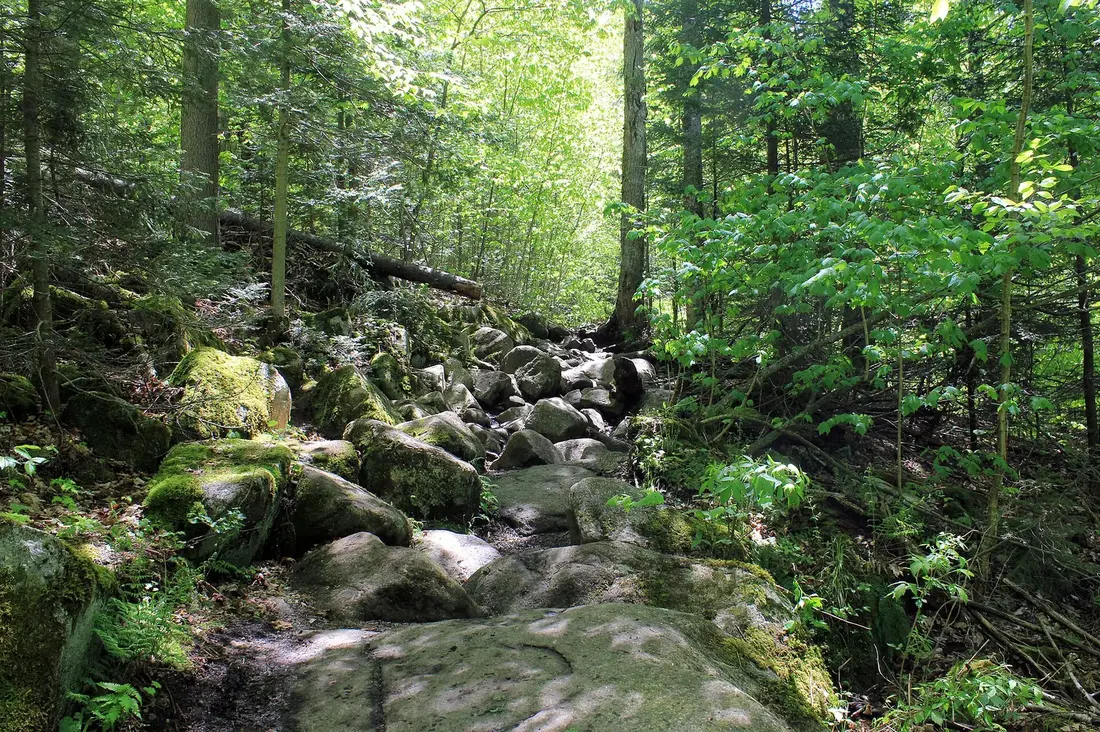
Near the cabins, the black fly spots are the moving water. High Falls in the Titusville Mountain State Forest, where the Salmon River drops about 30 feet, is about five road miles away and has what they need on a humid morning in early June: a current and still air. The same goes for the riverbank walks along the Salmon River in Malone.
In the peak weeks, open and breezy places are better bets. The rock ledges near the top of Owls Head, about four road miles away, are out in the open, and the lakes south of the cabins, Indian Lake, Mountain View Lake and Lake Titus, are all within about ten road miles; the lakes guide covers them. Paddle lakes rather than rivers, and walk the waterfall and river trails at midday on a dry, breezy day, or leave them for July.
Deer flies and horse flies
As the black flies fade, the deer flies arrive. They are a little larger than a house fly, often striped yellow and black, with dark marks on the wings, and they are most active in June and July. Only the females bite, in daylight, and they are thickest near swamps and marshes, along pond and stream banks and at the edges of the woods, where they circle your head until they find a place to land. Horse flies are bigger; some reach two inches long. Both have blade-like mouthparts that leave a deep, painful bite that bleeds. Their young grow up in wetlands and wet soil, and the adults find people by watching for dark moving objects and following the carbon dioxide we breathe out.
Repellents help only a little against them. High-strength DEET gives some protection, but it can melt plastic, so keep it off sunglasses, watch straps and gear. Long sleeves, long pants and a hat do more, and a sticky deer fly patch on the back of a cap catches many of the flies that circle your head. Swatting and running only draw more of them.
Mosquitoes
Mosquitoes breed in water that stands still: ponds, swamps, puddles, a bucket left in the yard. Some kinds go from egg to adult in about a week. Only the females bite, taking blood for the energy to make eggs, and both sexes also feed on flower nectar. Different kinds keep different hours: some bite in the daytime, others at dusk, through the night and at dawn.
West Nile virus has been in New York since 1999, and eastern equine encephalitis also occurs in the state. Most people infected with West Nile have no symptoms; when illness comes, it usually starts 3 to 15 days after the bite. The protection is the same as for every other bug on this page: repellent, long sleeves at dusk, and screens on the windows and doors.
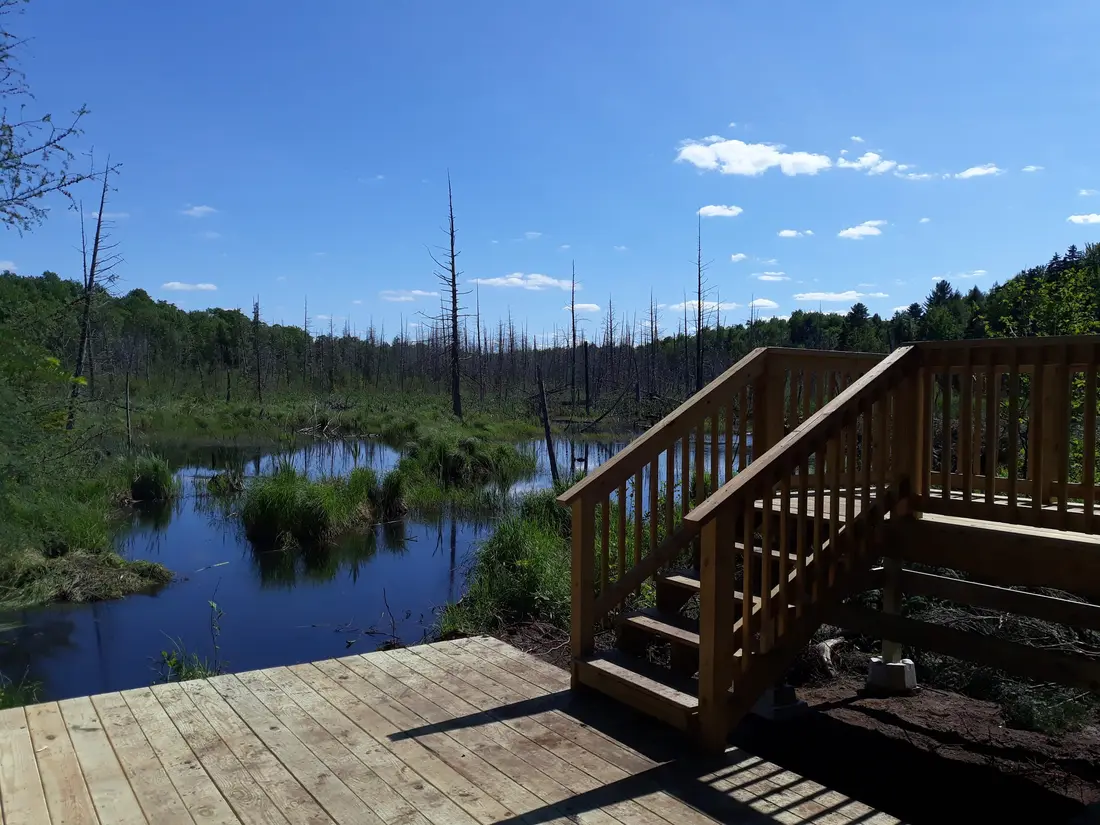
At the cabins, expect mosquitoes at the pond and the observation deck at The Modern Tiny Home on a still June or July evening; go before dusk or go covered. Summer evenings are not always a fight, though. One family who spent eight weeks at the Tiny Home in the summer of 2020 wrote:
"The bugs were super mild and we could eat on the porch comfortably."
Ticks
The ticks in this area
The blacklegged tick, also called the deer tick, is the one that matters. It is the tick that spreads Lyme disease in New York, and it can also carry the germs that cause anaplasmosis, babesiosis, hard tick relapsing fever and Powassan virus. Nymphs are brown and the size of a poppy seed. Adults are about the size of a sesame seed; the females are red and black, the males black.
The tick takes two years to finish its life cycle. Nymphs are out from mid-May to mid-August, and most Lyme disease cases are reported from May through August, so the nymph season is the risky one. Adults are most active from March to mid-May and again from mid-August into November. They never shut down for the whole winter: below about 40°F they go dormant, and they come out again on winter days when the ground warms above about 45°F.
Ticks live in shady, moist places at ground level and cling to tall grass, brush and shrubs, usually no more than 18 to 24 inches off the ground. They also live in lawns and gardens, especially at the edges of the woods and around old stone walls. They cannot jump or fly, and they do not drop onto people from above; they get on you when you brush past. The American dog tick, which can carry Rocky Mountain spotted fever and tularemia, is found next door in St. Lawrence County too. The lone star tick lives elsewhere in New York but has not been found there.
How common tick-borne illness is
Lyme disease is the most common tick-borne illness in New York. Nearly 19,000 cases were reported in the state in 2024, and the state has averaged more than 17,500 new cases a year over the last three years. In 2024 Lyme disease was reported in all 57 counties outside New York City, Franklin County among them, and the rate outside the city had climbed from 37.2 cases per 100,000 people in 2020 to 164.8 in 2024. Part of that jump came from a 2022 change in the national case definition, which lets states with high case counts, New York among them, report cases from lab results alone. These figures are for the state as a whole.
Closer to the cabins, a Paul Smith's College team led by biology professor Lee Ann Sporn collected blacklegged ticks in St. Lawrence, Clinton, Franklin and Essex counties, and the state health department tested them. In results reported in 2017, nearly half of the adult ticks and a quarter of the nymphs carried the Lyme bacterium, and reported human cases in Franklin, Clinton and Essex counties had risen by nearly 200 percent from 2012 to 2015. Those figures date from 2017 and cover four North Country counties, and they show how common infected ticks were here then.
Keeping ticks off
- Wear light-colored long sleeves and long pants, with the pants tucked into your socks, so ticks show up and stay on the outside.
- Treat boots, clothes and gear with products containing 0.5 percent permethrin, or buy clothing that comes treated. It keeps working through several washings. Never put permethrin on skin.
- Put an EPA-registered repellent on exposed skin; the repellents section below lists the ones that work.
- Walk in the center of the trail and stay out of high grass, brush and leaf litter.
The tick check at the cabin
Shower within two hours of coming in, which has been shown to lower the risk of Lyme disease. Then check everyone from head to toe: under the arms, in and around the ears, inside the belly button, behind the knees, in and around the hair, between the legs and around the waist. Ticks ride in on clothes, so put the day's dry clothes in the dryer on high heat for 10 minutes; every cabin has its own washer and dryer. Dogs carry ticks indoors too, so see bringing your dog for checking a dog and pet-friendly cabins for the cabins' pet rules.
Removing a tick
- Use fine-tipped tweezers. Grasp the tick as close to the skin as you can, by the head or mouthparts where they enter the skin, never by the body.
- Pull upward with steady, even pressure. Do not twist or jerk.
- Clean the bite and your hands with rubbing alcohol or soap and water.
- Drop the tick in rubbing alcohol, or seal it in a small bag or container, and keep it. A doctor deciding on a preventive antibiotic will want to know what kind of tick it was and how swollen it was with blood.
- Note the date and where you picked the tick up, and watch the bite for a rash for the next 30 days.
Skip the folk remedies. Petroleum jelly, nail polish and heat can agitate the tick and force infected fluid into the skin. Sending the tick to a lab is not recommended either: the labs are not held to required quality standards, a positive result does not prove you are infected, a negative one can give false comfort, and you would probably have symptoms before the result came back.
Speed matters. The risk of Lyme disease is much lower if the tick comes off within the first 36 hours, but Powassan virus can pass in as little as 15 minutes, which is why the shower and the check belong at the end of every walk.
When to see a doctor
See a doctor if a rash or a fever shows up in the weeks after a tick bite, and say when the bite happened and where you were. The classic sign of Lyme disease is a red rash called erythema migrans. It appears in about 70 to 80 percent of infected people, 3 to 30 days after the bite (about 7 days on average), and spreads over several days to 12 inches or more across. It may feel warm but is rarely itchy or painful, and it does not always look like a bull's-eye. Fever, chills, headache, fatigue, muscle and joint aches and swollen lymph nodes can come with the rash or without it.
If a tick was attached for a day and a half or more, call a doctor soon. New York is one of the states where Lyme disease is common, and when an adult or nymph blacklegged tick has been attached for 36 hours or more, a single dose of the antibiotic doxycycline, started within 72 hours of removing the tick, can lower the risk of Lyme disease. It has not been shown to prevent anaplasmosis, babesiosis or the other tick-borne illnesses.
Near the cabins, UVM Health's Alice Hyde Medical Center in Malone, about 10.5 road miles away, runs a walk-in clinic at 134 Park Street, open from 9 a.m. to 7 p.m. every day with no appointment needed (check the hours before you go), and a 24-hour emergency department at 133 Park Street. Kinney Drugs at 485 East Main Street fills prescriptions. The health and safety page has the emergency numbers and the rest of the local help.
Repellents that work
Use an EPA-registered repellent with one of these active ingredients: DEET, picaridin, IR3535, oil of lemon eucalyptus, para-menthane-diol (PMD) or 2-undecanone. All six are recommended against both mosquitoes and ticks, and DEET, picaridin and IR3535 also work on black flies. Strength matters as much as the ingredient. Higher concentrations protect longer, whatever the ingredient; products with less than 10 percent of the active ingredient may last only an hour or two; and DEET adds little more protection past about 50 percent. EPA's online repellent finder lists the protection time of each registered product against mosquitoes, ticks or both.
Outside the United States, picaridin goes by the name icaridin, so look for that word on Canadian labels if you are stocking up before the drive down. Crossing the border covers the open crossings and their hours.
Using repellent safely
- Read the label and use only as much as it says.
- Put repellent on exposed skin and on clothing, never under clothing. For your face, spray your hands and rub it on.
- Do not spray it in a closed room, and do not breathe the spray.
- Put on sunscreen first and repellent second.
- For children, put repellent on your own hands and then on the child, and keep it off their hands.
- Back indoors, wash treated skin and clothes with soap and water.
What does not work
Wristbands soaked in repellent, devices that give off sound, and vitamin B or garlic taken by mouth do not keep bugs off. Sprays made from plant oils such as citronella, cedarwood, lemongrass and peppermint can be sold under a federal exemption for minimum-risk pesticides; EPA generally does not review those products before they go on sale, and how well repellents without EPA registration work is unknown. Fogging the yard for deer flies kills only the flies in the air at that moment, and more move in within minutes. Swatting at deer flies, or running from them, brings in more.
Head nets and clothing
Carry a head net, or a hat with netting that hangs down over the neck, from mid-May through June; DEC lists a bug net among its hiking essentials. Add long sleeves and long pants, tuck the pants into your socks or boots, and close the shirt at the wrists and the front; a zippered shirt keeps black flies out better than one with buttons.
Color matters. Orange, yellow and light blue draw fewer black flies than dark green, brown and red. Light colors also make ticks easier to spot, and deer flies home in on dark things that move, so dress light all summer. For ticks, permethrin-treated pants, socks and shoes matter most, because ticks wait on low grass and brush. For deer flies, a sticky patch on the back of a cap does more than spray.
The screened rooms at the cabins
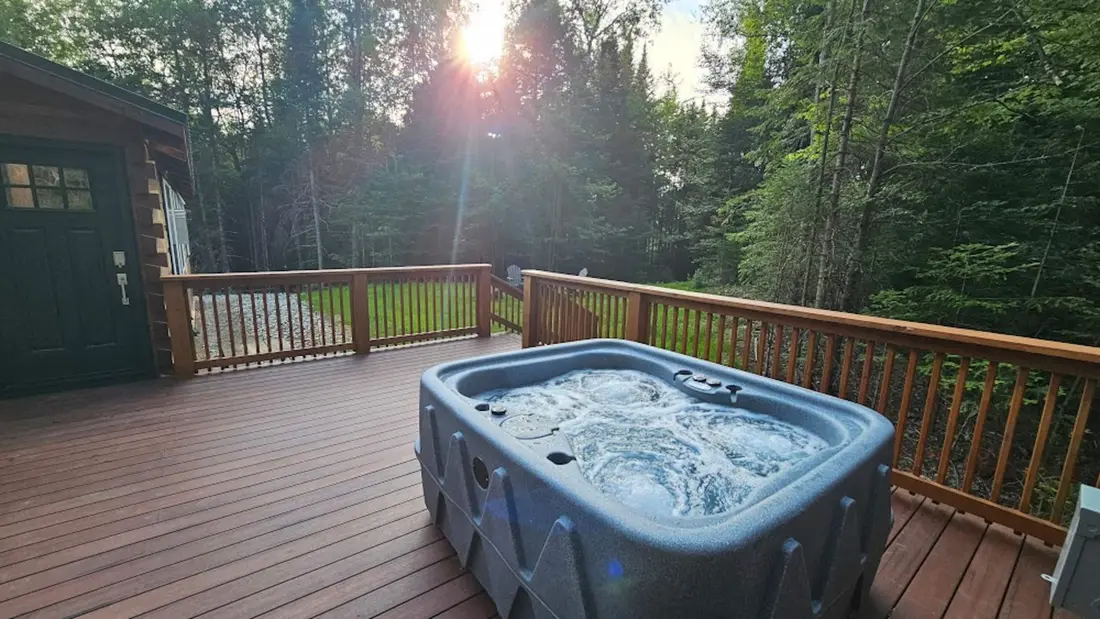
Two of the three cabins have a screened place to sit outside. The Modern Pine has a large screened room on its deck, on the same deck as its private hot tub, which is open all year, 24 hours a day. A July 2025 guest wrote:
"We also loved having the screened in porch, fire pit & hot tub"
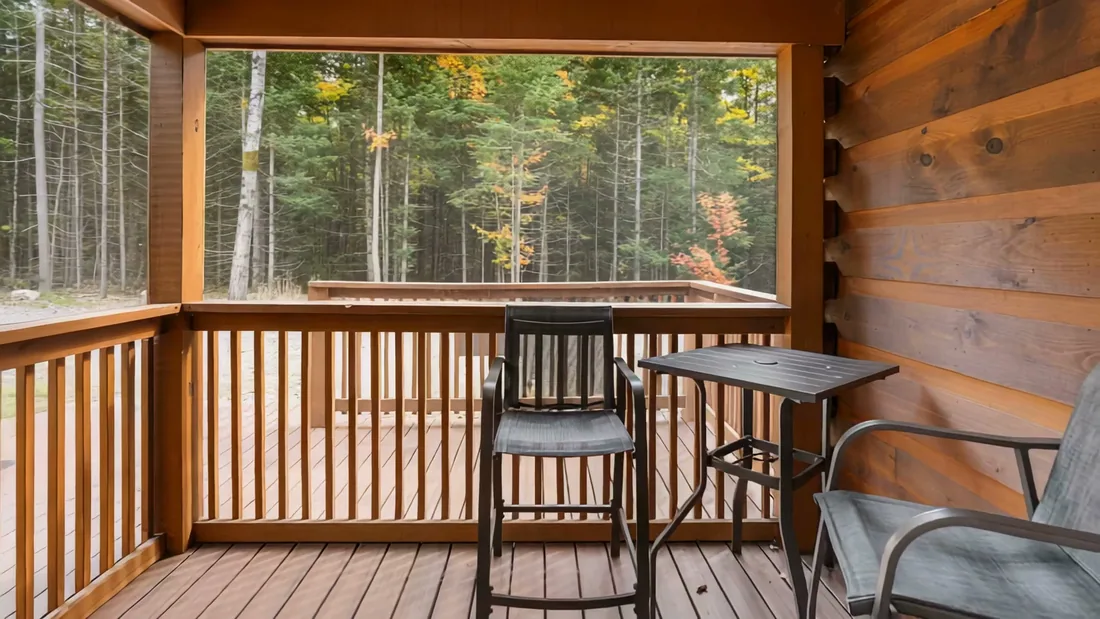
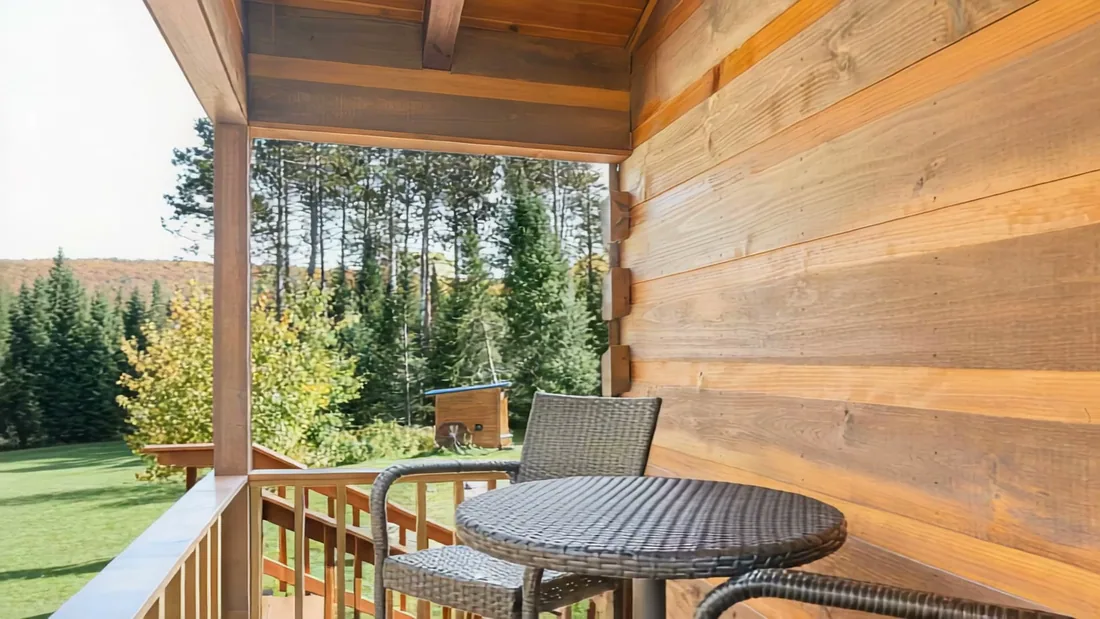
The Modern Tiny Home has a small screened corner on its deck with a table and chairs, enough for dinner on a June evening, and outdoor seating on the rest of the deck. The Aviator has a large open deck with no screen, so in black fly season its guests eat inside or wear head nets, and use the hot tub after dark, when black flies do not bite, though mosquitoes may still find them. All three cabins have air conditioning, so on a buggy night you can close up and stay cool. Compare the cabins has the rest of the differences.
Planning a stay around the bugs
Mid-May through June
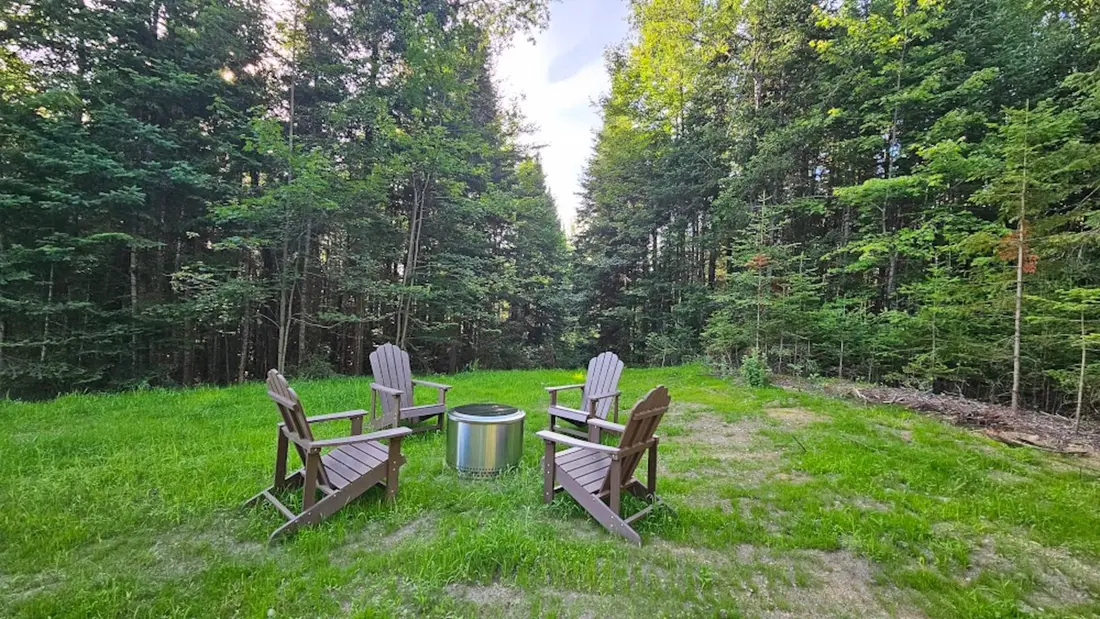
These are the black fly weeks. Do the waterfall and river walks at midday on dry, breezy days, take the lakes and the open summits on humid ones, keep head nets in the car, and plan the evenings for the screened room, or for the fire pit after dark. In May the higher trails may still be in mud season: each spring DEC asks hikers to stay off trails above 2,500 feet until they dry out. Spring at the cabins covers what is open.
Late June through August
The black flies are mostly gone by early July. Deer flies take over at the sunny edges of the woods, so wear a hat with a sticky patch, and the mosquitoes come out at dusk near the pond and the wetlands, so eat early or eat in the screened room. By August the deer flies thin out as well. Summer at the cabins has the rest of the season.
September through November
The biting flies are done, but adult ticks are active again from mid-August into November, the same weeks as the fall color and the hunting seasons. Keep up the permethrin and the tick checks, and wear blaze orange or blaze pink on state land. The fall foliage guide covers the color.
December through March
No biting flies and no mosquitoes. Ticks are dormant on cold days but come out on winter days when the ground warms above about 45°F, so a March thaw is tick weather. When to come and what to pack covers the rest of the year.
A bug kit for the cabins
- A head net for everyone, from mid-May through June.
- An EPA-registered repellent with DEET, picaridin or IR3535.
- Permethrin-treated pants, socks and shoes, or a permethrin spray to treat your own.
- Light-colored long sleeves and long pants, and a shirt that zips.
- A cap with a sticky deer fly patch, for July.
- Fine-tipped tweezers, a few small zip bags for ticks, and rubbing alcohol.
- Anti-itch cream for the bites.
Each cabin has a first aid kit, but bring your own tweezers. The stores in Malone, about 20 minutes away, are listed in groceries and supplies.
Questions
When is black fly season near Malone?
Black flies come out around mid-May and usually fade by early July. The worst stretch is the last week or so of May and the first half of June. They bite only in daylight, mostly from about 9 to 11 in the morning and 4 to 7 in the late afternoon, most of all on humid, cloudy days, and they are thickest near streams and waterfalls. See when to come and what to pack.
Do black flies carry disease?
In the United States, black flies are not known to pass any disease to people. Their bites are painful and itchy and can swell, and in people who are allergic the reaction can be severe. Ticks are the bigger health concern: blacklegged ticks can carry Lyme disease, anaplasmosis, babesiosis and Powassan virus.
What should I do if I find a tick attached?
Grasp it as close to the skin as you can with fine-tipped tweezers and pull upward with steady pressure, without twisting. Clean the bite, keep the tick in a sealed bag, and note the date. If it was attached 36 hours or more, call a doctor soon: a single preventive dose of doxycycline has to start within 72 hours of removal. The walk-in clinic at Alice Hyde Medical Center in Malone is open every day; see health and safety.
Which repellent works best?
Use an EPA-registered repellent with DEET, picaridin, IR3535, oil of lemon eucalyptus, PMD or 2-undecanone; higher concentrations last longer. DEET, picaridin and IR3535 also work on black flies. For ticks, add permethrin-treated clothes, and never put permethrin on skin. Repellent wristbands do not work.
Which cabin is best in bug season?
The Modern Pine has a large screened room on its deck, and The Modern Tiny Home has a small screened corner on its deck. The Aviator has a large open deck with no screen. All three have air conditioning, a washer and dryer for the day's clothes, and a private hot tub. See compare the cabins.
Are there bugs in the fall and winter?
Black flies are done by early July and deer flies by fall, though mosquitoes can still bite in September. Adult blacklegged ticks keep going: they are active from mid-August into November and come out on winter days when the ground warms above about 45 degrees, so keep checking after walks. Wear blaze orange or blaze pink on state land during the fall hunting seasons.
Sources
Facts on this page were checked against these sources in October 2026. Hours, fees and schedules change; confirm before you go.
- extension.unh.edu extension.unh.edu/resource/black-flies-fact-sheet
- yardandgarden.extension.iastate.edu yardandgarden.extension.iastate.edu/encyclopedia/black-fly
- adkwatershed.org adkwatershed.org/blog/black-flies-adirondacks
- townofcaroga.com townofcaroga.com/misc/bti.htm
- hort.extension.wisc.edu hort.extension.wisc.edu/files/2014/11/Deer_Flies_and_Horse_Flies.pdf
- cals.cornell.edu cals.cornell.edu/integrated-pest-management/outreach-education/whats-b
- New York State Department of Health health.ny.gov/diseases/west_nile_virus/
- New York State Department of Health health.ny.gov/press/releases/2025/2025-07-22_west_nile.htm
- New York State Department of Health health.ny.gov/publications/2813/
- New York State Department of Health health.ny.gov/publications/2825/
- New York State Department of Health health.ny.gov/diseases/communicable/lyme/
- New York State Department of Health health.ny.gov/diseases/communicable/lyme/fact_sheet.htm
- New York State Department of Health health.ny.gov/diseases/communicable/lyme/risk_score_map.htm
- stlawrence.cce.cornell.edu stlawrence.cce.cornell.edu/agriculture-natural-resources/ticks
- New York State Department of Health health.ny.gov/diseases/communicable/lyme/docs/tbd_report_2025.pdf
- New York State Department of Health health.ny.gov/press/releases/2026/2026-04-30_precautions_against_tick-
- New York State Department of Health health.ny.gov/press/releases/2026/2026-05-08_lyme_disease_awareness.ht
- cdc.gov cdc.gov/mmwr/volumes/73/wr/mm7306a1.htm
- Adirondack Explorer adirondackexplorer.org/adirondacks-almanack/research-finds-increased-i
- cdc.gov cdc.gov/ticks/prevention/index.html
- cdc.gov cdc.gov/ticks/after-a-tick-bite/index.html
- cdc.gov cdc.gov/lyme/media/pdfs/Caring-for-Patients-after-a-Tick-Bite.pdf
- cdc.gov cdc.gov/lyme/signs-symptoms/index.html
- cdc.gov cdc.gov/mosquitoes/prevention/index.html
- cdc.gov cdc.gov/mosquitoes/pdfs/mosquitobitepreventionus_508.pdf
- cdc.gov cdc.gov/yellow-book/hcp/environmental-hazards-risks/mosquitoes-ticks-a
- epa.gov epa.gov/insect-repellents/find-repellent-right-you
- epa.gov epa.gov/insect-repellents/using-insect-repellents-safely-and-effective
- epa.gov epa.gov/minimum-risk-pesticides/minimum-risk-pesticide-definition-and-
- epa.gov epa.gov/sites/default/files/2015-12/documents/minrisk-active-ingredien
- New York State Department of Environmental Conservation dec.ny.gov/things-to-do/hiking/hike-smart-ny
- New York State Department of Environmental Conservation dec.ny.gov/news/press-releases/2025/5/dec-issues-spring-conditions-adv
- uvmhealth.org uvmhealth.org/locations/walk-in-clinic-uvm-health-alice-hyde-medical-c
- uvmhealth.org uvmhealth.org/locations/emergency-department-uvm-health-alice-hyde-med
- The cabin's Airbnb listing airbnb.com/rooms/53628054
- The cabin's Airbnb listing airbnb.com/rooms/41023086
- The cabin's Airbnb listing airbnb.com/rooms/1168252128174283244
In this guide
Stay nearby
The après-ski cabin: a Jøtul gas stove between two picture windows, a large screened room on the deck, a hot tub open all year, and Titus Mountain minutes away.
 The Modern PineCabin 2 · 2 bd · 1 ba · sleeps 4
More in Plan Your Trip
Sources
37 references, listed in full at the end of this guide: official park, state, tourism-office and business sources, checked October 2026.