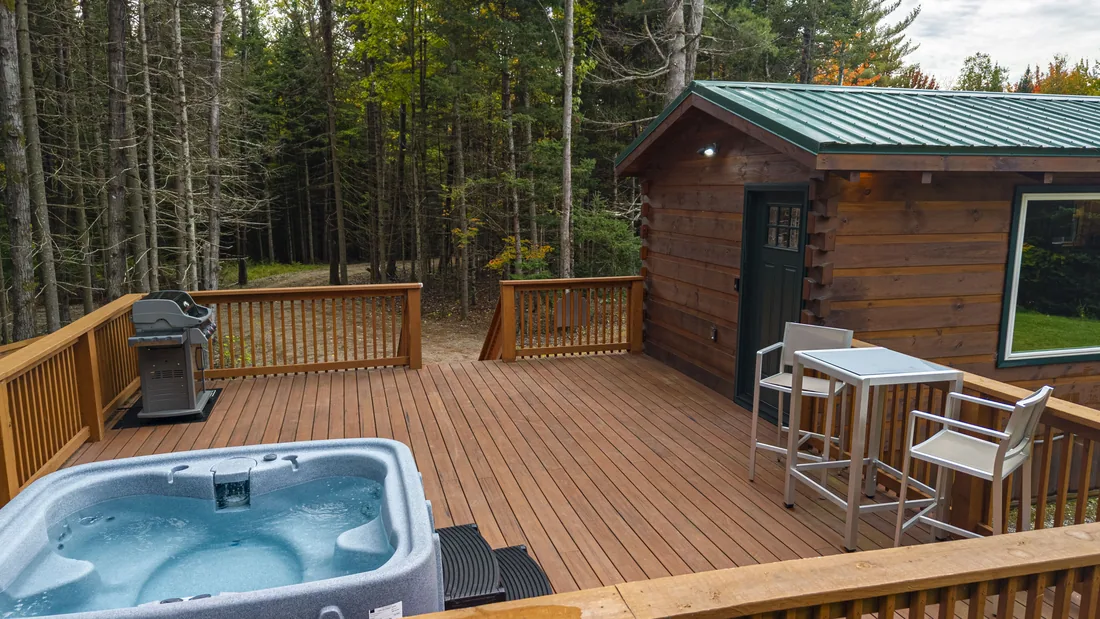
The Aviator is the newest of our four cabins about ten road miles south of Malone, and the one built for anyone who looks up when a plane goes over. Airplane prints line the living room, a print of a 1930s poster for New York City's municipal airports hangs in the main bedroom, and full electric reclining theatre chairs face the large windows. This post walks through the cabin room by room, then covers the aviation within reach of it: the town airfield in Malone, the bombers at Plattsburgh's old Air Force base, a B-47 crash site on Wright Peak and Canada's national aviation museum in Ottawa.
The cabin and its theme
The Aviator is Cabin 3, and it has had guests since July 2024; The Modern Tiny Home has had them since February 2020, The Alpine since December 2021 and The Cozy Bear since August 2022. It is a custom-designed log cabin built for aviation enthusiasts and furnished with quality furniture and linens, satellite TV and wifi. The aviation decor is what sets it apart from its two sister cabins, along with a Jøtul GF 160 DV gas stove, a large open deck and full electric reclining theatre chairs.
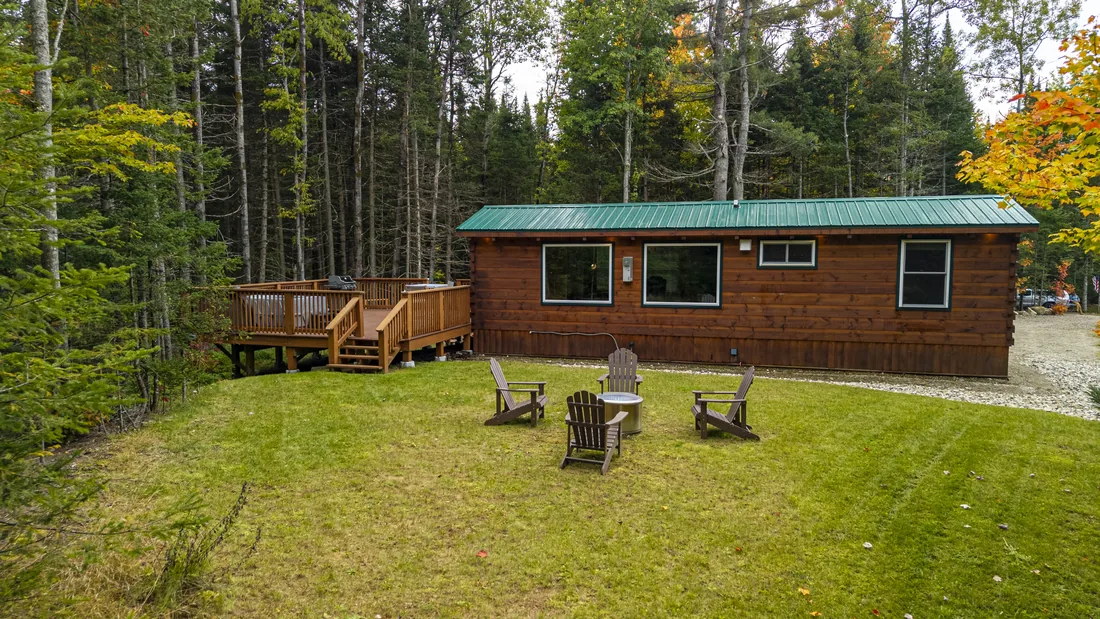
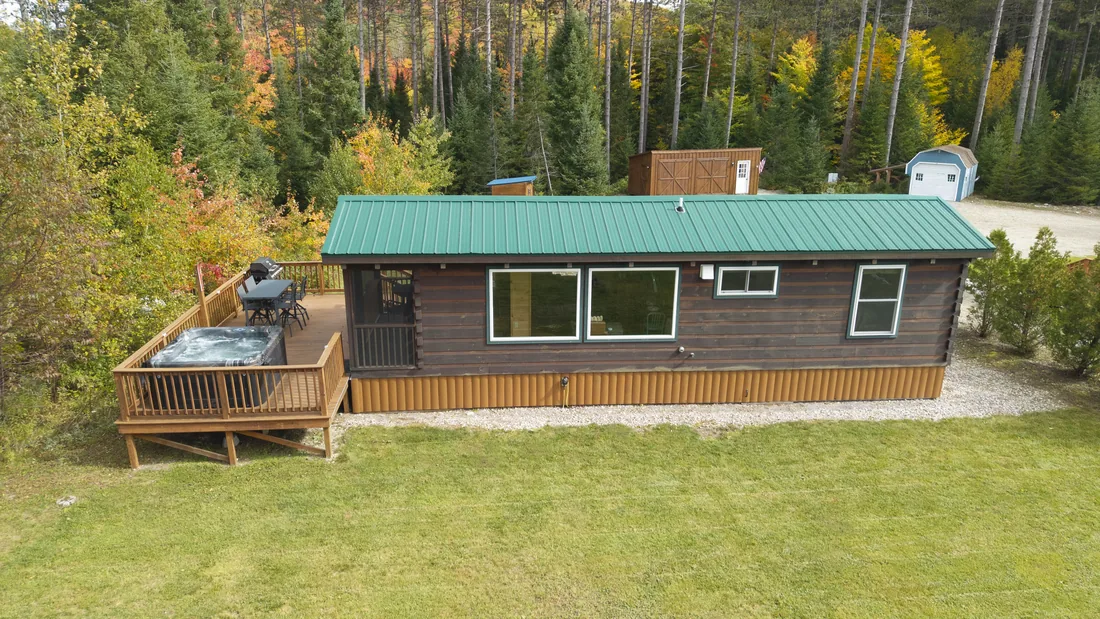
Under the theme it is the same cabin as The Modern Tiny Home and The Alpine: two bedrooms, three beds and one bathroom for up to four guests, a living room with two large picture windows on the woods, a full kitchen, a washer and dryer, and a deck with a private hot tub. The main bedroom has a king bed, and the bunk room has a queen below and a single above. Guests notice the theme. A March 2026 guest, on a third stay at our cabins and a first at this one, called it "a nicely themed tiny home along with great amenities," and a July 2026 guest back for a second visit wrote that "the attention to detail in its design makes you completely forget it's a tiny home."
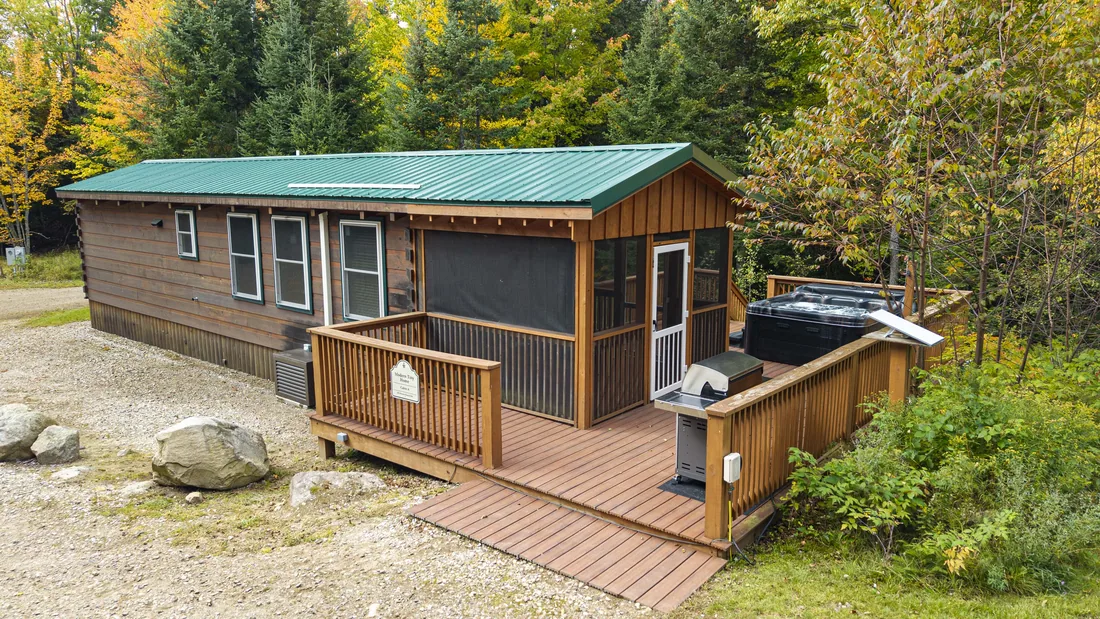
The cabin stands on a wooded property of more than 100 acres near the hamlet of Owls Head in the Town of Bellmont, off County Route 25 at the northern edge of the Adirondack Park. It shares that land and a gravel drive with The Alpine. It is the far cabin of the two: follow the drive past The Alpine and look for the sign with its name. How the two sit together is the subject of its own post.
The living room
The door from the deck opens into the living room, where pine boards cover the walls and the peaked ceiling, with exposed beams, a ceiling fan and a wall-mounted air conditioner. The aviation wall is the first thing you see: three black-and-white photographs of propeller airplanes, one large and two small, above a brown leather armchair whose sides are polished metal studded with rivets. Next to the chair stands a small two-drawer chest in the same riveted metal, and in the corner a floor lamp built like an old spotlight on a stand. By the door, a canvas sign with a biplane and the word AVIATOR hangs over a row of brass coat hooks.
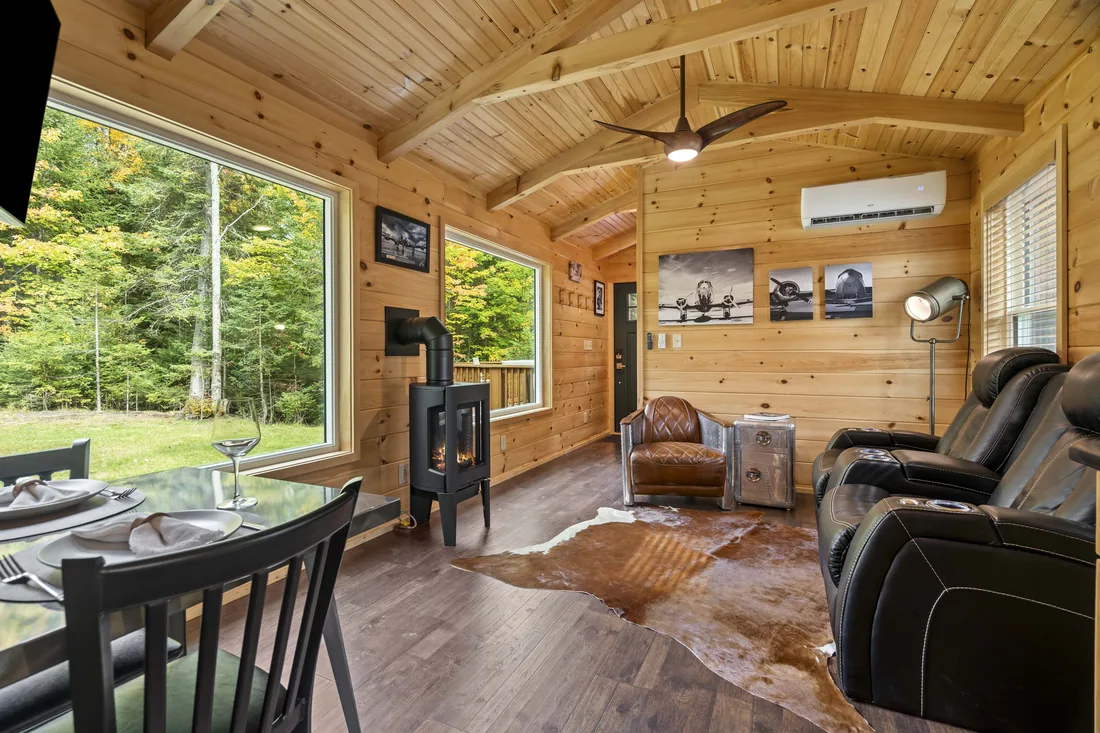
The seating is full electric reclining theatre chairs, a first-class seat for the view out the large windows. A cowhide rug lies on the floor, and a TV hangs on the wall beside the big window.
The two windows frame the rest of the room. The large picture window looks across the lawn to the fire pit and its Adirondack chairs, and the side window looks onto the deck railing. In the corner between them stands the stove, under a framed print of a four-engine propeller plane against a dark sky. It is a Jøtul GF 160 DV, the same gas stove The Alpine has; the Jøtul stoves post explains how it works and how to run it. A metal-topped dining table with black chairs stands at the picture window.
The poster in the main bedroom
The red poster on the bedroom wall carries the most history of anything in the cabin. Its lettering advertises the City of New York's municipal airports, No. 1, Floyd Bennett Field, and No. 2, North Beach, with seaplane bases at Wall Street and 31st Street. The Library of Congress holds the design in its collection of posters from the Works Progress Administration's Federal Art Project, which made it in New York City in 1936 or 1937; it shows an airplane and a seaplane. The library's copy is stamped December 8, 1937, on the back, and the poster credits Mayor F. H. La Guardia and John McKenzie, the city's Commissioner of Docks.
It came out of a very large program. At its height the Federal Art Project had Poster Project offices in cities in 18 states, printing 2 million posters of about 35,000 designs. On March 7, 2017, at the Franklin D. Roosevelt Presidential Library and Museum in Hyde Park, the U.S. Postal Service issued a booklet of 20 Forever stamps in ten designs taken from the program's posters, and City of New York Municipal Airports was one of the ten.
Floyd Bennett Field
The first airport on the poster was New York City's first municipal airport. It was dedicated on May 23, 1931, on Barren Island in Brooklyn, and named for Floyd Bennett, the naval aviator who flew as pilot on Commander Richard E. Byrd's 1926 North Pole expedition and received the Medal of Honor. Between 1931 and 1939, 26 around-the-world or transatlantic flights started or ended there. When the city's second municipal airport opened in 1939, the city sold the field to the Navy, and Naval Air Station New York was dedicated there on June 2, 1941. The Navy deactivated it in 1971, and it became part of Gateway National Recreation Area, where the old control tower and terminal now serve as the William Fitts Ryan Visitor Center.
North Beach, now LaGuardia
The second airport on the poster is LaGuardia. Early in the 20th century its site in Queens was the Steinway family's Gala Amusement Park. By 1929 the park had become the 105-acre Glenn H. Curtiss Airport, later renamed North Beach Airport. Ground was broken in 1937 for a 558-acre airport on the site, and it was dedicated in 1939 as New York Municipal Airport, with "LaGuardia Field" added to the name a couple of weeks later. At the opening ceremony the mayor addressed some 325,000 spectators. The first scheduled flight, a Transcontinental and Western Air DC-3 from Chicago, landed just after midnight on December 2, 1939. The Port Authority signed its lease on the airport with the city in 1947.
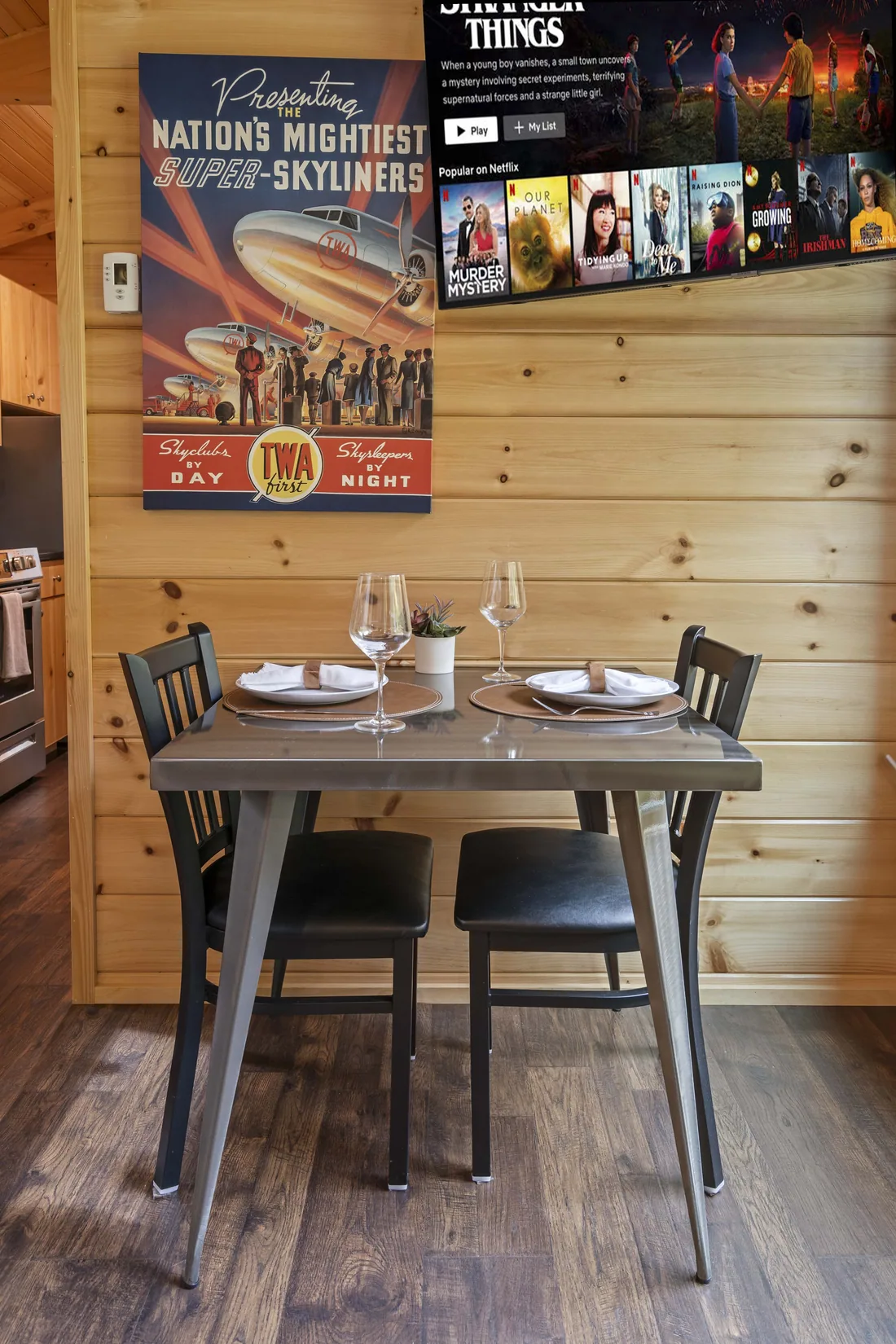
The TWA sign
That first airliner links the poster to the living room. In the photographer's shots, the dining table is set for two under an orange and blue TWA sign, with "Skyclubs by day" on the left, "Skysleepers by night" on the right and "TWA first" in a circle between them. In 1939 the letters stood for Transcontinental and Western Air, so the airline on the sign over the table flew the first scheduled flight into the airport on the poster in the bedroom.
The bedrooms
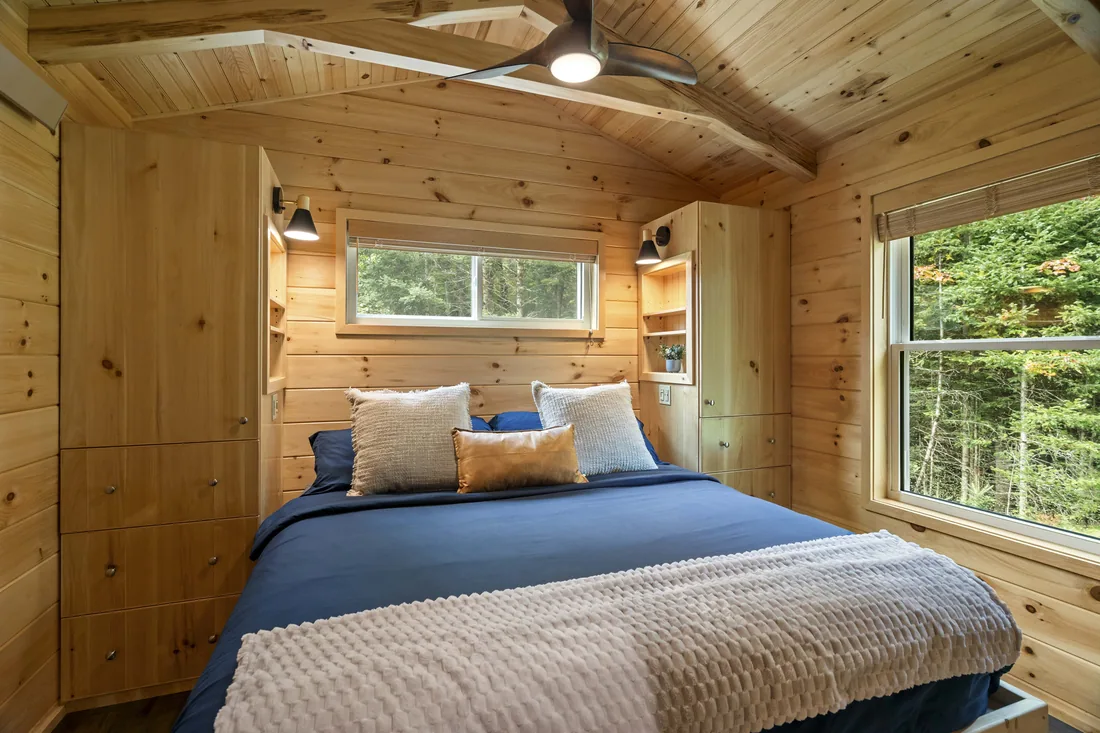
The main bedroom has the king bed. Built-in wardrobes with drawers stand on both sides of it, with lit open shelves beside the bed and a black wall lamp above each side. A long, low window runs over the headboard, a second window looks into the woods, and a TV is mounted on the wall. There is a ceiling fan, heating, bed linens and clothing storage, and the airport poster hangs on the wall beside the bed.
The bunk room has a queen bed below and a single bunk above, reached by a wooden ladder, with a window under the upper bunk. It has a ceiling fan and clothing storage too. One group in June 2026 argued over it: "We fought over who would get to sleep in the cozy bunkbed, enjoyed the hot tub, cooked dinner in the kitchen, and ate it outdoors on the deck." Another guest pointed out that the two bedrooms are on opposite sides of the house, which helps when two couples share the cabin.
Kitchen, bathroom and laundry
The kitchen has light wood cabinets, black counters, a stainless sink with a pull-down faucet, a stainless dishwasher, a range with the microwave above it, and a refrigerator. The rest is there too: a freezer, an oven, a kettle, a coffee maker, a toaster, wine glasses, a baking sheet, dishes and silverware, barbecue utensils, and the cooking basics, pots and pans, oil, salt and pepper. For the photographer the counter held a coffee station and a champagne bucket. Of the four cabins, The Alpine and The Aviator are the two with a dishwasher.
The bathroom has a glass-walled shower with marble-look panels, a toilet, and a vanity with a black counter under a three-light fixture, and the stacked washer and dryer stand beside the vanity. There is a hair dryer, cleaning products and hot water. One tip: bring your own shampoo; the packing guide covers towels and the rest.
The deck and the fire pit
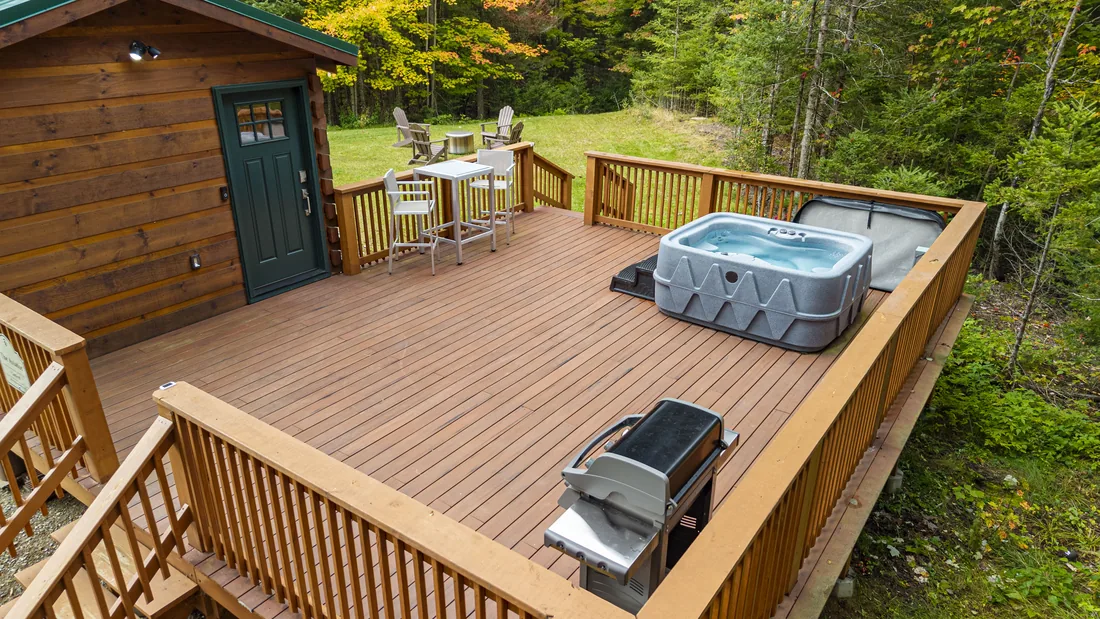
Outside is the large open deck. In the photos it runs along the end of the cabin by the door, with a wood railing all around, the hot tub in one corner, a grill under a cover, a high-top table with chairs, and steps down to the lawn. An evening here goes like this: dinner at the deck table, the night sky from the hot tub, and fireside stories and s'mores out on the lawn.
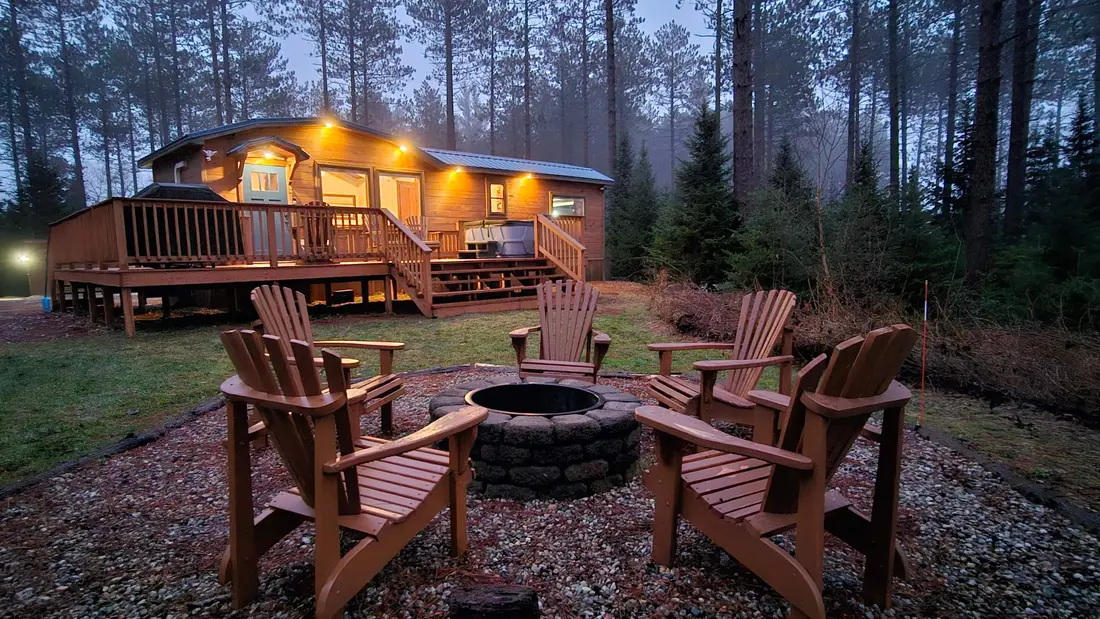
The fire pit is a steel smokeless one on the open lawn, in view of the picture window, with four Adirondack chairs around it. The hot tub and the fire pit are yours and nobody else's; The Alpine's guests have their own. Three things to know out here: the hot tub has no gate or lock; the region has plenty of wildlife, so no food or garbage stays outside; and a Ring doorbell camera overlooks the entrance and the entire deck and records video and sound.
Both get their mentions. A November 2025 guest found the hot tub "wonderful, especially in winter," and a September 2025 guest called the outside fire a "nice place to unwind." For the sky once the fire burns down, see stargazing from the hot tub.
Who The Aviator suits
The cabin sleeps four, and it was built for couples and families who want to get away and enjoy nature and the area's attractions; here, a family means children 10 and older. These are the trips it fits best.
- A couple. The far cabin on its property, with an open deck and a fire pit in view of the window.
- Two couples. One takes the king room and the other the queen in the bunk room, on opposite sides of the house. Four guests is the maximum.
- Skiers. Titus Mountain's base lodge is about three miles away, five minutes from the door; see ski cabins near Titus.
- A long stay. Stays of 28 nights or more are welcome, and there is wifi with an ethernet connection. An August 2026 guest found it "had all the amenities needed for a longer stay." See long stays and remote work.
- One small dog. The pet rules allow one pet of up to 25 pounds, house-trained, never left alone in the cabin and kept off the furniture, and a pet fee applies. See pet-friendly cabins.
- Families with children 10 and older. Guests are 10 and up, as at the other cabins, and the home is not childproofed. See family cabins.
- Pilots and airplane people. Malone's airfield is 11.6 road miles away, and the outings below can fill several days.
A few house rules: no parties or events, no smoking, with fees if anyone does, no commercial photography, no weapons or illicit drugs anywhere on the property, and quiet hours from 10 p.m. to 8 a.m. The entrance is up the deck steps. For a property entirely to yourselves, book The Alpine next door as well.
Flying in to Malone
A private pilot can land closer to The Aviator than any airline flies. Malone-Dufort Airport is 11.6 road miles from the cabins, about 20 minutes by car, and airports near the cabins has its runways, lights, frequencies and services, along with every airline option. The field is unattended and lists no rental or courtesy car, so arrange your ride before you fly.
For a day in Lake Placid, the village has its own field. Lake Placid Airport is a mile southeast of the village and about 54 road miles from the cabins, with one runway 4,196 feet long and 60 feet wide, attendance from 9 a.m. to 5 p.m., and both 100LL and Jet A. Its FAA remarks warn of mountains on both approaches, one to five miles from the runway ends, and of extensive glider activity in spring and fall. Check the current Chart Supplement and NOTAMs before any flight. The Olympic sites guide covers what to see once you are on the ground.
The old bomber base at Plattsburgh
Plattsburgh Air Force Base, built in the 1950s for the Strategic Air Command, closed in 1995; the Plattsburgh guide tells the base's story. Plattsburgh International Airport now flies from the old base, on a runway 11,759 feet long and 200 feet wide. For an airplane person, the place to go is the Plattsburgh Air Force Base Museum at 31 Washington Road, on the old base about 63 road miles east of the cabins.
The museum honors the forty years of Air Force presence in the North Country. The idea for it dates from 1982, and on June 7, 2014, it reopened as part of the Battle of Plattsburgh Association, with volunteers keeping it going. The base's main unit was the 380th, a Strategic Air Command bomb wing from 1954 to 1992 and an air refueling wing until 1995. Admission is free, and the museum gets no government money for its daily running, so donations keep it open. It opens Wednesday to Saturday from 10 a.m. to 3 p.m., May to October, and closes for the winter and on major holidays, so check its site before you set out.
Two things there are made for airplane people. The first is the Cardboard Trainer, a copy of the FB-111A cockpit in which every switch, dial, knob and control was a replica. The dials did not work, the radar scopes showed nothing and there was no oxygen system, but students and instructors used it to learn where every control was and to practice the normal and emergency procedures, and visitors are invited to sit in it. The second is outside. Behind the museum, in Clyde A. Lewis Park, stand a B-47 and an FB-111A, both of which were on display across Route 9 while the base was still active.
The B-47 is 53-2385, "Pride of the Adirondacks." In September 1965 it went from Plattsburgh to the Strategic Air Command's bombing and navigation competition at Fairchild Air Force Base in Washington State, took top honors in three of the four B-47 categories and came home hailed as the "World's Best B-47." It was preserved and put on display at the entrance to the base on February 8, 1966, and dedicated on March 21, 1966, before more than 300 people, in memory of the crews and maintenance men who flew and supported B-47s at the base.
The Battle of Plattsburgh Association's War of 1812 Museum shares the address, so one stop covers 1814 and the Cold War; the Plattsburgh guide has its hours. The road there is US 11 east through Malone and Chateaugay, then the Military Turnpike into Plattsburgh, roughly an hour and a quarter to an hour and a half each way.
The B-47 on Wright Peak
Plattsburgh's B-47s left another mark in the Adirondacks. On January 16, 1962, a B-47E of the 380th Bombardment Wing, out of Plattsburgh on a training mission to practice low-altitude bombing runs over Watertown, flew into Wright Peak in the High Peaks. Bound back for Plattsburgh, it had apparently strayed about 30 miles off course in bad weather and high winds. All four men aboard died, and searchers never found the remains of one of them. A plaque placed near the summit names them, Aircraft Commander 1st Lt. Rodney D. Bloomgren, Copilot 1st Lt. Melvin Spencer, Navigator 1st Lt. Albert W. Kandetski and Observer A1C Kenneth R. Jensen, as "a Strategic Air Command B-47 crew killed here 16 January 1962 while on a mission preserving the peace of our nation."
The site is a hike, not a roadside stop. Wright Peak rises to 4,580 feet, and the usual route is an out-and-back of 7 miles round trip with about 2,600 feet of climbing from Heart Lake, at the end of Adirondack Loj Road. The trail follows the Marcy Dam trail for 0.9 mile, goes straight at a four-way junction toward Algonquin Peak, passes MacIntyre Falls and climbs steeply. At the Wright Peak spur, the left-hand trail goes straight up a steep rock slab, and the summit is 0.4 mile farther. A side trail leads to the bomber, most of the wreckage remains, and hikers on the way up still find pieces of it just below the summit. It is a memorial as well as a crash site, so look, take pictures, and leave every piece where it lies.
The trail notes call wind protection a must for the final climb. In winter they add snowshoes, spikes or crampons, several extra non-cotton layers, a headlamp with spare batteries, extra food, a windbreaker, goggles, a face mask and supplies for a night out in an emergency. Parking at Heart Lake costs a fee. Expect changes at this trailhead: a consultant's study the state released in April 2026 recommends a limit of 400 visitors a day at Adirondack Loj and South Meadows, the busiest way into the High Peaks, from 2027. DEC said releasing it did not mean the recommendations were adopted, so check the rules before a 2027 hike. The trailhead is about 60 road miles from the cabins, roughly an hour and a half by NY 30, NY 86 through Saranac Lake, Old Military Road and NY 73; the High Peaks guide covers the area's busiest trails and the summit stewards.
Canada's national aviation museum
Canada's national aviation collection is in Ottawa. The Canada Aviation and Space Museum, at Rockcliffe Airport on Aviation Parkway, opened in 1960 as the National Aviation Museum and took its present name in 2010. It holds more than 130 aircraft and artifacts, from First and Second World War planes to Cold War jets, along with the original Canadarm and the largest surviving pieces of the Avro Arrow, a nose section and two wingtips. It is open all year, but its days and hours vary by season, so check the museum's own site before you leave.
It makes a long day. The museum is about 103 road miles from the cabins by NY 37 west, the bridge at Massena to Cornwall, and Highways 138 and 417 into Ottawa, roughly two and a quarter hours each way plus the border lines in both directions. Everyone in the car needs border documents; crossing the border has the ports, their hours and the rules for food and dogs.
Aviation outings at a glance
| Place | Road miles from the cabins | Open | What you see |
|---|---|---|---|
| Malone-Dufort Airport | 11.6 | Unattended field | The closest landing for a private plane |
| Lake Placid Airport | About 54 | Attended 9 a.m. to 5 p.m. | A field a mile from Lake Placid village |
| Wright Peak, from Heart Lake | About 60 to the trailhead | 7 miles round trip; winter gear in season | The 1962 B-47 wreckage and the crew's plaque |
| Plattsburgh Air Force Base Museum | About 63 | Wednesday to Saturday, 10 a.m. to 3 p.m., May to October | The Cardboard Trainer, the B-47 and the FB-111A |
| Canada Aviation and Space Museum, Ottawa | About 103 | All year; check the day's hours | More than 130 aircraft and artifacts |
Hours change with the seasons, so confirm each place before you drive. On a Plattsburgh day, leave the cabin by about nine to reach the museum near opening time, see the trainer inside and the two planes out back, take in the War of 1812 Museum at the same address before lunch, and be back for the fire pit before dark.
Booking The Aviator
The Aviator is booked on its own Airbnb page, which holds the calendar, the rate for your dates and the pet terms. Check-in is after 4 p.m. and checkout before 11 a.m., and the booking guest is 25 or older, as at the other cabins. Dates you pick on this site carry into the booking link; how to book explains it, and The Aviator's page has every photo and the guest reviews. To weigh it against the other cabins, see the cabins compared, and for a group of eight, book it together with The Alpine, which shares its property.
Questions
What makes The Aviator different from the other cabins?
Its aviation decor: airplane prints, a print of the 1930s City of New York Municipal Airports poster in the main bedroom, a TWA sign over the table and full electric reclining theatre chairs. It also has a large open deck and a smokeless fire pit on its lawn, and a Jøtul gas stove like The Alpine's. See the cabins compared.
How many people can stay at The Aviator?
Four. The main bedroom has a king bed, and the bunk room has a queen bed below and a single above. For a group of eight, book it together with The Alpine, which shares its property; how the two cabins share a property explains the layout.
Can I fly my own plane to The Aviator?
Yes, to Malone-Dufort Airport, two miles west of Malone and 11.6 road miles from the cabin. It is an unattended field with self-service 100LL and tie-downs, and no rental car or courtesy car is listed, so arrange a ride first. The runways and frequencies are in airports near the cabins.
Where can I see military aircraft near the cabins?
At the Plattsburgh Air Force Base Museum, 31 Washington Road in Plattsburgh, about 63 road miles east, with a B-47 and an FB-111A in Clyde A. Lewis Park behind it. Admission is free, and the museum opens Wednesday to Saturday, 10 a.m. to 3 p.m., May to October; check its site before you go.
Can we bring children to The Aviator?
From age 10. Guests are 10 and up, as at the other cabins, and the home is not childproofed. Families with children 10 and older and teenagers fit within the four-guest limit; see family cabins.
Can we bring a dog to The Aviator?
One pet of up to 25 pounds, house-trained, never left alone in the cabin and kept off the furniture, and a pet fee applies. See bringing your dog for walks, rules and vets near the cabins.
Sources
The sources for this page, checked October 2026. Hours, fees and schedules change; confirm before you go.
- The cabin's Airbnb listing airbnb.com/rooms/1168252128174283244
- The cabin's Airbnb listing airbnb.com/rooms/680317854139676578
- loc.gov loc.gov/item/96510345/
- about.usps.com about.usps.com/news/national-releases/2017/pr17_011.htm
- about.usps.com about.usps.com/postal-bulletin/2017/pb22460/html/info2_001.htm
- nps.gov nps.gov/gate/learn/historyculture/fbf.htm
- nps.gov nps.gov/gate/learn/historyculture/floyd-bennett-field.htm
- portfolio.panynj.gov portfolio.panynj.gov/2016/06/17/laguardia-airport-flashback-to-the-pas
- portfolio.panynj.gov portfolio.panynj.gov/2015/05/26/vintage-laguardia-airport/
- AirNav airnav.com/airport/KMAL
- AirNav airnav.com/airport/KLKP
- AirNav airnav.com/airport/KPBG
- flyplattsburgh.com flyplattsburgh.com/about-us
- plattsburghafbmuseum.org plattsburghafbmuseum.org/
- fb-111.net fb-111.net/Page-50.html
- battleofplattsburgh.org battleofplattsburgh.org/
- adirondack-park.net adirondack-park.net/history/b47.wright.html
- newyorkalmanack.com newyorkalmanack.com/2023/02/a-new-book-on-the-1962-b-47-crash-at-wrigh
- readtheplaque.com readtheplaque.com/plaque/mt-wright-memorial-plaque
- Lake Placid tourism (ROOST) lakeplacid.com/hiking/wright-peak
- thecanadianencyclopedia.ca thecanadianencyclopedia.ca/en/article/canada-aviation-museum
- tourismeoutaouais.com tourismeoutaouais.com/en/attractions/canada-aviation-and-space-museum
- router.project-osrm.org router.project-osrm.org/
- ingeniumcanada.org ingeniumcanada.org/newsroom/news-avro-search-and-recovery-2017
- ingenium.ca ingenium.ca/aviation/en/visit/
- events.nfb.ca events.nfb.ca/events/canada-day-2026-at-the-ingenium-aviation-and-spac
- b-47.com b-47.com/wp-content/uploads/2012/06/Newsletter-31-Nov-2009.pdf
- yahoo.com yahoo.com/news/articles/high-peaks-study-proposes-hiker-110200636.html