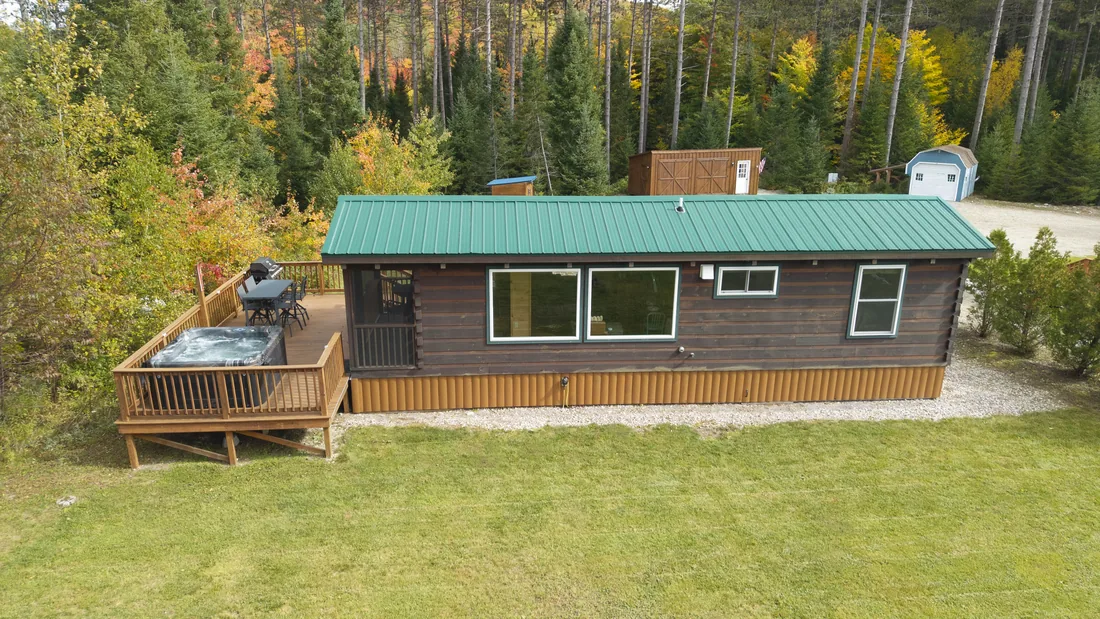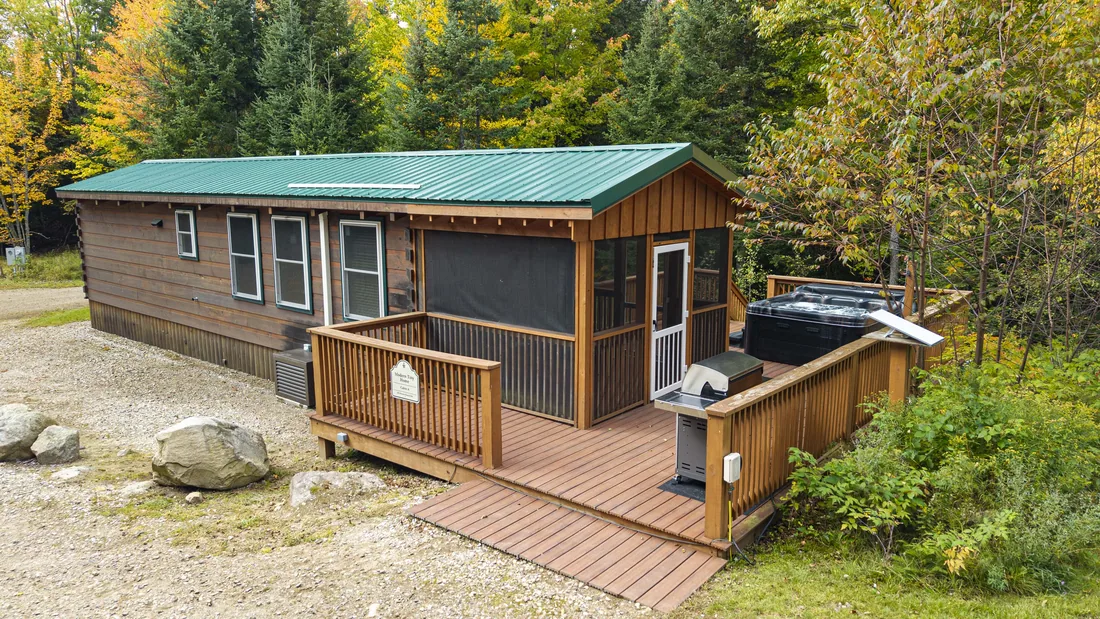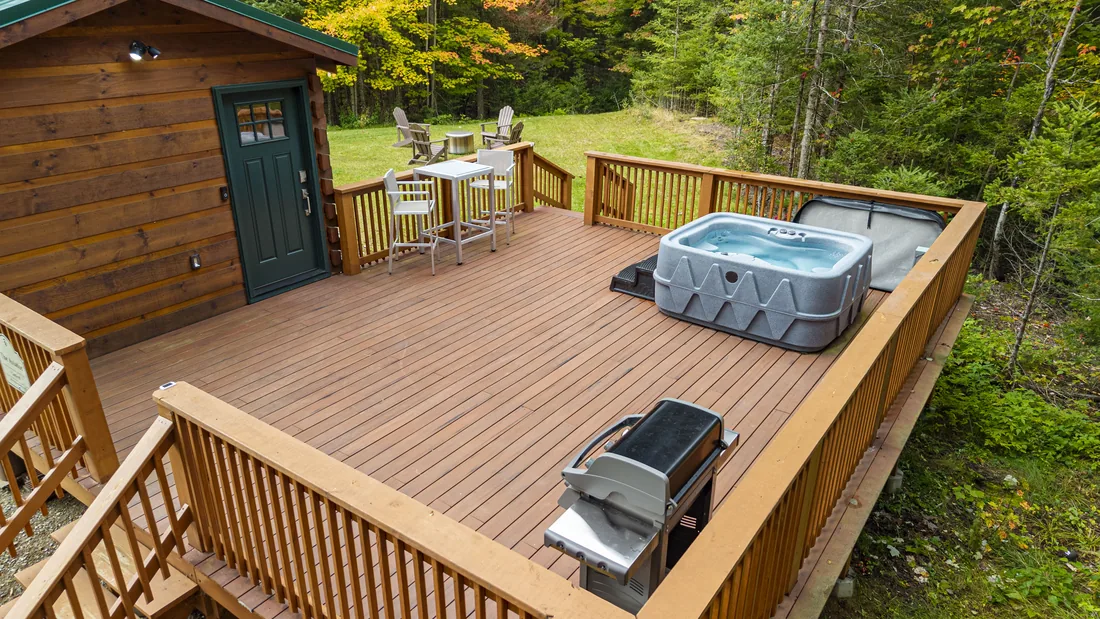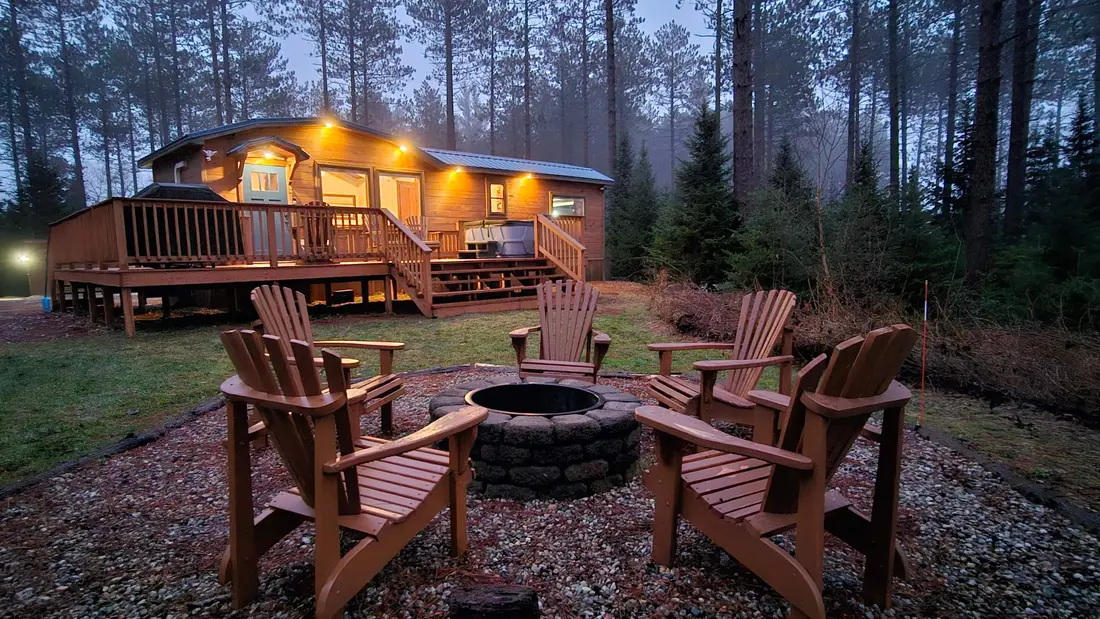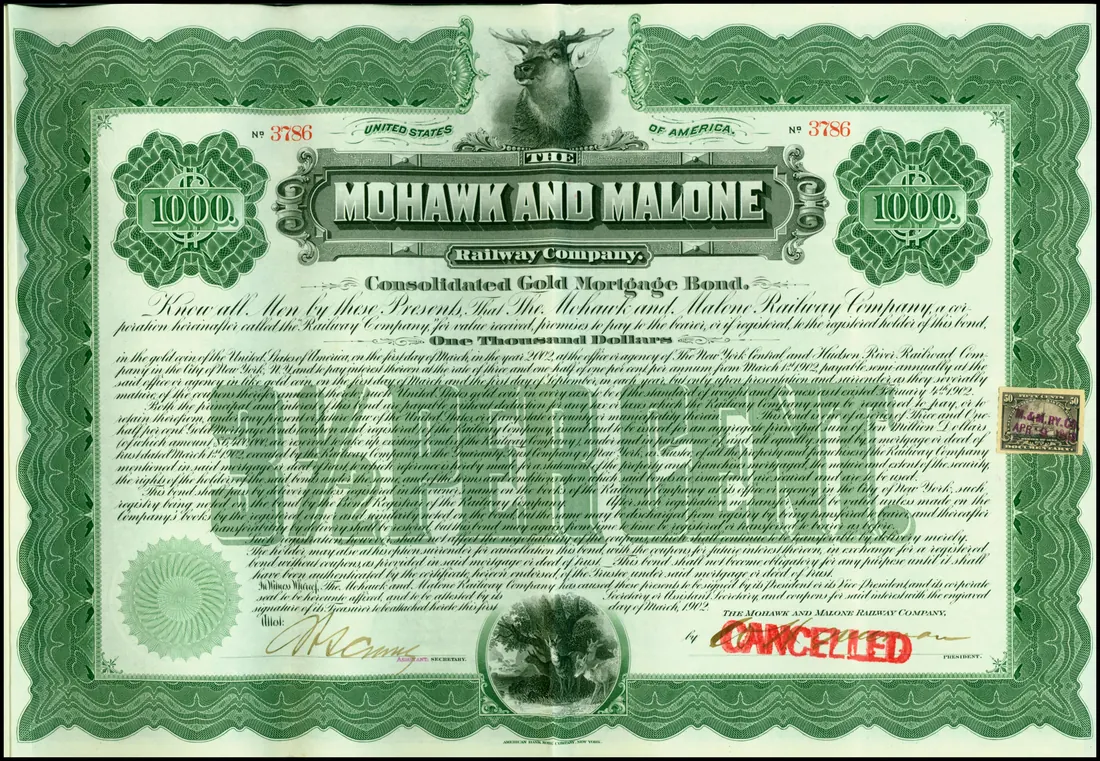
In July 1892 William Seward Webb's new railroad began running trains south from Malone, with a stop at Ringville, today's hamlet of Owls Head, and its old bed still passes within about a mile of the cabins. This post follows that line and its two neighbors, the old Northern through Malone and the Chateaugay Railroad, from their first trains to their last. It ends with the depots, the trains and the trail you can still visit, all within about an hour and a half of the cabins.
The old grade near the cabins
The bed of Webb's railroad runs south from Malone through Chasm Falls and the hamlet of Owls Head, then bends southeast toward the Town of Franklin and Loon Lake. At its closest it passes about three-quarters of a mile from the cabins as the crow flies. No train has run on this stretch since about 1960, and the strip of land is still easy to find, because two newer things took it over: snowmobiles and a power line.
In winter the corridor carries snowmobiles. South of the cabins the C7 runs through Owls Head and Mountain View, and around Malone riders still call it the tracks, because long stretches of it follow old railroad beds. Part of it runs along the power line instead, a stretch riders call the pole line. From The Alpine the C7 is about a three-minute snowmobile ride, The Modern Tiny Home has direct access to it, and Titus Mountain counts itself less than a mile from the tracks. The C7 guide has registration, trail rules and what riders from Canada need.
The rest of the year, look for the wires. When the trains stopped, the right-of-way from Lake Clear Junction north to Malone was sold to Niagara Mohawk, the power company, for its lines. Today a 115,000-volt National Grid line follows the old bed through Owls Head, the two side by side. Where you see that row of tall wooden poles crossing the county roads near the hamlet, the railroad ran right beside it.
Malone's first railroad
Malone had trains for more than forty years before Webb came. The Northern Railroad, built across the top of New York from Rouses Point on Lake Champlain to Ogdensburg on the St. Lawrence, opened for traffic in 1850. Its freight depot on Railroad Street dates from 1852 and was listed on the National Register of Historic Places in 1976, and the Malone history guide covers the men who brought the line to the village and the shops they built. In 1851 the Northern ran what railroad historians count as the first refrigerator car in the United States.
Farmers used it from the start. In the county fair's first years, in the 1850s, the railroad carried livestock and other exhibits to the fair free, at the owner's risk, and later charged for the trip one way. The fair guide has the fair as it runs now.
The road was reorganized as the Ogdensburg and Lake Champlain in 1864. Twice, in June 1866 and again in May 1870, Fenian raiders bound for Canada gathered at Malone on this line; the history guide tells that story. In October 1901 the line became part of the Rutland Railroad. Its passenger trains ended with a three-week strike in June 1953. The Rutland's last train ran during another strike, on September 25, 1961, and when the company asked to abandon the whole railroad, the federal hearings spent two days in Malone in the spring of 1962. The Interstate Commerce Commission approved the abandonment that September.
Dr. Webb and his railroad
Dr. William Seward Webb had married into the Vanderbilt family. His wife, Lila, was the youngest daughter of William H. Vanderbilt, one of the world's wealthiest men when he died in 1885. Her inheritance paid for Shelburne Farms, the estate of 33 farms and nearly 4,000 acres the Webbs put together on Shelburne Point, on the Vermont shore of Lake Champlain. In the Adirondacks, Lake Lila, on Webb's Nehasane preserve, carries her name.
Webb came at the Adirondacks from the south. He bought the Herkimer, Newport and Poland, a narrow-gauge line out of Herkimer built in 1882, converted it to standard gauge in 1891 and extended it to Remsen. From Remsen he built north across the mountains toward Malone. Work began in 1891 and was done in about 18 months. The line's highest point, at Big Moose Lake, is 2,035 feet above sea level.
He stayed close to the work. Webb spent the summer of 1891 in Saranac Lake while his crews pushed the line through the woods around the village.
How Webb's line came to Malone
The northern half started with a telegram. On April 1, 1891, Henry Patton, an Albany lumber merchant, sent word to Malone that Webb would be there the next day. Webb's terms were short: raise $30,000, to be paid to him once the road was finished and running, and he would build it, the first fifty miles within four months and the whole line within two years. He gave the village one week, and the money was in hand by the deadline.
The company that built south from Malone was the Adirondack and St. Lawrence, organized with $2,000,000 in capital. Its rails were to weigh 75 pounds to the yard, with 3,000 ties to the mile instead of the usual 2,800. Westbrook, a New York contractor, took the grading of the first forty miles south of the village, which took in the country around Owls Head, and sublet the work to smaller outfits: Sullivan and Hawkes, I. A. Hodge, and McLane and Company.
North of the village, Edson J. Chamberlin, manager of the Canada Atlantic Railway, offered to build the eleven or so miles from the Canadian border to Malone for a cash bonus of about $37,000, paid on completion. Malone's line north opened first: in January 1892, half a year before Webb's trains, the first passenger train ran from Malone to Valleyfield and Montreal. With both lines open, Malone sat on a through route between New York and Montreal.
In the Town of Bellmont, where the cabins are, the grade came in from Malone at Chasm Falls, near the town's northwest corner and about two road miles from the cabins. It bore southeast for about twelve miles past Owls Head and Mountain View and passed into the Town of Franklin near Plumadore Pond. The older Chateaugay line came in at Standish, on the town's eastern border, and ran southwest seven or eight miles to Wolf Pond, where the two railroads almost touched.
Opening day in July 1892
Regular passenger trains from Malone south to Saranac Lake and Tupper Lake began on Saturday, July 16, 1892. With the southern half still unfinished, the first train came up from New York the long way, by the Central to Utica and then by way of Norwood, with Webb's party aboard his private car, the Elsmere. It was due in Malone at eight in the morning and got there after ten, and it reached Saranac Lake village at about three in the afternoon.
The fares announced before the opening, counted from Malone, were 39 cents to Mountain View, 75 cents to Loon Lake, 95 cents to Rainbow, $1.11 to Paul Smith's, about $1.45 to Saranac Lake and $1.80 to Tupper Lake. Until then the trip by rail to Tupper Lake had cost $3.95. One account of the first run called the stretch from Whippleville to Mountain View, the miles that pass Owls Head, "to the minds of many the finest view on the whole trip."
That fall the two halves met, and through trains began running from Herkimer to Montreal by way of Malone. Not every part of the service paid at first. By December 1892 the dining car, first run only between Malone and Montreal, ran from Saranac Junction to Montreal, and it lost money on every trip.
The stations from Malone south
The stations listed for the opening, north to south, were Malone, Whippleville, Ringville, Mountain View, Loon Lake, Rainbow, Paul Smith's, Saranac Junction, Saranac Lake, Saranac Inn and Tupper Lake. Saranac Lake sat on a short branch that left the main line at Saranac Junction, and the main line went on past Saranac Inn to Tupper Lake. Some names have changed, and some stations stood a few miles from the places they were named for, so the table sets each stop beside what you will find there now.
| Station in 1892 | Fare from Malone | The place today | Road miles from the cabins |
|---|---|---|---|
| Malone | Start | The village; the 1852 freight depot on Railroad Street | About 10 |
| Whippleville | Not listed | A hamlet in the Town of Malone, between Chasm Falls and the village | About 6.5 |
| Ringville | Not listed | The hamlet of Owls Head | About 3.5 |
| Mountain View | 39 cents | The hamlet on Mountain View Lake, once called State Dam | About 6.4 |
| Loon Lake | 75 cents | Inman, a former settlement in the Town of Franklin about three miles from Loon Lake | Not measured |
| Rainbow | 95 cents | A stop between Loon Lake and Paul Smith's | Not measured |
| Paul Smith's | $1.11 | A stop about three miles from Paul Smith's Hotel | Not measured |
| Saranac Junction | Not listed | Lake Clear Junction from 1893; Charlie's Inn | About 37 |
| Saranac Lake | About $1.45 | The 1904 Union Depot, 42 Depot Street | About 43 |
| Saranac Inn | Not listed | The stop near the Saranac Inn on Upper Saranac Lake | Not measured |
| Tupper Lake | $1.80 | Tupper Lake; today's station is at 37 Depot Street | About 59 |
Ringville is the old name of Owls Head, and Mountain View had been State Dam. Saranac Junction became Lake Clear Junction in 1893. The lakes guide has the Mountain View station's busy summers, when trains brought cottagers to Indian Lake and Mountain View Lake.
Owls Head and Station Road
Before the railroad, Owls Head was Ringville, a small sawmill settlement the lakes guide describes. The station changed it. In his 1918 history of the county, Frederick Seaver of Malone wrote that Ringville had "since become a busy and thriving hamlet, with a railway station, shops, stores and a Methodist Episcopal church."
Station Road is the short dead-end lane north off Ragged Lake Road, across from the volunteer fire station, that hikers use for Owls Head mountain. Follow it north and it turns into a gravel track under a high-voltage power line, and the old railroad bed runs right beside those wires. No record we found marks the exact spot where the Owls Head depot stood, so the lane's name and the grade at its end are the clues left on the ground.
At Mountain View the site is known. The station stood across the road from the First Union Protestant Church at 7 Church Road, about 6.4 road miles from the cabins.
People live along Station Road. The Owls Head guide shows where hikers park so every driveway stays clear, and from the end of the lane the grade is easy to see.
The Chateaugay Railroad
The other railroad in this corner of the mountains came from the east, and it started as an iron company's tool. The Chateaugay Iron Company built it in 1879 as a narrow-gauge line between Dannemora and Lyon Mountain, to carry ore and charcoal for its ironworks. It reached Standish in 1885, Loon Lake in 1886 and Saranac Lake in December 1887, seventy-two miles from Plattsburgh. Going west from Plattsburgh, its route ran by way of Lyon Mountain, Standish, Wolf Pond, Plumadore, Loon Lake, Rainbow, Vermontville and Bloomingdale.
The Delaware and Hudson took control in 1901. In 1903 it combined the line with the one from Saranac Lake to Lake Placid as the Chateaugay and Lake Placid Railway and converted the whole railroad to standard gauge. In 1904 the D&H built the Union Depot in Saranac Lake, which brought its trains from the east and the New York Central's from the west under one roof.
Over time the two railroads leaned on each other. In 1940 a new connection about five miles north of Loon Lake let D&H trains run over the New York Central's track to Lake Clear Junction and on to Lake Placid, and the D&H gave up its own route into Saranac Lake. In 1946 the D&H left the area and sold its ten miles between Saranac Lake and Lake Placid to the Central.
Pieces of the Chateaugay story are easy to visit. The level path through Bloomingdale Bog follows its bed; see the Saranac Lake and Paul Smiths guide. The Chateaugay Lakes guide has the iron company's forge at the outlet of Lower Chateaugay Lake, and Lyon Mountain keeps a mining and railroad museum in its old depot.
What the trains carried
Ore, charcoal and wood
The Chateaugay line was built to move ore and charcoal for the iron company, and the Lyon Mountain guide has the mines it served. On Webb's line, forest-products companies and loggers ran several branches of their own, and many of them were short-lived.
Hotel guests and summer people
Two of the stops on opening day were named for big hotels: Paul Smith's station, about three miles from the famous hotel, and Saranac Inn, near the hotel of that name on Upper Saranac Lake. The Saranac Lake guide has Paul Smith's story, and many of the summer crowds came for the old hotels of the northern Adirondacks. By the 1920s ten passenger trains a day ran on the division, five each way, and on summer Friday afternoons a sleeper left Grand Central with through service to Lake Placid, often in as many as five sections.
Patients
Saranac Lake spent the decades from 1884 to 1954 as a world-famous center for curing tuberculosis, a story that began with Dr. Edward Livingston Trudeau in 1873. The cure was rest, good food and gentle exercise in the fresh air, and patients came in a steady stream from the 1890s on. By the turn of the century the train was the main way in. Patients stepped off at the Union Depot and were taken first to the Riverside Inn, where Riverside Park's bandshell stands now, to be examined. After a couple of days they consulted the "TB Book," which listed the places that might suit each one's illness, care and money.
Olympic crowds
In 1932 the railroad carried athletes and spectators to the Winter Olympics at Lake Placid on special trains from Utica and New York. It laid sidings where Pullman sleeping cars housed about 500 visitors, and it rushed boxcars of snow from Old Forge to Lake Placid.
Commuters to Montreal
From Malone the trains also ran north. Malone-Montreal commuter runs on Webb's old line lasted until 1958, five years after the through trains from Utica stopped.
The New York Central years
Webb did not run his railroad for long. In May 1893 the New York Central took it over, ran it as its Adirondack Division and moved the southern end from Herkimer to Utica. The mileposts kept counting from Herkimer, with an H in front of the number.
Through its junctions at Remsen and Lake Clear Junction, the division gave central New York its only direct rail link to Canada. At Saranac Lake the Union Depot became the largest station on the line north of Utica, and in its busiest years, 1912 to 1940, it handled 18 to 20 trains a day. Through passengers rode from Utica to Montreal, past Owls Head and through Malone, until 1953.
How the trains stopped
The end came from the north. Through service between Utica and Montreal stopped in 1953. Passenger trains between Lake Clear Junction and Malone ended in 1957, and the Malone-Montreal commuter runs in 1958. In 1960 the line was cut between Gabriels and Malone, and the Adirondack Railroad's own history dates the abandonment of the stretch from Lake Clear Junction to Malone to 1961. The rails from Lake Clear Junction to Gabriels came up in 1962, and the track from Malone north to the Canadian border lasted until 1983.
South of Lake Clear the trains held on a few years longer. The last New York Central passenger train left the Union Depot in Saranac Lake on April 24, 1965, and that summer every station on the division closed except Tupper Lake, which kept a freight agency for a few more years. The Central merged into Penn Central in 1968. Freight ended in the early spring of 1972, when a washout below Tupper Lake stranded cars that Penn Central then took out by truck to Potsdam.
The state bought the corridor in the 1970s. The Adirondack Railway Corporation ran trains to Lake Placid for the 1980 Winter Olympics, and the state ended its lease in February 1981. Rail fans brought the southern end back to life: on July 4, 1992, the first revival train left Thendara for Minnehaha, and more than 55,000 people rode that first season. In 1994 the operation took the name Adirondack Railroad. The state finished rehabilitating the 84 miles of track from Remsen to Tupper Lake in 2022.
Where to see the railroad today
In Malone
Malone is about ten road miles north of the cabins, about 20 minutes away. The National Register lists the Northern's freight depot of 1852 at 99 Railroad Street, about 10.3 road miles from the cabins. For the rest of the village, from groceries to dinner, see the Malone town guide.
In Owls Head and Mountain View
Owls Head is about 3.5 road miles away. Look at the grade from the end of Station Road, or make a morning of it with the climb on Owls Head mountain, whose trailhead is on the same lane. Mountain View, about 6.4 road miles away, has the church that stood across the road from its station.
At Lake Clear
Lake Clear Junction, where Webb's Saranac Lake branch left the main line, is about 37 road miles from the cabins, under an hour south on County Route 25 and NY 30. Lake Clear has a Station Road of its own. The Junction House, there since about 1891, is now Charlie's Inn at 44 Junction Road, with lodge rooms, cabins, a campground, a restaurant and a bar, and it stood across the road from the junction's station. The Adirondack Rail Trail runs past it on the old railroad bed.
Saranac Lake's Union Depot
About 43 road miles from the cabins, roughly an hour. The depot at 42 Depot Street dates from 1904 and closed after the last passenger train in 1965. Historic Saranac Lake oversaw a first restoration in 1997 and 1998 with federal funds. The state owns it, and it has been repairing it again for the rail trail: a new roof in 2024, paint, trim and siding work in 2025, and new electrical and mechanical systems planned for 2026, with a public call for proposals on its use to follow. Plan to see it from the outside. From here the rail trail runs east to Lake Placid and west through Lake Clear to Tupper Lake.
Tupper Lake station and the Adirondack Railroad
About 59 road miles from the cabins, roughly an hour and a half. The rail trail ends at Tupper Lake, beside the station at 37 Depot Street, which the Town of Tupper Lake owns, and the Adirondack Railroad's trains run south from there. Excursions to Tupper Lake resumed in 2023, the first passenger service there since the 1980 Olympics, and the state's $13.5 million upgrade of the station added an 18-foot-wide, 550-foot platform with a canopy and wheelchair lifts, a baggage platform for bikes and kayaks, and a shed for year-round locomotive work.
The state's plan for the corridor sets rail service from May to November, with snowmobiles on the line from December to April. In 2025 the Tupper Lake Explorer made a 1.5-hour round trip south to Sabattis on Sundays, at noon and 2 p.m., the Adirondack Mountaineer came up from Thendara on Sundays with a four-and-a-half-hour layover in Tupper Lake, and the High Peaks Limited ran from Utica on select fall Saturdays. New in 2026, the Tupper Lake Taps and Tracks, a three-hour evening round trip to Sabattis with live music for riders 21 and over, was scheduled for July 25 and September 19. Tupper Lake's tourism office lists a Halloween trivia train for October 23, 2026, and the railroad also lists an Adirondack Christmas Train. Bikes ride at no extra charge if you note them when you book. Dates change every year, so check the railroad's schedule before you build a day around a train, and pair it with The Wild Center across town.
The Adirondack Rail Trail
The 34-mile Adirondack Rail Trail between Lake Placid and Tupper Lake follows the old corridor. The state finished it in the fall of 2025 at a cost of almost $40 million, and it is free and open all year to walkers, cyclists and cross-country skiers, with snowmobiles in winter. The surface is compacted stone dust or asphalt, and the whole length is built to be wheelchair accessible. For a railroad fan, Lake Clear Junction is the place to start. West of the junction the trail runs on Webb's main line toward Tupper Lake, the same railroad that ran north past Owls Head, and east of it the trail follows his 1892 branch to the Saranac Lake depot. When the branch was being graded in 1891, the builders planned a 1,000-foot trestle across Lake Colby to carry it.
Lyon Mountain
About 40 road miles east, at 2914 Standish Road, the Lyon Mountain Mining and Railroad Museum fills the hamlet's old Delaware and Hudson station. The exhibits cover the mines, the company towns of Lyon Mountain and Standish, and the D&H's Chateaugay branch. Admission is free, with donations welcome. Volunteers run it, and its usual season runs from early June to the Saturday before Columbus Day, on Wednesdays and Saturdays from 10 a.m. to 2 p.m., with visits at other times by appointment. In 2025 it opened on May 24 and kept Saturdays only from September to October 11. Check its Facebook page or call (518) 565-6278 for this year's days before you drive over.
A railroad day from the cabins
This plan follows Webb's line south from the cabins and back. It works best in summer and early fall, when the Tupper Lake trains run.
- Early morning at Owls Head. Drive the 3.5 road miles to the hamlet and walk to the end of Station Road to see the old grade under the wires. Hikers can add the Owls Head climb from the same lane.
- South on NY 30. Take County Route 25 to NY 30 and follow it south past Paul Smiths to Lake Clear, about 37 road miles, under an hour. Stop at the junction and the old Junction House, now Charlie's Inn.
- Ride the 1892 branch. Ride or walk the rail trail east from Lake Clear on Webb's old Saranac Lake branch to the Union Depot, then have lunch in Saranac Lake before you head back to the car. Bring your own bikes; the cabins do not list any.
- Or take the train. On a weekend when the railroad is running, drive on to Tupper Lake, about 59 road miles from the cabins, and ride whatever the Adirondack Railroad has on its calendar that day.
- Home for the evening. NY 30 brings you north again, and the cabins are about an hour and a half from Tupper Lake.
In winter, swap the drive for a snowmobile on the C7, which rides the old railroad beds toward Malone, and see skiing at Titus for the hill itself. In foliage season, the drive south on NY 30 doubles as a foliage drive. Whatever the season, each cabin has its own hot tub and fire pit for the end of the day; the cabins page shows how the three differ.
Reading more about the lines
The Franklin County Historical and Museum Society's House of History is at 51 Milwaukee Street in Malone. Its research room, the Schryer Center, opens on Tuesdays and Thursdays from 10 a.m. to 3 p.m. or by appointment, and museum tours are by appointment only, so call ahead. Historic Saranac Lake's online wiki gathers old newspaper reports on Webb's line, the Chateaugay Railroad and the Union Depot. The Rutland Railroad Historical Society keeps a timeline of the Rutland and the old Northern, and the New York Central System Historical Society has published a short history of the Adirondack Division.
If you go looking for the Owls Head depot yourself, start at the House of History and ask whether it has photographs of the hamlet's station. If you find where it stood, the host would love to hear about it.
Questions
Did a railroad run near the cabins?
Yes. William Seward Webb's line, later the New York Central's Adirondack Division, opened south from Malone in July 1892 with stations at Ringville, now Owls Head, and Mountain View. Its old bed passes about three-quarters of a mile from the cabins as the crow flies, and a power line and the C7 snowmobile corridor now share that strip of land. The C7 guide covers riding it in winter.
When did the last train run through Owls Head?
Passenger trains between Lake Clear Junction and Malone ended in 1957. In 1960 the line was cut between Gabriels and Malone, and the Adirondack Railroad's history dates the abandonment of the Lake Clear Junction to Malone stretch to 1961. The rails south of Gabriels came up in 1962, and the right-of-way from Lake Clear Junction north to Malone was sold to Niagara Mohawk for its power lines.
Can I still ride a train on Webb's old line?
Yes, on the southern part. The Adirondack Railroad runs excursion trains from its Tupper Lake station at 37 Depot Street, about 59 road miles from the cabins, and from Utica and Thendara. In 2025 that meant a Sunday round trip to Sabattis and fall Saturday trains from Utica, and a Halloween trivia train is listed for October 23, 2026. Schedules change every season, so check the railroad's calendar before you plan a day around a train.
Where can I bike or walk on the old railroad bed?
The Adirondack Rail Trail runs 34 miles from Lake Placid to Tupper Lake on the old corridor, free and open all year to walkers, cyclists and skiers, with snowmobiles in winter. The closest access to the cabins is at Lake Clear, about 37 road miles away, where Webb's 1892 branch to Saranac Lake left the main line. Bring your own bikes; the cabins do not list any.
Where was the Owls Head station?
No record we found marks the exact spot. Station Road, the dead-end lane across from the volunteer fire station, ends at the power-line corridor where the old bed runs, and that is the best clue left. The House of History in Malone is the place to ask about old photographs. See the Owls Head guide for where hikers park.
Is there a railroad museum near the cabins?
The Lyon Mountain Mining and Railroad Museum, about 40 road miles east in the hamlet's old Delaware and Hudson station, covers the mines and the D&H's Chateaugay branch, and admission is free. It usually opens Wednesdays and Saturdays from early June to the Saturday before Columbus Day, so check its days first. The Lyon Mountain guide pairs the museum with a hike.
Sources
The sources for this page, checked October 2026. Hours, fees and schedules change; confirm before you go.
- wiki.historicsaranaclake.org wiki.historicsaranaclake.org/index.php/Adirondack_%26_St._Lawrence
- wiki.historicsaranaclake.org wiki.historicsaranaclake.org/index.php/Adirondack_Division_of_the_New_
- wiki.historicsaranaclake.org wiki.historicsaranaclake.org/index.php/Lake_Clear_Junction
- wiki.historicsaranaclake.org wiki.historicsaranaclake.org/index.php/Union_Depot
- wiki.historicsaranaclake.org wiki.historicsaranaclake.org/index.php/Chateaugay_Railroad
- wiki.historicsaranaclake.org wiki.historicsaranaclake.org/index.php/W._seward_webb
- wiki.historicsaranaclake.org wiki.historicsaranaclake.org/index.php/Inman
- wiki.historicsaranaclake.org wiki.historicsaranaclake.org/index.php/Charlie%27s_Inn
- nycshs.blogspot.com nycshs.blogspot.com/2008/10/adirondack-division.html
- rutlandrailroad.org rutlandrailroad.org/history/timeline/
- adirondackrr.com adirondackrr.com/history
- adirondackrr.com adirondackrr.com/
- tupperlake.com tupperlake.com/attractions/adirondack-railroad
- romesentinel.com romesentinel.com/ce/adirondack-railroad-beer-wine-trains-2026/article_
- governor.ny.gov governor.ny.gov/news/governor-hochul-announces-completion-recreation-a
- apa.ny.gov apa.ny.gov/meeting/2025/09/files/state-lands/DECRailTrail.pdf
- adirondackrailtrail.org adirondackrailtrail.org/
- Saranac Lake tourism saranaclake.com/story/2014/10/biggest-cure-tour-them-all
- shelburnefarms.org shelburnefarms.org/about/history-property
- archive.org archive.org/details/cu31924079502492
- npgallery.nps.gov npgallery.nps.gov/AssetDetail/NRIS/76001217
- Adirondack Explorer adirondackexplorer.org/recreation/owls-head-malone/
- Franklin County tourism (Always Franklin) alwaysfranklin.com/listing/charlies-inn
- Visit Malone visitmalone.com/attractions/lyon-mountain-hiking-and-mining-museum
- adkcoastcultural.org adkcoastcultural.org/museum-days.html
- goadirondack.com goadirondack.com/entries/lyon-mountain-mining-and-railroad-museum
- franklinhistory.org franklinhistory.org/
- OpenStreetMap (road distances) openstreetmap.org/way/95182745
- OpenStreetMap (road distances) openstreetmap.org/way/20074059