Valcour Island
Valcour Island on Lake Champlain: the 1776 battle, the Bluff Point Lighthouse, 9 miles of shore trail, DEC campsites and the paddle from Peru Dock.
Valcour Island is about 968 acres of state land in Lake Champlain, a mile off the Peru Dock state boat launch and about six road miles south of downtown Plattsburgh. From the cabins the launch is about 67 road miles, an hour and a half by car, and then a short paddle or boat ride. The bay between the island and the New York shore is where Benedict Arnold's small fleet fought the British on October 11, 1776, and the island has an 1874 lighthouse, a 9.2-mile trail around its shore and primitive campsites for anyone who brings a tent.
The island at a glance
| Item | Details |
|---|---|
| Size | About 968 acres in the state's 2017 plan; older guides say 1,100 |
| Who runs it | New York State DEC, as the Valcour Island Primitive Area of the Adirondack Park |
| Getting there | By boat only; about a mile across from the Peru Dock launch on US 9 |
| From the cabins | About 67 road miles to the launch; allow an hour and a half |
| Trails | Perimeter Trail 9.2 miles, two trails across the island, a loop at the lighthouse |
| Camping | Primitive tent sites, first come, first served; under DEC's 2017 plan, a permit from the summer caretaker |
| Lighthouse | Bluff Point, built 1874 and relit in 2004; open on summer Sunday afternoons |
| History | The Battle of Valcour Island, October 11, 1776; the bay is a National Historic Landmark |
The island is the largest of the six state-owned islands DEC manages together as the Lake Champlain Islands complex, and with Schuyler Island to the south it is one of two classed as Primitive; the smaller islands are Wild Forest. It came inside the Adirondack Park's Blue Line when the park was expanded in 1973. All of it belongs to the state except a tenth of an acre under a Coast Guard light tower.
The drive from the cabins
The road to Valcour is the road to Plattsburgh: north from the cabins to Malone, east on US 11 through Chateaugay, then the Military Turnpike (NY 190) and NY 374 into the city. The Plattsburgh guide has that drive and its history. From the city, US 9 follows the lake shore south. The Peru Dock launch is on the lake side of US 9, about six road miles south of Plattsburgh and a mile and a half north of the hamlet of Valcour.
From the cabins, Plattsburgh takes about an hour and a quarter and the launch about ten minutes more, so plan on an hour and a half each way, longer with a trailer or boats on the roof. In winter, the winter driving guide covers the roads, and for the last miles home after dark, follow the host's directions; getting to the cabins explains why. Buy food and fuel in Malone or Plattsburgh on the way. The island has privies and fire rings but no stores and no treated water, so everything you need, drinking water included, goes over in the boat. Groceries and supplies lists the stores near the cabins.
The Battle of Valcour Island
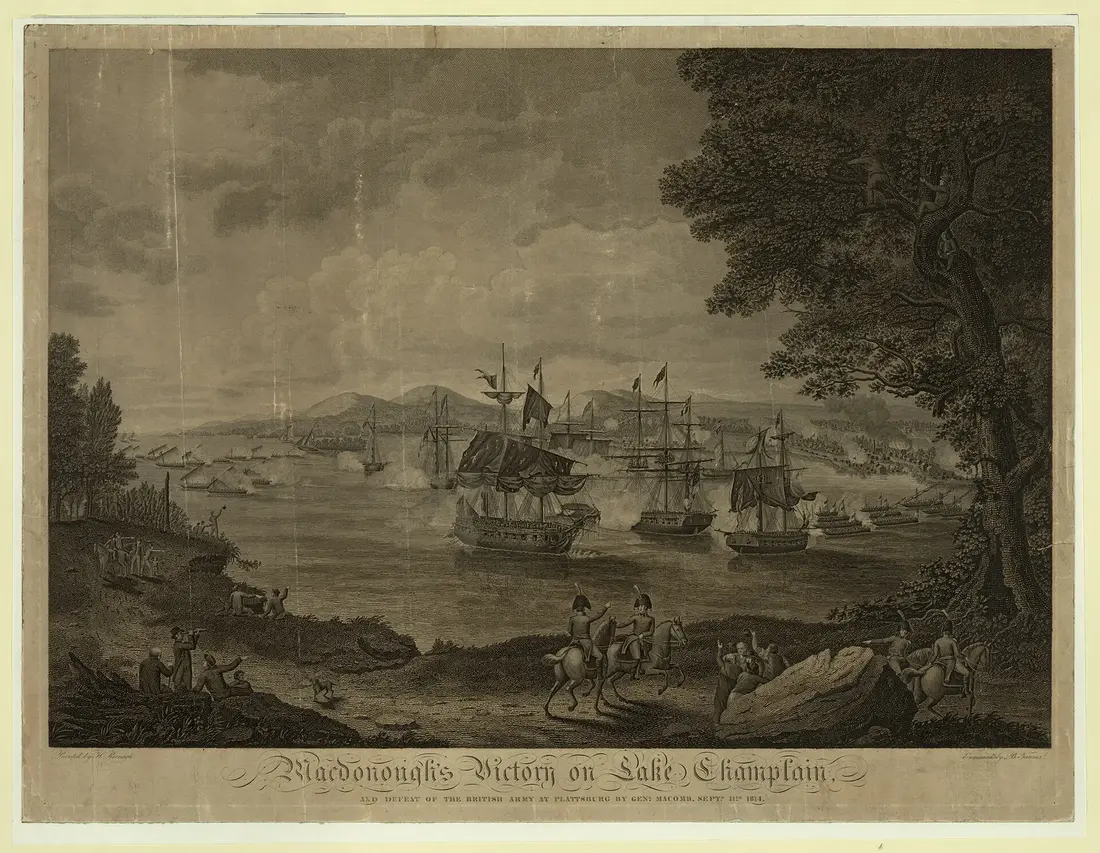
In the summer of 1776 the Americans built a fleet of small gunboats at Skenesborough, now Whitehall, at the south end of Lake Champlain, to meet a British invasion coming down the lake from Canada. Benedict Arnold commanded it. On September 23 he brought the fleet into the bay on the west side of Valcour Island and anchored it in a line below a high bluff, hidden from the main lake by the island.
The British fleet, under the overall direction of General Guy Carleton and commanded on the water by Captain Thomas Pringle, sailed into the lake on October 9 with about 50 unarmed support boats behind it. Two days later it sailed south down the open lake past the northern tip of the island. When the British found the Americans in the bay, they had to form their line against a strong headwind. Arnold sent the schooner Royal Savage and the galley Congress forward to draw fire; the Royal Savage ran aground, its crew abandoned it, and the British burned it.
The heavy fighting ran from about midday until dusk, at close range. The gondola Philadelphia was holed and sank at about 6:30 in the evening. On the gondola New York a cannon burst, killing Lieutenant Thomas Rogers and wounding Sergeant Jonas Holden, both of Westford, Massachusetts. The British Carleton took heavy damage and 16 casualties. At dusk the big British ship Inflexible came up and silenced most of the American guns, and the British landed Native allies on the island and the shore to cut off any escape by land.
That night was moonless and foggy. From about 7:30 Arnold's boats slipped south past the anchored British along the New York shore, each one steering by a shaded lantern on the stern of the boat ahead. They stopped at Schuyler Island, about a dozen miles south, where the crews worked around the clock plugging leaks and throwing gear overboard. On October 13 the British caught them near Split Rock. The galley Washington surrendered. Arnold ran the Congress and four gondolas into Ferris Bay on the Vermont shore, now called Arnold's Bay, and burned them, and about 200 men walked overland to Crown Point. Arnold ordered the fort at Crown Point destroyed and fell back to Fort Ticonderoga.
The British won the battle, and only four of Arnold's boats made it back to Ticonderoga. The fight still mattered. Carleton judged it too late in the year to push on, and the British attack down the lake waited until 1777. That campaign ended at Saratoga in the fall of 1777, the American victory that helped bring France into the war. Valcour is counted among the first naval battles of the Revolution and one of the first fought by the United States Navy.
Counts of the fleets differ from one history to the next: fifteen to seventeen American craft, among them eight gondolas and the row galleys Trumbull, Washington and Congress, against twenty-nine or thirty British vessels led by the 22-gun Inflexible, with anywhere from about 500 to 760 men under Arnold.
The gunboat Philadelphia
The Philadelphia was one of the eight gondolas, small gunboats built in the early summer of 1776 at what is now Whitehall, almost entirely of oak. The hull is 54 feet long, 15 feet wide and about 5 feet deep, with a 35-foot mast, and it carried a 12-pounder and two 9-pounders. A payroll later found in old papers at Fort Concho, Texas, lists all 44 of the crew, under Captain Benjamin Rue of Pennsylvania; more than half of them came from New Hampshire. During the battle a 24-pound ball hit it near the bow and it went down. Survivors scrambled onto the galley Washington.
In 1935 the salvage engineer Lorenzo Hagglund found the gunboat on the sandy bottom near the middle of Valcour Bay, about 60 feet down, and his team raised it and towed it to the beach. Inside were shot, cooking utensils, tools, buttons, buckles and human bones. Hagglund showed the boat around Lake Champlain and the Hudson for years; in the 1950s it sat in a shed on NY 22 between Willsboro and Essex. His will left it to the Smithsonian, and it went to Washington in time for the 1964 opening of the Museum of History and Technology, now the National Museum of American History. It is a National Historic Landmark and the only surviving gunboat built and manned by American forces in the Revolution.
Today the boat is the subject of a long preservation project. After 160 years under water and decades on display, its timbers are shrinking and its iron fittings breaking down, and conservators are studying how temperature, humidity and vibration affect it. Since August 2025 the museum has had two viewing windows where visitors can follow the work; check the museum's site for what is open before a trip to Washington.
Among the remains found in the wreck in 1935 were a few human teeth, and five of the 44 men on the crew list were never accounted for. In 2026 the Army arranged a military funeral for the teeth, set for October 13 at the Gerald B.H. Solomon Saratoga National Cemetery in Schuylerville, with a granite headstone for unknown soldiers of the Continental Army from the gunboat Philadelphia.
A full-size replica, the Philadelphia II, stands on the green at the Lake Champlain Maritime Museum on Basin Harbor Road near Vergennes, on the Vermont shore. You can walk around it and step aboard, and docents staff it on scheduled days. Admission to the museum is free, and its grounds open for the season in late May.
The Spitfire and the bay today
The Spitfire, one of the Philadelphia's sister gondolas, sank during the retreat and was the last vessel from the battle no one could account for until 1997, when the Lake Champlain Maritime Museum's lake survey found it upright and intact, its mast still standing and its bow gun in place. The wreck is on the National Register and protected by the federal Sunken Military Craft Act, with fines of up to $100,000 a day. It lies too deep for recreational divers, and the museum asks the public not to try to find it; its website has a 3D model instead.
The bay has given up more. From 1999 to 2007 the Valcour Bay Research Project, local divers working with the maritime museum's archaeologists, surveyed the bottom of the bay. Ed Scollon, a state trooper and diver, found the largest piece of the New York's burst cannon in 1999, and later dives brought up about 90 percent of the gun. On July 20, 2026, divers lifted the last missing fragment, 100 to 200 pounds of iron that had lain under about four feet of clay, and at the Peru launch lined it up against a 3D replica of the piece beside it. The museum in Vergennes keeps the lake's naval finds and shows more than 200 artifacts from the bay online.
The battle's 250th anniversary came in October 2026, and the historical association and its partners planned a weekend of events around it in Plattsburgh and Peru. The plans included the dedication of a Battle of Valcour Island interpretive center at the Peru launch, backed by DEC, the Town of Peru, two American Legion posts and a heritage grant; a small monument to the battle already stands there. The events calendar lists the region's yearly events.
The Bluff Point Lighthouse
The lighthouse stands on Bluff Point, on the west side of the island, 95 feet above the lake. Orren Shipman, who owned the north half of the island, agreed in 1872 to sell the federal government a strip of land for it, and the light was working by 1874, one of a series of beacons built along the lake. The building is dark-blue limestone in the Second Empire style, with a mansard roof of cedar shakes and a 36-foot tower. The keeper's family lived inside, with three bedrooms upstairs and a spiral stair to the lantern, which held a fixed white light in a fifth-order lens. The original light burned oil; the foundation of the oil shed is behind the house.
In 1929 the government put up a steel tower about 100 feet away, and in 1931 the lighthouse was shut down and sold for about $800. It served as a private camp until 1986, when the state bought it from its fourth and last private owner, Dr. Adolph Otto Raboff, who wrote into the sale a conservation easement for the Clinton County Historical Association. The association restored the house with paid and volunteer work, and by 1993 it was on the National and State Registers of Historic Places. In November 2004 the Coast Guard, DEC and the association moved the solar-powered light from the steel tower back into the lantern room, and Bluff Point became a working light again. DEC finished a major repair in 2015: the lantern floor, the chimney, the windows, a new roof and new shakes on the tower.
Tours
The association's volunteers open the lighthouse on summer Sunday afternoons, 1 to 3 p.m. In 2026 that meant every Sunday from early July through August 30. Inside are exhibits on the lake's lighthouses, its military history, the island's twentieth-century camps and a keeper's life, and you can climb to the lantern room to see the working light and the view. Check the association's events page for next summer's dates before you plan around them.
On the regular Sundays, getting to the island is up to you. For people without a boat, the association runs a couple of all-day guided trips a summer from the Peru launch. In 2026 they ran on July 5 and August 2 at $30 a person, with boats every 20 minutes from 9:20 a.m., lighthouse tours and a free copy of the Heritage Trail guide; an extra trip for the battle's anniversary in October filled up. The association's museum office in Plattsburgh, open Wednesday to Saturday, takes reservations at (518) 561-0340.
Trails on the island
DEC keeps about 13 miles of foot trails in the islands complex, almost all of them on Valcour, with yellow DEC markers on the main routes:
- Perimeter Trail, 9.2 miles, all the way around the island near the shore, past the lighthouse, the Seton House and most of the campsites.
- Royal Savage Trail, 1.4 miles, across the north half of the island from east to west.
- Nomad Trail, about 1.2 miles, across the south half of the island from east to west.
- Lighthouse Loop, 0.6 mile, a circle around Bluff Point and the lighthouse.
The walking is easy, mostly along the shore, with 21 bog bridges and boardwalks over the wet spots. In June 2025 a Northern Forest Canoe Trail crew working with DEC rebuilt 150 feet of boardwalk on the cross-island trail. DEC's 2017 plan lists every trail on the island as closed to mountain bikes, so leave the bikes at home. On the bluffs the Perimeter Trail runs close to the edge, so keep dogs on a short leash there.
How much to walk depends on your landing. The beaches at North Bay and Bullhead Bay and the picnic area at Butterfly Bay are the usual places to come ashore, and the trails to the lighthouse get the most use. From Bullhead Bay the trail follows the edge of the bay to the lighthouse, and the Lighthouse Loop adds the point. For a half day, cross the island on the Royal Savage Trail and come back on the Perimeter Trail. The full Perimeter Trail takes most of a day, with time to stop at the bays.
The Heritage Trail and the old camps
The island has been farmed, sold and resold many times. Between 1846 and 1928 its land passed through at least 25 owners. In 1874 a group led by Colonel John Wilcox of Chicago founded the Dawn Valcour Agricultural and Horticultural Association here, a commune built on spiritualism and free love, on land Orren Shipman offered them; it failed within a year, and Shipman lost the land in 1875. Camp Penn, a boys' summer camp, opened on the island in 1906 with its own dairy and farm, and by the 1920s cottages ringed the shore.
The state began buying the camps in the early 1960s for a park. Early plans called for public beaches, marinas, an 18-hole golf course and a giant movie screen for boaters to watch conservation films. Local people objected, and the plans shrank to nature trails, picnic and camping spots, a beach and moorings. DEC owned the whole island by 1980 and removed every camp except one.
The Valcour Island Heritage Trail, a guide written by Kevin Kelley with research by Roger Harwood for the historical association, leads you to what is left: a 7.5-mile loop that takes four to five hours, with GPS points for each stop. Among them:
- The remains of the Raboff Great Camp, south of the lighthouse near what the guide marks as campsite 25: what is left of a guest house and an ice house, and a dock by campsite 26 that goes under water when the lake is high. Campsite numbers may change with DEC's work on the sites.
- The Gill Farm, with a well and house and barn foundations, and the remains of an old truck that probably carried milk to Camp Penn. The well hole can hide in the grass.
- Indian Point, the view over the bay where the battle was fought and the Philadelphia was raised.
- The Seton Stone House at the south end, built in 1929 for Henry Seton on 129 acres, of stone quarried and timber cut on the island. It is the one camp left standing and is closed to the public.
- The Nomad Monument on the shore of Smugglers Cove, on the east side, for Lieutenant Colonel Gerald Birks of Montreal, whose yacht Nomad was crewed by students; four of his companions died in the First World War and five of his crewmen in the Second. It is the only known Canadian war memorial on United States soil.
- The chimney of Dr. George Hudson's camp, built around 1900, and the small cave on the east shore he used as a darkroom.
- The Harney farm on the north end, with an old hay baler and loader, and part of the foundation of the Dawn community's one-room house.
The guide's rules are short: pack out everything you bring, take only photos, give campers their privacy, and learn poison ivy (shiny leaves in threes, reddish branches). The guide is a free download from the historical association.
Camping on Valcour
Valcour's campsites are some of the most sought-after on the lake. They are DEC primitive tent sites, and there are no reservations: sites go first come, first served. Under DEC's 2017 plan for the island, camping is allowed only at the designated sites and only with a permit, and in summer a DEC caretaker who looks after the island and the Peru launch visits occupied sites and writes the permits; stays have historically run up to two weeks. Each site is built for up to three tents and eight people, and the same plan proposed limits of eight people for an overnight group and fifteen for a day group. Rules can change, so check DEC's page for the islands before a trip.
The number of sites is changing. The island had 29 in 2017, when DEC's management plan called for moving and closing sites that sat too close together or too near rare plants and the old heron rookery. In May 2026 DEC gave notice of work to close 14 existing sites and build 6 new ones, for 21 in all, so an older map may show sites that are gone. The 2017 plan also sets aside the site at Pebble Beach, on the island's south tip, for paddlers and other non-motorized visitors.
In the 2017 plan every site but two had a pit privy, and each had a concrete fireplace, which DEC planned to replace with stone fire rings as they wear out; in 2025 a trail crew rebuilt four of them with slate from the island. Keep fires in those fireplaces and rings, and burn only dead and down wood: cutting standing trees is not allowed on state land. New York bars untreated firewood from other states and from more than 50 miles from its source, so leave wood from home behind. The firewood guide covers the rules. The 2017 plan also calls for removing the picnic tables, so a camp chair is worth the space in the boat.
On a warm, sunny summer weekend the sites fill fast, and the bays around the island are at their busiest over the Fourth of July and Canada Day. On most weekdays you can find an open site, though the best ones are often taken. Spring and fall bring the most choice.
Paddling across from Peru Dock
The Peru Dock launch sits straight across from the island, about a mile of open water away depending on where you land, and on a calm day the crossing in a kayak or canoe takes about 20 minutes. The wind decides the day. The usual wind is from the south, and south and north winds have the whole length of the lake to build waves, which on this part of the lake can top four feet. A west wind loses strength crossing the land; an east wind has open water from Vermont to build on. Read the forecast, go in the morning while the wind is usually light, stay close to shore where you can, and turn back if whitecaps show up in the channel.
A few tips:
- Wear the life jacket. One strapped to the deck keeps the kayak afloat and does little for you, and a wind-blown empty kayak can drift faster than most people swim. New York requires everyone in a pleasure boat under 21 feet, canoes and kayaks included, to wear one from November 1 to May 1, and children under 12 always.
- Carry NOAA chart 14782, Cumberland Head to Four Brothers Island, for the shallows and rocks around the islands.
- Land at the beaches in Bullhead Bay, North Bay and Butterfly Bay, or near the campsites on the east shore. Around the south end much of the shore is limestone cliff with nowhere to land, and in big waves the water bouncing back off the rock makes it rough close in, so give the cliffs a berth of 75 yards or so.
- Turn the bow into big waves and boat wakes so they do not catch you broadside. In wind, a sea kayak or a canoe with a spray skirt handles the crossing best.
- Pack food, water and a warm layer for longer than you plan to stay. Weather on the lake changes fast, and waiting out the wind on the island is part of paddling here.
- Clean, drain and dry the boat before you launch; New York law requires it before launching into any public water.
The cabins have no boats. Canoe and kayak rentals lists the outfitters within reach and which ones set you up to car-top a boat. For a trip built around the water, see cabins for a paddling trip.
By motorboat or sailboat
Peru Dock is the busiest of the three DEC launches in the islands complex and the main New York access to Valcour. As DEC's 2017 plan describes it, it has a double-width concrete ramp with aluminum docks, two lots that hold about 50 cars with trailers, flush toilets, which few DEC launches have, and a pump-out for boats with heads. Silt builds up at the end of the ramp from time to time, and larger boats can touch bottom there when the lake is low.
Lake Champlain runs high in spring and drops through the summer, which changes the beaches and the landings; in 2011 it reached a record of about eight feet above its mean level. Around the island there is a sheltered anchorage for almost any wind: Spoon Bay, Smuggler Harbor, Sloop Cove and both sides of Bluff Point. On summer weekends the bays fill with sailboats, many of them Canadian. In DEC's 2017 plan the Seton House dock at the south end was the one usable dock on the island, with a new dock planned for Bullhead Bay. Anyone running a motorboat in New York needs a state-approved boating safety course; adults renting from a livery are the exception. For slips and fuel in the city, see the marina section of the Plattsburgh guide.
Birds and wildlife
Valcour once held the largest great blue heron rookery in New York, about 550 nests at its peak, on the south end of the island. Predators raided the nests from 2006 on, and by 2010 the colony was down to one nest, which failed. In September 2006 the state named the island a Bird Conservation Area, and DEC's 2017 plan keeps campsites away from the old rookery in case the herons return. Ospreys have nested on the island's old light tower, and two young flew from it in 2016. The cliffs at the south end are an old peregrine falcon eyrie, unused for decades, and bald eagles are seen around the island.
Deer, snowshoe hares and red foxes live on the island, and deer hunting is allowed in season, so wear something bright on the trails in late fall. The limestone shores and woods hold rare plants, which DEC's plan protects when it places campsites. The French called the island Isle de Valcours, the Island of Pines; its first forest, mostly white pine, was cut long ago, and today's woods are second growth. Garden Island, an acre of limestone half a mile south, has a rare plant, northern tansy-mustard, found nowhere else in eastern Clinton County. For more on wildlife near the cabins, see wildlife watching.
Seasons on the island
The island is busiest from late spring to early fall, when the beaches, bays and campsites are in use. July and August bring the lighthouse's Sunday openings, and swimmers use the beaches at Bullhead Bay and North Bay; the swimming guide covers the staffed beaches near Plattsburgh. The Heritage Trail guide calls spring and fall the best time to walk the island: most campsites are empty, and the brush and insects are down. Bring repellent in early summer and learn to spot poison ivy, which grows along the trails; the bug guide has what works.
The trails are open all year. Fall brings fewer boats and turning leaves in the hardwoods, along with the hunting season and colder water, when the November life jacket rule starts. In winter, most of the people who sign the register at the Peru launch are ice anglers. See fall at the cabins and summer at the cabins for the rest of each season.
Dogs on the island
The cabins welcome pets for a fee, and Valcour is state Forest Preserve, where DEC's general rules apply: keep your dog under control, leash it when other people come near, and bury its droppings away from water, trails and campsites. On a busy summer beach or near an occupied campsite, the leash stays on. Bring water for the dog, a life jacket for the crossing if it rides in a canoe, and do a tick check afterward. The dog guide and pet-friendly cabins cover the rest.
Pairing Valcour with Plattsburgh and Ausable Chasm
The launch sits between two good stops. Plattsburgh is about six road miles north; the Plattsburgh guide covers the city, its beaches and the 1814 battle, a different fight on the same lake. Ausable Chasm is about seven road miles south on US 9; see the Ausable Chasm day trip.
A summer day from the cabins might run like this. Leave by 7:30, stop for coffee and lunch supplies in Malone, and launch from Peru Dock by about 9:30. Paddle across to Bullhead Bay, walk to the lighthouse and around the loop, and eat lunch on the beach. Paddle back early in the afternoon, or sooner if the forecast shows the wind building, then drive seven miles south for a walk at Ausable Chasm, or north into Plattsburgh for dinner. You are back at the cabins in about an hour and a half for an evening in the hot tub; see the cabins.
Questions
How do you get to Valcour Island?
By boat only. Most people launch at Peru Dock, the state boat launch on US 9 about six road miles south of Plattsburgh, and cross about a mile of water to the island, about 20 minutes by kayak on a calm day. North and south winds build big waves on this part of the lake, so go in the morning and check the forecast. The cabins have no boats; see canoe and kayak rentals.
Do you need a permit to camp on Valcour Island?
Under DEC's 2017 plan for the island, yes: camping is allowed only at designated primitive tent sites, and only with a permit, which the summer caretaker writes once you are on a site. There are no reservations; sites are first come, first served, and each takes up to three tents and eight people. In May 2026 DEC gave notice of work to bring the island to 21 sites. Weekdays, spring and fall give the most choice; check DEC's page for the islands before you go.
When is the Bluff Point Lighthouse open?
The Clinton County Historical Association opens it on summer Sunday afternoons, 1 to 3 p.m.; in 2026 that was every Sunday from early July through August 30. On those days you need your own way across. The association also runs a couple of guided boat trips a summer from the Peru launch ($30 a person in 2026). Check its events page for next summer's dates or call (518) 561-0340.
Can you see the gunboat Philadelphia?
The original, raised from Valcour Bay in 1935, is at the National Museum of American History in Washington, where a preservation project with two viewing windows has been under way since August 2025. A full-size replica, the Philadelphia II, stands on the green at the Lake Champlain Maritime Museum near Vergennes, Vermont, where admission is free and the grounds open for the season in late May.
How far is Valcour Island from the cabins?
The Peru Dock launch is about 67 road miles from the cabins: Malone, US 11 through Chateaugay, NY 190 and NY 374 to Plattsburgh, then US 9 south. Allow about an hour and a half each way. See the Plattsburgh guide for the drive.
Can I bring my dog to Valcour Island?
Yes. The island is state Forest Preserve, where DEC asks you to keep a dog under control, leash it when others approach and bury droppings away from water, trails and campsites. Keep it leashed on busy beaches and near occupied campsites. The cabins take pets for a fee; see bringing your dog.
Sources
Facts on this page were checked against these sources in October 2026. Hours, fees and schedules change; confirm before you go.
- New York State Department of Environmental Conservation extapps.dec.ny.gov/docs/lands_forests_pdf/lcimcump.pdf
- New York State Department of Environmental Conservation dec.ny.gov/places/lake-champlain-islands-complex
- New York State Department of Environmental Conservation dec.ny.gov/news/environmental-notice-bulletin/2026-05-27/public-notice
- battlefields.org battlefields.org/learn/battles/valcour-island
- nps.gov nps.gov/places/the-philadelphia-u-s-gundelo.htm
- my.si.edu my.si.edu/exhibitions/the-gunboat-philadelphia-preservation-project
- sevendaysvt.com sevendaysvt.com/arts-culture/history-arts-culture/valcour-islands-unkn
- lcmm.org lcmm.org/archaeology/shipwrecks/revolutionary-war-gunboat-spitfire/
- lcmm.org lcmm.org/lake-champlain-and-the-american-revolution/
- vermontpublic.org vermontpublic.org/local-news/2026-07-28/divers-raise-lost-revolutionar
- clintoncountyhistorical.org clintoncountyhistorical.org/news/hc-valcour
- clintoncountyhistorical.org clintoncountyhistorical.org/america250
- clintoncountyhistorical.org clintoncountyhistorical.org/event/boat-trips-to-valcour-island-bluff-p
- clintoncountyhistorical.org clintoncountyhistorical.org/event/sunday-on-the-island
- clintoncountyhistorical.org clintoncountyhistorical.org/event/commemoration-ceremony-battle-of-val
- clintoncountyhistorical.org clintoncountyhistorical.org/exhibits/valcour-island-heritage-trail
- champlainvalleynhp.org champlainvalleynhp.org/wp-content/uploads/2020/09/Valcour-Guide-2020.p
- wcax.com wcax.com/2022/08/22/tours-boost-visits-bluff-point-lighthouse
- passageport.org passageport.org/journey/lake-champlain-blueway-trail-valcour-crab-isla
- passageport.org passageport.org/journey/lake-champlain-blueway-trail-valcour-crab-isla
- northernforestcanoetrail.org northernforestcanoetrail.org/nfct-continues-valcour-island-work/
- New York State Parks parks.ny.gov/activities/boating
- New York State Department of Environmental Conservation dec.ny.gov/nature/animals-fish-plants/invasive-species/help-prevent/fi
- New York State Department of Environmental Conservation dec.ny.gov/things-to-do/camping/state-land-rules
- clintoncountyhistorical.org clintoncountyhistorical.org/island-events
- clintoncountyhistorical.org clintoncountyhistorical.org/event/sunday-on-the-island-july-2026
- clintoncountyhistorical.org clintoncountyhistorical.org/event/sunday-on-the-island-6
- passageport.org passageport.org/journey/lake-champlain-blueway-trail-valcour-crab-isla
- Adirondack Explorer adirondackexplorer.org/recreation/destination-valcour-island/
- Adirondack Explorer adirondackexplorer.org/recreation/valcour-island-adventure/
- nps.gov nps.gov/maritime/ref/landmarks/battles.htm
In this guide
Stay nearby
The aviation cabin: flight-themed décor, a Jøtul gas stove, a large open deck with its own hot tub, and a smokeless fire pit on the lawn.
 The AviatorCabin 3 · 2 bd · 1 ba · sleeps 4
More in Lakes & Paddling
Sources
31 references, listed in full at the end of this guide: official park, state, tourism-office and business sources, checked October 2026.