
Fire Pits and Firewood
The fire pits at the three cabins, New York's campfire and spring burn ban rules, the 50-mile firewood rule, and how to build, cook on and put out a fire.
Each of the three cabins has its own fire pit out on the lawn: a big stone ring at The Modern Tiny Home and round steel pits at The Modern Pine and The Aviator, each with Adirondack chairs pulled up around it. A fire after dinner is one of the best parts of a stay here, on an August night or in the snow. Here is what New York allows, where to get wood that is legal to burn at the cabins, and how to build, cook on and put out a fire.
The fire pits at the three cabins
All three listings include a fire pit, and The Aviator's spells out that each cabin on its property has its own fire pit and hot tub, kept for that cabin's guests alone. The pits differ, and so do the fires they make.
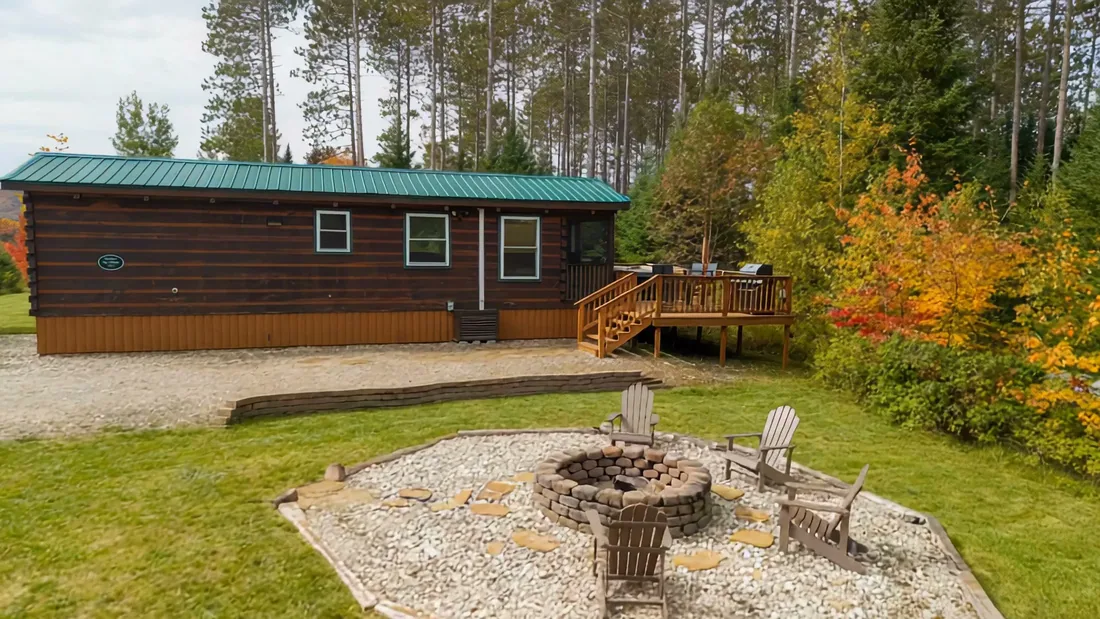
The Modern Tiny Home (Cabin 1). The big stone fire pit sits on the lawn in front of the cabin, just past the gravel parking area: a round ring of stacked stone in an eight-sided bed of gravel, with flat stepping stones set into the gravel and Adirondack chairs around it. The listing calls it "a beautiful fire pit with Adirondack seating." An open ring lets a wood fire burn down to a bed of coals, and coals are what you cook on. One guest put it this way:
The fire pit was a nice benefit too, we roasted marshmallows and the pit is a great size that we all had plenty of space for roasting.
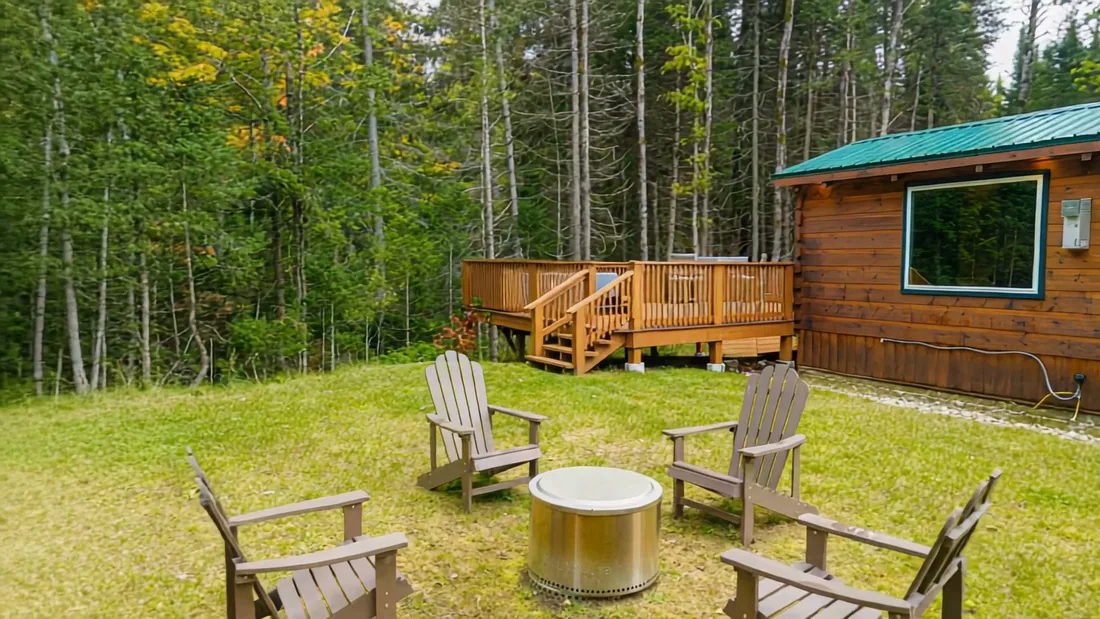
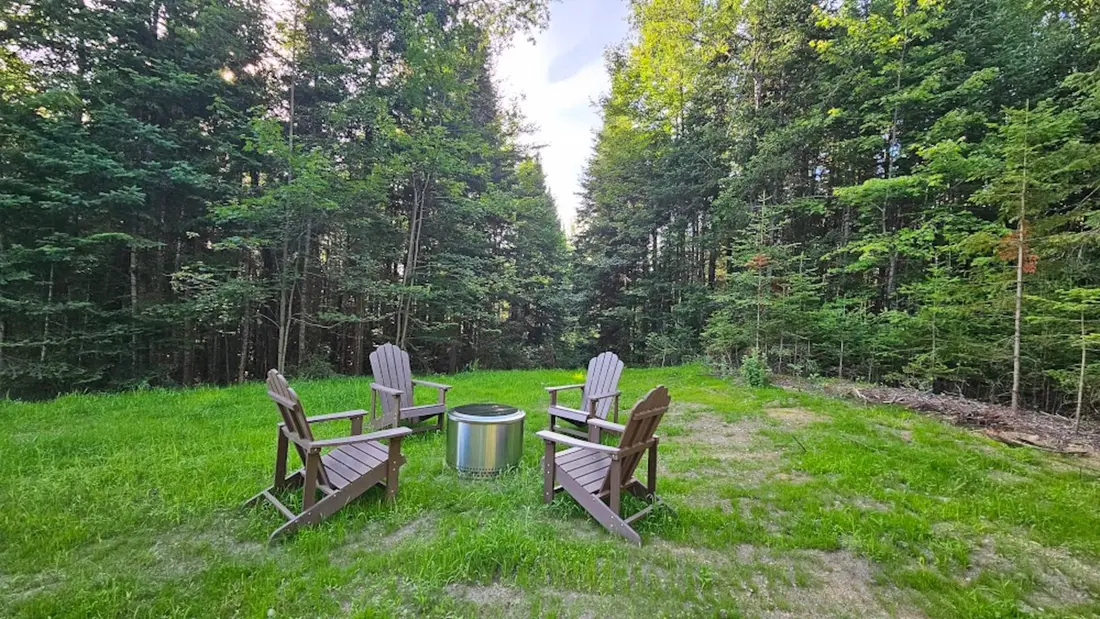
The Modern Pine (Cabin 2). The Pine's pit stands on the grass at the edge of the woods, with four Adirondack chairs around it and big boulders along the tree line. It is a round steel pit like the one at The Aviator. The listing describes "a beautiful fire pit with authentic Adirondack seating."
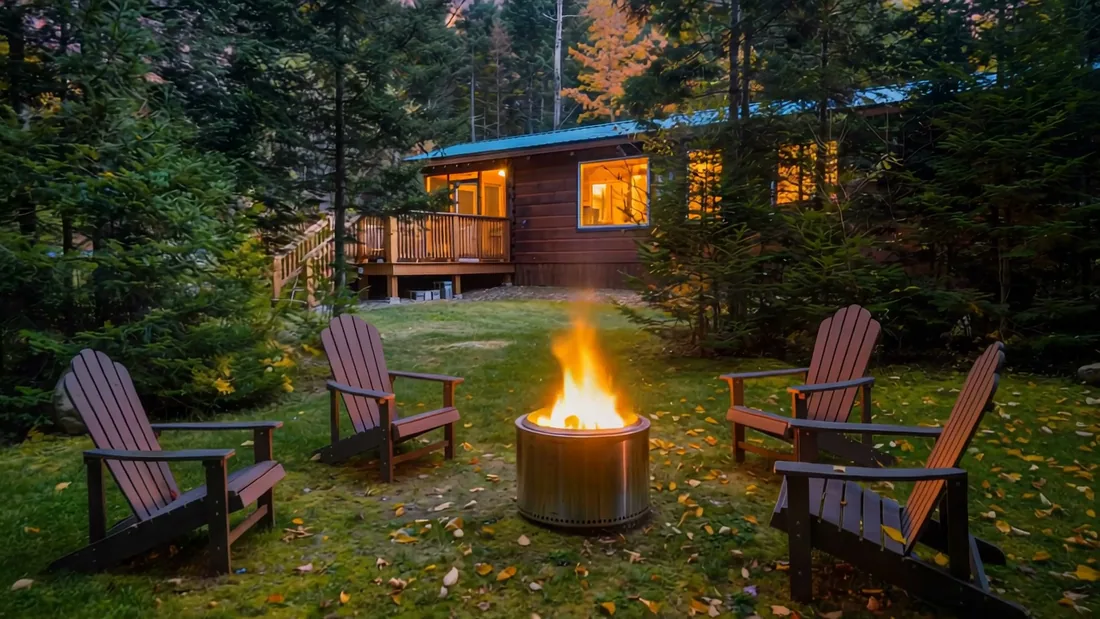
The Aviator (Cabin 3). The Aviator's listing describes a smokeless fire pit on the lawn with Adirondack chairs, and suggests fireside stories and s'mores there. The pit stands on the open lawn in front of the deck, with four chairs around it. A guest there in September 2025 wrote:
Outside fire was nice place to unwind.
The Aviator and The Modern Pine share one property, and the Tiny Home shares its property with a cabin that is not one of ours; how the two cabins share a property shows the layout at the Pine and The Aviator. Every cabin also has a grill, and each lists a fire extinguisher and barbecue utensils. The chairs around the pits have a history of their own, told in the Adirondack chair post, and the cabin comparison sets the three cabins side by side.
House rules that matter at the fire
None of the three listings has a rule about fires as such. A few of the house rules come into play once the chairs are pulled up.
- Quiet hours. 10 p.m. to 8 a.m. at The Modern Tiny Home and The Aviator. The fire can keep going; keep voices low after ten, since each property has a second cabin.
- Group size. Four guests at most, and no parties or events, at all three cabins.
- Food and garbage. The Aviator's listing asks that no food or garbage be left outside, and the Tiny Home's asks guests to keep all garbage and food in the proper containers, because wildlife lives in the woods around the cabins. Carry the s'mores box, the leftovers and the trash in when you go inside. Wildlife watching covers the animals you may see.
- The last night. Checkout is before 11 a.m. Let the last fire burn down early, and make sure the pit is cold before you pack the car.
- Pets and children. Each has its own section below.
New York's rules for backyard fires
New York's open-burning regulation bans open fires in general, then lists the ones that are allowed. Campfires and small cooking fires are on that list, as long as they burn only charcoal or untreated wood and someone stays with them until they are out. The state Department of Environmental Conservation, DEC, sets the size: a backyard fire pit or a campfire stays under 3 feet high and 4 feet in length, width or diameter. Burn only charcoal or dry, clean wood that is untreated and unpainted, and put the fire out completely. Garbage and leaves may never be burned anywhere in the state, in any season.
The state fire code, in its 2025 edition, adds distances. It defines a recreational fire as one with a fuel pile no more than 3 feet across and 2 feet high, and it keeps such a fire at least 25 feet from any structure or anything that burns. A portable outdoor fireplace, which the code describes as a solid-fuel fireplace made of steel, concrete, clay or another material that does not burn, follows the maker's instructions and stays 15 feet away, a rule the code waives at one- and two-family houses. The code also requires every fire to be attended constantly until it is out, with a fire extinguisher or other means close at hand, such as a water barrel, a garden hose, sand or dirt.
All of this adds up to a modest fire in the pit and nowhere else. The cabins' pits stand out on the lawns; leave the steel pits where they are, and never carry one onto a deck or under a roof. Local rules can be stricter than the state's, and any instructions the host leaves at the cabin come first.
The spring burn ban
Every spring from March 16 through May 14, New York bans residential brush burning, and DEC has enforced the ban each year since 2009. The reason is the season. Once the snow goes, last fall's leaves and debris dry out quickly, wind pushes a fire along before anything has turned green, and burning debris is the single largest cause of spring wildfires in the state. The dates are fixed in the regulation, and the 2026 ban ran on them.
The ban is about brush, and it leaves the fire pits alone. Backyard fire pits and campfires within the size limits stay legal through it, and so do small cooking fires, with the same fuel and the same rule that someone stays with the fire until it is out. Outside the ban, towns with fewer than 20,000 people may burn brush for most of the year. The Town of Bellmont, where the cabins are, is one of the state's fire towns (the law spells it Belmont), where burning brush, logs, leaves, stumps, dry grass or other debris needs a written permit from DEC at any time of year. Guests have nothing to burn except firewood, so the working rule at the cabins is the same in every season: wood in the pit and nothing else.
Fire danger ratings and dry spells
During the fire season, DEC posts a fire danger map that splits New York into fire danger rating areas and rates each one from low to extreme. Since late 2024 the ratings have been worked out every day from the University at Albany's statewide network of weather stations, the New York State Mesonet. At high, "all fine, dead fuels ignite readily and fires start easily from most causes." Look at the map before you light a fire on a dry, breezy day.
The National Weather Service issues a Red Flag Warning when critical fire weather is happening or about to start, and its advice is to be extremely careful with open flames. On a Red Flag evening, skip the fire and spend the evening under the stars instead; stargazing from the hot tub covers what to look for.
In a long dry spell the state can go further. During a drought in November 2024, a statewide order banned brush fires, uncontained campfires and open cooking fires through November 30. From October 2 to 15, 2025, after Forest Rangers had responded to 64 wildland fires around the state since the start of August, a second order did the same. Both orders still allowed backyard fire pits and contained campfires within the usual size limits, along with small, contained cooking fires. New York averaged 117 wildfires a year from 2007 to 2023, burning about 1,400 acres a year. In September 2025, DEC counted 53 fires that Rangers had answered since August 1, and about half of them began as campfires that escaped or were not put out properly. If an order is in force during your stay, read its exact wording and check with the host before you light anything.
The firewood rule
Firewood is the one thing to leave at home. Untreated firewood may not come into New York from any other state or country. Untreated wood from New York trees has to stay within 50 miles of its source, the village, town or city where it was grown or that the seller names, and the 50 miles are a straight line on a road map. Treated firewood has been heated until its core reaches 71°C, about 160°F, and held there for 75 minutes. Sold at retail, it carries a label marking it as New York-approved, pest-free treated firewood, and it may go anywhere in the state. Kiln-dried wood counts only if the kiln met that standard, so look for the label and not the word kiln. Bundles with the NYS Grown & Certified mark have had the same heat treatment, with wood cut on managed forest land.
Bought wood needs paperwork while it travels: a receipt, an invoice or a label with the name and address of the seller or producer and where the wood came from. Wood you cut yourself needs DEC's one-page self-issued certificate of origin, which names the town where the trees grew and the town the wood is going to. Keep the paper with the wood in the car.
The rule is there for the trees. Untreated wood can carry wood-boring insects, leaf-eating pests, fungi and tree diseases as eggs, larvae or spores hidden in the wood, and moving firewood is one of the main ways they reach a new forest. The woods around the cabins are a big part of why guests come.
For most guests the math is short. The cabins are 188 road miles from Albany, 329 from Boston and 337 from New York City, so a woodpile from home is far past 50 miles, and untreated wood from Vermont, Quebec or Ontario is barred outright, even from Montreal, 78 road miles away. The border guide covers what else to leave behind at the crossing.
Where to get firewood
The listings do not say whether wood comes with a stay, so message the host a few days before you arrive and ask what to burn in your cabin's pit and where they get it. Whatever the answer, buy close to the cabins. Any seller will do as long as the receipt or label names a source within 50 miles of the cabins, or the bundle carries the state's heat-treated label.
- Malone. The village is about 10 road miles north, with the supermarkets and hardware stores; groceries and supplies lists them with their hours. Call ahead before you count on a bundle of firewood from any of them for the first night.
- Meacham Lake Campground. The state campground at 119 State Camp Road in Duane, about 20 road miles from the cabins, lists firewood sales among its services during its camping season, which runs from about mid-May to mid-October. Call (518) 483-5116 before you drive over. It pairs well with a day on the water; see paddling Meacham Lake.
- Long stays. Stays of 28 nights or more are allowed at The Modern Pine and The Aviator. For a month of fires, a face cord is a stack 4 feet high and 8 feet long of wood cut 16 or 18 inches long, about a third of a full cord, which measures 4 by 4 by 8 feet. Ask the host before a load is delivered or stacked anywhere on the property.
Pack fire starters and a long lighter or matches too, since none of them is on the listings; Runnings, on West Main Street in Malone, carries fire-starting supplies.
Dry wood and what not to burn
Dry wood lights faster, burns hotter and makes much less smoke, which matters with a second cabin on each property. Burn wood below 20 percent moisture; wetter wood smokes, builds creosote and gives less heat. Green wood needs at least six months to dry, and oak can take two years or more. Two quick checks work at the woodpile. Dry pieces usually have cracks in the cut ends, up to about a quarter inch wide, and two dry pieces knocked together make a crisp, solid sound, where wet wood sounds dull.
The Aviator's listing calls its pit smokeless, and the Pine's is the same kind of steel pit. One maker of pits like these advises very dry hardwood kept below the top row of holes, and warns that overfilling chokes the airflow and makes smoke.
Keep out of every pit: garbage, leaves, painted or pressure-treated lumber, and anything else that is not wood or charcoal. Aerosol cans and other pressurized containers, batteries, glass and aluminum stay out too. Bottles and cans go back inside with the rest of the trash.
Building the fire
Get set before the first match. Fill a bucket or the biggest pot in the kitchen with water and stand it by the pit, with a stick or a shovel for stirring. Check the wind; a breezy evening carries sparks into dry grass, and the safe call on a windy day is no fire. Move dry leaves and twigs back from the pit, keep the spare wood a few steps away from the flames, and look up for open sky, with room overhead of at least three times the height of the flames. Set the chairs at least 3 feet back from the fire.
Then build it in layers. Tinder goes in the middle: small dry twigs, dry grass or a fire starter. Kindling, sticks smaller than about an inch around, goes over it, either leaned together in a teepee or stacked in a small square, log-cabin style. Light the tinder with a match or a lighter, never with gasoline, lighter fluid or any other flammable liquid, which can flare up explosively. Blow gently at the base, and add bigger pieces as the kindling catches.
In the Tiny Home's stone ring, a log-cabin stack of split wood burns down into an even bed of coals, the base for cooking. In a steel pit, keep the wood below the top row of holes and add a piece or two as the fire burns down, rather than piling it high. Either way, keep it small. The state's limits are the most you may build, and a few split logs give plenty of heat to four people in Adirondack chairs.
From the first match to the last ember, someone stays with the fire; both the state's burning rules and the fire code require it.
Cooking on the fire
Small cooking fires are allowed all year, through the spring burn ban too, and every cabin also has a grill for anything that needs steady heat. Cook over glowing coals rather than tall flames, and use a food thermometer. Chicken and other poultry are done at 165°F, ground meat and sausage at 160°F, and steaks, pork chops and roasts at 145°F with a 3-minute rest. Fish is done at 145°F, or when the flesh is no longer see-through and separates easily with a fork.
S'mores
The first recorded recipe, for "Some Mores," appeared in the 1927 Girl Scout guidebook "Tramping and Trailing with the Girl Scouts," the same book that gave instructions for twelve kinds of campfire. The shorter name, s'more, was in print by 1938. Toast a marshmallow over the coals until it turns golden, press it onto a square of chocolate on half a graham cracker, and close it with the other half. All three listings include barbecue utensils, which Airbnb describes in general terms as things like a grill, charcoal and skewers; if you want long roasting forks for marshmallows, pack your own or ask the host what is in the drawer.
Foil packets
A foil packet is a dinner with no pan to wash. Lay sliced potatoes, onions and peppers with a sausage or a chicken thigh, a pat of butter and salt in the middle of a sheet of heavy-duty foil, then fold the edges together and seal them, leaving a little room inside for steam. Cut everything about the same size so it cooks evenly. On the grill, or on a grate over hot coals, turn the packets now and then with long tongs; a packet set right on the embers needs a second or third wrap of foil. Open it gently and away from your face, since the steam is hot, and check the meat with the thermometer before you call it done. The Tiny Home's stone ring has the coals for packets; at a cabin with a steel pit, the grill is the easier place for them.
Cast iron
A cast-iron skillet or a camp Dutch oven turns the stone ring into an outdoor kitchen. The listings name pots and pans and not cast iron, so bring your own. Start a wood fire 30 to 45 minutes before you plan to cook so it burns down to coals, or light charcoal briquettes 15 to 20 minutes ahead; charcoal is an allowed fuel. For a Dutch oven, set coals in a ring under the pot, at least half an inch in from its edge, and spread more on the lid in a checkerboard. Every 10 to 15 minutes, lift the pot a quarter turn one way and the lid a quarter turn the other, so nothing scorches, and lift the lid slowly to keep ash out of the food. Afterward, wash the iron in hot water with a little mild soap if it needs it, dry it completely, and wipe on a thin coat of oil while it is still warm.
Putting the fire out
Stop adding wood well before bed, so the fire is down to coals when you want to go in. In the stone ring, put it out with water: pour on plenty until the hissing stops, stir the coals and ashes so the water reaches all of them, scrape the half-burned sticks and logs, and add more water. Hold the back of your hand just above the wet ashes; if you feel any warmth, stir and soak again. Smokey Bear's rule is the one to remember: if it's too hot to touch, it's too hot to leave.
Dirt or sand alone will not put a fire out, and buried coals can smolder underground and catch again. In a dry spell, embers can burn down into the ground and smolder for days or even weeks before anyone sees smoke. Water finishes the job.
The steel pits are built to burn their wood down to ash, so stop feeding the fire early and stay with it until the flames and embers are gone. The steel holds its heat long after that, so never touch, tip or move a pit until it is cool. If you want a steel pit out sooner, ask the host how they would like it done, and in an emergency use the water and the extinguisher. On the last morning, check that every pit is cold before you head home.
A fire night through the year
Summer. July evenings in Malone cool to a normal low of about 58°F, which makes for long nights in the chairs. Black flies are out from mid-May into early July, and the bug guide has what works.
Fall. Lows average about 47°F in September and 36°F in October, and the leaves come down around the pits. Sweep them back from the fire before you light it. The last two falls each brought a statewide order during a dry spell, so check the fire danger map in October and November.
Winter. January in Malone averages a high of 23°F and a low of 4°F, with about 95 inches of snow over the year. A fire is a fine way to end a day at Titus Mountain, three and a half road miles away. Clear the snow out of the pit and off the chairs first, and wear the boots and layers you skied in. The après-ski post sets a winter evening at the Pine.
Spring. The burn ban runs from March 16 to May 14 and leaves the fire pits alone. April's normal low is near 32°F and last year's grass is still brown, so keep spring fires small, sweep the dry leaves and grass back from the pit, and save the fire for a calm evening.
Dogs at the fire
The cabins take pets for a fee, and the pet rules fit a fire night: a 25-pound limit, house-trained pets only, and never left alone in the cabin, so the dog comes out to the fire with you. The Aviator takes one pet, and the Pine and the Tiny Home do not take cats. The yards at the Pine and the Tiny Home are listed as not fully fenced, so keep the leash on near the fire and keep the dog well back from the pit.
Watch the food more than the flames. S'mores chocolate is the classic risk: it contains methylxanthines, which can cause vomiting, diarrhea, seizures and even death in dogs, and baking chocolate and cocoa powder hold the most. Onions, garlic and chives, staples of a foil packet, can damage a dog's red blood cells. Some candy and baked goods are sweetened with xylitol, which is also on the list of foods to keep from pets, and bones from the grill can injure a dog's gut. The ASPCA's Animal Poison Control number is (888) 426-4435.
Pick up after the dog outside; the Pine and Tiny Home rules ask for it. Pet-friendly cabins sets out each cabin's pet rules, and bringing your dog lists vets and dog-friendly trails.
Older children at the fire
The Modern Pine and The Modern Tiny Home are not suitable for children under 10, and all three listings carry Airbnb's flag that they are not suitable for children and infants, so a fire night here is for families with children 10 and up and teenagers. At that age a fire is a job worth handing over. One child keeps the water bucket full, another lays the tinder and kindling, and a teenager learns to build the whole fire and put it out, starting with the teepee and the log cabin.
Set the ground rules before the first match: chairs and feet at least 3 feet from the fire, walking around the pit and never running, long forks for the marshmallows, and an adult there the whole time. Teach the drill for clothing on fire before anyone needs it: stop where you are, drop to the ground, cover your face with your hands, and roll until the flames are out.
For a small burn, cool it with clean, cool water (not ice-cold) for several minutes, take off any rings or watch near it, and cover it loosely with a clean cloth. Larger or deeper burns need a doctor. The hospital in Malone, about 10 road miles away, has a 24-hour emergency department, and health and safety has the numbers and directions. Family stays covers the rest of a trip with older children.
Fires away from the cabins
A campfire on state land, at a campsite in the St. Regis Canoe Area or in one of the wild forests to the south, follows DEC's camping rules on top of the statewide ones. Use the existing fire ring wherever there is one, and never light a fire where a "No Fires" disk is posted. Burn only dead wood that is already on the ground, and leave standing trees alone. No fires are allowed above 4,000 feet in the Adirondacks except in an emergency, and fires are banned outright in the Eastern Zone of the High Peaks Wilderness. Clear leaves, needles and other burnable litter from a circle about 10 feet across, and put the fire out with water and a good stir until the ashes are cool.
The firewood rule follows you there. DEC's page for Meacham Lake Campground links a map of the 50-mile circle its firewood may come from, and buying wood at the campground settles the question. The St. Regis Canoe Area covers camping on its ponds.
If a fire gets away
If flames spread into the grass, the trees or anything beyond the pit, get everyone back and call 911 at once. For a wildfire you spot on state land, DEC's Forest Rangers also take calls at 1-833-NYS-RANGERS (1-833-697-7264). Each cabin lists a fire extinguisher, so find yours when you arrive, before the first fire, and keep the water you set out within reach. Afterward, tell the host what happened.
Questions
Is firewood provided at the cabins?
The listings do not say, so ask the host a few days before you arrive what to burn in your cabin's pit and where to get it. If you buy wood, buy it near the cabins and keep the receipt or label, which should name a source within 50 miles unless the bundle carries the state's heat-treated label. Groceries and supplies has Malone's stores.
Can I bring firewood from home?
Only if home is close and the wood qualifies. New York bars untreated firewood from every other state and country, and untreated New York wood has to stay within 50 miles of its source. Wood heat-treated to a core temperature of 160°F for 75 minutes and labeled as New York-approved treated firewood can go anywhere in the state. From Albany, Montreal or farther, leave the woodpile at home.
Can we have a fire during the spring burn ban?
Yes. The ban, March 16 through May 14 every year, stops residential brush burning. Backyard fire pits and campfires smaller than 3 feet high and 4 feet across stay legal, and so do small cooking fires, as long as you burn only charcoal or dry, clean, untreated wood, stay with the fire and put it out completely. Check DEC's fire danger map on dry, windy days.
How big can the fire be?
DEC allows a campfire or backyard fire pit under 3 feet high and 4 feet in length, width or diameter, and the state fire code defines a recreational fire as a fuel pile no more than 3 feet across and 2 feet high. Build well inside both. A few split logs in the pit give plenty of heat, with less smoke drifting toward the other cabin.
Can we cook over the fire pits?
Yes. Small cooking fires are allowed, and the Tiny Home's stone ring burns down to a good bed of coals for foil packets and cast iron. Every cabin also has a grill. Use a food thermometer: 165°F for poultry, 160°F for ground meat and sausage, and 145°F for steaks, chops and fish.
How do we put the fire out?
In the Tiny Home's stone ring, drown it: pour on water until the hissing stops, stir, scrape the sticks and logs, add more water and feel for heat with the back of your hand. The steel pits at the Pine and The Aviator are built to burn down to ash, so stay with the fire until it is out and let the pit cool before anyone touches it.
Can our dog come out to the fire?
Yes, and under the house rules it usually will, since pets may not be left alone in the cabin. Keep the dog leashed and back from the pit, because the Pine and Tiny Home yards are not fully fenced, and keep chocolate, onions, garlic and grill bones out of reach. Bringing your dog has vets and trails nearby.
What happens to fires in a dry spell?
In a drought the state can ban outdoor fires. Orders in November 2024 and October 2025 banned brush fires, uncontained campfires and open cooking fires statewide, while backyard fire pits, contained campfires within the size limits and small contained cooking fires stayed legal. If an order is in force when you stay, read its wording, check DEC's fire danger map and ask the host.
Sources
Facts on this page were checked against these sources in October 2026. Hours, fees and schedules change; confirm before you go.
- New York State Department of Environmental Conservation dec.ny.gov/news/press-releases/2026/3/dec-reminds-new-yorkers-statewid
- content.govdelivery.com content.govdelivery.com/accounts/NYSDEC/bulletins/34db0dd
- law.cornell.edu law.cornell.edu/regulations/new-york/6-NYCRR-215.3
- nysenate.gov nysenate.gov/legislation/laws/ENV/9-1107
- nysenate.gov nysenate.gov/legislation/laws/ENV/9-1105
- codes.iccsafe.org codes.iccsafe.org/content/NYSFC2025P1/chapter-3-general-requirements
- codes.iccsafe.org codes.iccsafe.org/content/NYSFC2025P1/chapter-2-definitions
- dos.ny.gov dos.ny.gov/notice-adoption
- governor.ny.gov governor.ny.gov/news/governor-hochul-announces-launch-new-state-art-sy
- New York State Department of Environmental Conservation dec.ny.gov/environmental-protection/wildfires/fire-danger-map
- National Weather Service weather.gov/safety/wildfire-ww
- governor.ny.gov governor.ny.gov/news/governor-hochul-provides-update-wildfires-impacti
- governor.ny.gov governor.ny.gov/news/due-increased-fire-risk-governor-hochul-implement
- New York State Department of Environmental Conservation dec.ny.gov/news/press-releases/2025/9/dec-reminds-new-yorkers-to-use-c
- wrfalp.com wrfalp.com/new-yorkers-urged-to-use-extra-caution-before-outdoor-burni
- wbng.com wbng.com/2023/05/25/you-ask-we-answer-open-burning-regulations
- law.cornell.edu law.cornell.edu/regulations/new-york/6-NYCRR-192.5
- New York State Department of Environmental Conservation extapps.dec.ny.gov/docs/lands_forests_pdf/selfisscert.pdf
- New York State Department of Environmental Conservation dec.ny.gov/nature/animals-fish-plants/invasive-species/help-prevent/fi
- New York State Department of Environmental Conservation dec.ny.gov/news/press-releases/2021/5/dec-and-state-parks-encourage-ca
- dontmovefirewood.org dontmovefirewood.org/map/new-york
- certified.ny.gov certified.ny.gov/firewood
- visitadirondacks.com visitadirondacks.com/camping/meacham-lake-state-campground
- Saranac Lake tourism saranaclake.com/campgrounds/meacham-lake-campground
- New York State Department of Environmental Conservation dec.ny.gov/places/meacham-lake-campground-and-day-use-area
- Franklin County tourism (Always Franklin) alwaysfranklin.com/listing/runnings
- franklin.cce.cornell.edu franklin.cce.cornell.edu/energy-and-environment/storing-and-drying-fir
- warren.cce.cornell.edu warren.cce.cornell.edu/natural-resources/heating-with-wood/buying-fire
- solostove.com solostove.com/us/en-us/community/p/5-tips-for-a-smokeless-fire
- solostove.com solostove.com/us/en-us/community/p/care-and-maintenance-for-your-solo-
- smokeybear.com smokeybear.com/en/prevention-how-tos/campfire-safety/how-to-build-your
- smokeybear.com smokeybear.com/campfire-safety
- smokeybear.com smokeybear.com/en/prevention-how-tos/campfire-safety/how-to-maintain-a
- nps.gov nps.gov/bith/planyourvisit/campfire-safety.htm
- New York State Department of Environmental Conservation dec.ny.gov/news/press-releases/2022/7/dec-issues-fire-danger-reminder
- ameriburn.org ameriburn.org/prevention/burn-prevention-fact-sheets/campfire-safety
- usfa.fema.gov usfa.fema.gov/gallery/pictographs/stop-drop-roll.html
- girlscoutsdiamonds.org girlscoutsdiamonds.org/content/dam/girlscoutsdiamonds-redesign/documen
- foodsafety.gov foodsafety.gov/food-safety-charts/safe-minimum-internal-temperatures
- lodgecastiron.com lodgecastiron.com/pages/cleaning-and-care-camp-dutch-oven
- reynoldsbrands.com reynoldsbrands.com/tips-and-how-tos/make-ahead-foil-pack-meals-camping
- aspca.org aspca.org/pet-care/animal-poison-control/people-foods-avoid-feeding-yo
- New York State Department of Environmental Conservation dec.ny.gov/things-to-do/camping/state-land-rules
- New York State Department of Environmental Conservation dec.ny.gov/places/high-peaks-wilderness-complex
- New York State Department of Environmental Conservation dec.ny.gov/environmental-protection/public-safety/forest-rangers/searc
- The cabin's Airbnb listing airbnb.com/rooms/53628054
- The cabin's Airbnb listing airbnb.com/rooms/41023086
- The cabin's Airbnb listing airbnb.com/rooms/1168252128174283244
In this guide
Stay nearby
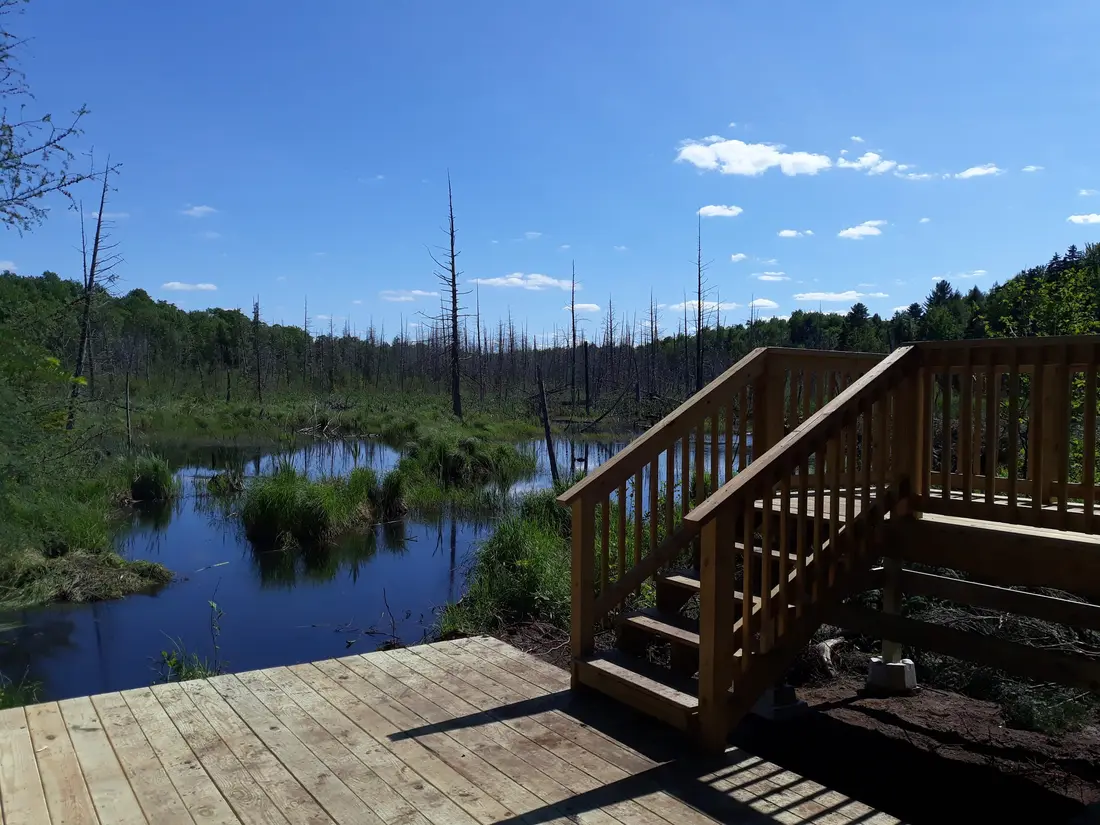
The first of the cabins: a big stone fire pit you see as you walk up, a screened corner of the deck, direct trail access, and a short walk to an observation deck over the pond.
 The Modern Tiny HomeCabin 1 · 2 bd · 1 ba · sleeps 4
More in Plan Your Trip
Sources
48 references, listed in full at the end of this guide: official park, state, tourism-office and business sources, checked October 2026.
Related guides
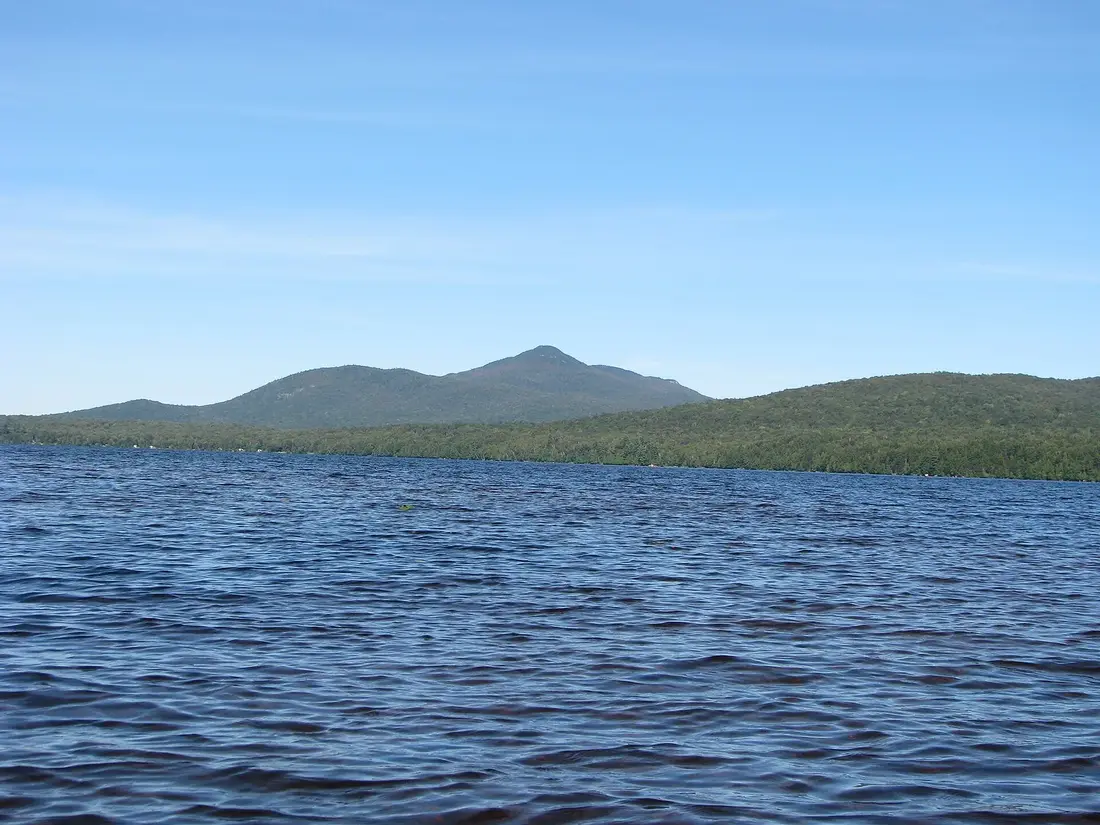


Photos on this page: Meacham Lake Franklin County New York by Mwanner, CC BY-SA 3.0. Resized and cropped for this site. All photo credits