
Birding in the Northern Adirondacks
Spruce grouse, black-backed woodpeckers, Canada jays and Bicknell's thrush: where to find the northern birds near the cabins, when to go, and the rules.
The cabins sit at the northern edge of the Adirondack Park, within about an hour's drive of the bogs and spruce flats where New York keeps its northern birds: spruce grouse, black-backed woodpeckers, Canada jays and boreal chickadees, with Bicknell's thrush singing near the top of Whiteface. This guide covers each of those birds and how to tell it apart, the places worth the drive from Madawaska Flow to Lake Champlain with road miles from the cabins, the best months, the 2027 festivals, and the rules that protect the rarest of them.
The northern specialties
Birders call these the boreal birds, after the northern spruce forest that holds most of them. In New York they hold on in two kinds of places: the cold lowland bogs and conifer swamps of the northern Adirondacks, and the stunted fir forest on the highest summits. The lowland birds share one habitat, black spruce and tamarack with some balsam fir around open peatland, so a walk into the right bog can turn up several of them in one morning. DEC treats the spruce grouse as a marker for the whole group: where it lives, so do the black-backed and American three-toed woodpeckers, Cape May and bay-breasted warblers, Lincoln's sparrow, Canada jay, boreal chickadee and palm warbler.
Spruce grouse
The spruce grouse lives year-round in patches of lowland conifers, black spruce and tamarack with a little balsam fir and white pine, along the edges of bogs and streams. In the state it is found only in the northwestern and north-central Adirondacks, in Franklin and St. Lawrence counties, and the nearest other populations, in Quebec and Ontario, are each about 175 miles (280 kilometers) away. It needs live branches close to the ground for cover and low berries such as blueberries underneath. In winter it lives in the trees and eats mostly conifer needles; in summer it feeds and nests on the ground.
The male is gray, about 16 inches long, with a black throat and breast edged in white and a small red comb over each eye. The female is mottled, reddish or gray. Spruce grouse are famously tame and may sit without moving while people pass a few feet away, so scan the trail edges as you walk instead of waiting for one to flush. New York lists the spruce grouse as endangered; the wildlife guide tells the story of its decline and the birds the state has brought in from Canada and Maine.
Black-backed woodpecker
About robin-sized, nine to ten inches, with a solid black back, barred sides and, on the male, a yellow cap. It lives on the larvae of wood-boring beetles and works dead conifers by flaking off the bark, sometimes stripping a whole snag. A dead spruce with its bark knocked off in patches is the sign to look for, and the bird gathers where fire or flooding has killed stands of trees, so beaver flows full of standing dead spruce are good places to listen. The call is a sharp, fast kyik and a scolding rattle. Its rarer cousin, the American three-toed woodpecker, shows more white on the face. Survey crews in the park have never recorded enough three-toed woodpeckers to measure a trend, so count one as a lucky day.
Canada jay
A fluffy gray jay, paler below, eleven to thirteen inches long; older local columns call it the gray jay. It spends summer and fall hiding food, using sticky saliva to glue bits into bark crevices, and lives on those stores through the winter. It nests in late winter, while the snow is still deep, and it rarely lives anywhere without spruce. Its boldness around camps and cabins earned it the name camp robber, and a few will follow a walker down a trail hoping for a handout. Listen for a whistled whee-ah and a soft chuck-chuck.
Boreal chickadee
Sparrow-sized, with a dusty look: brown cap, brown sides, grayish cheeks and plain wings. The voice gives it away before the bird does. Its chick-a-dee-dee is husky, lazier and more nasal than the black-capped chickadee's, and you will often hear one in thick spruce without ever seeing it. It gleans insects from needles and bark, pulls seeds from cones and stores food for later. In the Wildlife Conservation Society's bog surveys it was one of the scarcest of the boreal birds.
Bicknell's thrush
The summit specialist. A small, plain gray-brown thrush, six to seven inches long, it nests in short, stunted conifers near mountaintops in a narrow range from upstate New York to Nova Scotia and Quebec, and winters in the West Indies, mostly on Hispaniola. In a survey across New York and New England in the 1990s, 96 percent of the sites where it turned up were dominated by balsam fir and red spruce, and 91 percent were at 3,000 feet or higher. New York lists it as a species of special concern, and a 2017 study by the Vermont Center for Ecostudies projected that a warming climate will cut its breeding habitat in the Northeast in half over the next few centuries.
It looks almost exactly like the Swainson's thrush that sings lower on the same slopes. The Swainson's is more olive, with a buff eye ring and clearer spots on the upper breast. Song is the surer guide: the Bicknell's song is nasal and rises at the end, while the Swainson's is more flute-like.
The bog songbirds
The same bogs hold summer songbirds that are easier to find than the residents:
- Palm warbler. A rusty cap in breeding season, yellow under the tail, and a tail that bobs constantly. It nests on or near the ground, often on a hummock of sphagnum moss in bogs with scattered spruce and tamarack. It is one of the first warblers back in spring and one of the last to leave in fall.
- Olive-sided flycatcher. Sits upright on the highest dead branch and looks as if it wears an unbuttoned vest. The song is an emphatic quick-three-beers. It winters mostly in South America and is listed as near threatened.
- Rusty blackbird. Yellow-eyed, dull black in spring, with rusty feather edges in fall. The song sounds like the squeak of a rusty gate. Some scientists believe the population has dropped by more than 80 percent in recent decades.
- Warblers of the wet woods. Mourning, Canada and Nashville warblers, northern waterthrush and northern parula breed around the bogs; Massawepie alone has 18 breeding warbler species.
How the boreal birds are doing
Beginning in 2004, the Wildlife Conservation Society counted boreal birds each year at about 60 lowland sites in the park, with ten-minute counts at five points along each route. From 2007 to 2011 the crews logged 1,305 detections of eight target species. Yellow-bellied flycatchers made up 30 percent of them, Lincoln's sparrows 23 and palm warblers 20, while black-backed woodpeckers and Canada jays were 8 percent each, olive-sided flycatchers 6, boreal chickadees 3 and rusty blackbirds 2. Those first three are the ones you are most likely to hear on a June walk in good habitat. In the counts after 2011, all eight except the palm warbler were declining, and five of them, the rusty blackbird, Canada jay, both flycatchers and the black-backed woodpecker, were found in at least 15 percent fewer wetlands than in 2007.
The birds held on best in big wetlands that connect to other wetlands, away from roads and buildings, and a 2019 study suggested that large open peatlands may act as refuges as the climate warms. The society closed its Adirondack Program in 2018, and the work passed to the Adirondack Watershed Institute at Paul Smith's College. Spruce grouse were too scarce in those counts to analyze; DEC surveys them separately and now knows of 21 small populations, 14 of them on private land.
Around Paul Smiths and Saranac Lake
Three places between Paul Smiths and Saranac Lake make the easiest boreal morning from the cabins. The drive goes south on NY 30 past Meacham Lake to the VIC, about 30 road miles, roughly 45 minutes, and on to Saranac Lake by NY 86. The Saranac Lake and Paul Smiths guide describes the bog trail and the VIC's trails; what follows is what birders add to them.
Bloomingdale Bog
eBird's hotspot for the Bloomingdale Bog Trail lists 183 species, and a second hotspot covers the stretch of trail between County Route 55 and Bigelow Road. For Bigelow Road itself, park at its junction with Oregon Plains Road and walk in; birders have watched a male black-backed woodpecker knocking bark from a dead spruce a few hundred yards down. Crossbills, boreal chickadees, Lincoln's sparrows and rusty blackbirds turn up from time to time.
The south end, about 1.4 miles north of Adirondack Medical Center on NY 86, has its own list. Wood ducks, swamp sparrows, American bitterns and green herons use the marsh and beaver pond; veeries, chestnut-sided and mourning warblers and common yellowthroats sing along the power line cut; winter wrens, black-throated blue warblers and northern parulas sing in the forest. Solitary sandpipers feed on the mudflats in spring and late-summer migration.
In winter the bog trail becomes a snowmobile trail, and birders walk, ski or snowshoe it. The Canada jays near the County Route 55 lot have long been the easiest to see in the park, in large part because dog walkers feed them. Researchers at the University of Maine at Augusta advise against feeding the jays, since more jays can mean more raids on other birds' nests, so let them come to you.
Paul Smith's College VIC
The VIC's marsh and bog boardwalks, and the birds that nest along them, are in the wildlife guide. Its staff helped organize the first Great Adirondack Birding Celebration in 2003, and the 2026 celebration was held there; in 2027 it moves to Saranac Lake.
Lake Colby
Lake Colby sits across NY 86 from Adirondack Medical Center, about 41 road miles from the cabins. Reach the old railroad bed by John Munn Road, which turns off at the Saranac Lake Civic Center, and park along it beside the tracks or at the bottom of the gravel road to the Little League field. Loons breed on the lake and bald eagles nest in the white pines north of the tracks. The bog mat holds white-throated and Lincoln's sparrows, palm warblers, American redstarts and northern parulas, the marsh has American bitterns and swamp sparrows, barred owls call in the evening, and ducks stop over in fall.
Madawaska Flow and Quebec Brook
Madawaska Flow is the nearest of the big boreal wetlands in this guide. The pond covers more than 220 acres and is part of a state conservation easement on the Santa Clara Tract, working timberland open to the public for recreation. The turnoff is on NY 458, about a mile north of its junction with NY 30 and about 24 road miles from the cabins, marked by a large yellow and brown sign on the west side of the road. From there a dirt road runs roughly six miles to the trailhead. It is very rough and can be muddy or flooded in wet weather, so drive it slowly and skip it after heavy rain. Allow about an hour from the cabins.
From the trailhead it is a short walk to the water, and the hand launch is 0.4 mile in. Loons, common mergansers and American black ducks use the flow, and yellow-rumped, pine and northern parula warblers and common yellowthroats sing along the shore; a birder with a plan can count 50 or more species. Madawaska is one of the few places in the state to find spruce grouse, thanks to DEC's recovery work. In early summer 2017 a birder found a male sitting in the grass at the trail edge, near dust bowls, the shallow scrapes where grouse bathe. Paddling south from the launch takes you downstream into Quebec Brook. On a trip down the brook that same summer, birders logged mourning, Nashville and palm warblers, belted kingfishers, great blue herons, wood ducks, winter wrens, a singing Lincoln's sparrow, and olive-sided and yellow-bellied flycatchers.
Many roads on easement land are closed to public vehicles, so keep to the designated route. The start of the road crosses private land outside the easement, and it has been closed to the public at times, so call DEC's Region 5 office in Ray Brook, (518) 897-1200, on a weekday for its current state. The cabins do not list boats; you can bring your own or rent a canoe or kayak, and the Meacham Lake guide covers giving loons room.
Massawepie Mire
Massawepie Mire, west of Tupper Lake in the town of Piercefield, is one of the largest open bogs in the Adirondacks, and its eBird hotspot lists 154 species. It sits inside the Massawepie Scout Reservation; the surrounding land and dirt roads are private, and the state holds an easement for public use. From the cabins it is about 76 road miles, about two hours.
From the junction of NY 3 and NY 30 in Tupper Lake, by the Stewart's, follow NY 3 west for 11.5 miles to the Massawepie Boy Scout sign on the left. Drive about 4.8 miles of dirt road along an esker to a four-way intersection, turn right, go 0.2 mile to a fork, bear right and park at once in the dirt area on the right. The trail is the old railroad grade past the metal gate: level, about five miles long, and open to mountain bikes. The forest turns boreal about a third of a mile in, and then the bog opens up. The South Branch of the Grass River comes at about 1.5 miles and Silver Brook at just under 3.
Eighteen warbler species breed here, among them northern waterthrush and mourning, palm and Canada warblers. The boreal list includes spruce grouse, black-backed woodpecker, Canada jay, boreal chickadee, olive-sided and yellow-bellied flycatchers, Philadelphia vireo, Lincoln's sparrow and evening grosbeak.
Timing matters more here than anywhere else in this guide. The easement is closed to all public use from June 15 through August 31 while the scout camp runs; in 2026 it closed on June 14. From September 1 to mid-June you may hike, bike, bird, fish and paddle without motors, which makes late May and early June the window for breeding birds and September the time for fall migrants. In winter Massawepie Road is plowed for only about 1.5 miles, so reaching the bog means skiing about three miles of road, with no official parking for skiers. The Tupper Lake guide has lunch and the rest of the town.
Whiteface Mountain for Bicknell's thrush
The Whiteface Veterans' Memorial Highway in Wilmington is one of only two roads in the northeastern states that climb into high-elevation boreal forest, the breeding home of Bicknell's thrush, and Whiteface holds a good number of them. The tollbooth is about three miles from the four-way stop in Wilmington, and the top of the highway is about 59 road miles from the cabins, roughly an hour and three-quarters. The road is seasonal and charges a toll. In recent years it has opened in mid-May (May 16 in 2025) and run daily from 8:45 a.m. to 5:30 p.m. into October; check the season and the toll on Whiteface's site before you go.
Birders concentrate on the stretch from just below the hairpin known as the Lake Placid turn up to the summit. The thrushes favor small openings in the balsam fir, such as rock slides and the edge of the road itself, and they sometimes walk along the road edge or perch on the stone walls. Use the pull-offs, turn the engine off and listen. June is the month. They sing most at dawn and in the evening, outside the road's hours, so go up early in the day and give it time. Other birds of the summit forest include blackpoll warblers, which nest mostly above about 2,600 feet, yellow-bellied flycatchers, ruby-crowned kinglets, boreal chickadees, black-backed woodpeckers and common ravens. The summit runs well colder than the base, so bring a warm layer even in June. The Lake Placid and Whiteface guide covers the rest of the day.
Upper and Lower Lakes near Canton
For waterfowl and marsh birds, the Upper and Lower Lakes Wildlife Management Area is the big one. DEC manages 8,727 acres of wetlands, fields and forest there, mostly between the Grass and Oswegatchie rivers, three miles west of the village of Canton and twelve miles east of Ogdensburg. It sits on an important migration route for waterfowl and is an important nesting area for water birds. Bald eagles, loons, ospreys, bobolinks, American bitterns and wood ducks are among the birds that breed there.
Start at the Indian Creek Nature Center. From Canton, take NY 68 toward Ogdensburg and turn left onto County Route 14 about four miles out; the entrance is on the left. A trail runs from the parking area to an observation tower and a bird blind over the refuge, and a flat one-mile round trip crosses the marsh on a boardwalk. There is accessible parking along the county road, a 600-foot trail suited to wheelchairs and other mobility devices, and an accessible blind for watching waterfowl. The nature center and the public hunting areas are open all year; the rest of the area is restricted and open from mid-August to the end of May. Before you walk past the nature center, call DEC's Potsdam office at (315) 265-3090 on a weekday.
Canton is about 59 road miles from the cabins, roughly an hour and a quarter, and the nature center is a few miles beyond it. Waterfowl hunters use the area in fall, so wear orange then.
Lake Champlain for waterfowl
From late fall through winter, the open water of Lake Champlain draws diving ducks and gulls in numbers. The Plattsburgh shore is about 61 road miles from the cabins, roughly an hour and a half; the Plattsburgh guide covers the city.
- Cumberland Bay and Wilcox Dock. From I-87 Exit 38S, take Route 22 south, turn left on Boynton Avenue for 0.4 mile, then continue on Cumberland Avenue 0.4 mile; the docks are on the left. Look for bufflehead, common goldeneye, common merganser, greater and lesser scaup and the less common long-tailed duck. Gulls mix in with the ducks; watch for bald eagles and peregrine falcons too. Scan the Canada geese for cackling and greater white-fronted geese, and the gulls for glaucous, Iceland and lesser black-backed.
- The mouth of the Saranac River and Cumberland Head. Waterfowl gather at the river mouth in Plattsburgh, and a Barrow's goldeneye sometimes hides among the common goldeneye. The Cumberland Head ferry area gets better as winter goes on and ice closes off the rest of the water.
- Ausable Marsh Wildlife Management Area. 3346 Lake Shore Road, about 71 road miles from the cabins: from I-87 Exit 35, go east on Bear Swamp Road, Route 442, about three miles to Route 9. Marsh, sand dunes and floodplain forest, where bald eagles are regulars. Look for wintering scaup, goldeneye and common mergansers, migrating rusty blackbirds in the red-winged blackbird flocks, and nesting wood ducks, blue-winged teal, Wilson's snipe, Virginia rails and American bitterns. A level boardwalk runs into the marsh, and a wheelchair-accessible viewing platform has its own parking. The old access road floods in spring and is closed in winter, when you can park off Route 9 and ski in; the Ausable Point campground road stays open to walkers and birders.
- Kings Bay Wildlife Management Area. 683 acres of cattail marsh, hardwood swamp and old pasture in the Town of Champlain, about 64 road miles away. The state bought it in the 1960s mainly for waterfowl, and it is open all year at no charge.
Close to the cabins
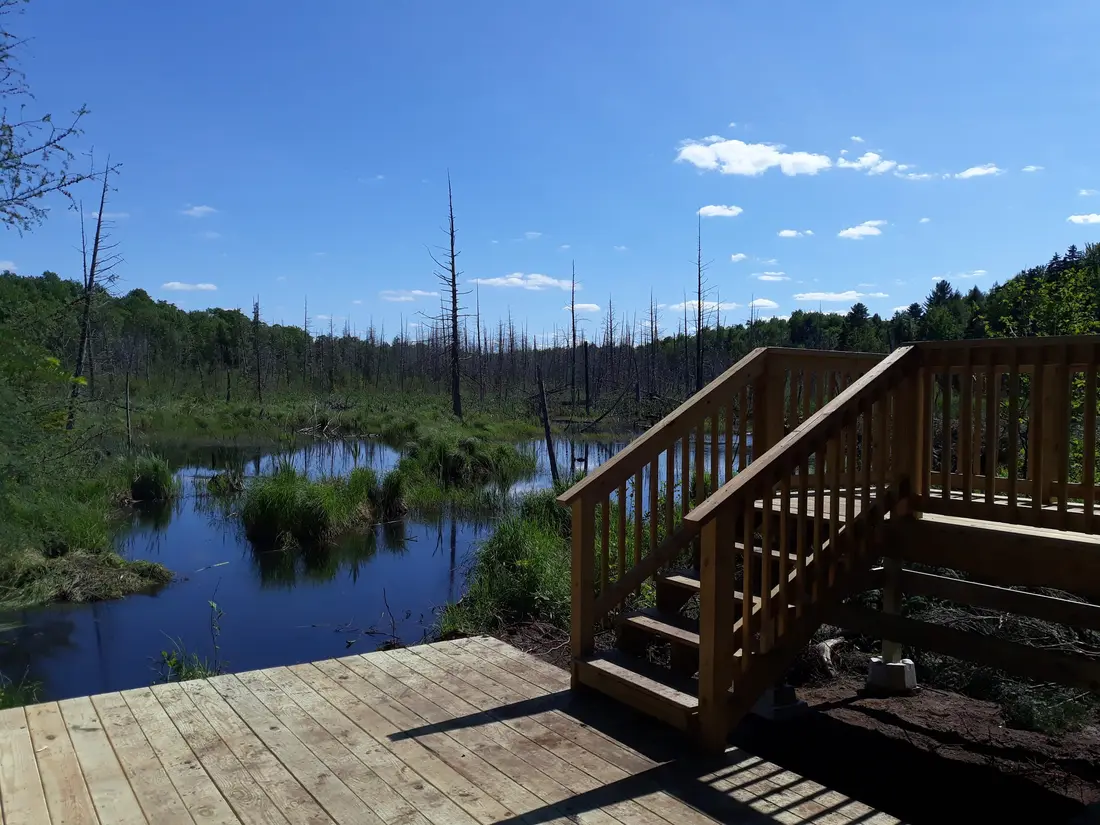
You do not need a long drive to start. The Modern Tiny Home has a pond with an observation deck a short hike from the cabin, and the wildlife guide covers what guests have seen there and at Rotary Lake in Malone, where the snow geese come in each fall. About 21 road miles south, the state land around Meacham Lake belongs to the Debar Mountain unit of the Forest Preserve, one of the three Forest Preserve units that hold spruce grouse populations; the Debar Mountain Wild Forest guide has the trails. For birding from a canoe, see the Saint Regis Canoe Area.
Distances from the cabins
| Place | Road miles | Best for |
|---|---|---|
| Meacham Lake | About 21 | Loons, Debar Mountain forest |
| Madawaska Flow (turnoff on NY 458) | About 24, then 6 on dirt | Boreal birds, ducks, warblers |
| Paul Smith's College VIC | About 30 | Barnum Bog, marsh birds |
| Bloomingdale Bog, north lot | About 38 | Canada jays, black-backed woodpeckers |
| Lake Colby, Saranac Lake | About 41 | Loons, eagles, bog sparrows |
| Canton, for Upper and Lower Lakes | About 59 | Waterfowl, marsh birds |
| Whiteface Memorial Highway summit | About 59 | Bicknell's thrush, blackpoll warbler |
| Wilcox Dock, Plattsburgh | About 61 | Winter ducks and gulls |
| Kings Bay WMA | About 64 | Marsh and bay ducks |
| Ausable Marsh and Ausable Point | About 71 | Eagles, rails, bitterns, wintering ducks |
| Massawepie Mire | About 76 | Boreal birds, 18 breeding warblers |
When to go
- December to March. The spruce grouse, black-backed woodpecker, Canada jay and boreal chickadee stay all year, and the jays are nesting by late winter. Northern finches come and go with the seed crops; the 2026-2027 Winter Finch Forecast, posted September 25, 2026, expects small to medium flocks of evening grosbeaks in the northeastern states, plenty of pine siskins, some white-winged crossbills, and few pine grosbeaks, redpolls or Bohemian waxwings. The Christmas Bird Count runs December 14, 2026 to January 5, 2027, and each count circle picks one day.
- April. The first warblers, yellow-rumped and palm, arrive in the second half of the month, and waterfowl move through the open marshes. DEC closes gates on seasonal access roads during mud season, so dirt-road trips like Madawaska wait until the roads dry.
- May and June. The warbler flight peaks around the middle of May, and late May into June is the breeding season, when the bogs are loudest at dawn. The Whiteface highway usually opens in mid-May, and June is the month for Bicknell's thrush. Both 2027 festivals fall in the first week of June. Black flies are out from mid-May into early July; the bug guide has what works.
- July and August. Song tapers off and the young birds fledge. Massawepie is closed until September 1, and the restricted wetlands at Upper and Lower Lakes until mid-August.
- September and October. Fall migration is in full swing in September, Massawepie reopens, and rusty blackbirds show their rusty fall edges. The Whiteface highway closes for the season in October, and the hunting seasons open; the hiking guide covers hunting season and blaze orange.
- November. The snow geese in Malone peak from late October into early November, and diving ducks build up on Lake Champlain.
The Great Adirondack Birding Celebration and other events
The Great Adirondack Birding Celebration began in 2003, organized by the High Peaks Audubon Society with the staff of the Paul Smith's College VIC, and has run every year since; Northern New York Audubon runs it now. The 2027 celebration is June 4 to 6, headquartered for the first time at North Country Community College in Saranac Lake, about 44 road miles from the cabins. The club promises guided birding trips, presentations and hands-on workshops, and plans to post the keynote speakers, field trips, registration and lodging in early 2027. Past keynote speakers include Scott Weidensaul, Noah Strycker and Frank Gill, and the signature birds are the ones in this guide: Bicknell's thrush, boreal chickadee, Canada jay and black-backed woodpecker.
The Adirondack Boreal Birding Festival in Hamilton County, farther south in the park around Long Lake, Indian Lake, Speculator and Blue Mountain Lake, has listed June 3 to 6, 2027, with its schedule still to come; it overlaps the celebration, so pick one or split the weekend. In winter, a guided birding weekend in Long Lake has run in late January for several years, most recently January 31 to February 1, 2026, looking for Bohemian waxwings, grosbeaks, redpolls and crossbills with the resident boreal birds. The events calendar lists the rest of the year.
Using eBird and Merlin
Before each trip, open the eBird hotspot for the place: Bloomingdale Bog Trail and its CR 55 to Bigelow Road segment, Massawepie Mire, the Whiteface Memorial Highway from the toll house to the summit, and the Indian Creek Nature Center tower and trails. Each one shows the species list, recent checklists and bar charts by week, which tell you whether a bird is likely in the week you will be there.
The Cornell Lab's free Merlin app identifies birds by sound, and its Sound ID works completely offline. Set your location and download the bird pack for the region on the cabins' wifi before you go; with the pack loaded, the photos and descriptions work without a signal too. In a bog full of singing warblers, Sound ID is a fast way to learn which bird is which.
Etiquette and the rules
- Leave the speaker off. The American Birding Association's code asks birders to limit recordings and other sounds used to attract birds, especially in heavily birded places, for birds that are rare in the area and for threatened or endangered species. Spruce grouse are endangered in New York and Bicknell's thrush is a species of special concern, so play no recordings for either.
- Give the grouse room. In New York law, taking wildlife includes disturbing, harrying or worrying it. Enjoy a tame grouse from the trail and walk on.
- Let the jays be wild. The Bloomingdale jays get handouts already; watching them costs them nothing.
- Respect private land. Massawepie's camp, lake and roads are private, open to the public only under the state easement and only outside the summer closure. On easement land like the Santa Clara Tract, stay on the designated roads and trails. Farm fields are private too, so ask before you walk onto one to scan for birds.
- Check the closures. Massawepie closes June 15 to August 31, and the restricted wetlands at Upper and Lower Lakes open on DEC's schedule.
What to bring
- Binoculars for each person. The cabins do not list any, so pack your own.
- A spotting scope for Lake Champlain, the Upper and Lower Lakes and Madawaska Flow, where the birds sit far out on the water.
- Waterproof boots. The rail-bed trails at Bloomingdale and Massawepie are level; the Ausable Marsh road floods in spring and the Madawaska road can be mud.
- Warm layers and a hat for the summit of Whiteface, even in June, and for the wind off Lake Champlain in winter.
- A head net in June. Bogs and black flies go together.
- Skis or snowshoes in winter for the bog trails and the road into Massawepie; the cabins do not supply them, and the skiing and snowshoeing guide lists rentals.
- A phone with Merlin and eBird loaded before you leave the cabins.
- Time for the dirt roads. The Madawaska and Massawepie roads are long and rough; drive them slowly, and see winter driving if you go in the snow.
Questions
Which northern birds can I find near the cabins?
The boreal specialties are the spruce grouse, black-backed woodpecker, Canada jay and boreal chickadee in the lowland bogs, and Bicknell's thrush on the highest summits. The same bogs hold palm warblers, Lincoln's sparrows, olive-sided and yellow-bellied flycatchers and rusty blackbirds in summer. Madawaska Flow, about 24 road miles away, and Bloomingdale Bog, about 38, are the nearest of the big boreal wetlands this guide covers.
When is the Great Adirondack Birding Celebration in 2027?
June 4 to 6, 2027, headquartered at North Country Community College in Saranac Lake, about 44 road miles from the cabins. Northern New York Audubon runs it and plans to post the speakers, field trips and registration in early 2027. The Adirondack Boreal Birding Festival in Hamilton County has listed June 3 to 6, 2027. See the events calendar for the rest of the year.
Where can I see a spruce grouse?
Spruce grouse live only in small patches of lowland spruce and tamarack in Franklin and St. Lawrence counties, and seeing one takes luck. Birders have found them at Madawaska Flow and Massawepie Mire. Walk slowly and scan the trail edges, since they sit still instead of flying. They are endangered in New York, so never use recordings to call one in.
Can I see Bicknell's thrush without a long hike?
Yes. The Whiteface Veterans' Memorial Highway in Wilmington, about 59 road miles from the cabins, climbs into the thrush's breeding habitat. Listen in June along the stretch from just below the Lake Placid hairpin turn to the summit. The road is seasonal, usually opening in mid-May, and charges a toll; check the dates on Whiteface's site before you go.
Is Massawepie Mire open to the public?
Yes, outside the summer camp season. The easement is closed to the public from June 15 through August 31; from September 1 to mid-June you may hike, bike, bird, fish and paddle. The land and roads around it are private, so stay on the old railroad grade and the easement roads.
Is winter a good time for birding here?
For the year-round boreal birds and northern finches, yes. Spruce grouse, black-backed woodpeckers, Canada jays and boreal chickadees stay all winter, and the Bloomingdale Bog trail can be walked, skied or snowshoed. The 2026-2027 finch forecast expects evening grosbeaks, pine siskins and some white-winged crossbills in the northeast. Lake Champlain holds ducks and gulls in open water.
Do the cabins have binoculars?
The cabins do not list binoculars, so bring a pair for each person, and a spotting scope if you plan to scan Lake Champlain or the Upper and Lower Lakes. The Modern Tiny Home has a pond with an observation deck; the wildlife guide covers what guests have seen there.
Sources
Facts on this page were checked against these sources in October 2026. Hours, fees and schedules change; confirm before you go.
- New York State Department of Environmental Conservation extapps.dec.ny.gov/fs/programs/dfw/SWAP2025/Birds/Spruce%20grouse.pdf
- audubon.org audubon.org/field-guide/bird/spruce-grouse
- Saranac Lake tourism saranaclake.com/story/2017/07/birding-madawaska
- audubon.org audubon.org/field-guide/bird/black-backed-woodpecker
- uvm.edu uvm.edu/femc/data/archive/project/borealbirds
- audubon.org audubon.org/field-guide/bird/canada-jay
- audubon.org audubon.org/field-guide/bird/boreal-chickadee
- audubon.org audubon.org/field-guide/bird/bicknells-thrush
- whitefaceregion.com whitefaceregion.com/story/2022/bicknells-thrush-whiteface
- audubon.org audubon.org/field-guide/bird/palm-warbler
- wildadirondacks.org wildadirondacks.org/adirondack-warblers.html
- audubon.org audubon.org/field-guide/bird/olive-sided-flycatcher
- audubon.org audubon.org/field-guide/bird/rusty-blackbird
- tupperlake.com tupperlake.com/hiking/massawepie-mire
- newsroom.wcs.org newsroom.wcs.org/News-Releases/articleType/ArticleView/articleId/5155/
- northamerica.wcs.org northamerica.wcs.org/Portals/37/Glennon_Viewpoint_final_Explorer2014 (
- ebird.org ebird.org/hotspot/L212481
- ebird.org ebird.org/region/L1432948
- Saranac Lake tourism saranaclake.com/story/2014/12/searching-boreal-birds
- adk.corsizio.com adk.corsizio.com/event/69e23122f7da8b6bc26ff697
- Saranac Lake tourism saranaclake.com/story/2019/04/three-great-spring-and-summer-birding-si
- wabi.tv wabi.tv/2024/09/24/study-looks-effects-human-interaction-with-canada-j
- wildadirondacks.org wildadirondacks.org/adirondack-birds-paul-smiths-college-vic-birds.htm
- Saranac Lake tourism saranaclake.com/paddling/madawaska-flow
- Saranac Lake tourism saranaclake.com/story/2017/08/paddling-and-birding-along-quebec-brook
- New York State Department of Environmental Conservation dec.ny.gov/places/santa-clara-conservation-easement-tract
- New York State Department of Environmental Conservation dec.ny.gov/outdoor/9198.html
- ebird.org ebird.org/hotspot/L212483
- Lake Placid tourism (ROOST) lakeplacid.com/birding/whiteface-mountain-no-hike-birding
- Whiteface Mountain (ORDA) whiteface.com/mountain/conditions
- New York State Department of Environmental Conservation dec.ny.gov/places/upper-and-lower-lakes-wildlife-management-area
- New York State Department of Environmental Conservation dec.ny.gov/things-to-do/watchable-wildlife/sites/upper-lower-lakes-wil
- stlawco.gov stlawco.gov/sites/default/files/Planning/IndianCreek.pdf
- northcountrynow.com northcountrynow.com/stories/indian-creek-nature-center-is-celebrating-
- lakechamplainregion.com lakechamplainregion.com/birding/wilcox-docks
- lakechamplainregion.com lakechamplainregion.com/node/86991
- lakechamplainregion.com lakechamplainregion.com/birding/ausable-marsh-wildlife-management-area
- New York State Department of Environmental Conservation dec.ny.gov/outdoor/24406.html
- finchnetwork.org finchnetwork.org/winter-finch-forecast-2026-2027
- audubon.org audubon.org/community-science/christmas-bird-count/join-christmas-bird
- Lake Placid tourism (ROOST) lakeplacid.com/story/2012/05/warblers-are-coming-warblers-are-coming-w
- New York State Department of Environmental Conservation dec.ny.gov/news/press-releases/2025/3/dec-closes-seasonal-access-roads
- nnya.org nnya.org/gabc
- ADK Taste adktaste.com/adirondack-events/great-adirondack-birding-celebration-pa
- experienceouradirondacks.com experienceouradirondacks.com/events/adirondack-boreal-birding-festival
- nybirds.org nybirds.org/Articles/WinterWeekendAdirondacks2026.pdf
- ADK Taste adktaste.com/adirondack-events/long-lake-winter-birding-weekend
- birds.cornell.edu birds.cornell.edu/landtrust/aba-code-of-birding-ethics/
- fishwildlife.org fishwildlife.org/law-research-library/law-categories/definition-take-a
- digitalcommons.usf.edu digitalcommons.usf.edu/wilson_bulletin/vol108/iss4/7
- vtecostudies.org vtecostudies.org/news-and-resources/newsroom/new-study-reveals-populat
- Whiteface Mountain (ORDA) whiteface.com/2018/06/01/high-elevation-birding-on-whiteface-mountain/
- pubs.usgs.gov pubs.usgs.gov/publication/70205098
- ebird.org ebird.org/region/L19545261
- northcountrynow.com northcountrynow.com/stories/migratory-bird-day-to-be-marked-by-canton-
- support.ebird.org support.ebird.org/en/support/solutions/articles/48000961587-merlin-bir
- support.ebird.org support.ebird.org/support/solutions/articles/48000966223
- Adirondack Explorer adirondackexplorer.org/?p=2650
- I LOVE NY iloveny.com/thebeat/post/olympic-authority-kicks-off-summer-and-fall-a
- ADK Taste adktaste.com/adirondack-events/winter-birding-weekend-long-lake-januar
- Visit Malone visitmalone.com/blog/2015/10/snow-geese-spectacle
In this guide
Stay nearby
The first of the cabins: a big stone fire pit you see as you walk up, a screened corner of the deck, direct trail access, and a short walk to an observation deck over the pond.
 The Modern Tiny HomeCabin 1 · 2 bd · 1 ba · sleeps 4
More in Trails & Hiking
Sources
61 references, listed in full at the end of this guide: official park, state, tourism-office and business sources, checked October 2026.
Related guides


Photos on this page: Meacham Lake Franklin County New York by Mwanner, CC BY-SA 3.0. Resized and cropped for this site. All photo credits