
For about eighty years the northern Adirondacks were a hotel country. Trains and stagecoaches brought city families to big wooden houses on Lower St. Regis Lake, Loon Lake, the Chateaugay Lakes, the Saranac lakes and Mirror Lake, and the biggest held several hundred guests at a time. Almost all of them are gone now, and the places where they stood are an easy day out from the cabins: Paul Smiths is about 31 road miles south, Saranac Lake about 43.
Why a cabin guest should care about the old hotels
A stay at the cabins is a small version of what those hotels sold: clean air, a lake or a pond nearby, a guide or a trail map, a good meal and a porch at the end of the day. The difference is scale. A summer at Paul Smith's meant a room in a five-story building with hundreds of other guests, a dining room that fed them all, and a boathouse with guides waiting for work. At the cabins you get the porch, the woods and your own kitchen, with four people instead of four hundred.
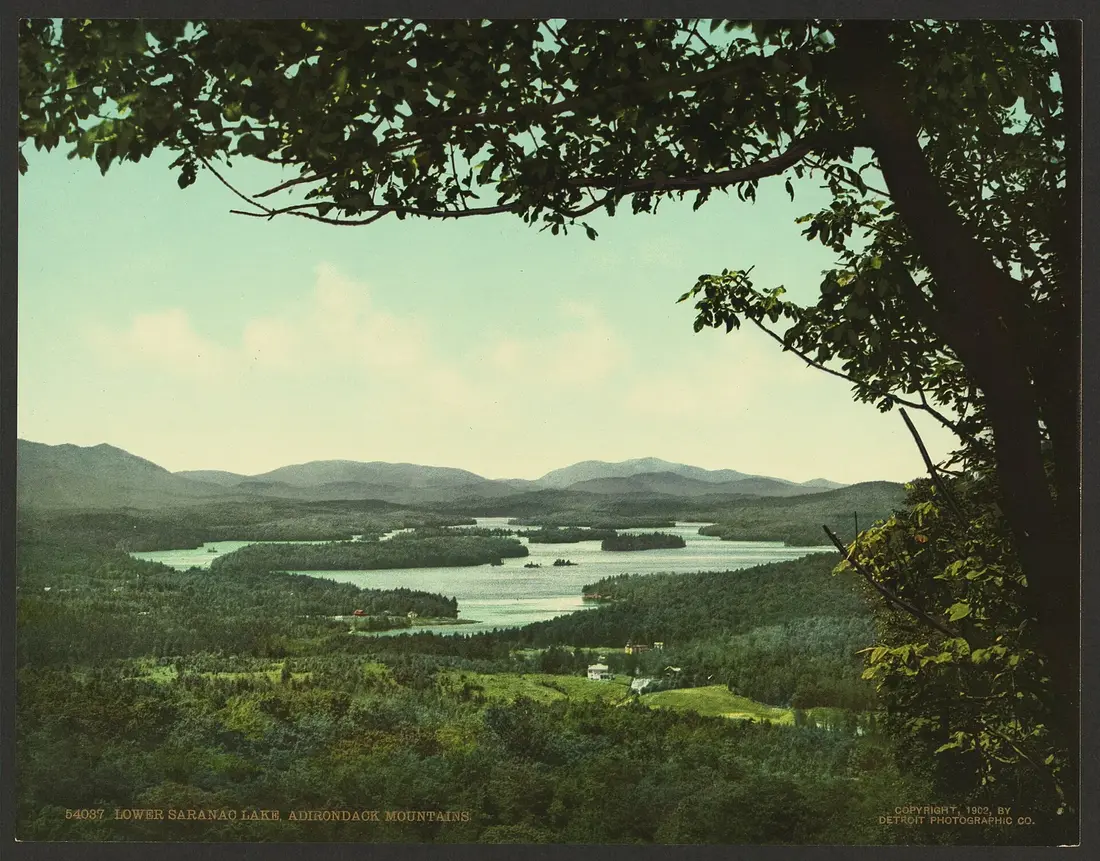
The hotel story also explains the country you drive through. The railroad beds that became snowmobile corridors and the new rail trail, a state boat launch on Lower Saranac Lake, the golf course at Saranac Inn, the college at Paul Smiths, the research institute on Lower Saranac Lake and the little park in the middle of Saranac Lake all stand where a hotel once stood. Once you know where to look, a drive from Malone to Lake Placid turns into a tour of an era that ended within living memory.
This post follows the guests: how they came north, where they stayed, what a season looked like, why the hotels burned or closed, and what you can still see. The neighborhood guides have the founders' stories, so this post links to them instead of repeating them.
How the guests got here
Before the railroads, reaching a northern lake meant days of stagecoach and wagon travel over rough roads. The trains changed that in two waves.
The Chateaugay Railroad
The first line into this corner of the mountains began as an iron company railroad. The Chateaugay Iron Company built it in 1879 as a narrow-gauge line from Dannemora to Lyon Mountain, to haul ore and charcoal for its ironworks. It reached Standish in 1885 and Loon Lake in 1886. A Plattsburgh newspaper that November described a train leaving Plattsburgh at 7 in the morning and reaching Loon Lake station around 11, with a stage on to Saranac Lake.
In 1887 a new Chateaugay Railway Company, built with Delaware and Hudson money, pushed the line on past Rainbow, Vermontville and Bloomingdale into Saranac Lake village; a later newspaper retrospective put the first train into the village on December 5, 1887. The Delaware and Hudson took control in 1901 and in 1903 widened the whole line to standard gauge and joined it to the branch to Lake Placid. For the first time a family from New York City could ride the rails almost to the hotel door.
Webb's railroad through Malone
The second wave came from the south and west. Dr. William Seward Webb, president of the Wagner Palace Car Company, built the Mohawk and Malone and the Adirondack and St. Lawrence railroads across the mountains to Malone. They were begun in 1891 and finished in 1892, and the Saranac Lake branch, which left the main line at a junction near Lake Clear, reached Depot Street in the village in July 1892. By 1893 the line was the Adirondack Division of the New York Central. Stations opened in the woods with hotel names on them, Paul Smith's Station and Saranac Inn among them, and by 1908 the guidebook writer Seneca Ray Stoddard noted that evening trains carried sleeping cars through to New York.
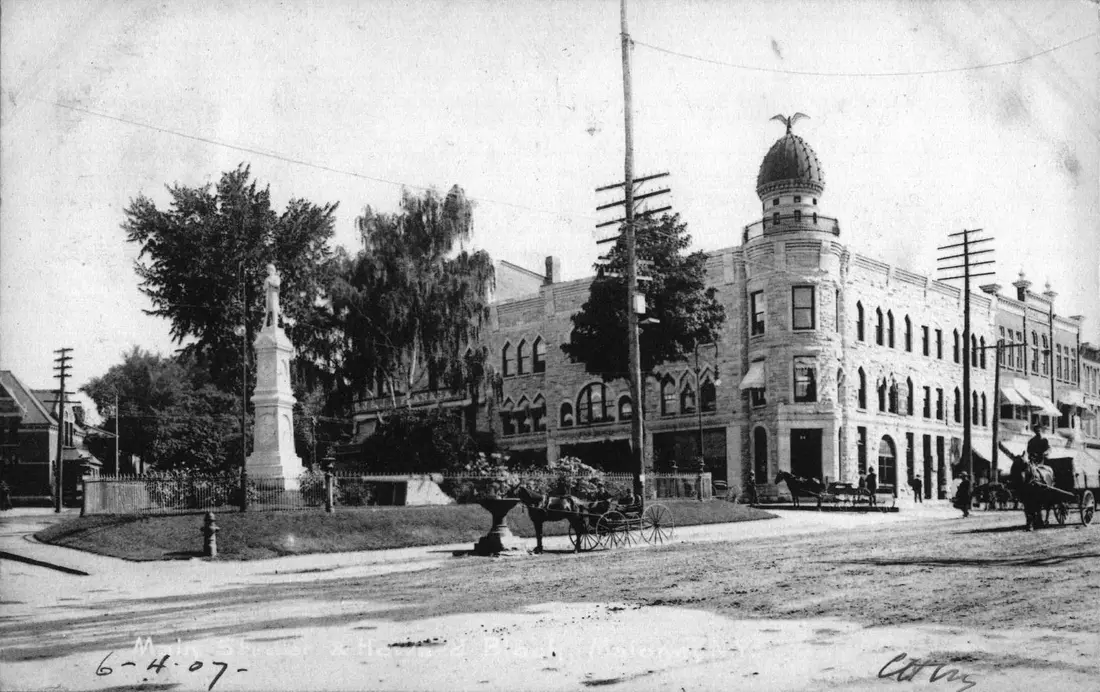
That line started at Malone Junction, about ten road miles north of the cabins, and ran south through the woods past Lake Kushaqua toward Paul Smith's and Saranac Lake. Much of its bed between Malone and Tupper Lake now carries the C7 snowmobile trail, which locals still call the tracks; the C7 snowmobile guide has the route.
The last miles
Trains rarely stopped at a hotel's door, so the hotels ran their own stages. In 1897 the nearest New York Central station was about three and a half miles from Paul Smith's, and Saranac Inn's guests rode about two miles by stage from theirs. Meeting every train on the different railroads took Paul Smith's, in one Lake Clear family's memory, "sixty horses and many stagecoaches and drivers."
A season at Paul Smith's
Paul Smith's was the hotel everyone measured the others against. The Saranac Lake and Paul Smiths guide tells how Apollos "Paul" Smith and his wife Lydia started with 17 rooms on Lower St. Regis Lake in 1859 and built the place into a five-story hotel with 255 rooms. The old newspapers fill in what running it took.
The guests came in numbers. In 1889, the busiest moment of the season put 370 guests in the hotel and its cottages at once. The next year a Plattsburgh paper counted room for 300 and 400 meals a day in the season, and the boathouse held about 100 boats. That boathouse also had quarters for sixty guides, the local men who rowed guests out to fish and hunt.
The payroll shows how many people a big hotel fed. In the five and a half months of the 1888 season the hotel paid $15,144 in wages: $6,831 to men on the hotel staff, $4,416 to women, $1,508 to carpenters and painters and $2,389 to the mill hands. It employed 91 different young women over that season, up to 86 at a time. In 1889 it bought about $2,800 worth of butter, plus milk and cream.
The hotel was a small town. It had stables, a casino, a bowling alley, a store, a sawmill and its own blacksmith, woodworking and electrical shops. By the turn of the century it even had "a wire to the New York Stock Exchange" for the businessmen among its guests. By 1897 the hotel had telephone connections to the principal Adirondack resorts. The family business incorporated as the Paul Smith's Hotel Company in December 1890 and spread into electric power, with hydro stations at Keese's Mills, Franklin Falls and Union Falls sending lines into three counties.
The guest list is the part everyone remembers: Presidents Grover Cleveland, Theodore Roosevelt and Calvin Coolidge, the showman P. T. Barnum with his family, the railroad man E. H. Harriman and the editor Whitelaw Reid.
The electric railway to Lower St. Regis Lake
Paul Smith already owned a power company, so the last link to his hotel became an electric railway. The obvious station, Paul Smith's Station at Gabriels, sat at the foot of a hill called Easy Street that was too steep for a trolley. He chose Lake Clear Junction instead, seven miles away over nearly level ground on his own land.
Work started in 1905 and the line opened on August 20, 1906, at first with steam locomotives until the electric car arrived, late in 1906 or in 1907 depending on the account. The car, built by the Brill company of Philadelphia with General Electric equipment, carried the name "St. Regis and Osgood Chain of Lakes" and seated up to 24 passengers. There was no turntable, so it pushed its cars up to the hotel and pulled them back, about five trips a day in season and two out of season. Power came from the Keese's Mills station, a water-powered sawmill Smith had converted in 1890. One local history puts the cost at about $25,000 for the car and $75,000 for the railroad.
The line outlived its builder. Paul Smith died on December 15, 1912. A gasoline car was running by 1928, and service ended around 1930 to 1932; the sources differ. The car's shell stood on the college campus until 1984. The Lake Clear Junction station still stands.
The fire of 1930 and the college
Phelps Smith, Paul's last surviving son, ran the hotel into its last years. The end came on Friday, September 5, 1930, after Labor Day, with 75 guests still in the house. A fire believed to come from a short circuit took the wooden hotel. Fire companies came from Saranac Lake, Lake Placid and Tupper Lake; the Tupper Lake truck covered 27 miles in 32 minutes. Their pumps clogged with debris drawn up from the lake bed. Every guest got out, and the store, the post office, the outbuildings and several cottages were saved. The loss was put at about $250,000.
The place limped on for a few years. In 1934 workers were turning the old casino into the clubhouse of a "Paul Smith's Adirondack Club" with cabins. Phelps Smith died in 1937 and left most of his estate, which included more than $2 million in cash, the hotel, electric and telephone companies and about 50,000 acres, to found a college that would "perpetuate the name of my father, the late Paul Smith." Paul Smith's College still runs on the hotel grounds; it held its 79th commencement in 2026.
The college's Joan Weill Adirondack Library keeps the Paul Smith's Hotel Company papers from 1872 to 1994 and the Smith family papers. The archives are closed to visitors for now because of staff shortages, and the historic photographs, including pictures of the 1930 fire, are online through the New York Heritage digital collection.
Loon Lake and the Chateaugay Lakes
Paul Smith got his start running lodgings at Loon Lake, and Loon Lake grew its own great hotel. The Loon Lake Mountain guide tells the story of Ferd and Mary Chase's Loon Lake House, its kitchenless cottages and its presidents. A few early numbers round it out: the house opened for a few fishing parties in May 1879 with 31 sleeping rooms, held its formal opening on July 6 and counted 61 guests on August 1 of that first summer. By 1910 additions and cottages had brought it to 350 guests, and at its peak, with about sixty cottages, it could take about 800. It burned in the early hours of September 19, 1956, two weeks after closing for the season, with the loss estimated at $500,000.
The Chateaugay Lakes, south of Chateaugay village, which is about 22 road miles east of the cabins, had six hotels at their peak, from the Banner House on the Lower lake to the Indian Point House, reachable only by boat. The Chateaugay Lakes guide covers them, the steamers that carried guests through the Narrows and the iron forge at the outlet.
Meacham, Kushaqua and the hotels in the woods
Smaller sporting hotels sat on lakes along the railroad. Meacham Lake, about 20 road miles from the cabins, had a hotel that burned for the last time in 1921; the Meacham Lake guide has its history and the state campground that replaced it.
Farther south, on Lake Kushaqua in the Town of Franklin, a hotel site took a turn that says a lot about the region. Elizabeth Wilmot Newcomb built the Stony Wold Sanatorium on the site of the former Lake Kushaqua Hotel. It opened on August 15, 1903, as a charitable sanatorium for young women of small means with tuberculosis, with its own station on the New York Central, and treated more than 6,000 patients before it closed on December 1, 1955, after new drugs changed the treatment of the disease. The state bought most of the property in 1974 and the buildings came down. Most of it is Forest Preserve now; the chapel, Stony Wold Hall, and two cottages are private.
Saranac Lake, hotels and the cure
Saranac Lake was a hotel town of a different kind, because many of its guests came to get well. Dr. Edward Livingston Trudeau settled there in 1876 and opened his sanatorium in 1884, and the Saranac Lake guide tells that story. The hotels grew up alongside the cure. In the first ten years of the 1900s the village and its edges had at least 15 hotels, eleven in the village and four just outside it, and many boarding houses became cure cottages for patients and their families.
The Ampersand
The Hotel Ampersand stood on raised ground at the eastern tip of Lower Saranac Lake, about two miles from the village. Ground was broken in April 1888 and it opened late that fall, four stories with steam heat, gas light, an elevator and fireplaces, and about 100 bedrooms. It drew both summer visitors and health seekers; Trudeau was among its first guests, and an 1896 benefit ball there raised $900 for his sanitarium. The main building burned on the night of September 23, 1907, in a fire that started in the elevator shaft, with the loss put at $270,000. The state later acquired the property, and a state boat launch is there today.
The Algonquin
Jabez D. Alexander of Vermontville built a hotel on a headland of Lower Saranac Lake in 1884. John Harding bought it in 1890, renamed it the Algonquin and added a fourth floor, a tower and an annex; it held about 100 guests and was known for its kitchen. After a short spell as a tuberculosis sanatorium in 1913 and early 1914, it ran as a hotel again in the early 1920s. It did not burn. The hotel and its boathouse were torn down in 1947, and since 1964 the Trudeau Institute's laboratories have stood on the site, on land given by Edmond Guggenheim.
The Berkeley
In the middle of the village, the Berkeley House stood at the corner of Main Street and Broadway. Built in the mid-1870s for tuberculosis patients and named for the philosopher George Berkeley, it grew into a downtown hotel; President Benjamin Harrison stayed there in September 1890 when he came to dedicate the new high school. A chimney fire on New Year's Day 1925 gutted its upper floors, and on January 10, 1981, with the temperature at 26 below zero, a fire destroyed it, leaving 22 residents homeless and taking 15 businesses. The site is now the small village park called Berkeley Green, where hikers ring the bell for the Saranac Lake 6er.
A door that was closed
The hotel era had a hard edge, and it belongs in the story. By the fall of 1890 the hotels on Lower Saranac Lake had "practically refused to receive Jews as guests." Some Adirondack hotel advertisements used phrases like "racial objection," and a pamphlet from Lake Placid's Stevens House said Jewish guests would not be welcome.
Saranac Inn on Upper Saranac Lake
At the north end of Upper Saranac Lake, Daniel S. Hough opened a small hotel in 1864. It failed after about nine years and became Ed Derby's Prospect House, room for 15 guests at first. In 1886 Dr. Samuel B. Ward and his partners bought it, formed the Upper Saranac Association and renamed it Saranac Inn. In 1916 Harrington Mills, owner of a Washington hotel, bought and rebuilt it. At its height it could take about 700 guests in the main house and cottages, and in the busy season it employed as many as 400 people.
Grover Cleveland, married in June 1886, brought his bride to one of its cottages, now known as the honeymoon cottage; Chester A. Arthur came too, and Charles Evans Hughes spent summers there while he was governor. The inn closed in 1962 as unprofitable, was partly taken apart for salvage in the mid-1970s, and a seven-hour fire on June 17, 1978, destroyed what was left. Its 18-hole golf course, which first appears in a 1901 guidebook, is still played as a public daily-fee course in summer (check its season before you go), about 44 road miles from the cabins; the Church of the Ascension and about ten of the old cottages also survive.
The Hotel Saranac
The one big hotel you can still sleep in is the Hotel Saranac, at 100 Main Street in Saranac Lake, about 43 road miles from the cabins. It came late. William H. Scopes promoted it and sold bonds for it around the village, the local firm of Scopes and Feustmann designed it, and it was built in 1927 for about half a million dollars: six stories, about 100 rooms, each with its own bath, stores on the ground floor, and a construction sold as fireproof at a time when wooden hotels were burning all over the mountains. Its main public rooms borrowed their details from the Davanzati Palace in Florence.
It lost money from the start. In March 1931, in the Depression, the hotel went to a receiver's sale. Village business people had bought hundreds of thousands of dollars of its bonds, and the failure nearly ruined Scopes. Paul Smith's College leased it in 1961 and bought it in the fall of 1962 as a training hotel: about fifty second-year students lived on the third floor in eight-week rotations, working some 36 jobs around the building. For decades the college that grew from one burned hotel kept another hotel running.
The college sold it in 2006. By October 2013 it had stopped taking reservations, and the new owners, the Roedel family's company, spent about $30 million over four years restoring it and building a two-level parking garage. It reopened on January 18, 2018, joined Hilton's Curio Collection and is a member of Historic Hotels of America. Of the thirteen hotels that once served the village, it is the only building left.
Even without a room booked, walk up to the second-floor lobby to see what the restoration brought back; the hotel's Great Hall Bar is a good place to sit for a while. Trudeau's Saranac Laboratory, now part of Historic Saranac Lake's museum, stands next to the hotel on Church Street.
Lake Placid's clubs and inns
Lake Placid, about 52 road miles from the cabins, built a different kind of resort. In 1895 Melvil Dewey, the librarian of the Dewey Decimal System, and his wife Annie founded the Lake Placid Club on a small parcel across Mirror Lake from Main Street. Dewey called it a club rather than a hotel and printed its publications in his simplified spelling. In the fall of 1904 he brought winter sports equipment over from Europe and kept the club open for its first winter season, which is why Lake Placid calls itself America's first winter resort. His son Godfrey won the 1932 Winter Olympics for Lake Placid, the first Winter Games held in America; Melvil died on December 26, 1931, weeks before the opening.
The club's exclusion was written down. Its 1901 handbook barred any member or guest against whom there was "any reasonable social, moral, race or physical objection," and in practice that meant Jews. In December 1904 Louis Marshall and other prominent Jewish New Yorkers petitioned the state Board of Regents to remove Dewey as State Librarian; the Regents rebuked him for "indirect responsibility for discrimination against Jews at the Lake Placid Club."
The club housed the International Olympic Committee during the 1980 Games and then faded. Later owners let the buildings decline, and after a series of fires a major one in 1992 left the clubhouse beyond saving. The land now belongs to the Lussi family's Lake Placid Club Resort.
Two other names carry on. The Whiteface Inn in Lake Placid first opened in the 1880s; the old hotel is gone, and the Whiteface Club and Resort, with its golf course and a Nordic center in winter, occupies the site. The Mirror Lake Inn began in the 1920s as the Mir-a-Lac Inn, which William and Climena Wikoff made from an old estate. For the 1932 Olympics the Norwegian team rented the whole place, and in 1933 Mrs. Wikoff renamed it the Mirror Lake Inn. It came through a fire in 1988 and carries on under the Weibrecht family, who have run it since 1977. The Olympic sites guide covers the 1932 and 1980 venues.
Malone's Flanagan Hotel
Malone had a big hotel too. Samuel, John and Joseph Flanagan began the Hotel Flanagan in 1913 on the site of the old Miller House and opened it with a dinner and an orchestra on July 1, 1914. It had more than a hundred rooms and cost over $100,000, and a 1918 county history called it "the most modern and probably the largest hotel in Northern New York." Babe Ruth and Theodore Roosevelt are among the guests the village remembers. A fire in the late 1990s closed it, and it stood empty for nearly thirty years. Demolition began on April 13, 2026, at a cost of about $1.5 million, and the mayor has said she hopes to see housing and shops on the site. The Malone history guide covers the village's other landmarks, and the Malone town guide has where to eat and shop today.
Why the hotel era ended
Bryant F. Tolles Jr., the architectural historian who went on to write Resort Hotels of the Adirondacks, named the first reason in a 1997 interview about the grand hotels of New Hampshire's White Mountains, and it held here too: most of them "were built entirely of wood and they were put up fast to make a profit," far from any fire equipment. In this corner of the mountains the dates read like a fire log. The Ampersand burned in 1907, the Meacham Lake Hotel in 1921, Paul Smith's in 1930, the Loon Lake House in 1956, and the Saranac Inn's remains in 1978. Few were rebuilt.
The second reason was money and the country's habits. Tolles pointed to the income tax, the wars and the Depression. Here the Depression shows in the record: in 1931 the four-year-old Hotel Saranac went to a receiver's sale.
The third was the car. In Tolles's words, "nothing changed the tourist industry as radically as did the popularization of the automobile." Families no longer had to take a train to one hotel and stay a month. They drove, stayed a few nights, moved on, and slept in the motor courts and motels that went up along the roads. Saranac Lake's hotels lost their trade to the same change.
Medicine closed the cure side of the trade. New antibiotics emptied the sanatoriums in the 1950s; Stony Wold closed in 1955, and the Trudeau Sanatorium the year before. The trains went last. Passenger service from Malone south to Lake Clear Junction ended in 1957, and the New York Central ran its last passenger train to Saranac Lake in 1965.
What you can still see
Most of what remains is a site, a marker or a building with a new job. Distances are road miles from the cabins.
| Place | What is there | Road miles |
|---|---|---|
| Paul Smith's College, Paul Smiths | The college on the hotel grounds, the 2023 Pomeroy marker at 7777 NY 30, and the VIC trails, one of them through the hotel's old golf course | about 31 |
| Hotel Saranac, 100 Main Street, Saranac Lake | The 1927 hotel, restored and open, with the Great Hall on the second floor | about 43 |
| Berkeley Green, Main Street and Broadway, Saranac Lake | The village park on the site of the Berkeley House, with the 6er bell | about 43 |
| Historic Saranac Lake museum campus | Exhibits on the cure and, in the Trudeau Building, the grand hotels and the railroad | about 43 |
| Saranac Inn Golf Course, Upper Saranac Lake | The inn's 18-hole course, with old cottages nearby | about 44 |
| Loon Lake | The old resort's surviving annex, caddie house and cottages, all private, seen from the road | about 24 |
| Mirror Lake Inn, Lake Placid | An inn since the 1920s, where the Norwegian team stayed in 1932 | about 52 |
| Adirondack Experience, Blue Mountain Lake | The 1876 Log Hotel from the Blue Mountain House, with the exhibit Hotels, Camps and Clubs | about 89 |
The Adirondack Experience is the long drive on this list, and its Log Hotel is the closest thing left to walking into a hotel of the era. The building dates to 1876, is original to the museum's grounds and was part of Merwin's Blue Mountain House; inside, a lobby and a guest room are set up the way they looked, and the exhibit Hotels, Camps and Clubs covers travel and lodging. The building closed in 2022 for restoration, so check that it is open before you plan a day around it. The museum's 2026 season ran from May 22 to October 12, from 10 a.m. to 5 p.m. daily.
In Malone, the Franklin County Historical and Museum Society's House of History at 51 Milwaukee Street holds the county's records and gives museum tours by appointment; the Malone history guide has the details.
A hotel-history day from the cabins
This loop covers the best of it in one day, with lunch in Saranac Lake. It runs about 87 road miles; plan on two and a half hours of driving in all.
- Leave the cabins after breakfast and drive south to Paul Smiths, about 31 road miles and a little under an hour. Find the Pomeroy marker at 7777 NY 30 and walk down toward Lower St. Regis Lake, where the hotel stood.
- Walk an hour at the Paul Smith's College VIC, a few minutes up NY 30. The Silviculture trail runs through the old hotel golf course, where you can still pick out fairways and tee boxes. The Saranac Lake and Paul Smiths guide has the trails and hours.
- Drive on to Saranac Lake for lunch. Park downtown and start at Berkeley Green, then walk to the Hotel Saranac and up to the Great Hall.
- Spend the early afternoon at Historic Saranac Lake's museum campus, where the Saranac Laboratory and the Trudeau Building cover the cure, the grand hotels and the railroad. Check its hours before you go.
- If the day is fine, drive out to the state boat launch at the Ampersand's old site on Lower Saranac Lake, or past the Trudeau Institute on the Algonquin's headland.
- Head home north by Bloomingdale and Loon Lake, roughly along the line of the old Chateaugay Railroad, and drive slowly through the Loon Lake hamlet to see the surviving buildings from the road. From Saranac Lake to Loon Lake is about 20 road miles, and Loon Lake is about 24 road miles from the cabins.
For a day built around Lake Placid instead, pair Mirror Lake and the Olympic sites with dinner at one of the old inns; the Lake Placid and Whiteface day trip has the plan.
Back at the cabins
Mary Chase built the Loon Lake cottages without kitchens so that every guest ate in her dining room. The cabins go the other way: a full kitchen, a grill on the deck and a fire pit outside, with Malone's groceries about ten road miles north. After a day of hotel sites, the evening is yours, and each cabin has its own hot tub. The cabins page has the three of them, and a week at the cabins fits a hotel-history day in with the rest of a trip.
Questions
Can you still stay in one of the old Adirondack hotels?
Yes, in Saranac Lake. The Hotel Saranac at 100 Main Street opened in 1927, served for decades as Paul Smith's College's training hotel, and reopened on January 18, 2018, after a restoration of about $30 million. It is about 43 road miles from the cabins. The Saranac Lake guide has the rest of the village.
Where did Paul Smith's Hotel stand?
On the shore of Lower St. Regis Lake, where Paul Smith's College is today. A William G. Pomeroy Foundation marker put up in 2023 at 7777 NY 30 in Paul Smiths marks the spot. The college's VIC trails are a few minutes up the road. Paul Smiths is about 31 road miles from the cabins, a little under an hour.
What happened to the Loon Lake House?
It burned in the early hours of September 19, 1956, two weeks after it closed for the season. Some of the resort's later buildings and many cottages still stand, all private. The Loon Lake Mountain guide has the hamlet's story; Loon Lake is about 24 road miles from the cabins.
Why did so many Adirondack hotels burn?
Most were built of wood, put up fast, and stood far from any fire company. The Ampersand burned in 1907, the Meacham Lake Hotel in 1921, Paul Smith's in 1930, the Loon Lake House in 1956 and what was left of the Saranac Inn in 1978. Few were rebuilt.
Is there a museum about the old hotels?
Historic Saranac Lake's museum campus in Saranac Lake has exhibits on the cure, the grand hotels and the railroad. The Adirondack Experience at Blue Mountain Lake, about 89 road miles away, has the 1876 Log Hotel from the Blue Mountain House and the exhibit Hotels, Camps and Clubs; it closed in 2022 for restoration, so check before you go. In Malone, the House of History keeps the county's records.
How did guests reach the hotels before cars?
By train and stagecoach. The Chateaugay Railroad reached Loon Lake in 1886 and Saranac Lake in 1887, and Dr. William Seward Webb's line from Malone through the woods opened in 1892. Hotels met the trains with their own stages, and Paul Smith built a seven-mile electric railway from Lake Clear Junction that opened in 1906.
Sources
Facts on this page were checked against these sources in October 2026. Hours, fees and schedules change; confirm before you go.
- wiki.historicsaranaclake.org wiki.historicsaranaclake.org/index.php/Paul_Smith%27s_Hotel
- wiki.historicsaranaclake.org wiki.historicsaranaclake.org/index.php/Paul_Smith%27s_Electric_Railroa
- wiki.historicsaranaclake.org wiki.historicsaranaclake.org/index.php/Lake_Clear_Junction
- wiki.historicsaranaclake.org wiki.historicsaranaclake.org/index.php/Chateaugay_Railroad
- wiki.historicsaranaclake.org wiki.historicsaranaclake.org/index.php/New_York_Central
- wiki.historicsaranaclake.org wiki.historicsaranaclake.org/index.php/Mohawk_%26_Malone
- wiki.historicsaranaclake.org wiki.historicsaranaclake.org/index.php/Loon_Lake_House
- wiki.historicsaranaclake.org wiki.historicsaranaclake.org/index.php/Stony_Wold_Sanatorium
- wiki.historicsaranaclake.org wiki.historicsaranaclake.org/index.php/Hotels
- wiki.historicsaranaclake.org wiki.historicsaranaclake.org/index.php/Hotel_Ampersand
- wiki.historicsaranaclake.org wiki.historicsaranaclake.org/index.php/Algonquin_Hotel
- wiki.historicsaranaclake.org wiki.historicsaranaclake.org/index.php/Hotel_Berkeley
- wiki.historicsaranaclake.org wiki.historicsaranaclake.org/index.php/Anti-Semitism
- wiki.historicsaranaclake.org wiki.historicsaranaclake.org/index.php/Saranac_Inn
- Saranac Lake tourism saranaclake.com/golf/saranac-inn-golf-and-country-club
- wiki.historicsaranaclake.org wiki.historicsaranaclake.org/index.php/Hotel_Saranac
- hotelsaranac.com hotelsaranac.com/about/history
- wgpfoundation.org wgpfoundation.org/historic-markers/paul-lydia-smith
- Paul Smith's College library.paulsmiths.edu/localcollections
- Paul Smith's College paulsmiths.edu/news/paul-smiths-college-celebrates-class-of-2026/
- newyorkalmanack.com newyorkalmanack.com/2026/08/historic-saranac-lake-museum/
- Adirondack Explorer adirondackexplorer.org/wp-content/uploads/2020/12/DebarComplex-Draft-U
- newyorkalmanack.com newyorkalmanack.com/2026/05/rare-tour-trudeau-sanitorium/
- Lake Placid tourism (ROOST) lakeplacid.com/do/history/melvil-dewey
- Lake Placid tourism (ROOST) lakeplacid.com/story/2023/ski-inn-to-the-whiteface-club
- mirrorlakeinn.com mirrorlakeinn.com/?p=11610
- rivercitymalone.com rivercitymalone.com/culture/dancing-at-elm-and-main/
- wcax.com wcax.com/2026/04/13/demolition-starts-former-north-country-hotel-vacan
- www1.udel.edu www1.udel.edu/PR/Messenger/98/1/working.html
- theadkx.org theadkx.org/exhibitions/the-log-hotel/
- theadkx.org theadkx.org/


