
From 1920 to 1933, liquor was legal in Quebec and illegal in New York, and the roads between them ran straight through the country around the cabins. Cars loaded with Canadian whiskey and ale came south through Rouses Point, Champlain, Mooers, Chateaugay and the back roads of Franklin County, with troopers, customs men and federal agents chasing them. Here is how the trade worked, the stories the local papers printed, and what you can still see within an easy drive of the cabins.
Why the liquor came through here
National Prohibition began in January 1920 and lasted until December 5, 1933. For those fourteen years, making, selling and transporting liquor was a federal crime in New York. A few miles north, the law was different. Prohibition had come to the rest of Canada in 1917, and Quebec was the one province that kept tolerating a drink. In 1919 French-speaking Quebecers voted for the legal sale of beer and wine, and on May 1, 1921, the province created the Commission des liqueurs de Québec, a government monopoly that sold alcohol in its own stores.
Those stores were plain places. Bottles were kept out of sight behind a counter, a price list hung on the wall, and every purchase went out wrapped in brown paper. Until the 1930s a customer could buy only one bottle of hard liquor at a time, with no limit on wine. Visitors from Ontario and the United States came north for the Commission's stores.
The one-bottle rule slowed nobody down for long. Sam Racicot of Rouses Point told the historian Allan Everest how he and two partners changed hats and coats between visits to several stores until they had the 30 or 40 bottles apiece that made a run worthwhile.
The money explains the rest. A case of ale bought in Canada for four or five dollars sold for ten in Plattsburgh and twenty-five in New York City. A 25-case carload could clear about $600, at a time when a state trooper at Malone earned $900 a year. Rye carried a markup of about $8 a bottle and Scotch about $12. More than 60 percent of the population earned less than $2,000 a year.
The Rum Trail and the roads south
The main road had a name. Route 9, the "rum trail," linked Montreal with Saratoga, Albany and New York City, and it ran down the eastern side of the Adirondacks. Rouses Point, at the north end of Lake Champlain, was its main entry point and a busy customs station. Everest's sources, smugglers and customs officers alike, agreed that if there was a way to move liquor by road, rail or water, someone tried it at Rouses Point.
The trail had its famous stretches. Miner's Woods, on Route 9 north of Chazy, was one. Spruce Hill near Keene was another. The road over Poke-O-Moonshine between Elizabethtown and Keeseville was a notorious artery, where troopers and federal men often set traps along the dirt road and violent run-ins were common.
The federal government's own histories of the border stations at Chateaugay and Fort Covington say both towns lay west of the Rum Trail, which kept Rouses Point the chief entry point for bootleg liquor in upstate New York. West of the trail did not mean quiet. In Franklin County the runners used the smaller roads south from the line, as several of the stories below show.
Today US 11 strings these places together. From Malone it runs east through Chateaugay to Champlain and ends at Rouses Point, about 61 road miles from the cabins. Chateaugay village is about 22 road miles away, Mooers about 49 and Champlain about 57.
A chase on the Brainardsville road
The closest story to the cabins is also one of the saddest. In June 1928 two federal Prohibition agents, Warren Frahm and Mervin Barnes, were patrolling for rum-runners on the Chateaugay to Brainardsville highway in Franklin County, each in his own government car. Brainardsville is a hamlet of the Town of Bellmont, the same town the cabins are in.
At about three in the morning they saw two cars loaded with whiskey, moving fast with their lights off. The cars split up, and each agent took one. Barnes chased his two or three miles down a country road and found it stuck in a muddy barnyard, its driver gone. Frahm chased the other at high speed. His car went off the road and overturned several times, and he was found dead beside it. The Bureau of Alcohol, Tobacco, Firearms and Explosives, which honors him among its fallen agents, records that the rum-runner probably forced him off the road; the Officer Down Memorial Page says it happened as he tried to pass. The men in the car were never identified.
Frahm was born in Dunkirk, New York, in 1903, and joined the Prohibition Unit in January 1926 at a salary of $1,860 a year. He was in his mid-twenties, single, and survived by his father, Henry. The ATF gives the place of death as "Belmont, NY." Brainardsville is about 27 road miles from the cabins by today's roads.
The cars and the tricks
Most of the liquor crossed in cars, and the cars were built for it. Runners favored fast cars fitted with extra springs to carry the load. Bottles went into false back seats, spare tires and fake gas tanks. Some outfits used tank trucks painted to look like oil company trucks. Near Plattsburgh officers stopped a Cadillac with a 42-gallon tank built into the roof.
On the road the runners had their own defenses. They scattered glass and nails behind them, poured oil on the pavement and laid smoke screens. Some runs went with a pilot car out ahead. In a chase on Spruce Hill that the Ticonderoga Sentinel reported on April 2, 1925, a bootlegger laid a screen of black smoke, turned onto the Cascade Lakes road, shot two holes in his own gas tank, set it on fire and vanished into the woods with his companion; the officers still salvaged 135 gallons of alcohol.
The runners talked in code on the telephone. Federal agents said they had broken it: "inner tubes" meant liquor and "patches" meant ale. In 1923 the New York Times described a chain of bootlegger garages through the Adirondacks, and farmers along the routes could earn a couple of thousand dollars extra for storing liquor in their barns.
The trains carried their share. Boxcars came south with hidden compartments and false bills of lading. At Rouses Point, customs men searched passengers too: the Broadway producer Florenz Ziegfeld was fined $614 there, and the opera singer Geraldine Farrar was searched. In July 1928 officers found at least 3,000 bottles on the Ringling Brothers and Barnum and Bailey circus train, which delayed the show in Ogdensburg. Some loads crossed by water, which is a story for the lake.
On the lake
In 1924 the U.S. Customs Service set up the Lake Champlain Boat Patrol to close the lake to liquor. The patrol worked from St. Albans Bay on the Vermont side, mostly at night, with three-person crews searching the northern lake from the border down to the Burlington area. The smugglers answered with the Champlain rum boat, a small craft with shelves along the bow for bottles. A crew that saw the patrol coming could tip the load overboard and claim to be out for a midnight cruise. The Lake Champlain Maritime Museum notes that most of the contraband still came by car. The Plattsburgh and Lake Champlain guide covers the lake today, and Valcour Island lies just off the city.
Who was chasing them
When Prohibition began, the border was barely watched. New York's custom houses stood about a mile south of the line, and travelers were expected to stop and report what they had bought. Early enforcement rested on a handful of customs officers, often on foot or on horseback. In May 1923 eleven agents covered the whole border from Fort Covington to Rouses Point, about five miles each.
The state answered first. On June 1, 1921, the New York State Police opened Troop B at Malone to fight the smuggling Prohibition had brought to the border. It was called the Black Horse Troop for the black Morgan horses its men rode. Under Captain C. J. Broadfield the troop started with 56 men, later 96, armed with Colt .45s and Winchester .30-30 rifles. The troopers soon had cars as fast and powerful as the bootleggers' own. The Tupper Lake Herald printed the troop's yearly report in January 1927: 51 "booze cars" seized, 3,154 arrests, $192,574.98 in fines, and 315,072 miles driven by car, with another 52,276 miles on horseback.
In 1923 New York repealed its own Prohibition law, the Mullan-Gage Act. The legislature voted on May 4 and Governor Al Smith signed the repeal on June 1, warning that it did not lessen any officer's duty to enforce the federal Volstead Act. In practice, the main job of enforcing Prohibition in the state passed to about 250 federal agents.
The federal government added men. Congress created the U.S. Border Patrol on May 28, 1924, to guard the line between the inspection stations. A Border Patrol station opened at Rouses Point on July 1, 1924, with three officers, responsible for Grand Isle County in Vermont, Clinton County and the part of Franklin County east of Fort Covington; its officers sometimes worked a hundred miles south of the line. Stations with two or three officers each were also set up at Chestertown, Ticonderoga, Chateaugay and Mooers. A new patrolman earned $1,680 a year. The government gave him a badge and a revolver, and he brought his own horse and saddle.
Not every idea worked. An armored truck with searchlights and machine guns went out on about twenty missions, got stuck in the mud and never made a capture. A plan for a fleet of patrol planes was never adopted.
Stories from the local papers
The Malone Farmer, the Plattsburgh Sentinel and the other North Country papers reported the arrests and the chases. The Historic Saranac Lake wiki has gathered many of their reports, and a few of them show how close to home it ran.
Bert LaFountain of Gabriels
On December 20, 1919, before national Prohibition had even started, Bert LaFountain of Gabriels was stopped driving a Buick Six with 40 cases of sealed rye whiskey and a case of gin, the Malone Farmer reported. In 1921 he was arrested near Rouses Point with James Frenyea of Saranac Lake and 20 cases of Walker, Dewar and White Horse Scotch. In November 1925 Prohibition agents raided his home and took 162 bottles of Frontenac Special beer, eleven quarts of whiskey and a gallon of alcohol. In June 1926 he was sentenced to two and a half years. A song, "Bert LaFountain's Packard," was written about his runs, and a road in Gabriels carries his name.
Broken bottles at Teboville
In August 1922 Captain Broadfield of the troopers and Franklin County Sheriff F. S. Steenberg were out looking for a man who had escaped from the county jail at Malone. Instead they saw Pietro Tanzini of Saranac Lake and his son-in-law Tony Salretti coming from Canada in a car loaded with liquor. Tanzini "stepped on the gas," the Plattsburgh Sentinel wrote, and when that failed he smashed bottles of beer on the road to blow out the officers' tires. The officers drove through the broken glass and overtook the car at Teboville. Salretti ran for it across the fields, and the police dog caught him after a short fight. The Sentinel called it the first arrest a police dog had made in the annals of rum-running in northern New York.
Ale near Dannemora
In December 1930, customs patrolmen arrested Howard G. Dickinson of Saranac Lake near Dannemora with 1,104 pints of Canadian ale and 36 quarts of wine. Unable to make $2,000 bail, he went to the Clinton County jail, the Plattsburgh Sentinel reported.
The trooper on the covered bridge
Around 1925, at the covered bridge in Hogansburg, Trooper Dave Benjamin stopped a heavily loaded open Buick by grabbing a rafter as the car passed under him, dropping into it and setting the emergency brake. The story comes from Maitland DeSormo's 1974 history, retold in the Adirondack Daily Enterprise in 2007.
Glass in the park at Rouses Point
Seized liquor was destroyed in public. In September 1924 alone, the customs station at Rouses Point reported destroying 93,960 bottles. Officials broke them and left the glass in the town square park as a warning, and the smashing drew crowds.
When the chase turned deadly
Agent Frahm was not the only person to die on these roads. In November 1922 a trooper at Plattsburgh killed a man who drove through a roadblock. In 1924, near Keene, a Malone trooper killed a Schenectady man during a chase; no liquor was found in the car. In June 1929 border patrolmen at Plattsburgh killed a 20-year-old, and President Herbert Hoover condemned the use of guns by border officers. Drivers began putting "Don't shoot" signs on their cars.
In March 1923 Clinton County's district attorney said crime in the county had risen at least 300 percent because of Prohibition. The courts grew tougher as the decade went on. Bail of $1,000 was common and later doubled, and in fiscal 1926 federal fines in northern New York came to $600,000, more than in any other region. The Jones Act of 1929 made Volstead violations felonies.
The trade had a poisonous side too. Liquor that never saw a Quebec store could be anything. Jamaica ginger, served in speakeasies, paralyzed about 15,000 people in 1930, and in 1928 at least eight deaths in Essex County were blamed on poisoned alcohol.
Line houses, roadhouses and speakeasies
Some of the drinking happened right on the border. Line houses were hotels and bars built across the line itself, in New York and in Vermont, so the liquor never had to be smuggled at all. Just across the line, border hotels in Quebec sold liquor legally, and New Yorkers and Vermonters drove up to them.
Route 9 had its roadhouses. Between Lake George and Glens Falls stood the Halfway House, the Royal Pines, the Rosebud and High Point. In Saranac Lake, raids in May 1921 closed 102 places, the Plattsburgh Republican reported. A Saranac Inn taxi driver known as Major Dawson kept the hotel's guests and staff supplied, hiding bottles under the Saranac Inn church, and later opened Major's Inn. In Gabriels, a 1982 Press-Republican remembrance recalled that the state troopers stayed at the Riley Hotel while Bert LaFountain's unlicensed place, a short distance away, sold good whiskey on credit. Gabriels, Paul Smiths and Saranac Lake today are in the Saranac Lake and Paul Smiths guide.
Dutch Schultz, the New York bootlegger, was tried for tax evasion in Malone in 1935, two years after repeal, and acquitted.
The border stations built for Prohibition
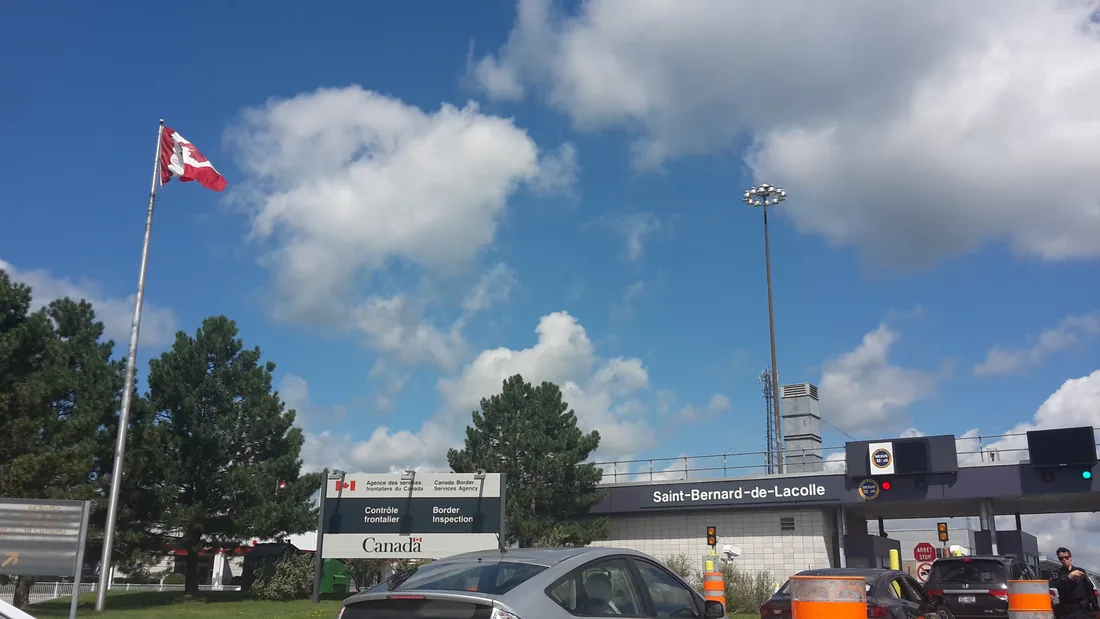
The government's lasting answer was a row of new buildings. Before Prohibition, a traveler checked in at the nearest town. Prohibition put the checkpoint on the line itself. New York's stations were designated as early as 1929, and seven survive, all built between 1931 and 1934. Land purchases, design and bidding stalled at times for each of them, and the work stretched unevenly over about five years.
- Chateaugay, on NY 374 north of the village, built in 1932 and 1933 by local labor. It is one of two stations that still have both inspectors' houses on the site, and it was finished just before repeal. The port is currently open from 6 a.m. to 6 p.m.
- Trout River, on NY 30, built in 1931 and 1932; its rebuild and closure have their own post, a border station built for Prohibition.
- Fort Covington, on Dundee Road, the only one of the stations that watched a border over both land and water, and the most altered of the five built to a similar plan.
- Mooers, on NY 22, now open around the clock.
- Rouses Point, Overton Corners, on NY 276, built in 1931 and 1932, the only station to have had an addition.
- Rouses Point, St. John's Highway, on NY 9B, finished in 1933, the most elaborate of the New York stations and among the best preserved.
In September 2014 the National Park Service listed the stations at Mooers, both Rouses Point stations, Fort Covington and Trout River on the National Register of Historic Places as a group, the U.S. Border Inspection Stations. The federal histories name a seventh station at Champlain. These are working federal ports, so the way to see them is from the road, or as you cross; the crossing the border guide has the documents and the current hours.
How it ended
Beer came back first. On March 22, 1933, President Franklin Roosevelt signed the Cullen-Harrison Act, which allowed beer of 3.2 percent alcohol where the Volstead Act had allowed half a percent. Congress had already sent the Twenty-first Amendment to the states in February 1933. It was the only amendment ever put to state conventions instead of legislatures, and New York's convention voted for it in June. Ratification was complete on December 5, 1933, and national Prohibition was over.
The border stations kept working. Smuggling went on after repeal, the federal histories say, partly because Americans had learned to like Canadian liquor, and partly because the trade reversed: bootleggers could now make money running raw alcohol north into Canada, where prices were higher. In Quebec, the Commission des liqueurs felt it too: the end of American Prohibition, landing in the middle of the Depression, cut into its revenues.
Troop B stayed in Malone for almost sixty years after the troopers first rode out on their black Morgans. In 1980 it moved to Ray Brook, into a building put up as the security headquarters for the Lake Placid Winter Olympics, and today it covers Clinton, Essex, Franklin and St. Lawrence counties and the northern half of Hamilton County.
What remains to see
The buildings are the best of it. The Chateaugay station is the closest, a short way north of Chateaugay village; pair it with the lakes and the falls in the Chateaugay Lakes and High Falls guide. The two stations at Rouses Point and the one at Mooers are in Clinton County, on the drive toward Plattsburgh and the lake.
The Clinton County Historical Association's museum, at 98 Ohio Avenue on the Old Base museum campus in Plattsburgh, keeps the county's past in four galleries and a research library, a good place to start if the rum-running years draw you in. The museum lists hours from Wednesday to Saturday, 10 a.m. to 3 p.m., and by appointment; check its site for the current schedule. It is about 63 road miles from the cabins, and the Plattsburgh and Lake Champlain guide covers the rest of the city.
In Malone, the Franklin County Historical and Museum Society keeps the county's records at the House of History; the Malone history museum guide has its hours and the rest of the town's past.
The best reading is free. Allan S. Everest, a history professor at SUNY Plattsburgh, wrote Rum Across the Border: The Prohibition Era in Northern New York, first published by Syracuse University Press in 1978 and reissued in 2018; the press now offers it as a free open-access ebook. Everest interviewed smugglers, residents and customs officers, and the book covers the chases, the courts and the female smugglers as well as the routes. Lawrence P. Gooley, who grew up in Champlain, picked up the story in Bullets, Booze, Bootleggers, and Beer, a history of Prohibition in northern New York. Lynn Woods's 1999 Adirondack Life article "Shots and Chasers," now online, is a good short account of the Adirondack side.
A rum trail drive from the cabins
A loop along the old routes makes a good fall or spring day, and it needs no passport if you stay on the American side. Head north on County Route 25 into Malone, where Troop B began in 1921, and pick up US 11 east. At Chateaugay, about 22 road miles from the cabins, take NY 374 north to see the 1932 station, then come back to US 11 and keep east through the farm country of the old smuggling roads to Mooers, Champlain and Rouses Point, about 61 road miles in all. Back at Champlain, Route 9 runs south past Miner's Woods, one of the old trouble spots north of Chazy, to Plattsburgh, where the county museum and lunch are waiting; the drive home from Plattsburgh is about 63 road miles.
If you do cross into Quebec on the way, the crossing guide has the documents and the ports that are open, and Montreal to the cabins covers the routes from the north. Then it is back to the cabins, where a cold drink and the hot tub are perfectly legal. The cabins page has the three of them.
Questions
What was the Rum Trail?
During Prohibition, from 1920 to 1933, Route 9 was called the rum trail. It carried Canadian liquor from Montreal down the eastern side of the Adirondacks to Saratoga, Albany and New York City. Rouses Point, at the north end of Lake Champlain, was the busiest customs station on it. Smaller roads through Franklin County, around Chateaugay, carried their share too.
Why did smugglers buy their liquor in Quebec?
Quebec was the one Canadian province that kept selling alcohol. Its government liquor commission opened in 1921, and visitors from the United States came for its stores. Until the 1930s a customer could buy only one bottle of hard liquor at a time, so runners went from store to store. A case of ale bought for four or five dollars in Canada sold for ten in Plattsburgh and twenty-five in New York City.
Did rum-running happen near the cabins?
Yes. In June 1928 a federal Prohibition agent, Warren Frahm, died chasing a car loaded with whiskey on the Chateaugay to Brainardsville highway; Brainardsville is in the Town of Bellmont, where the cabins are. Troop B of the State Police was founded in Malone in 1921 to fight the border smuggling.
Can I see the Prohibition-era border stations?
Yes, from the road or as you cross. Six of the stations built between 1931 and 1934 are at Chateaugay, Trout River, Fort Covington, Mooers and two at Rouses Point, and five of them are listed on the National Register of Historic Places. They are working ports of entry. Chateaugay, about 22 road miles from the cabins, is the closest. The crossing guide has the current hours.
Where can I learn more in person?
The Clinton County Historical Association's museum at 98 Ohio Avenue in Plattsburgh, about 63 road miles from the cabins, has four galleries and a research library, with hours listed Wednesday to Saturday, 10 a.m. to 3 p.m., and by appointment. In Malone, the Franklin County Historical and Museum Society keeps the county's records at the House of History; the Malone history museum guide has the details.
What is the best book on rum-running in northern New York?
Allan S. Everest's Rum Across the Border: The Prohibition Era in Northern New York, by a SUNY Plattsburgh history professor, first published in 1978. Syracuse University Press now offers it as a free open-access ebook. Lawrence P. Gooley's Bullets, Booze, Bootleggers, and Beer is a newer history of the same years.
Sources
Facts on this page were checked against these sources in October 2026. Hours, fees and schedules change; confirm before you go.
- adirondacklife.com adirondacklife.com/2019/07/30/shots-and-chasers/
- press.syr.edu press.syr.edu/supressbooks/170/rum-across-the-border/
- syracuseopen.syr.edu syracuseopen.syr.edu/upressbooks/rum-across-the-border/
- saq.com saq.com/en/100-years/chronology
- lcmm.org lcmm.org/prohibition/federal-prohibition/
- U.S. General Services Administration gsa.gov/node/161308
- U.S. General Services Administration gsa.gov/node/161922
- U.S. General Services Administration gsa.gov/node/161988
- U.S. General Services Administration gsa.gov/node/161986
- govinfo.gov govinfo.gov/content/pkg/FR-2014-08-22/html/2014-19924.htm
- atf.gov atf.gov/our-history/fallen-agents/warren-c-frahm
- odmp.org odmp.org/officer/5059-federal-prohibition-agent-warren-c-frahm
- wiki.historicsaranaclake.org wiki.historicsaranaclake.org/index.php/Bert_LaFountain
- wiki.historicsaranaclake.org wiki.historicsaranaclake.org/index.php/Pietro_Tanzini
- wiki.historicsaranaclake.org wiki.historicsaranaclake.org/index.php/Bootlegging
- wiki.historicsaranaclake.org wiki.historicsaranaclake.org/index.php/New_York_State_Police_Troop_B
- nysenate.gov nysenate.gov/legislation/resolutions/2017/2017-j3380
- americanheritage.com americanheritage.com/1923-seventy-five-years-ago-0
- U.S. Customs and Border Protection cbp.gov/border-security/along-us-borders/history
- U.S. Customs and Border Protection cbp.gov/border-security/along-us-borders/border-patrol-sectors/swanton
- U.S. Customs and Border Protection cbp.gov/contact/ports/champlain
- unwritten-record.blogs.archives.gov unwritten-record.blogs.archives.gov/2015/03/23/a-spirited-republic-in-
- docsteach.org docsteach.org/documents/document/21st-amendment
- clintoncountyhistorical.org clintoncountyhistorical.org/
- nny360.com nny360.com/artsandlife/localhistory/author-documents-bullets-booze-boo
- clintoncountyhistorical.org clintoncountyhistorical.org/museum-exhibits
- encyclopedia.com encyclopedia.com/law/legal-and-political-journals/twenty-first-amendme
- oalib-perpustakaan.upi.edu oalib-perpustakaan.upi.edu/Record/doab_20_500_12854_89213/Details
- U.S. General Services Administration gsa.gov/node/161984


